The Frontline Club began its June documentary programme on Monday 1 with a retrospective look at various forms of non-violent protests in the cross-media documentary, Everyday Rebellion. The film was directed by the Riahi brothers and Arman Riahi was present for a lively Q&A after the screening.

To summarise, Everyday Rebellion is a tribute to civil disobedience in its various forms, from Tahrir Square to Occupy Wall Street. It is a record of some of the creative ways in which individuals have challenged oppressive norms, be it the authoritarian regime in Syria or mass unemployment and austerity policies in Spain. As the subjects of the film challenge the status quo, so too is the documentary film’s aesthetic style non-conformist. The Riahi brothers filmed over two years, and collected more than 14,000 hours of material from over seven countries. The result is a juxtaposition of talking head interviews, observational narratives and amateur mobile phone footage.
Riahi explained that the film was partly inspired by the brothers’ Iranian identity and their parents’ direct experience of curtailed freedoms. The film features a number of Iranian citizens who enact small, habitual acts of resistance. A woman paints her toenails red, for example.
Riahi said: “On the outside everyone is living how the regime wants and behind the curtain people are living western lives.”
He continued: “We began with Iran and quickly history happened; very soon the Arab Spring came… To be honest it was too fast for us. It was a time where every week something was happening.”
Apart from celebrating non-violent resistance, Riahi readily admitted that the film was intended to actively inspire protest in, crucially, “non-violent ways.”
Riahi spoke about the ways in which the film had been used since its release. “At some point we got a message from the Umbrella Movement in Hong Kong – they asked to screen the film on the main square of the Umbrella Movement, where it was shown at least six times.”
Apart from sharing tactics for voicing dissent, the film highlights the importance of camaraderie among civilian protesters. By focusing on the similarities between various protest movements, the film instills a sense of transnational, cross-cultural power in the protester.
“The project is about inspiration and empowerment; we wanted to give people the feeling that there are people like them,” explained Riahi.
Great to see @EricaChenoweth in Arman Riahi's film #EverydayRebellion @frontlineclub documenting powerful #nonviolent movements @nvconflict
— Natasha Dyer (@nrlcadyer) June 1, 2015
A number of audience members questioned whether non-violent tactics are effective in defeating groups such as ISIS, or in challenging complex capitalist systems.
Riahi’s response brought into light the disparity between tactics and results: “Solutions don’t come overnight.”
Evidently the result of overthrowing a leader, as was the case in Egypt, is often the disheartening discovery that their system is deeply entrenched. As Riahi said: “If you change a system, only then do you see that beneath the system there is another system.”
The film nevertheless offered one tangible example of how non-violent resistance can lead to change: a court hearing in the 1980s, in which victims spoke out against atrocities committed by the Islamic Republic against their family members.
Accountability was a key theme pushed by many of the film’s protagonists: including Serbian political activist Srdja Popovic; Femen activist Inna Shevchenko; Yes Men activist Jacques Servin; and Reverend Billy. This lead to an audience observation that those able to occupy public spaces are often from a middle class background, and can therefore afford to act on their beliefs. Riahi agreed that this was often the case initially.
The role of the Internet in helping spread protest to civil society was an important point in the discussion. While not undermining its centrality, Riahi said of social media tools: “It’s not a substitution for going to the streets and being there when things need to be done.”
Riahi also criticised the failure of mainstream media to cover non-violent protest, mainly, he reasoned, because “it does not sell as much as the guns and blood.”
Riahi concluded: “We knew this project was more than a film, because we knew of the restrictions in film and cinema.”
The cross-media platform continues to tell stories and showcase non-violent protest across the globe; visit the Everyday Rebellion website to find out more.
]]>The subject of Egypt’s tempestuous recent history was brought to the Frontline Club on Monday 19 January in the form of the documentary film, Mubarak’s Egypt. The screening, which was the English language premier following its broadcast in Arabic on the al Arabiya news channel, was followed by a Q&A with director Charlie Smith and executive producer Christopher Mitchell. Poignantly, the screening closely followed the recent acquittal of Hosni Mubarak over numerous charges of murder and corruption allegedly committed during the 2011 uprising.

Unlike other documentaries that have captured the build-up to Egypt’s uprising and subsequent overthrow of it’s authoritarian leader, Mubarak’s Egypt does not approach the subject from the perspective of Egypt’s youth, activists or opposition groups. The film instead gives voice to insights from the old guard, government officials and policymakers. In essence, Mubarak’s Egypt is a portrait of the former President himself, as narrated by those who knew him.
Mitchell commented on the film’s consistent choice of interviewees:
“These are voices that most of us have not heard before, and if you want to understand the Mubarak regime then it’s of value to listen to the people who were closest to him.”
Insights from Foreign Minister Ahmed Aboul Gheit, and Cabinet minister Farouk Hosni, are coupled with US equivalents, such as President Bush’s adviser Elliott Abrams and Secretary of State Mike Posner. Together they portray the former Egyptian President, to varying degrees, as the leader of a corrupt and repressive authoritarian regime.
US- Egyptian relations and the role of the United States in the Middle East at large are likewise a central theme of the film. External developments in the region, largely the 2003 invasion of Iraq and the de-thawing of the Israel-Palestine peace process, directly set America’s tone in this regard. Nevertheless, the consistent US agenda in Egypt, spearheaded by the Bush administration, was one of pluralism and so-called democratisation.
Egypt too was fighting its own battle on this front to no avail. A key figure in the film is opposition candidate and runner-up in the 2005 presidential election, Ayman Nour, who was imprisoned the same year. The film offers a reminder that although the Egyptian people as a mass made history when they marched onto Tahrir Square, individuals too, for better and, too often, for worse dictate its course.
Mitchell was struck by what he called the “fickleness of interests that the Americans had.” A succession of visits between both the US and Egyptian foreign secretaries exposed how volatile these relationships often were. Irritated by Condoleezza Rice’s demands for political reform, the former Egyptian foreign minister, Ahmed Aboul Gheit, recalled his tactics to delay her for meetings and to generally ensure that her visits were not a success. Beneath these amusing anecdotes the question remained, was the United States Egypt’s friend or foe under Mubarak?
While the film’s hindsight offered some clarity, it also exposed the ongoing grey area that continues to loom over Mubarak’s three-decade long rule. The certainty of the hard-nosed military men surrounding Mubarak in contrast with the uncertainty of his successor. While popular belief was that nepotism would prevail, Egypt’s military seemingly opposed to Gamal Mubarak following his father’s footsteps. During the Q&A, a number of audience members questioned why the film only alluded to the army’s pivotal role in dictating Egypt’s socio-economic and political environment. Both filmmakers answered simply that they were limited when it came to access and budget.
Smith said his approach was to, “leave out analysis and let them [the interviewees] speak for themselves.”
Mitchell went on to speak of the difficulties of filming in Egypt when they were there in January 2014.
“The reason we only got five or six [Egyptian interviewees] was because most of them were in jail,” said Mitchell.
In spite of these logistical limitations, Mubarak’s Egypt effectively took advantage of the vacuum that followed Egypt’s brief revolution in order to reopen a discussion which has been closed for too long. Although Mitchell expressed optimism for Egypt’s prospects, he mainly emphasised the need for this discussion to continue.
]]>Since 2011 Cairo’s Tahrir Square has repeatedly been occupied by Egyptians demanding change. Director Jehane Noujaim captured what happened in the square through the eyes of several young revolutionaries.
She followed Ahmed Hassan, a charismatic example of Egypt’s disenfranchised youth; Magdy Ashour, a member of the Muslim Brotherhood; and Khalid Abdalla, an accomplished actor who put his career on hold to document the revolution.
Noujaim documents key events during these turbulent years: the euphoria of bringing an end to the corrupt thirty-year regime of President Hosni Mubarak and later the shifting of alliances among the power centres of the military, the Muslim Brotherhood and secularist revolutionaries. The result is an immersive film, that goes deeply into the emotional drama and personal stories behind the news.

Khalid Abdalla
British-Egyptian actor and filmmaker (The Kite Runner, United 93 and Green Zone), leaves his life in London to join the revolution inspired by the activism of his father who was jailed in Egypt in the 70s. In Cairo, he discovers a profound sense of his Egyptian identity. He co-founded Mosireen, a collective of individuals turning their cameras towards those in authority to hold them accountable for their actions in the square and beyond.
Directed by Jehane Noujaim
Duration: 99′
Year: 2013
The Square will be released by Netflix UK on 17 January.
]]>In the wake of the Egyptian revolution, four women speak of their fight for the future and what it means to be a woman in Egypt. Although Wafaa, Suzanne, Shahinda and Badreya are each from vastly different backgrounds and generations, they are deeply connected by the current changes in Egypt.
Cutting across class and geography, In the Shadow of a Man weaves through their worlds as they tell their stories of marriage, divorce, love and resistance. The film mirrors their lives with Egypt’s greater struggle for freedom and self-determination. The title is derived from the Egyptian proverb, “In the shadow of a man, not in the shadow of a wall”, reflecting an Egyptian society whose customs have long favoured men over women.

Hanan Abdalla is a British-Egyptian freelance documentary filmmaker. Her first feature-length documentary In the Shadow of a Man, premiered at the Berlinale and won the Best Documentary Filmmaker Award at the Doha Tribeca Film Festival. Her upcoming film is on women candidates running in Egypt’s first parliamentary elections after the fall of Mubarak.
Directed by Hanan Abdalla
Duration: 65′
Year: 2011
This screening is in partnership with The British Egyptian Society, promoting friendship and bilateral relations between the UK and Egypt in all fields – cultural, commercial, economic and educational – for the benefit of the community at large.

The 2011 revolution in Egypt raised hopes that democratic institutions would replace Hosni Mubarak’s dictatorship. The recent removal of President Morsi by the Egyptian military and the violence on the streets that followed has instead left Egypt facing an uncertain future.
Jeremy Bowen, BBC Middle East Editor and renowned Egyptian journalist Yosri Fouda met at the Frontline Club on 12 August to attempt to shed some light on recent events and on Egypt’s political future.

Yosri Fouda (Left) and Jeremy Bowen (Right). Photo Wotienke Vermeer
Fouda explained that the Muslim Brotherhood, whom many had seen as the most well-organised political faction in Egypt had overreached, causing their administration to quickly lose popularity:
“I think the legacy of more than 80 years of working underground; they were subjected – and we have to always remember this – to all sorts of oppression and exclusion, and torture in some cases, got them a little bit ahead of themselves and they wanted to not only form the government but to actually reshape the state.”
Fouda also claimed that while the Army had chosen to remove Morsi following massive street protests, it was not done out of pure economic self-interest, as many had claimed, noting that:
“The army had more privileges under Morsi compared to even what they had under Mubarak.”
He also explained that the army had found the year-and-a-half period of directly administrating the country after the fall of Mubarak unpleasant and did not want a return to martial law.
I went to a celebration with some military people and some civilian people… to my left was the Commander of the Artillery. There were some young officers with their families, every now and then shouting the famous slogan… “The army and people are one hand“. And every time they shouted this the Commander of the Artillery said, “Never again!… What did we have in the end? We were shaving in the street, going to the toilet in the street and we were called names by kids!”… So they too had a very bad experience with us and they too have been trying to learn something from it.”
Responding to an audience question on how the Muslim Brotherhood could be included in any future liberal democratic form of government if they subscribe to an Islamic ideology, Fouda emphasised the dangers of excluding them again:
“In my opinion what we do not want to have is going back to the time when many forces… particularly Islamic, had to work underground… you really need to accommodate and it’s not going to be perfect, it’s going to be painful and it’s going to take time but it is much better than driving anyone underground.”
Bowen fielded a similar question on why Western governments had chosen to deal with the Muslim Brotherhood despite their alleged ties to terrorist groups and why Western media had chosen to frame Morsi’s removal almost exclusively as a coup d’etat.
“The Americans and other Western countries attach a lot of great importance to elections. They believe that the way of establishing a new Egypt was through a democratic process, so well there’s an election… it produced the result it produced. I think they felt obliged to say, “Well alright. Go ahead. See what you can do.””
Fouda received a round of applause from many of those in attendance, by stressing the importance of building genuine democratic institutions if Egypt is to move forward through its current political turmoil:
“What you are really after is the rule of law… if we manage together to lay the foundations for a healthy society that goes by the rule of law, then the revolution will have succeeded.”
Daniel is a freelance journalist and researcher specialising in foreign affairs, with an emphasis on Russia and the former Soviet Union. Twitter: @danielabkennedy
Watch and listen to the event here:
https://soundcloud.com/frontlineclub/egypt-crisis-yosri-fouda-in
]]>

A round up of world news in the week ahead from journalist resource ForesightNews.
Monday 21 January

Barack Obama delivers his second inaugural address on Monday, the climax of a day of festivities in the US capital following his re-election in November. The need for further action to stem gun violence is all but certain to feature, as well as the ongoing economic challenges facing the United States.
In Brussels, meanwhile, eurozone finance ministers are scheduled to meet, with current president of the grouping Jean Claude-Juncker expected to pass leadership to the Dutch Finance Minister, Jeroen Dijsselbloem.
Finally, India’s Supreme Court is expected to issue its ruling in the controversial Niyamgiri bauxite mine case. The bauxite extracted would be used in an aluminium refinery run by mining conglomerate Vedanta Resources but critics say it will cause untold damage to the Niyamgiri Hills, which are in Orissa state.
Tuesday 22 January

Israeli’s go to the polls in parliamentary elections in which Prime Minister Binyamin ‘Bibi’ Netanyahu and his Likud party is all but certain to secure enough seats in the Knesset to retain power. The campaign has been notable for the rise of Naftali Bennett and his hard-right Jewish Home party.
Meanwhile, Germany’s Angela Merkel and France’s François Hollande will lead celebrations of the 50th Anniversary of the Elysée Treaty. A joint cabinet meeting of the two countries will be held, as well as a joint session of France’s National Assembly and the Bundestag. Expect much focus on the future of the European project.
Japan’s Central Bank, which is under pressure from Shinzo Abe’s government, concludes a two-day monetary policy meeting on Tuesday. Observers anticipate an easing of policy and possibly a doubling of the inflation target to 2%.
Finally, Tuesday marks the 40th anniversary of one of the US Supreme Court’s most well-known, and controversial, decisions: Roe v Wade.
Wednesday 23 January
Some of the world’s most influential business figures will gather in Davos from Wednesday at the World Economic Forum. While health is formally the major theme of this year’s gathering, the US economic outlook and the future of the euro will no doubt be major topics of conversation among the attendees.
In Moscow, Russian Foreign Minister Sergey Lavrov is due to address domestic and foreign journalists. Again, although ostensibly a reflection on Russian diplomacy in 2012, questions are more likely to focus on future affairs, especially in as regards the Syria conflict.
In the United States, outgoing Secretary of State Hillary Clinton is scheduled to address the House Foreign Affairs and Senate Foreign Relations Committees on the September attack on the US consulate in Benghazi in Libya, delayed from December. This will almost certainly be her final testimony before she leaves the post (her nominated successor, Senator John Kerry, is due to have his confirmation hearing on Thursday).

Lastly, Jordan holds elections which the country’s Muslim Brotherhood has vowed to boycott.
Thursday 24 January

As mentioned above, Senator John Kerry will appear before the Senate Foreign Relations Committee on his nomination to be US Secretary of State. He will be questioned on the full gambit of US foreign policy priorities, particularly Israel, Iran and Syria. North Africa also expected to be a significant area of questioning.
Also in US affairs, Senator Dianne Feinstein, author of a ban on assault weapons that expired in 2004, will introduce legislation to once more ban the sale of assault weapons and high-capacity magazines.
In Addis Ababa, African Union Foreign Ministers are due to begin a two-day meeting, with the current conflict in Mali likely to be a key point of discussion, in addition to events in the DR Congo, relations between Sudan and South Sudan (a special meeting on this is scheduled for Friday), as well as unrest in the Central African Republic.
Finally, in Strasbourg, the European Court of Human Rights holds its annual briefing for the media.
Friday 25 January
The Czech Republic holds a run-off in its presidential election, with Foreign Minister Karel Schwarzenberg squaring up against former Prime Minister Milos Zeman.

Egypt, meanwhile, marks two years since the protests began that ultimately led to the downfall of Hosni Mubarak.
Also, US Treasury Secretary Tim Geithner is scheduled to step down. His designated successor, Jacob Lew, has yet to be confirmed. Lew’s unusual signature has attracted much attention.
Saturday 26 January
The top US diplomat on North Korea, Glyn Davies, arrives in Tokyo for talks with counterparts. This is the final destination on a trip that also sees him travel to Seoul and Beijing to discuss the secretive communist state. His visit comes amid reports the DPRK is planning to test another nuclear device.

Saturday is also Australia Day and Republic Day in India.
Sunday 27 January
Leaders from the African Union begin their two-day summit. Again, Mali, the Sudans, DR Congo, Somalia and Algeria all likely to be discussed.
Finally, Bulgarians are due to take part in the country’s first referendum since 1989. The issue at stake: whether to approve the construction of a new nuclear power plant.
Images courtesy of
]]>
With the presidential elections scheduled at end of May, a possible run-off mid June and the trial verdict of President Hosni Mubarak expected, Goodbye Mubarak goes back to the period before Egypt’s leader was ousted by the people.
The film examines the anger and discontent brewing in the country before people took to the streets on 25 January 2011. Filmed in late 2010, it shows the impact of the November legislative elections and the people’s outrage amid charges of ballot fixing, bullying and dirty tricks by Mubarak’s National Democratic Party.
Having recently travelled back to Egypt for the first time after shooting the film, Katia Jarjoura will share her experience and insight on the current situation in Egypt 18 months after the start of the uprising.
Followed by a Q&A with director Katia Jarjoura
Directed by: Katia Jarjoura
Year: 2011
Running Time: 72′
]]>
With a panel of experts and journalists we will be examining the political realignment taking place in the Middle East and North Africa.
We will be asking what the shifts in Arab world mean for Israel, Iran and Saudi Arabia: What is Israel’s likely response to the emerging democracies that are replacing autocrats who held onto power in the name of “stability” in the region. How will countries like Egypt respond to Israel in the future and how will the balance of power change?
We will be looking to at how Iran and Saudi Arabia respond to the changes taking place and the role of the Arab League in the future.
In association with BBC Arabic
Chaired by Sam Farah, the lead presenter of BBC Arabic’s flagship interactive programme Nuqtat Hewar (Talking Point).
With:
Marwan Bishara, Al Jazeera’s senior political analyst;
Abdel Bari Atwan, since 1989 he has been the editor-in-chief of Al-Quds Al-Arabi, a major independent pan-Arab daily newspaper published in London and author of The Secret History of al-Qa’ida and A Country of Words, his memoir.
William Morris, Secretary General of the Next Century Foundation, formerly a journalist and publisher he has been involved in the Middle East for more than 30 years. As Chairman of the International Media Council he has led press delegations to Iraq, Palestine, Israel, Egypt and Syria.
Picture credit: Bahrain Ministry of Foreign Affairs
]]>The first half of the evening at the Royal Institution of Great Britain, considered the role of technology in the Egyptian revolution and the panel resoundingly downplayed the role of Facebook, Twitter and even the Internet.
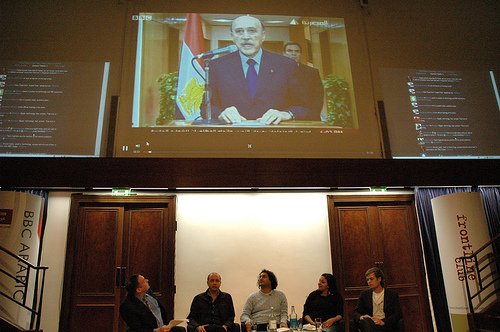
"I guess [the] audience could tell we didn’t really want to talk about media and tech rather we wanted to talk revolutions"
From 25 January the world watched as protesters took to the streets across Egypt and gathered in Cairo’s Tahrir Square day after day before their demands were finally met on 11 February and President Hosni Mubarak resigned.
Egyptian author, political and cultural commentator Ahdaf Soueif will be joining us in conversation with BBC presenter Mishal Husain, to discuss her experiences at the heart of the protest in Tahrir Square during those momentous 18 days, looking at the roots of the pro-democracy movement and addressing the question of where her country goes from here.
Born in Cairo and educated in Egypt and England, Ahdaf Soueif is the author of two collections of short stories; Aisha (1983) and Sandpiper (1996), two novels; In the Eye of the Sun (1992) and the bestselling The Map of Love which was shortlisted for the Booker Prize for Fiction in 1999. And a collection of essays, Mezzaterra: Fragments from the Common Ground (2004).
]]>