There has been a considerable amount of discussion about the implications of events in Ivory Coast for the rest of Africa – we will be addressing this issue at our event The Ivory Coast: What now for Africa and its strongmen?
Analyst Knox Chitiyo argues that with no higher authority available to decide and implement the decision the stage was set for ‘a violent showdown’ after the stakeholders boxed themselves into a corner:
The lesson? Ivory Coast needs a higher, independent judicial body which has the mandate to resolve post- electoral disputes; and which has the tools to implement decisions.
And such a body must exist in other countries, too.
The arrest of Laurent Gbagbo sent a message to dictators that they cannot disregard the verdict of free elections, US Secretary of State Hillary Clinton said.
There was a great deal at stake in the Ivory Coast, not least because the African Union and the Economic Community Of West African States (Ecowas), have taken an increasingly hard line against illegal takeovers and recalcitrant incumbents in recent years. The continent had to be seen to back its pledge to support democratic transitions of power, Knox Chitiyo argues:
Ivory Coast is a step change in Africa’s support for electoral democracy and democratic transitions.
Over the past decade the tradition has been for power-sharing governments to resolve post-electoral disputes – as seen in Sudan, Zimbabwe and Kenya.
Power-sharing is an important way of resolving military conflict, but it does not always resolve political conflict.
Ivory Coast may mark a shift away from the power-sharing default setting, and back to the tradition of the electoral winner becoming the national leader and forming a government of their choice – either inclusive or single party government.
Ideally, elections are held to choose leaders, but in many cases in Africa, elections are either intended to launder regimes that fought their way to power, or otherwise dress up despots in democratic garb – so the idea of losing is academic. In these neopatrimonial states, the big man, like Mugabe or Museveni, believes only he has the capacity and the right to rule. Hence, Museveni sees "no one else with the vision" to lead Uganda, and Mugabe believes Tsvangirai cannot lead Zimbawe because he did not fight for independence.
With such logic, elections are routinely rigged – the Ugandan courts have found the previous two presidential polls were. And if the rigging falls short, there must be a mechanism in place to announce the big man as the winner.
In Kenya, Zimbabwe and Ivory Coast, the pressure to end the chaos has come from abroad. Whether such pressure can be sustainable is questionable, but perhaps Ivory Coast represents a watershed for African democracy – the optimistic exceptions of countries such as Ghana and Botswana notwithstanding.
Less than a week after Laurent Gbagbo was captured, it was the turn of Nigerians went to go to the polls on Saturday.
Already described as free and fair, it was clear that the elections were judged important by ECOWAS and the EU, which said it was looking to the country to model democracy.
Nigerian-born novelist and journalist Kingsley Kobo – who has spent the past 16 years in Ivory Coast reflects on lessons that could be learnt from events in Ivory Coast and urged the people of Nigeria to play their part in ensuring the same didn’t happen there:
Elections are meant to create a peaceful atmosphere for progress and development, in the way we imagined the Ivorian presidential election would. Sadly, artilleries and mortars, pillaging and looting are speaking.
I urge you never to let this happen in our great country, Nigeria.
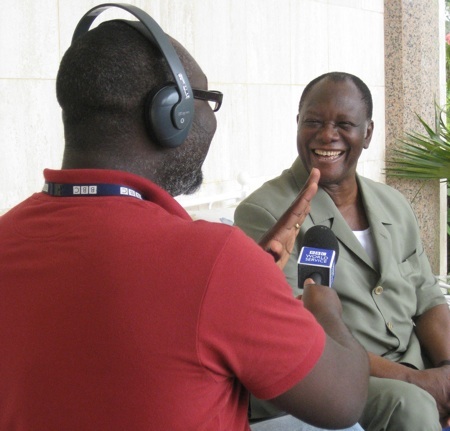
Events are moving fast in Ivory Coast, with a ceasefire reportedly being negotiated and suggestions that the besieged incumbent Laurent Gbagbo who has stubbornly refused to cede the presidency to Alassane Ouattara may now be considering surrender.
At our event on 20 April we will be discussing what message the events in Ivory Coast will send to Africa’s strongmen. With a number of elections due in in Africa in the coming year, the dispute in Ivory Coast took on added significance.
But news of a possible ceasefire comes as the UN announced the discovery of a mass grave with nearly 200 bodies. Sky News’ Emma Hurd puts the number of bodies at more than 300 and writes that the massacre in the western town of Duekoue last week shows that there are "no good guys in this conflict".
At least 800 people were killed in intercommunal violence in Duekoue last week and UN investigators believe president elect Alassane Ouattara‘s fighters were responsible for at least 220 of the deaths.
The warnings had been there for months – a disputed election, an illegitimate president clinging to power through force, and the rightful claimant arming his supporters for a battle.
But the world was focusing on Libya and Colonel Gaddafi as the simmering violence erupted into a full-scale war.
There seems no doubt now, Hurd concludes that Alassane Ouattara will win this battle.
But the atrocities committed by his fighters will taint his presidency and leave the country deeply divided.
The "robust" position taken by UN peacekeeping force which, supported by the French military, targeted forces loyal to Laurent Gbagbo after itself coming under attack, appears to have broken the impasse, writes the Guardian’s Africa correspondent David Smith.
He also highlights concerns about the role of the UN "if they are seen to be co-ordinating with the rebels to topple Gbagbo". And what if Gbagbo has stepped down?
Human Rights Watch worker Corinne Dufka, on Channel 4 News warned that even if if Abidjan and Laurent Gbagbo fall quickly, violence may continue:
A few things raise alarm bells: Ouattara’s forces the RFCI are a loose coalition from different rebel forces, Gbagbo defectors, and decommissioned soldiers, so there is a high potential for undisciplined members to commit abuses" she said
Many of them have committed war crimes in the past, which they have not been prosecuted for. And given the level of brutality of Gbagbo’s side in Abidjan, there is a very high possibility of reprisal killings by Ouattara’s forces were they to take the city.
What role should UN play in disputed elections? What role has the Economic Community of West African States (ECOWAS) and the African Union played and how effective has it been in its handling of the conflict? Join us at the Frontline Club on 20 April to discuss events in Ivory Coast and the implications for future elections in Africa. You can book tickets here.
Picture credit: bbcworldservice via a creative commons licence.
]]>