
A round up of world news in the week ahead from journalist resource ForesightNews.
By Jasper Wenban-Smith, international editor of ForesightNews.

Eurogroup finance ministers, after finally reaching an agreement on the latest €43.7bn disbursement to Greece last week, reconvene Monday in Brussels. Discussions are likely to include a significant focus on the planned establishment of an EU banking union from the start of next year. Also likely to feature are the proposed restructuring of the Spanish banking sector and creation of a ‘bad bank’ there later in December. A meeting of all 27 finance ministers from the EU follows on Tuesday.
At the International Court of Justice in The Hague, oral arguments open Monday in the long-standing maritime dispute between Chile and Peru. The case was filed with the court back in 2008 by Peru, which is seeking access to the rich fishing waters currently controlled by Chile. Arguments run until December 14.

Russia’s President Vladimir Putin, meanwhile, is due to arrive in Istanbul on Monday for talks with Turkish Prime Minister Recep Tayyip Erdogan. The visit was initially planned for October but was delayed after Turkey grounded a commercial airliner travelling from Moscow to Syria on the suspicion it was being used to ferry arms to Bashar al Assad’s regime. Turkish frustration with Russia’s perceived intransigence at the UN over Syria is likely to come up in talks between the pair.

The ongoing violence in Syria is again likely to feature when NATO foreign ministers meet in Brussels on Tuesday and Wednesday. The meeting follows a Turkish request to the grouping, made last month, for Patriot missiles to be placed on its border with Syria. The planned exit from Afghanistan is also expected to feature heavily, and is likely to involve a briefing from General George Allen, who was recently in hot water over his involvement in the surreal FBI investigation into threatening emails that led to David Petraeus’ bombshell resignation as head of the CIA.

Also on Tuesday, German Chancellor Angela Merkel is due to address her Christian Democratic Union party conference in Hanover, as Germany begins the ramp up for general elections due next September.
On Wednesday, Thais will celebrate the 85th birthday of King Bhumibol Adulyadej.
Meanwhile, in Beijing, Japan and North Korea are due to begin a second round of talks after they met last month for the first time since 2008. Discussions will likely include the abductions of Japanese citizens by Pyongyang in the 70s and 80s as well as the DPRK’s nuclear programme. The meeting comes ahead of elections this month in both South Korea and Japan, with some speculating North Korea may be considering its second missile test under newly-crowned Sexiest Man in the World Kim Jong-un.
European Central Bank President Mario Draghi will be addressing the media after the bank’s Governing Council meets Thursday. Further comments on Greece, Spain and the overall health of the euro area are all expected.
Ireland is due to host a meeting of some 50 foreign ministers from the OSCE on Thursday, the largest gathering of its kind in the country has seen.

Meanwhile, having presented his highly-anticipated report into press standards last week, Lord Justice Leveson will on Friday be discussing privacy in the 21st Century at an event organised by the University of Technology Sydney in Australia. This will be his first public appearance since he published his report.
Also Friday, Ghanaians go to the polls to elect a president to the oil-rich West African nation. The strongest challenge to incumbent John Dramani Mahama (NDC) comes from Nana Akufo-Addo (NPP).
Brazilian President Dilma Rousseff is due to host counterparts from the Mercosur grouping. Venezuela’s recently re-elected President Hugo Chávez had been scheduled to attend, however it remains to be seen whether he returns in time from his latest trip to Cuba to receive cancer treatment.

Finally Friday, UN Secretary General Ban Ki-moon is expected in Turkey where he intends to visit refugees fleeing the conflict in neighbouring Syria.
The weekend sees France host from Saturday the fifth World Policy Congress in Cannes with the futures of the European Union and the Middle East top of the agenda. Speakers include Italian Prime Minister Mario Monti and UN/Arab League Special Representative for Syria Lakhdar Brahimi.
Lastly, Sunday sees the second election of the week, this time in Romania. Despite failing to have President Traian Basescu dismissed, opposition party the Social Liberal Union (PSU) is expected to fare strongly, setting the scene for a potential show-down between the President and parliament.
]]>
By Nicole Hunt
Monday looks to be the biggest day of what should be an interesting week internationally. Kicking off with the ongoing EU debt crisis, German Chancellor Angela Merkel hosts French President Nicolas Sarkozy in Berlin to iron out amendments to the new EU fiscal stability treaty that was agreed last month.
Italian bank Unicredit opens its €7.5bn rights issue, having discounted shares by about 43 per cent in a bid to raise funds. Investors will be watching the sale closely to gauge market support for European banks.
South Korean President Lee Myung-bak begins a three-day visit to China at the invitation of President Hu Jintao. Discussions are expected to focus heavily on regional security in the wake of the death of North Korean leader Kim Jong-il.
Malaysian opposition leader Anwar Ibrahim’s sodomy trial, which has dragged on for nearly two years, finally comes to an end as the jury is scheduled to deliver its verdict in Kuala Lumpur. In addition to Ibrahim’s freedom – he faces up to 20 years in prison if found guilty – the verdict will also determine who will run against Prime Minister Najib Razak in the country’s next elections, which are not due until June 2013 but look increasingly likely to be called this year.
Attentions turn Stateside on Tuesday as New Hampshire Republicans cast their ballots in the presidential primary. Following the 3 January Iowa Caucus, in which Mitt Romney beat Rick Santorum by just eight votes, Michelle Bachman announced that she was dropping out of the race.
In Washington, the Bulletin of Atomic Scientists announces whether to move the minute hand on the Doomsday Clock, which represents how close humanity is to ‘catastrophic destruction’. The last time the clock was moved, in January 2010, the BAS’ outlook was somewhat positive, moving the minute hand back one minute from five to six minutes before midnight.
Tuesday also marks the 10th anniversary of the arrival of the first detainees at the Guantánamo Bay detention centre.
The High Court in London is expected to rule on Wednesday whether the Occupy London protesters can remain in their camp outside of St Paul’s Cathedral. Despite legal action from the City of London Corporation, the camp has been in place since 15 October.
The World Economic Forum releases its annual Global Risk Report ahead of the Davos Forum, which opens on 25 January. Last year’s report found that the financial crisis had ‘drained’ the world’s ability to deal with shocks.
The European Central Bank’s Governing Council meets in Frankfurt on Thursday to decide whether to raise, lower, or maintain the euro area’s interest rate. After last month’s meeting, during which the interest rate was decreased to 1 per cent, ECB President Mario Draghi announced major refinancing operations to support bank lending and market activity.
Alleged al Qaeda member Umar Farouk Abdulmutallab, who pled guilty in October to attempting to set off an explosive device in his underwear on a Detroit flight on Christmas Day in 2009, is sentenced in Detroit.
India is hoping to celebrate a milestone anniversary on Friday. If no new cases of polio are reported between now and then, the country will mark its first-ever year without any new cases. The World Health Organisation considers a disease to be eradicated when no new cases are reported for three consecutive years. Apple is set for a massive sales boost as the iPhone 4S goes on sale in China and 21 other countries in South America, the Caribbean and Africa.
Apple is set for a massive sales boost as the iPhone 4S goes on sale in China and 21 other countries in South America, the Caribbean and Africa.
Saturday marks the one year anniversary of the resignation of Tunisian President Zine El Abidine Ben Ali, whose 23-year rule was ended after nearly a month of protests dubbed the Jasmine Revolution. The success of protests in Tunisia spurred similar movements across the region, with widely varying results in Egypt, Libya, Bahrain, Yemen, Algeria, Morocco and Syria.
In Taiwan, voters go to the polls to elect a new President for a four year term. Incumbent Ma Ying-jeou faces challenges from China-sceptic Tsai Ing-wen and pro-Beijing James Soong.
Elections also take place in Kazakhstan on Sunday, following President Nursultan Nazarbayev’s snap decision to dissolve Parliament on 16 November. The vote is expected to see at least one opposition party enter Parliament, usually dominated by Nazarvbaeyev’s Nur Otan party, though that party is likely to be close ally Ak Zholl.
]]>
Oh lieber Otto! What a night that was mate. Greeks and Germans like Eurozone brothers-in-arms. Bier and ouzo never tasted so good together and we all danced to Zorba the Greek just like it was Karneval. Schön…
But oh meine Damen und Herren, what a difference an EU financial crisis makes. Especially when your average German is trying to work out if Berlin should be bailing out Athens to the tune of about 8 billion euros and where exactly do their politicians stand on the issue.
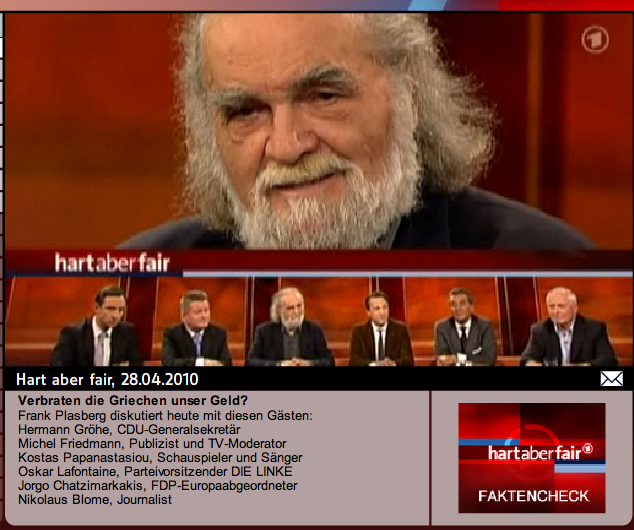
A TV talk show debate on the proposed Greek bailout mid-week had me rather engrossed (which is saying something as I feel there’re far too many talk shows on the national broadcaster). Politicians from across the spectrum thrashed out their views on how to help Greece on the appropriately named programme, Hard But Fair. Though a well known Greek-Berliner restaurateur-actor on the panel somewhat struggled to get a word in.
So, it was with little surprise the next morning when I popped into my local cafe, the headline of Bild screamed:
"Greeks want even more billions from us!"
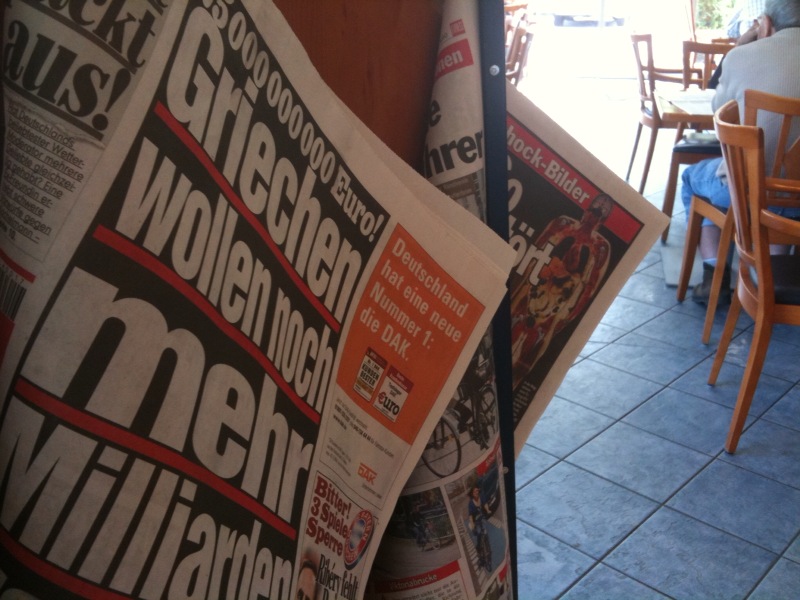 Regular Bild readers might have been dismayed that such a headline left hardly any room for the page 1 girl. The tabloid spelt out rather simply that while the coalition government considers billions of euros for helping Greece, there’s no money for tax cuts, repairing schools or maintaining streets and parks.
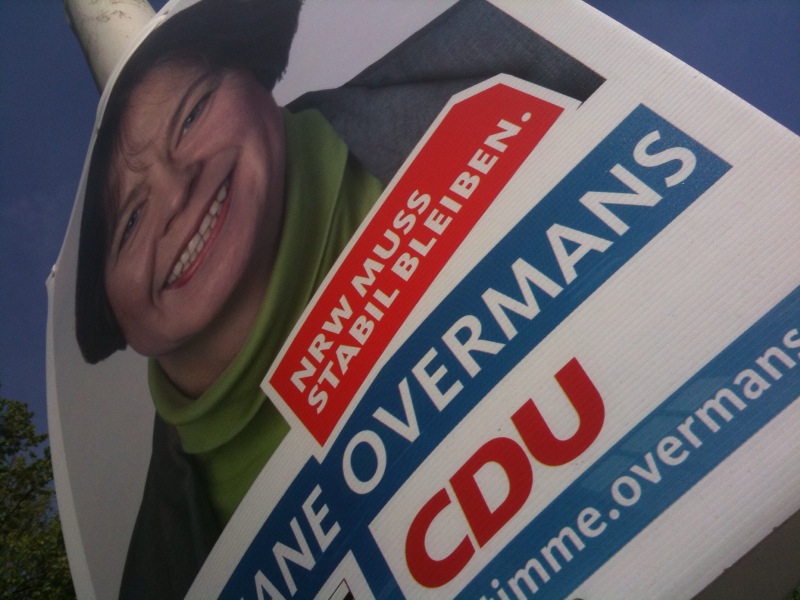 Meanwhile, we have to keep things stable. That’s what Chancellor Merkel’s CDU party is campaigning for in the May 9 election in Germany’s largest state, North Rhine Westfalia (NRW). A state election which might end up signaling what Germans think about the federal government stepping in to help sort out the economic woes of Greece. The emergency Eurozone summit is scheduled the day after the NRW elections.
However while Germany, being the good EU member that it is will be seeking to do its (usual) part to maintain stability in the Eurozone, the German reaction to whole episode has me thinking back to what Timothy Garton Ash mentioned at a Frontline Club talk recently. TGA spoke about Germany’s change in attitude towards Europe. Germany is now much more sceptical and much more happier talking about national interests.
Anyway, getting back to what Germans and Greeks do well together, I wonder if on May 10 the German delegation at the Eurozone summit will emerge from the talks singing the classic Griechischer Wein? Take it away Üdo…
]]>