Drone pilots Lisa, Heather and Daniel reveal how drone warfare, presented as efficacious and selective, is much more liable to error than US officials are ready to admit. The “safe distance” at which it is conducted has very real and damaging effects both for civilians and drone operators.
The primordial act of killing is dehumanized and sanitized, and leaves Heather with post traumatic stress disorders, Daniel with suicidal thoughts and a looming charge for espionage, and compels Lisa to travel to Kabul to seek pardon from the communities she contributed to grief.
As shown in the Ed Snowden case, the US government is quick to punish dissenters: a different war on terror is waged on whistleblowers breaching the secrecy of US military and speaking out against lies and abuses relating to the drone war.
In the discussion that followed, director Sonia Kennebeck highlighted how whistleblowing has become increasingly dangerous and all the more important to investigative journalism in today’s information society. She highlighted how the Intelligence Support Activity, a surveillance system classified as a weapon in itself, is able to watch everyone everywhere without us even knowing.
British barrister and former intelligence official Frank Ledwidge explains that humanitarian law is not fit deal with the relatively unrestricted warfare of drones, and the issue is likely to aggravate as more countries (Russia, Iran, Hezbollah and increasingly China) develop drone capabilities.
Findings by the Bureau of Investigative Journalism seem to corroborate the argument that drone warfare emboldens decision makers and hide the scale of harm away from public scrutiny: reporter Jack Serle logged US air strikes on Pakistan, Somalia, Yemen and Afghanistan demonstrating much higher casualties compared to US official figures.
Drones have numerous civilian applications. One of them, filming, was skilfully used by Kenneback to demonstrate just how intrusive the National Bird’s “unblinking stare” is.
But like any new technology it demands open societal debate. The harmful consequences of secrecy and censorship are boldly portrayed by Kennebeck, whose documentary powerfully advocates for more transparency both at home and abroad.
]]>National Bird follows the dramatic journey of three whistleblowers who are determined to break the silence around one of the most controversial issues of our time: the secret U.S. drone war.
At the centre of the film are three U.S. military veterans. Grappling with guilt over their participation in the drone programme, they decide to speak out publicly in spite of the possible consequences. Their stories take dramatic turns, leading one of the protagonists to Afghanistan where she learns about the horrific consequences of a drone strike for a civilian family. But her journey also gives hope for peace and redemption.
National Bird gives unprecedented insight into the U.S. drone programme through the eyes of veterans and survivors, connecting their stories to create a comprehensive overview of events as never seen before. Its images haunt the audience and bring a faraway issue close to home.
Discussion chaired by Juliana Ruhfus, journalist, filmmaker, and senior reporter at Al Jazeera English, People and Power.
Panel:
Sonia Kennebeck is an independent documentary filmmaker and investigative journalist with more than 15 years of directing and producing experience. She has directed eight television documentaries and more than 50 investigative reports. She lives in New York where she runs her own production company (Ten Forward Films) that makes films about international politics and human rights. Filmmaker Magazine recently selected her as one of the “25 New Faces of Independent Film 2016.” Sonia Kennebeck received a Master’s degree in International Affairs from American University in Washington, D.C. and was born in Malacca, Malaysia. NATIONAL BIRD is her first feature-length documentary film.
Frank Ledwidge is a barrister who served as a military intelligence officer in the Balkans and Iraq. He has also worked for the British government in Afghanistan and Libya. He is the author of ‘losing Small Wars’. He is the author of Losing Small Wars (Yale 2011) and Investment in Blood (Yale 2013)
Jack Serle is a specialist reporter on the Bureau’s Covert Drone War team. He has worked on the Bureau of Investigative Journalism’s drone war coverage since 2012.
Directed by: Sonia Kennebeck
Produced by: Ines Hofmann Kanna
Executive Producers: Wim Wenders and Errol Morris
Year: 2016
Country: United States
Runtime: 92′
For the second event of the series, we will be joined by critically-acclaimed artist David Birkin, in conversation with Max Houghton, who uses his work to examine elements of censorship and spectacle in the so-called War on Terror. He has explored subjects ranging from the covert deployment of drones in Pakistan and Yemen, to the Bush-era ban on photographing flag-draped coffins. We will be hearing from Birkin on his recent work that engages with invisible warfare – including ‘The Shadow of a Doubt’, his public performance involving a plane circling the Statue of Liberty’s torch; and ‘The Evidence of Absence’, in which he launched a replica of a military surveillance blimp currently flying over Kabul above a London residential neighbourhood.
This event will be moderated by Max Houghton, senior lecturer in photography at London College of Communication, University of the Arts London. She previously ran the documentary photography MA at the University of Westminster, and edited the photography biannual 8 magazine for six years. She writes regularly on the arts for publications including FOAM, Photoworks, 1000 Words and The Daily Telegraph.
David Birkin is a British-born artist based in New York. He studied anthropology at Oxford University and fine art at the Slade, and was a fellow on the Independent Study Program at the Whitney Museum of American Art. His past projects have included a collaboration with the courtroom sketch artist at Guantanamo, a visual rendering of identification numbers from the Iraqi civilian casualty database, and skywriting an extract of CIA legalese above Manhattan. He has exhibited internationally, most recently at The Mosaic Rooms in London, FotoFest in Houston, and the Whitney ISP in New York, and has written for publications including Creative Time Reports, Cabinet Magazine, Ibraaz and the Harvard Advocate.


Since the attacks of 11 September 2001, drones, or as the military prefers to call them “unmanned aerial vehicles,” have winged from an obscure surveillance tool to a central weapon in conflicts in Afghanistan, Iraq, Libya, Yemen, Pakistan and Somalia.
To explain why, investigative journalist and Martha Gellhorn Journalism Prize-winner Chris Woods spoke about his new book Sudden Justice: America’s Secret Drone War at the Frontline Club on Wednesday 15 April with Mark Urban, diplomatic and defence editor for BBC Two’s Newsnight.
Woods, whose work has followed the development of drone warfare since 2011, described speaking with spies, soldiers, victims, and advocates to understand how these remote weapons have affected not only civilians and conventional battlefields, but the legality of secret assassination.
Today, with one in three RAF strikes against the Islamic State carried out by reaper drones, he looked ahead to how the technology will impact warfare in years to come.
A Brief History of Drones
Drones had been in the works for decades before 9/11. But had the attack not happened, the CIA’s Predator drone would probably have been sent back to the drawing board, said Woods, adding that it turned out to be quite good at two things: surveillance and assassination.
“When I spoke with a lot of elderly generals, they told me that there used to be this huge rift between the war fighting bit of the Air Force and the intelligence gathering Air Force,” he said. “They didn’t want to arm surveillance aircraft.”
But that changed when the CIA began using weaponised drones to strike in Pakistan in 2004. “By 2008 they pretty much destroyed Al Qaeda,” Woods said. But “the CIA’s drone program in Pakistan began being used as cover for a much more conventional drone program across the border [in Afghanistan], much more like the bombing of Laos and Cambodia in Vietnam, but under the name of ‘targeted killing’,” he continued.
The CIA “did things in Pakistan that would not be tolerated on a conventional battlefield,” he said, adding that even under Obama “the CIA was deliberately bombing rescuers and mass funerals attended by hundreds of people.”
Is ‘targeted killing’ with drones legal?
Drones were a heavy presence in the 2014 war in Gaza. However, when it comes to ‘targeted killing’ programs the Israelis, unlike the Americans, have worked out a legal framework that went all the way to their Supreme Court.
“The Supreme Court judgment in 2006 was quite interesting and said that assassinations weren’t lawful nor unlawful, each had to be judged on its individual merit,” said Woods.
Watch and listen back:
America, by contrast, has “really blocked the examination of their program at every possible turn,” he said. “And, in fact, the Department of Justice puts ridiculous effort in preventing the U.S. federal courts from engaging on the lawfulness of the American program,” he added, suggesting the assassination program “comes out of that same legal black hole” as Guantanamo and extraordinary rendition.
Under Obama, ‘targeted killing’ becomes “just another plank of American foreign policy,” he said. But “there is still a huge question mark about whether this is somewhere where we want to go,” and, “whether this is somewhere we want other nations to go.”
Where are the drones headed?
In the fight against the Islamic State in Iraq and Syria, US Central Command claim they are not killing civilians. But this feeds into the “fiction of the perfect war” that drones create, said Woods.
In the past, U.S. National Security Council spokeswoman Caitlin Hayden has said “we can’t give guarantees that we’re not going to kill civilians,” said Woods. “I think that’s honest. That’s a grown up way of dealing with it,” he continued. But “in terms of accountability, can we hold the coalition members to account for what’s happening in Iraq and Syria?” he asked.
Proportionally, drones are killing fewer civilians than weapons 20 years ago, “and a hell of a lot less than we were 50 years ago,” Woods argued. But it’s a challenging question to answer whether this has an impact on radicalisation. “That is the problem, and we just don’t know what the implications of that will be ten years, 20 years down the line,” he said. “We’re telling a lot of people we’re doing the right thing at the moment without really knowing what we’re doing. We may yet reap what we’re sowing.”
]]>Days after the September 11 attacks, a CIA Predator in Afghanistan executed the world’s first lethal drone strike. The technology used had been nurtured and developed by the agency for almost a decade, with the aim to monitor targets and take lethal action instantly.
Since then, remotely-piloted aircraft have played a critical role in America’s global counterterrorism operations and have been deployed in conflicts in Afghanistan, Iraq and Libya. They are also used in a secret war, a war that the American government insists is legal, in which drones scour the skies of Yemen, Pakistan and Somalia in search of militant and terrorist targets.
The CIA claims that its armed drones are ‘the most precise weapon ever invented,’ but what is the true cost? In a new book, Sudden Justice, investigative journalist Chris Woods explores the secretive history of the United States’ use of armed drones. He will be joining us to explore that history and the key role they play on today’s battlefields and in covert targeted killings.
Chris Woods is a widely-published investigative journalist who specialises in conflict and national security issues. A former senior BBC Panorama producer, he has authored some of the key investigations into covert US drone strikes and their true effects. He was recently awarded the Martha Gellhorn Journalism Prize for his work.
Chaired by Mark Urban, diplomatic and defence editor for BBC Two’s Newsnight. He is the author of several books including Big Boys’ Rules: The SAS and the Secret Struggle Against the IRA, The Tank War and Task Force Black: The explosive true story of the SAS and the secret war in Iraq.
]]>Directed by Tonje Hessen Schei and produced by Flimmer Film, Drone takes an in depth look at the United States’ use of drone technology, questioning how drones are altering the psychology of war. Drone explores new war technology from both the perspective of civilians living under drones in Pakistan and drone pilots training on programmes that resemble video games.
The film covers diverse and integral ground, from the recruitment of young pilots at gaming conventions and the re-definition of “going to war”, to the moral stance of engineers behind the technology, and the world leaders giving the “green light” to engage in targeted killing. Tonje Hessen Schei presents a thorough and well researched examination of how drones are remoulding the technological, political, and psychological landscape of war for both countries using the new technology and citizens of countries under drone strikes.
In the midst of the rapid advancement of technology, with which international legislation is struggling to keep up, Schei‘s film displays how drones are rapidly defining a new perception of war.
Directed by Tonje Hessen Schei
Duration: 78′
Year: 2014
https://soundcloud.com/frontlineclub/drone-journalism-the-future-of
Interest in the potential for using drones, or Unmanned Aerial Vehicles (UAV), for journalism is growing. As the technology becomes cheaper and easier to use, journalist are experimenting with using drones for news gathering.
They offer the opportunity to document scenes that cannot be captured on the ground and to be used in circumstances when it would be too dangerous to send in a journalist. But what might this mean for privacy, ethics and safety in our skies?
With these opportunities come many questions and challenges. We will be bringing together a panel of experts to explore the potential for the use of drones in journalism and to discuss the challenges this new technology presents.
Chaired by Richard Sambrook, professor of journalism and director at the Centre for Journalism, Cardiff University. He is a former director of Global News at the BBC where he worked as a journalist for 30 years as a producer, editor and manager.
The panel:
David Goldberg is legal and regulatory specialist for Unmanned Experts and is co-author of Remotely Piloted Aircraft Systems & Journalists published by the Reuters Institute, Oxford University. He directs deeJgee Research/Consultancy and is a senior visiting fellow at the Institute of Computer and Communications Law in the Centre for Commercial Law Studies, Queen Mary, University of London.
Professor Robert Picard is the director of research at Reuters Institute, University of Oxford. He is a world-leading specialist on media economics and government media policies. He was formerly based in the Media Management and Transformation Centre at Jönköping International Business School in Sweden where he was director and Hamrin Professor of Media Economics.
Tom Hannen is a Senior Innovations Producer in the BBC’s Global Video Unit. Working with a small team, he is currently learning how to build, fly and film with small unmanned multi-rotor helicopters.
Gerry Corbett joined the Civil Aviation Authority’s (CAA) Safety and Airspace Regulation Group in June 2012, his focus is all matters associated with the operation of Unmanned Aircraft Systems in UK airspace. He is also the sponsor for Civil Aviation Publication 722, the primary guidance document for Unmanned Aircraft System Operations in UK Airspace.
]]>A president’s second term is usually regarded as the one in which he has the potential to reinvent the world. On 13 June, a panel chaired by author and journalist Michael Goldfarb explored the foreign policy legacy of the Obama administration.

Michael Goldfarb, Kim Ghattas and Nick Schifrin.
Kim Ghattas, BBC State Department correspondent and author of The Secretary: A Journey with Hillary Clinton from Beirut to the Heart of American Power, opened the discussion by asking:
“How much power does the US really have to implement its decisions? There is still this image out there of an omnipotent superpower. ( . . . ) People often ask ‘Why doesn’t the US just intervene and end the conflict in Syria?’”
On Syria, Professor Michael Cox, founding co-director of LSE IDEAS and Professor of International Relations at LSE, said:
“I think the US strategy on Syria is entirely right. The idea of the US getting involved in another war without an end in sight, against whom and for what we don’t know, strikes me as the craziest thing the US could do.”
Nick Schifrin, foreign correspondent for ABC News, drew the attention to Obama’s speech on drones and Guantanamo on 23 May this year, at the National Defense University.
“He [Barack Obama] said ‘All wars must end,’ it seemed an attempt to define that legacy and say ‘We’re going to move beyond the post-9/11 world.”

Nick Schifrin, Professor Michael Cox and Dana Allin.
Ghattas remembered Secretary of State Hillary Clinton’s reaction to the uprising in Libya: “Once the Arab league and the Golf Corporation Council had called for a No-Fly-Zone, Clinton was already convinced that something had to be done.”
Schifrin, who was reporting from Benghazi during this week, added:
“From the ground it was very simple: If the No-Fly-Zone hadn’t passed by the weekend, tens of thousands of people would have died. ( . . . ) There were a lot of mercenaries behind the other planes who would have been happy to flatten Benghazi.”
Dana Allin, Senior Fellow for US Foreign Policy and Transatlantic Affairs and Editor of Survival: Global Politics and Strategy at The International Institute for Strategic Studies (IISS), brought the Israel-Palestine peace process into the foreign policy evaluation:
“Focusing on the settlements clearly failed when [Israeli Prime Minister] Benjamin Netanyahu said ‘No’ [to build 3,000 new homes in the West Bank and Jerusalem for Palestinians] and Obama didn’t have a Plan B. This was the largest foreign policy defeat of the president. ( . . . ) Sometimes Obama seems overwhelmed by the power of his own eloquence.”
Obama has detoxified (not ended) the war on terror by officially repudiating #torture @frontlineclub
— Elisa Peter (@ElisaPeter) June 13, 2013
The panel identified that Afghanistan has become Obama’s war. Professor Cox explained:
“He detoxified the war on terror but continued it and increased the number of troops and drones in Afghanistan. ( . . . ) We get to the point where we can’t blame George W. Bush for everything anymore.”

A member of the audience is contributing to the debate.
The debate was then opened to the public. One member of the audience asked: “He’s pouring more and more money in Afghanistan, but the country seems to be a drain that absorbs troops and money. Pakistan is an unreliable ally, to say the least. What could he [Obama] have done differently?” Schifrin mentioned failed American attempts to support and strengthen Pakistan.
“For every Dollar he spent in Pakistan, he spent 30 in Afghanistan. ( . . . ) But people need to see more than ‘more troops and drones.’ They tried to open an American hospital in Islamabad but that wasn’t successful. Overall, there would have to be more effort.”
Moving on to the unpredictable and time-consuming problems with Assad in Syria, Ghattas concluded:
“The problem with US policy is that it’s often based on hope. And it doesn’t work like that in the Middle East.”
Watch and listen to the event here:
]]>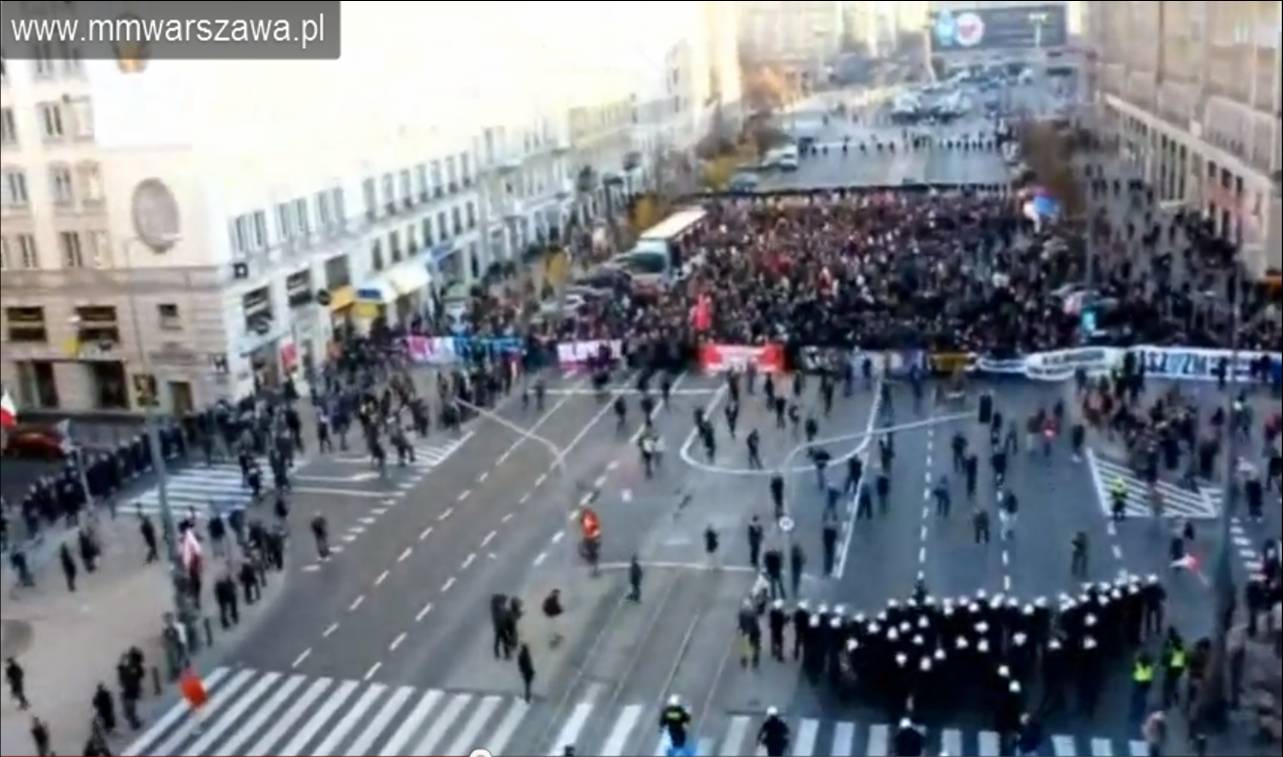
In November 2011, Polish firm RoboKopter filmed striking images of a political demonstration in Warsaw using a video camera attached to a drone or unmanned aerial vehicle (UAV).
The New York Times heralded the footage as signalling the arrival of ‘drone journalism’. Since then, we haven’t seen many newsgathering drones in UK skies, but we might well be seeing them some time soon.
Drones have been receiving more attention in recent months usually in the context of military operations. The Bureau of Investigative Journalism has been tracking the controversial use of drone strikes by the US military in Afghanistan, Pakistan and Africa. It has also emerged that the RAF were flying US drones during the conflict in Libya last year.
But much smaller UAVs – whether fixed wing or rotary – are now being used in civilian settings not for targeted killing but for image gathering. Last week, BBC Newsnight explored some of the issues around civilian drones and earlier in the year, Al Jazeera English filmed a training exercise with the German fire brigade which showed how UAVs could support firefighting.
I understand that several media organisations in the UK have already started to explore how they could use UAVs for newsgathering.
UAVs for Aerial Newsgathering
Aerial footage is not new of course, but UAVs are much smaller than helicopters allowing them to provide imagery from previously inaccessible locations.
The fact that they are unmanned also means there is no risk to a journalist or pilot. The latest models are being equipped with high definition technology allowing them to potentially provide stunning footage of national celebrations, political protest, natural disasters and conflict.
Safety, legality and ethics
The use of UAVs for newsgathering nevertheless raises a host of practical, legal and ethical issues. Question marks remain over safety concerns and the reliability of the technology, although the UAV industry is developing features such as an automatic ‘return to base’ function if the battery runs out or the operator loses control.
Legally, there is already a fairly well-established regulatory framework in place in the UK for flying UAVs which is outlined in guidance issued by the Civil Aviation Authority (CAA).
But this is an evolving area. The CAA’s chapter on ‘Civil Operations, Approval to Operate [UAVs]’ was completely rewritten in the latest guidance for August 2012. The requirements for ‘the licensing and training of United Kingdom civil Remote Pilots have not yet been fully developed’ and there is no European-wide standard to test UAV pilot competency.
It is likely that larger media organisations will look to fully licensed and CAA approved UAV operators to provide them with a newsgathering capability or apply for their own licenses to operate UAVs. But there is no particular reason why smaller organisations or individual ‘citizen’ ‘drone’ ‘journalists’ couldn’t do the latter and attempt to gather their own footage.
Gizmodo recently featured the (intriguingly named) Spy Hawk RC Glider which allows you to record video from the sky for a mere £250. With a battery life of 15 minutes it’s unlikely to have any heavyweight journalistic applications but we can expect the cost of more sophisticated equipment to come down.
Ethically, UAVs are likely to compound longstanding editorial dilemmas. It is not hard to imagine scenarios in which the deployment of UAVs for newsgathering is likely to directly invade individuals’ privacy or indirectly facilitate ‘collateral intrusion’.
These concerns might need to be balanced against a ‘public interest’ defence in a situation where it is deemed that the footage reveals serious wrongdoing.
News organisations might then face requests from other organisations for access to video footage. Only last year, the Metropolitan Police asked UK media organisations to handover footage of the London riots, but the police have already been exploring the deployment of their own UAVs and are likely to continue to do so in the future.
Indeed, in a rather strange – but perhaps not unrealistic vision of the future – it is possible to envisage a stand off between a fleet of media-operated UAVs and their police counterparts at the site of a protest or emergency. Newsgathering sorties might have to be coordinated or argued over with ‘rival’ UAV operators or interested parties.
Another possible scenario which raises some profound questions is the use of UAVs in the context of conflict. What would happen if a news organisation flew a UAV from Jordan over the border into Syria? Will opposition activists of the future be streaming live video footage to YouTube shot with UAVs?
Newsgathering UAVs coming soon?
Until now, these have been hypothetical debates set out in ‘future scenarios’ by interested thinkers and there has not been much visible evidence of UAVs being deployed by media organisations in the UK.
But recently I’ve been in contact with several people from the media and UAV industries. Behind the scenes discussions are taking place about UAVs for newsgathering and I think we can expect to see major developments in this area within a year and perhaps even by the end of 2012.
It would not be a surprise to see UAV footage being played out on air in the near future and maybe we’ll run into some of these other issues before too long as well. So watch this space – the one just above your head.
]]>