Drone pilots Lisa, Heather and Daniel reveal how drone warfare, presented as efficacious and selective, is much more liable to error than US officials are ready to admit. The “safe distance” at which it is conducted has very real and damaging effects both for civilians and drone operators.
The primordial act of killing is dehumanized and sanitized, and leaves Heather with post traumatic stress disorders, Daniel with suicidal thoughts and a looming charge for espionage, and compels Lisa to travel to Kabul to seek pardon from the communities she contributed to grief.
As shown in the Ed Snowden case, the US government is quick to punish dissenters: a different war on terror is waged on whistleblowers breaching the secrecy of US military and speaking out against lies and abuses relating to the drone war.
In the discussion that followed, director Sonia Kennebeck highlighted how whistleblowing has become increasingly dangerous and all the more important to investigative journalism in today’s information society. She highlighted how the Intelligence Support Activity, a surveillance system classified as a weapon in itself, is able to watch everyone everywhere without us even knowing.
British barrister and former intelligence official Frank Ledwidge explains that humanitarian law is not fit deal with the relatively unrestricted warfare of drones, and the issue is likely to aggravate as more countries (Russia, Iran, Hezbollah and increasingly China) develop drone capabilities.
Findings by the Bureau of Investigative Journalism seem to corroborate the argument that drone warfare emboldens decision makers and hide the scale of harm away from public scrutiny: reporter Jack Serle logged US air strikes on Pakistan, Somalia, Yemen and Afghanistan demonstrating much higher casualties compared to US official figures.
Drones have numerous civilian applications. One of them, filming, was skilfully used by Kenneback to demonstrate just how intrusive the National Bird’s “unblinking stare” is.
But like any new technology it demands open societal debate. The harmful consequences of secrecy and censorship are boldly portrayed by Kennebeck, whose documentary powerfully advocates for more transparency both at home and abroad.
]]>Drone warfare has become the defining policy of Obama’s war on terror. Unmanned aerial vehicles provide a unique solution to the unpopular politics of war, granting the United States the ability to take out targets in the remotest parts of the world without any risk to American life.
Drone, directed by Tonje Hessen Schei and four years in the making, was screened at the Frontline Club on Monday 13 April 2015. The documentary explores the true cost of drone strikes, from civilian casualties to the mental health of drone pilots and the implications for international law.

Tonje Hessen Schei
“I’ve been obsessed with this issue since 2010, but now after all these years of the drone strikes and all the people that have been killed, to meet people on the street that don’t know what a drone is… it scares me,” said Schei.
“I’m not anti-drone,” Schei told the Frontline Club audience. “What I’m very critical of is the CIA’s use of drones where they’re killing thousands of people outside of declared war zones.”
One of the underlying problems with drone strikes that Schei’s documentary explores is the lack of intelligence. In Waziristan, the remote part of Pakistan that Drone largely focuses on, accurate intelligence is almost impossible and this is reflected in the statistics.

Director Tonje Hessen Schei
“I think some of the recent numbers [of targets killed] are around 69 high level militants. So then you wonder, what about the other 90 percent. Who are they killing? And what kind of ‘imminence’ are these people posing to the security of the States?”
“One of the main things that we hope to do is to sort of take down the whole selling point on the drones being this perfect surgical weapon in the war on terror… it is important to acknowledge the thousands of people and the thousands of civilians that have been killed in this war.”
Creating this film was no easy task, as gaining access both in the US and in Pakistan proved difficult.
Schei told audience members that she was starting to get “a little bit desperate” whilst trying to get access to the US Air Force.
“Interestingly enough, as soon as Brandon [Bryant] agreed to participate in the documentary, the US Air Force opened their front door, pretty much almost the day after,” said Schei. Bryant was an ex-drone pilot who, after leaving the Air Force with severe post-traumatic stress, told his story to Der Spiegel.
“There was something about the way he told his story and the importance of his voice that really made an impact on me,” said Schei. She spent nine months building up trust with Bryant because of the “incredible media hunt” which he experienced after the Der Spiegel story was published.
Once the US Air Force were sure of Bryant’s participation in the documentary, they extended invitations to Schei to visit airbases and provided access to their video library.

Tonje Hessen Schei
“What do you really think the chances are of seeing genuine prosecution?” asked a member of the audience. “Is there really a chance of actual indictment of the head of the CIA for war crimes?”
In fact, two of the film’s protagonists, Shahzad Akbar and Clive Stafford Smith of Reprieve, have recently been making legal progress in Pakistan.
“[Akbar] actually, last week, won a very important case in Pakistan where a judge is now opening up the possibilities for the CIA officials to be prosecuted for their involvement in the 2009 strikes against Kareem Khan and his family,” said Schei.
Drone strikes still have significant popular support in the US, likely because they give the impression of security without the human cost of the lives of US soldiers. “They [the American public] don’t have enough information about what is really going on,” said Schei. However, the use of drones in warfare is not solely an American issue.
Over 100 countries worldwide are currently developing drone technologies, including the UK, Israel, China, Russia and Iran. Schei told audience members that the use of drones by the US is setting a dangerous precedent, both with regards to international law and international standards surrounding the use of drones.
“I think it’s going to be very very difficult for us to point our finger at anybody else that starts going after whoever they might see as imminent threats around the world,” she said, “…it’s just a matter of time before we will see this.”

Visit the Drone website for more information on the film and upcoming screenings.
]]>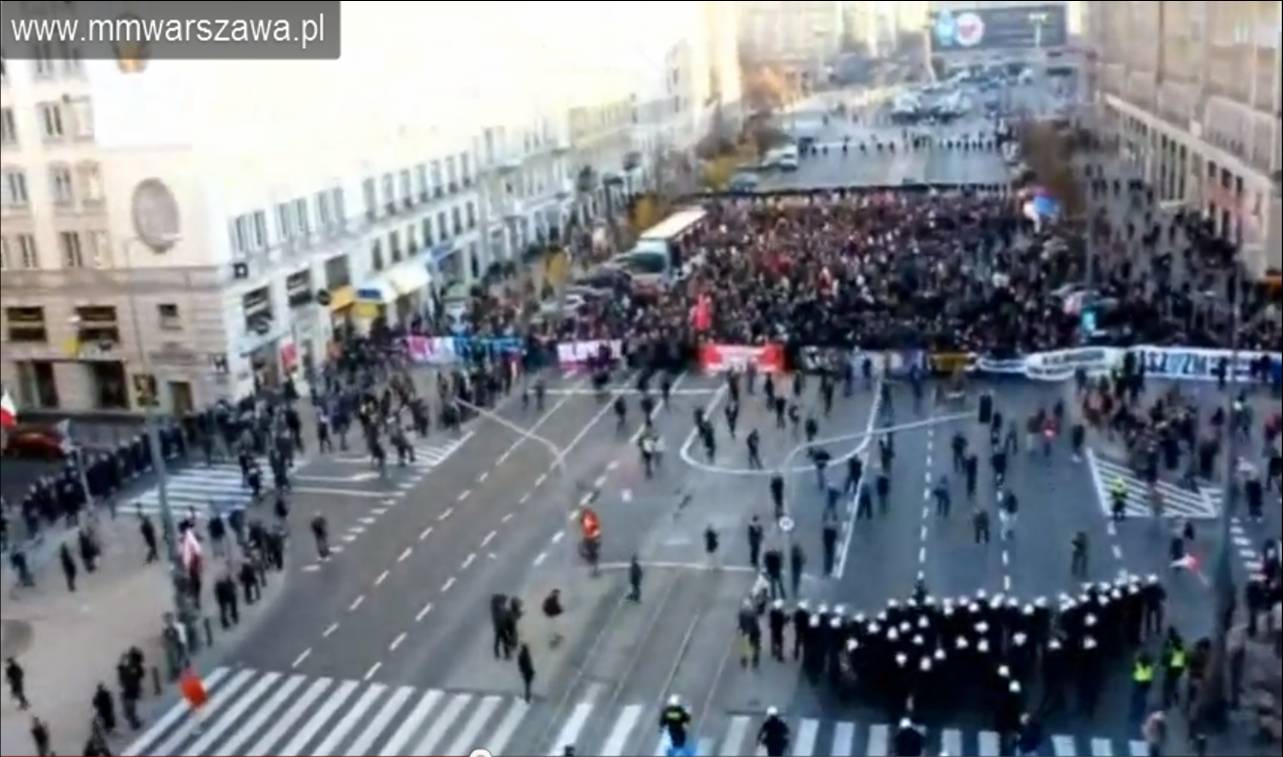
In November 2011, Polish firm RoboKopter filmed striking images of a political demonstration in Warsaw using a video camera attached to a drone or unmanned aerial vehicle (UAV).
The New York Times heralded the footage as signalling the arrival of ‘drone journalism’. Since then, we haven’t seen many newsgathering drones in UK skies, but we might well be seeing them some time soon.
Drones have been receiving more attention in recent months usually in the context of military operations. The Bureau of Investigative Journalism has been tracking the controversial use of drone strikes by the US military in Afghanistan, Pakistan and Africa. It has also emerged that the RAF were flying US drones during the conflict in Libya last year.
But much smaller UAVs – whether fixed wing or rotary – are now being used in civilian settings not for targeted killing but for image gathering. Last week, BBC Newsnight explored some of the issues around civilian drones and earlier in the year, Al Jazeera English filmed a training exercise with the German fire brigade which showed how UAVs could support firefighting.
I understand that several media organisations in the UK have already started to explore how they could use UAVs for newsgathering.
UAVs for Aerial Newsgathering
Aerial footage is not new of course, but UAVs are much smaller than helicopters allowing them to provide imagery from previously inaccessible locations.
The fact that they are unmanned also means there is no risk to a journalist or pilot. The latest models are being equipped with high definition technology allowing them to potentially provide stunning footage of national celebrations, political protest, natural disasters and conflict.
Safety, legality and ethics
The use of UAVs for newsgathering nevertheless raises a host of practical, legal and ethical issues. Question marks remain over safety concerns and the reliability of the technology, although the UAV industry is developing features such as an automatic ‘return to base’ function if the battery runs out or the operator loses control.
Legally, there is already a fairly well-established regulatory framework in place in the UK for flying UAVs which is outlined in guidance issued by the Civil Aviation Authority (CAA).
But this is an evolving area. The CAA’s chapter on ‘Civil Operations, Approval to Operate [UAVs]’ was completely rewritten in the latest guidance for August 2012. The requirements for ‘the licensing and training of United Kingdom civil Remote Pilots have not yet been fully developed’ and there is no European-wide standard to test UAV pilot competency.
It is likely that larger media organisations will look to fully licensed and CAA approved UAV operators to provide them with a newsgathering capability or apply for their own licenses to operate UAVs. But there is no particular reason why smaller organisations or individual ‘citizen’ ‘drone’ ‘journalists’ couldn’t do the latter and attempt to gather their own footage.
Gizmodo recently featured the (intriguingly named) Spy Hawk RC Glider which allows you to record video from the sky for a mere £250. With a battery life of 15 minutes it’s unlikely to have any heavyweight journalistic applications but we can expect the cost of more sophisticated equipment to come down.
Ethically, UAVs are likely to compound longstanding editorial dilemmas. It is not hard to imagine scenarios in which the deployment of UAVs for newsgathering is likely to directly invade individuals’ privacy or indirectly facilitate ‘collateral intrusion’.
These concerns might need to be balanced against a ‘public interest’ defence in a situation where it is deemed that the footage reveals serious wrongdoing.
News organisations might then face requests from other organisations for access to video footage. Only last year, the Metropolitan Police asked UK media organisations to handover footage of the London riots, but the police have already been exploring the deployment of their own UAVs and are likely to continue to do so in the future.
Indeed, in a rather strange – but perhaps not unrealistic vision of the future – it is possible to envisage a stand off between a fleet of media-operated UAVs and their police counterparts at the site of a protest or emergency. Newsgathering sorties might have to be coordinated or argued over with ‘rival’ UAV operators or interested parties.
Another possible scenario which raises some profound questions is the use of UAVs in the context of conflict. What would happen if a news organisation flew a UAV from Jordan over the border into Syria? Will opposition activists of the future be streaming live video footage to YouTube shot with UAVs?
Newsgathering UAVs coming soon?
Until now, these have been hypothetical debates set out in ‘future scenarios’ by interested thinkers and there has not been much visible evidence of UAVs being deployed by media organisations in the UK.
But recently I’ve been in contact with several people from the media and UAV industries. Behind the scenes discussions are taking place about UAVs for newsgathering and I think we can expect to see major developments in this area within a year and perhaps even by the end of 2012.
It would not be a surprise to see UAV footage being played out on air in the near future and maybe we’ll run into some of these other issues before too long as well. So watch this space – the one just above your head.
]]>