Freelance/Student £140
Members £115
*Tickets include lunch

Vicky and Patty going to work and running to get the last bus of the early morning hours. Piedras Negras, Mx. 1994. ©️Lina Pallotta
This one-day workshop challenges the boundaries of the documentary tradition and questions the prevailing conventions of storytelling in photography. Subjective or conceptual documentation, diaristic interpretation and metaphorical narrative will be among the methods of visual practice that we will examine during the day. The value of content, and the need to establish a point of view will be encouraged as a mean to challenge the dominant representation, and a way to tell stories with visual narratives closer to a more personal perception of reality.
This workshop is open to anyone interested in documentary photography. Whether you have experience in the field or not, this is an opportunity to broaden your knowledge on the wide-range of possibilities of visual storytelling.
The participants are encouraged to explore and define the objectives of their work, highlight their personal vision, but also to place it in the broader context of cultural, sociopolitical, artistic and psychological use of images. We encourage anyone who would like to discuss their personal projects in class but we will only briefly discuss their ideas and this is not going to be an in-depth analysis of their work. Instead, we will show and analyze the work of well-known photographers such as Jim Goldberg, Mathieu Asselin, Laia Abril etc. The relationship between image/text, the multimedia, and the possibility of developing the project in book-form will be discussed.
Trainer:
Lina Pallotta is a photographer and teacher who lives between Rome and New York. She regularly holds workshops and conferences at the International Center of Photography and the Empire State College in New York as well as Officine Fotografiche in Rome. She is also part of award’s juries at various photography festivals and a portfolio reviewer and curator of international exhibitions. Pallotta is also the artistic director of “Gazebook: Sicily Photobook Festival 2017”. As a photographer, she works on long-term projects with a personal approach, mostly about women and gender identity. Among the best-known works: Porpora and Valerie (2013), a 20-year-long story about the relationship between Porpora, president of the Transsexual Identity Movement, and Valerie; BASTA – to Work and Die on the Mexican Border (1999), on the life of Mexican workers at frontier factories. She has received many scholarships and residences, including the New York Foundation for the Arts Fellowship 1998 The Atelier de Visu, Marseille, (2001); CASE Media Fellowship, University of Texas, El Paso (2002); Fund for Creative Communities, Lower Manhattan Cultural Council (2003). Wins the Osvaldo Buzzi Award from “International Photography Trophies” BN (2014).
]]>
To mark World Day against Trafficking in Persons, we will be hosting a screening night in collaboration with the Ethical Journalism Network to present –Sea of Pictures.
Over the last three years improving the quality of migration reporting has been a priority for the Ethical Journalism Network, conducting two major studies on migration coverage, creating practical tools for journalists.
Sea of Pictures is a documentary that supports this work. The film focuses on the image of Syrian toddler Alan Kurdi, who was found drowned on a beach in Turkey while trying to reach Europe with his family. This image went viral and became a symbol of the refugee crisis and the widespread international apathy up until that point. His image was seen on newspapers across the globe. But how as a media outlet do you choose which pictures to show to the public? What are the ethics surrounding taking pictures such as these? Can you really control how these pictures are interpreted and repurposed?
The screening will be followed by a debate around these questions. The panelists will discuss how pictures can impact and reshape public discourse and policy, but often in ways that were entirely unintended.
The EJN has released a special edition of Ethics in the News in which the makers of Sea of Pictures, Misja Pekel and Maud van de Reijt write a Report on the Ethics of Photographing Refugees.
Last year the EJN was commissioned by the International Centre for Migration Policy Development (ICMPD) to write a report on how media on both sides of the Mediterranean cover migration. The report, which was published to mark World Press Freedom Day on May 3, covers 17 countries and provides recommendation for media and policy makers.
Chair

Dorothy Byrne is Head of News and Current Affairs at Channel Four in the United Kingdom. She was appointed in September 2003, having previously edited the award-winning Dispatches. During her tenure, the Channel’s news and current affairs programmes have won numerous BAFTA, RTS, Emmy Awards and others. In 2014, Dispatches won the RTS Journalism Awards for both best Home and best International Current Affairs, the first time one strand won both awards, and Channel Four News won the RTS Journalism Award for Best News Programme of the Year for the second year running.
Speakers

Anastasia Taylor-Lind is an English/Swedish photojournalist who has been working on issues relating to women, population and war for over a decade. She is a Harvard Nieman Fellow 2016, and recently finished a year of research at the university on war, and how we tell stories about modern conflict. During the program she studied narrative non-fiction writing. Anastasia is also a TED fellow. She has written about her experiences as a photojournalist for The New York Times, TIME LightBox, Nieman Reports and National Geographic. As a photographic storyteller, her focus has been on long-form narrative reportage for monthly magazines. She is a National Geographic Magazine contributor, and other clients include Vanity Fair, The New Yorker, TIME, The New York Times, The Sunday Times, The Telegraph and The Guardian.
Misja Pekel is a film maker and producer of the film Sea of Pictures. Misja studied Law and Journalism in Amsterdam and Leeds. He is a documentary filmmaker at the Dutch public broadcasterHuman. Besides documentaries, he is working on Medialogica, a tv series about public opinion and the influence of media
Find out how to donate to the EJN here: https://ethicaljournalismnetwork.charitycheckout.co.uk/
Check out Moving Stories, a report on how to cover the migration crisis here: http://ethicaljournalismnetwork.org/resources/publications/moving-stories
]]>On the publication of her new book Afghanistan: Between Hope and Fear, Paula Bronstein will join us in conversation with Christina Lamb to discuss her expansive work that intimately captures everyday life in Afghanistan against the backdrop of the 14-year US-led invasion and its enduring legacy.
Paula Bronstein is an American photojournalist and a multiple nominee and award-winner of international contests including The Pulitzer, Pictures of the Year International, and The National Press Photograher’s Association. Previously a senior staff photographer with Getty Images and for major US newspapers including The Hartford Courant and the Chicago Tribune, she is currently based in Bangkok, Thailand as a freelancer represented by Reportage by Getty Images.
Christina Lamb is the roving foreign affairs correspondent for The Sunday Times. She has been a foreign correspondent for more than twenty five years, living in Pakistan, Brazil and South Africa, first for the Financial Times then The Sunday Times. She is the author of The Africa House, House of Stone: The True Story of a Family Divided in War-torn Zimbabwe, Waiting For Allah: Pakistan’s Struggle for Democracy, The Sewing Circles of Herat, My Afghan Years and co-author of I Am Malala. Her new book Farewell Kabul: From Afghanistan to a More Dangerous World, is based on two decades of reporting from Afghanistan.
Photo: Paula Bronstein/Getty Images
]]>The plethora of technology now available to communicate different forms of journalism, across a variety of platforms, has allowed journalists more freedom in their storytelling process. This is the driving force behind Me-Mo, a new multimedia magazine created by award-winning freelance photojournalists, Manu Brabo and Fabio Bucciarelli, in partnership with web-developing group, Libre.

(l-r) Matteo Dispenza, Manu Brabo, Fabio Bucciarelli and Paul Lowe
On Tuesday 17 February, Brabo and Bucciarelli, along with Libre president Matteo Dispenza, convened at the Frontline Club to discuss the genesis of Me-Mo and to share their thoughts on the future of visual storytelling. The two photojournalists also presented their work on the Libyan revolution, which is featured in the magazine’s recently released first issue. The event was chaired by Paul Lowe, course director of the Masters Programme in Photojournalism & Documentary Photography at London College of Communication, University of the Arts London.
The difficulties faced by freelancers when looking for viable ways to publish their work was a main source of inspiration for the founders of Me-Mo. This was especially evident during the Libyan War in 2011, when Bucciarelli and Brabo both worked as freelance photographers for various major news outlets. After their return from Libya, the two photojournalists continued to work in conflict areas and began to brainstorm and collaborate with other freelance journalists in order to develop the Me-Mo concept.
Brabo emphasised the necessity of collaboration and solidarity amongst freelancers, saying: “We are out there alone. If we don’t have each other, what do we have? We have nothing. In the end, through this sense of humanity and solidarity, you start to create links and you realise you have the same idea as another guy.”
“We are trying to create a space for all these kinds of people, people that we know, who have been working in Syria, in Libya for too long.”
Bucciarelli and Brabo hope that the magazine will become an innovative platform for freelancers who want to maintain creative control over their material in the commercialised world of news journalism. They want their contributors to fully utilise the capabilities of digital technology and to build a dynamic interaction with their subscribers. Bucciarelli said: “What we are trying to do is use the digital way… not only using picture or video, but also 360 pictures, paralysis effect, 360 video, infographics… A new platform for freelancers using the digital way.”
Each issue of Me-Mo will concentrate on a central theme, the first issue focused on fear, and will be published four times a year. A single issue can be bought for €10, and a year-long subscription is priced at €25. On this subject, Dispenza commented: “We decided to work on quality and not quantity.”
An audience member enquired as to whether Me-Mo would accept submissions exclusively from photojournalists, or if they would be open to stories presented through other journalistic mediums. The panelists agreed that high quality content was Me-Mo’s ultimate goal.
Dispenza said, “It’s more about the ideas and not about one kind of media. Me-Mo is really open to every kind of good idea because we are not a big publisher and we are really free to do the best things we can choose together. It’s really about the ideas.”
Watch and listen back to the event below:
]]>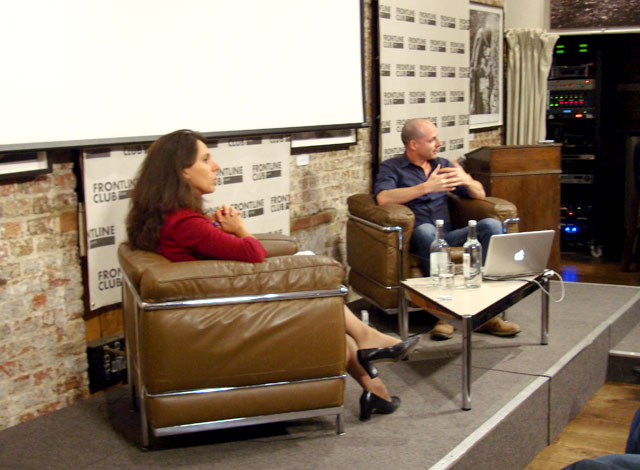
Aiming to dispel the familiar and stereotypical image of refugees living in camps World Press Photo Award winning photographer Andrew McConnell previewed a new body of work about the 50% of refugees now living in cities at the Frontline Club’s, In the Picture: Urban refugees with Andrew McConnell, on September 24.
Taken over the last four months, in seven cities and four continents, with the help of the International Rescue Committee (IRC), McConnell photographed and produced short films about individual refugees in cities such as Nairobi, Bangkok, Kuala Lumpur, Jordan, Port-au-Prince and New York.
Dr Sara Pantuliano, a political scientist and Head of the Humanitarian Policy Group at the Overseas Development Institute (ODI) introduced McConnell and he wasted no time in getting to his motivations behind the project:
"The whole reason for this project is this new phenomenon, that refugees no longer flee to camps, that the old stereotypes don’t really fit anymore. Over half the world’s refugees live in cities. And so what I hope to achieve with the work is to challenge those stereotypes and hopefully present a new way of viewing refugees in the modern world."
Pantuliano asked whether McConnell had any expectations about what he would find when starting the project:
"There were no huge surprises, I found what I suspected I would find. People living in terrible conditions, in very small cramped places, one family in one room … the same things repeated themselves; the same fears, fear of detention, the authorities, afraid to go outside."
The element of fear was not the only similarity that McConnell found between the people he met:
"They had an incredible resilience, they’ve suffered things that you and I can only imagine. That will to survive was there in each and every one of them – they weren’t giving up."
McConnell relayed the stories of the people in his photographs from a lady who had escaped with her family to Burundi from Congo where she had been kidnapped and raped by FDLR or Mai-Mai forces; to Syrians who had fled over the southern border into Jordan after conditions in Homs became unbearable.
He then took the audience through how he tried to convey these people’s stories through his images:
"The whole series was photographed at night time and what I’m really trying to do is give a sense really, how forgotten these people in cities are … They don’t understand what rights they have and so they’re afraid to go outside, they suffer discrimination, it’s hard to find employment and so they often find themselves hidden away."
"We were really here trying to give a sense of the isolation these people feel, coming to a foreign city like this and trying to some how survive."
McConnell has big plans for the project – there will be an exhibition in St Pancras Station in January and after that he hopes to take it to Brussels and New York.
Listen to Andrew McConnell on his photographs:
Listen to Andrew McConnell on why refugees choose cities instead of camps:
]]>
As urbanisation reshapes much of the world, refugees are increasingly moving to built up areas, including large towns and cities. Working with the International Rescue Committee and the European Commission’s humanitarian aid and civil protection department ECHO in eight cities across four continents, Panos Pictures photographer Andrew McConnell has spent many months documenting the new reality for refugees. Through images, refugee testimonies and video, the resulting body of work presents a unique insight into the lives of urban refugees today and challenges commonly held stereotypes. From Somali refugees in Nairobi to Syrian refugees in north Jordan, and from Burmese refugees in Kuala Lumpur to Afghani refugees in New York, the story of where people flee when all is lost is changing.
McConnell will present his work at the Frontline Club in an event moderated by Dr Sara Pantuliano, Head of the Humanitarian Policy Group at the Overseas Development Institute (ODI).
Andrew McConnell began his career covering the end of the conflict in his home country Ireland, before venturing overseas to document social issues around the world. McConnell‘s work has been published and exhibited internationally, appearing in National Geographic Magazine, Time Magazine, The New York Times, The Guardian, FT Magazine, Vanity Fair, the Sunday Times Magazine and Der Spiegel among other publications. In 2011, he won two 1st prizes at World Press Photo Awards and two National Press Photographers Awards, including the prestigious Best of Show.
Dr Sara Pantuliano is a political scientist with more than 20 years’ experience in conflict and post-conflict contexts. Prior to joining ODI, Pantuliano led UNDP Sudan’s Peace Building Unit. She has written extensively on Sudan and is a regular media commentator on Sudan and humanitarian issues. Pantuliano is the Managing Editor of Disasters, the leading peer-reviewed journal in the field of natural catastrophes and man-made disasters, anda member of the World Economic Forum’s Global Agenda Council on Catastrophic Risk.
]]>Picture credit: Andrew McConnell / Panos Pictures / IRC UK
As urbanisation reshapes much of the world, refugees are increasingly moving to built up areas, including large towns and cities. Working with the International Rescue Committee and the European Commission’s humanitarian aid and civil protection department ECHO in eight cities across four continents, Panos Pictures photographer Andrew McConnell has spent many months documenting the new reality for refugees. Through images, refugee testimonies and video, the resulting body of work presents a unique insight into the lives of urban refugees today and challenges commonly held stereotypes. From Somali refugees in Nairobi to Syrian refugees in north Jordan, and from Burmese refugees in Kuala Lumpur to Afghani refugees in New York, the story of where people flee when all is lost is changing.
McConnell will present his work at the Frontline Club in an event moderated by Dr Sara Pantuliano, Head of the Humanitarian Policy Group at the Overseas Development Institute (ODI).
Andrew McConnell began his career covering the end of the conflict in his home country Ireland, before venturing overseas to document social issues around the world. McConnell‘s work has been published and exhibited internationally, appearing in National Geographic Magazine, Time Magazine, The New York Times, The Guardian, FT Magazine, Vanity Fair, the Sunday Times Magazine and Der Spiegel among other publications. In 2011, he won two 1st prizes at World Press Photo Awards and two National Press Photographers Awards, including the prestigious Best of Show.
Dr Sara Pantuliano is a political scientist with more than 20 years’ experience in conflict and post-conflict contexts. Prior to joining ODI, Pantuliano led UNDP Sudan’s Peace Building Unit. She has written extensively on Sudan and is a regular media commentator on Sudan and humanitarian issues. Pantuliano is the Managing Editor of Disasters, the leading peer-reviewed journal in the field of natural catastrophes and man-made disasters, anda member of the World Economic Forum’s Global Agenda Council on Catastrophic Risk.
]]>