Seen through the lens of filmmaker Brian Oakes, Foley’s close childhood friend, Jim: The James Foley Story takes us from small-town New England to the adrenaline-fuelled front lines of Libya and Syria, where photojournalist James (Jim) Foley pushed the limits of danger to report on the plight of civilians impacted by war.
On Thanksgiving Day 2012, Jim Foley was kidnapped in Syria and went missing for two years. Thrown into a world of false leads and misinformation, the Foley family was threatened with prosecution by the U.S. government if they paid a ransom. In Oakes’s gut-wrenching film, Foley’s family, friends, and fellow journalists tell Jim’s story, while his fellow hostages reveal the details of captivity with chilling immediacy.
Brilliantly constructed with unparalleled access, Jim is a harrowing chronicle of bravery, compassion, and pain at the dawn of a new World War against ISIS.
Tickets can be booked through the Bertha DocHouse website and the screening will take place at the Curzon Bloomsbury cinema.
Directed by: Brian Oakes
Country: United States
Year: 2016
runtime: 120′
On 29 October, exactly one year and one day after the bombing of al-Bara in northern Syria, an audience gathered in the Ritzy Cinema to watch filmmaker Olly Lambert’s extraordinary footage of the attacks. The Bombing of al-Bara screening was hosted by the Frontline Club and DocHouse as part of a series of Between the Lines Follow-up Events and was followed by an in-depth Q&A with the director.


L: Director Olly Lambert answers audience questions | R: Director Olly Lambert before the screening
In order to fully appreciate this film, a brief background should be outlined. Lambert was commissioned by Channel 4 and PBS to produce his documentary Syria: Across the Lines. The film involved gaining access into both rebel and regime held territory, on either side of the valley in the Idlib province.
While filming inside a rebel leader’s house, a large bomb fell only 300 meters away. Lambert let his camera film the aftermath and chaos that ensued. Months later he added his voiceover to the raw footage and uploaded the film to Youtube where it has reached a widespread audience.
Lambert’s motivation from the onset was clear. He explained that by spending time with the local population, he hoped it would offer insights into the reality of life in the periphery of war. He stated:
“I am not interested in warfare, I am interested in how ordinary people react in finding suddenly a war around them.”
The film’s uncensored style, combined with Lambert‘s honest commentary, creates a harrowingly intimate insight into war journalism. The retrospective quality of his narration, coupled with the spontaneously shot footage balances the mediated with the unmediated, the conscious with the subconscious, to great effect. An audience member said of his narration style:
“There was something about having your voice there and the story there that made it bearable.”
At times the scenes could certainly be described as unbearable. Graphic images depicted a woman’s body ripped apart by the attack and a child screaming for his grandparents buried under the mass of rubble. Perhaps the eeriest of all were the fragments of normality that co-exist with the chaos as a woman pushes her pram and an onlooker casually lights his cigarette.

Director Olly Lambert and the Frontline Club’s Documentary Programmer, Wotienke Vermeer
In response to the risk Lambert took in going to Syria, one which almost cost him his life, he said, “honestly I didn’t expect to come that close.” In terms of coping with the destruction he saw, Lambert emphasised the need to hold it together but also an ability to let go:
“I was really glad to cry. . . . As a filmmaker you need to have not only a thick skin to be able to go in there and do it, but it’s also totally essential to have a really paper thin skin.”
The mainly male Syrians depicted are all too conscious of the power of media images in this war and were acutely aware of Lambert‘s role as witness to their suffering. Lambert found this dynamic to be somewhat burdensome. He reflected:
“It was an occupational hazard there, people always telling me to film stuff.”
A sense of helplessness featured in the footage which Lambert reaffirmed in one of his anecdotes. He recounted one man saying to him in the aftermath of the bomb: “Your government did this.” Lambert explained his reaction:
“My government, Western governments were doing nothing…I was ashamed of how abandoned these people were.”
The discussion on security training during the Q&A was a poignant one. Lambert explained that the safety process required by the broadcasters who commissioned the film took a long time:
“I had to prove that I had thought every single possible eventuality from what to do if the car breaks down…to what happens if I lose both my legs and my fixer is killed in every single location I might go to.”
He continued:
“It was a real pain in the arse. . . . But the moment we crossed into Syria for the first time I was so grateful to have done it and been forced to have done it because things did start to go wrong very quickly.”
One audience member asked if there would be more films coming out of Syria. This prompted Lambert to explain how dramatically things had degenerated over the last year for foreign journalists. He noted:
“Someone told me a few days ago that to try and make this film now would be suicide.”
With regards to speculation over Syria’s future he said:
“Radicalisation is the thing to watch . . . I don’t think the really hard-line groups are going to have any long term traction in Syria, but at the moment they are extremely powerful. Extremely powerful.”
Watched a YouTube video in the cinema:The Bombing of al-Bara by @ollylambert.1 of most powerful things Ive ever seen. http://t.co/wuq5Bl3vUP
— Ola Cichowlas (@olacicho) October 30, 2013
]]>

By Antonia Roupell
Between the Lines Follow-Up Events once more succeeded in showcasing a diverse range of films at the Frontline Club on the 25th October. Each of the five documentaries opened a window onto a subject rarely documented from places like North Korea, Yemen and Iraq. Multimedia journalist, Adrian Branco and filmmakers Jason Lee and Tim Travers Hawkins were present for the Q&A with a large audience.
A bleak and urgent tone was set, starting with Travers Hawkins’ film 1000 Voices. It dealt with the reality of asylum seekers held in indefinite detention centres across the UK. The inhumanities the detained face were conveyed through authentic voice recordings juxtaposed with animation and performance art. Travers Hawkins said, “all the footage is suggestive.” He explained that the multiple mediums used were born out of their limitations, stating:
“There was talk at one stage of smuggling in camera phones and getting that kind of footage. . . . But then you have to ask yourself a question whether that kind of footage is better?. . . I think there is also an opportunity when you are denied access to film the subject to create something new and to use new forms of documentary expression.”
Branco also struggled with having to obey protocols in the pursuit of his story. In his film, The Death of Corporal Rivierè, he followed French troops to Afghanistan’s Surobi Valley and told the intimate story of one soldiers’ burial. He expressed his frustration at finding out that the images he had captured could not be made public:
“I was pissed off a lot and I was wondering how can I succeed in giving the feeling of being true to my audience without lying to the audience.”
He achieved this balance with the help of cartoonist Adrien Demot who drew the censored images, thus conveying the story without breaking any rules. Through both Travers Hawkins and Branco’s films the blurred boundaries within the aesthetics of reality were brought to light.


Death of a Prisoner by Laura Poitras also dealt with the direct reality and consequences of death in a war context. This time it was a disturbing portrait of a deceased Guantanamo Bay prisoner. His is a final journey home in a coffin to his family in Yemen after suffering great physical and psychological trauma in captivity which lead to his death. A glimpse into an individual tragedy, in view of a far bigger picture, had the effect of silencing the audience.
Evidently, creativity became the key in many of these films to overcome technical boundaries. Performance art itself empowered by a social statement was the subject of Maryam Ebrahimi’s film, The Death Row. This portrayed an act of defiance made by a group of 15 females in Kabul dressed in traditional mourning robes in a plea for Afghan women’s right to education. As they stand anonymously side-by-side the footage focuses on their audience of bewildered locals passing by.

Perhaps the most uplifting of the journeys was captured in Lee’s Letters from Pyongyang. A touching story which sees Lee make the journey with family in Canada to reunite momentarily with their long-lost relations isolated in North Korea. Their joyous reunion proved to be a painful reminder of the lost time stolen from them. From idea to completion this project took five years. The audience wanted to know how Lee had permission to film in North Korea. He explained that gaining a visa was the hard part and that in terms of filming:
“I was there on a very personal mission. My intentions were very clear from the beginning when I was in contact with the North Korean authorities.”
In both content and access it would be an understatement to describe these films as difficult. However Lee made an important point with regards to this in explaining that the complexity of the film process should not eclipsing the films’ subject. He spoke for the three filmmakers present when he said, “we stayed true to our stories.”
[vimeo clip_id=”77472035″ width=”400″ height=”225″]
Branco’s online documentary can be explored here: http://www.journageek.com/
Travers Hawkins’ multimedia projects continues here: http://www.invisiblepictureshow.com/
“The evening breeze
blows towards the bride
as she takes her leave
on her wedding day.”
(“New Bride, New Night” by Salma)
On Thursday 26 September, the Frontline Club and DocHouse screened the evocative documentary Salma. Hosted at Rich Mix, the film was the latest in the Between the Lines Follow-Up series.
Directed by Kim Longinotto, the film follows the poet and novelist Salma on her return to her home village where she was effectively imprisoned for 25 years. Editor Ollie Huddleston joined for the post-film Q&A.
Elizabeth Wood of DocHouse began with a discussion on the craft of editing:
“Fiction films are shot to a script, but really, with a film like this, and with all Kim’s films, a script is really written during the edit.”
“I think the best documentary films are like fiction films,” responded Huddleston:
“You’re building a story. . . . I look at this film now and I see it’s of course a film about Tamil Nadu and Muslim culture and Salma, but the important thing is always that it should connect to us. It’s a very universal story in some ways. The bonds, the knots, the ties, the families. Fear of breaking away and not being able to break away.”

Editor Ollie Huddleston. Photo: George Symonds
An audience member asked if the village had changed since the film was made.
“My experience of the village,” said Huddleston, “is what I see through that material. My understanding is that it hasn’t changed, no, not at all. And I think Malik – Salma’s husband – is quite unusual. As much as he was a very strong part of keeping her away and keeping her apart from society, he also helped her to break free, and that’s very unusual.”
“He must have grown too, in a way do you think?” followed Wood.
“Yeah, the weirdest thing was that Kim and Salma, when I finally met her, said he liked the film, that he was proud of the film. That is amazing for me,” said Huddleston. “Because he doesn’t come across brilliantly sometimes. Kim said he was a lovely guy and incredibly friendly and all the rest of it, but maybe he’s happy that the story is being told. He seems very proud of his wife so eventually maybe he’s coming around and maybe the village will change, one day.”
“But,” countered Wood, “do you think perhaps he’s the one who made his sons critical of her?”
“Yes, I do. Definitely he did. But he’s part of the village, isn’t he? I mean they all are. So the village tradition has meant that they’re all bound by the past and traditions that women are locked up and hidden away.”

Ollie Huddleston in conversation with Elizabeth Wood. Photo: George Symonds.
Huddleston then spoke of the difficulties faced during filming:
“Salma had to hide a lot. They thought she was making some kind of drama film and she was going to make money out of this film in some way. So I think there was a lot of antagonism in the village. But she’s an extraordinary, pragmatic, charismatic, thoughtful, incredibly eloquent person so I imagine she found a way to explain it to them, and to get the film made.”
Hands went up in the audience to ask about the inclusion of the Hindu wedding:
“We wanted to balance the film out. That it’s not just Muslim weddings. I mean, that girl is about 10 or 11. It happens quite a lot in the village so that was the reason. It’s quite shocking, and truthful.”
Is she, Salma, interested in the world of politics and making a difference that way?
“She started a women’s refuge in Chennai and yes, she’s very interested in changing the world, most definitely,” explained Huddleston. “Politics is one way of doing that but I think at the moment she’s writing. I couldn’t say whether she’d go back into politics again. Maybe.”

Huddleston then responded to how he approached representing the many complex characters:
“You try to make stories develop. . . . Throughout the film you’re probably thinking, ‘God, how could she [Salma’s mother] do that to her daughter?’ . . . In the end, she helps her publish her books, she smuggles them out – she’s more complicated than that. So to be really crude about it, there’s a kind of set up about who the mother is. You think she’s this person then, later on, you’ve changed your opinion of her. ‘Wow, she’s stood up, she went and got the books, she sent them to a publisher, she is on Salma’s side.’ There’re many references to the mother and the complexity of that relationship is huge and crucial to the film really. You’re trying to make it understandable and very real.”
'Each shot has to count and each moment has to count' – editor Ollie Huddleston #documentary #Salma
— BerthaDocHouse (@BerthaDocHouse) September 26, 2013
To conclude, Huddleston commented on the circularity that the film depicts:
“It’s that idea that we’re constantly going in a circle. When she lies on the floor and says, ‘What can I do, I can’t leave the ones that love me, I’d be completely alone,’ isn’t that true of all families? It’s a circular thing. That seemed to be the most truthful point. She’s still yearning for her mother’s approval or love or closeness. Nothing has changed, in certain ways, even though she’s done extraordinary things.
“It’s because it’s a film about circles. Circles within families, within tradition, within religion, and trying to break free from those. That felt like the most honest end, the most truthful end. Nothing is simple.”
A collection of Salma’s poems and Longinotto’s reflections on creating the documentary is published by OR Books.
Upcoming films in the Between the Lines Follow-Up series can be found here.
]]>This launch event at the Frontline Club will provide a taster of what the festival holds in store, featuring clips from documentaries and the announcement of the full programme. Free drinks will be provided throughout the evening, courtesy of Chivas Regal.
A limited number of tickets are available to the public to book for this launch event via the BOOK NOW link above. If you work in the media and would like a press ticket to attend the launch, please email flora.carmichael@www.beta.frontlineclub.com to request an invitation.
Presented by:


Sponsored by:

Supported by:


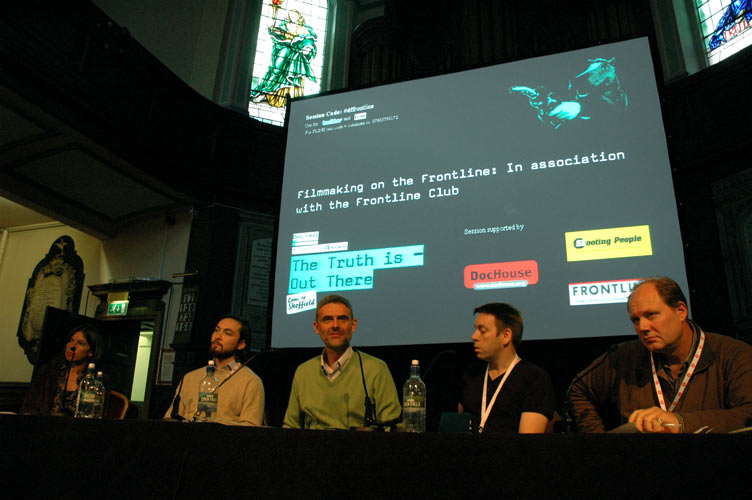
Putting the panel together was extremely difficult as, due to the nature of the job, many of our panellists were either stuck in difficult places filming or had to rush off to film in reaction to sudden changes in the world.
However, it worked out for the best and our final line-up had an incredible array of experience and insight. Joining Frontline Club founder Vaughan Smith were Danfung Dennis, Jules Williamson, John D McHugh and James Mullighan from Shooting People as chair.
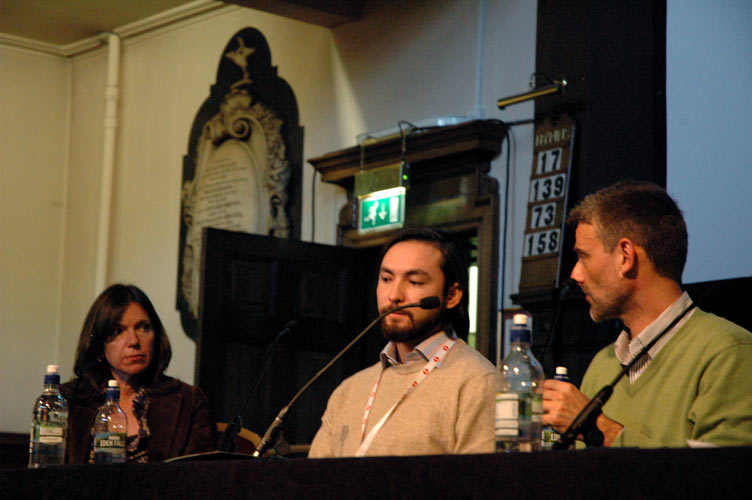
It was a fantastic discussion and all panellists showed clips from their work.
The panel discussed various aspects involved when preparing to shoot in a conflict zone. The resounding advice was explained best by Vaughan who said that fundamentally you should make sure you go on a shoot with a purpose. He went on to caution potential filmmakers that it’s easy to get scared before you go to a warzone when, if you work it out, the risks they could be very low.
John D. McHugh and Danfung Dennis went into greater detail about how to behave whilst on a shoot. John D. spoke of how the more you can think about what you’d do in situations the better you’ll be prepared and not get it wrong and Danfung stressed that telling the story is really important and that you must decide whether you are going for the experience or to tell a story.
Jules Williamson (apologies I don’t have a link to her stunning new film looking into a radio station helping child soldiers, but keep an eye out for it) spoke from the perspective of setting up a shoot and explained how risk assessment is important as it gives you focus, no matter what topic or situation.
It was fantastic to see the club have a greater presence at the festival this year and to bump into the various members attending. We also got a mention at various panels and it was particularly wonderful to hear Jess Search of BritDoc telling a packed room that she loved the club.
A huge thanks to the other organisations that helped us with the discussion. The session couldn’t have been possible without our producing partners DocHouse and the help of Shooting People.
John D’s Rory Peck nominated film can be seen in full here
You can see the trailer for Danfung’s new film here:
]]>