
Monday 18 February

In Moscow, the posthumous trial of whistleblowing lawyer Sergey Magnitsky on tax evasion charges is scheduled to resume. Magnitsky died aged 37 in prison in November 2009 as he awaited trial. Critics suggest the charges were trumped up in retaliation for Magnitsky’s role in exposing an alleged $230m fraud that was linked to a Russian Interior Ministry official.
In Brussels, there is a debate on the EU’s long-term budget which will be attended by EU Council President Herman van Rompuy and European Commission President Jose Manuel Barroso.
In Turkey, the trial of pianist Fazil Say for insulting Islam on Twitter is scheduled to resume, having been adjourned last October when a request to have the case dismissed was rejected.
Finally, Armenians will head to the polls on Monday for presidential elections, with incumbent Serzh Sargysyan hoping to secure a second five-year term.
Tuesday 19 February

Russian Foreign Minister Sergey Lavrov, meanwhile, is scheduled to travel to Brussels for talks with EU High Representative Catherine Ashton. Although Syria is likely to come up in the talks, it seems highly unlikely that the meeting will produce any fundamental breakthrough in terms of reconciling the divergent positions of Moscow and Brussels vis-a-vis the conflict.
Finally, parliamentary elections are scheduled to take place in Grenada.
Wednesday 20 February
China’s Foreign Minister Yang Jiechi is scheduled to begin a three-day visit to Russia on Wednesday. Although there have been telephone talks between Moscow and Beijing since North Korea conducted its third nuclear test last Tuesday, the visit will provide the first opportunity for face-to-face talks between Yang and his Russian counterpart Lavrov on Pyongyang’s latest provocation to the international community.

Finally, in New York, Japanese electronics giant Sony is due to hold mysterious media event, which many speculate will be used to launch the PlayStation 4.
Thursday 21 February

In Brussels, NATO defence ministers will converge for a two-day meeting. It follows the announcement made in President Obama’s State of the Union address that a further 34,000 US troops would be home from Afghanistan by next February ahead of the scheduled end of NATO combat operations next December. The meeting may also provide an opportunity for informal discussions on Syria.
Finally, a highly-anticipated meeting of shareholders of the mining group Bumi is scheduled to take place on Thursday. The meeting was called by financier Nat Rothschild, who has been locked in a dispute with Indonesia’s powerful Bakrie family, with whom he co-founded the company. Rothschild was ousted from the board, but retains a significant stake in the group and is seeking to oust 12 of Bumi’s 14 board members.
Friday 22 February

In the US, an Irish nanny charged over the death of a baby in her care is scheduled to make a court appearance. Aisling McCarthy Brady is charged with the assault and battery of one-year-old Rehma Sabir, who died last month. Some have compared the case to that of Louise Woodward.
Finally, parliamentary elections are scheduled to take place in the tiny east African nation Djibouti.
The weekend
The son-in-law of the Spanish king, Iñaki Urdangarin, has been ordered to appear before a magistrate in Mallorca on Saturday in connection to accusations of fraud and corruption at the Noos Institute, a charitable institution which he ran. Although he has not been formally charged, the connection of a royal to a case is the last thing the Spanish monarchy needs at the moment, given the dire economic situation many Spaniards are finding themselves in at the moment.


Part of the fun of travel anywhere involves the matching of a preconceived image with a reality. The northern Horn of Africa is steeped in travelers mythology which dates back to Richard Burton’s famous, first footstep,in the mid 19th Century and stretches into popular modern imaginings of the, archetypical failed state, Somalia. Separating fact from fiction here isn’t always easy.
For a journey to Somaliland I’ve been in full tourist mode. I’m no Richard Burton – for one thing I’m pretty sure colonial-era explorers didn’t carry Lonely Planets. At the same time, as there are so few other foreign travelers in Eastern Ethiopia it is possible to pick up on that scent of adventure and sense of genuine wonder. The region has vast potential to develop as a location for independent travel and the beauty of the country would certainly warrant it. From cosmopolitan Addis Ababa the road stretches out through undulating green farmland and falls into a dusty interior populated by nomadic tribes people and their livestock. Beyond the savannah-like plains of Awash however, the road rises again into verdant highlands where the valleys sparkle with the reflected light of scattered tin-roofed settlements. This is chat country and the terraced hillsides are lined with this plant whose leaves when chewed (and they are, a lot) act as a mild narcotic. Chat is consumed throughout the Eastern Ethiopian and Somali Horn and the trade has developed into a massive and hugely influential regional industry – in many ways this little leaf ties these nations together. Afternoons in the ancient city of Harar are spent roasting coffee beans, downing multiple sugar laden cups of the rich brew and chewing the cud. Chat debris is strewn all over the floor and the cumulative stimulant effect is enough to set hearts palpitating to the same rhythm as the buses which bounce through in clouds of dust. Not that such intoxicants are really needed to get a kick out of a place like Harar where the nightly ritual involves the feeding of the local Hyenas. Skulking out of the darkened fields these magnificently scruffy animals howl and yap in deference to the old men who call them by name and hand over big chunks of meat.
From Harar I double back to the more modern town of Dire Dawa, the second largest urban centre in the country built up at the turn of the century for the new railway line running from Addis all the way to Djibouti and the
The tiny African country of Djibouti is definitely a Somali state, but is, at the same time, defined by a colonial history and modern geopolitics. Traditionally playing host to French legionnaires, Djibouti is now home to the Americans. It is from here that the Combined Joint Task Force Horn of Africa operates to conduct intelligence and military operations in the Horn. The G.Is on leave in downtown Djibouti city show off fierce crew cuts and a general lack of discernible necks, whilst the burly legionnaires sport their snazzy desert boots and short shorts combos. In the heart of the city the Somali market buzzes with the intensity of semi-organised chaos, whilst a five minute walk will take you to leafy colonial squares and air-conditioned supermarkets patronised by white families driving shiny SUVs.
Short of time, I elect to jump into Somaliland by plane and show up bright and early at the airport to catch my scheduled flight. After waiting around outside for an hour or so while all the airport staff arrive for work, I am duly informed that there will be no plane to Hargeisa today. Several ticket-holding passengers gather up their luggage and set off back into the city. I inquire at the airline office and find out that a, no plane today, can evolve into a, maybe later this morning, to finally a wonderful, oh look, there it is’. The best thing about the delay is getting some time in the departure lounge to drink overpriced cups of tea and watch the F-16s use the runway for takeoff.
So that’s the neighbours. It’s a superficial glance to be sure, but is one that might give you some sense of context for this de facto independent but diplomatically unrecognized modern nation state of Somaliland. Somaliland’s fledgling democracy, (excuse the phraseology) is apparently reeling in a protracted constitutional crisis. The most recent postponement of the presidential election, scheduled for September 27th, resulted in clashes on the streets, police shootings and several fatalities. Once again Somaliland’s hard won and oft-ignored stability was rocked by political violence. The previous instance occurred last year with Islamist-linked bombings in Hargeisa and Bossaso in largely autonomous Puntland, which targeted government buildings, the UN, and Ethiopian commercial and diplomatic interests.
To some, Somaliland is as a country on the brink. Democratic functioning (another of the Republic’s previous claims to fame) is faltering and the whirlwind forces of insurgency which plague Mogadishu and the South of the country, could conceivably expand into a vacuum brought by destabilisation Somaliland. The stakes are no doubt high though that in itself may be a moderating factor. Political crises come and go in this part of the world (as do the staff of some international organizations who are pulled out of the country as soon as any trouble is spotted on the horizon) and already political concessions have been made. Whilst not without controversy, Somaliland’s Guurti legislature has, in effect, confirmed an extension of President Rayaale’s term of office, and an election will be unlikely to take place this year. Does this represent a return to normality for a large proportion of the population who are more concerned about putting food on the table than elite political wrangling, or does it instead epitomise the perpetuation of an inherently vulnerable and potentially combustible status-quo? This is a question I hope to explore during my stay in this fascinating corner of the Horn of Africa.
For pictures visit my photojournal.
]]>
Having returned from a trip to Somaliland, I spent the last few days editing video footage and pictures.
I went there as a nostalgic ethnic Somali who hadn’t seen the land I left twenty years ago. Although my family come from Hargeisa I spent many of my formative years living in Mogadishu. This experience has left me with a deep affinity for both cities and a claim to both Somalia and Somaliland. It has been difficult for me to divorce Somaliland from Somalia. I found that in my vocabulary the two are like conjoined twins; two different individuals who are not quite separate. This is not helped by the fact Somaliland remains internationally unrecognised. To the outside world Hargeisa is just a city which lies in the northern part of Somalia and Somaliland is simply its northern region. To Somalilanders Hargeisa is the capital of their country. A country of which they are very proud.
I found one of the most offensive things you could say in Somaliland was to make the mistake of calling it Somalia. When I accidentally referred to the currency as Somali shillings in the market, I was quickly rebuked and corrected that it was Somali-LAND shillings. Although Somalis share the same religion, ethnicity and even language, Somaliland is now for all intents and purposes a separate country to its neighbour Somalia.
In the Somali people’s pre-colonial history, settlement and living was primarily a nomadic and pastoral one determined by the seasons and where one’s clan resided. The concept of borders was introduced by competing colonialists. Djibouti was formed by the French, Somaliland by the British and Somalia by the Italians. Two other regions were enveloped by Kenyan and Ethiopian borders. The Somaliland Republic reclaimed the old British name given to it and declared independence in 1991. While the debates on Somalia irredentism continue, so does life for ordinary Somalis wherever they reside.
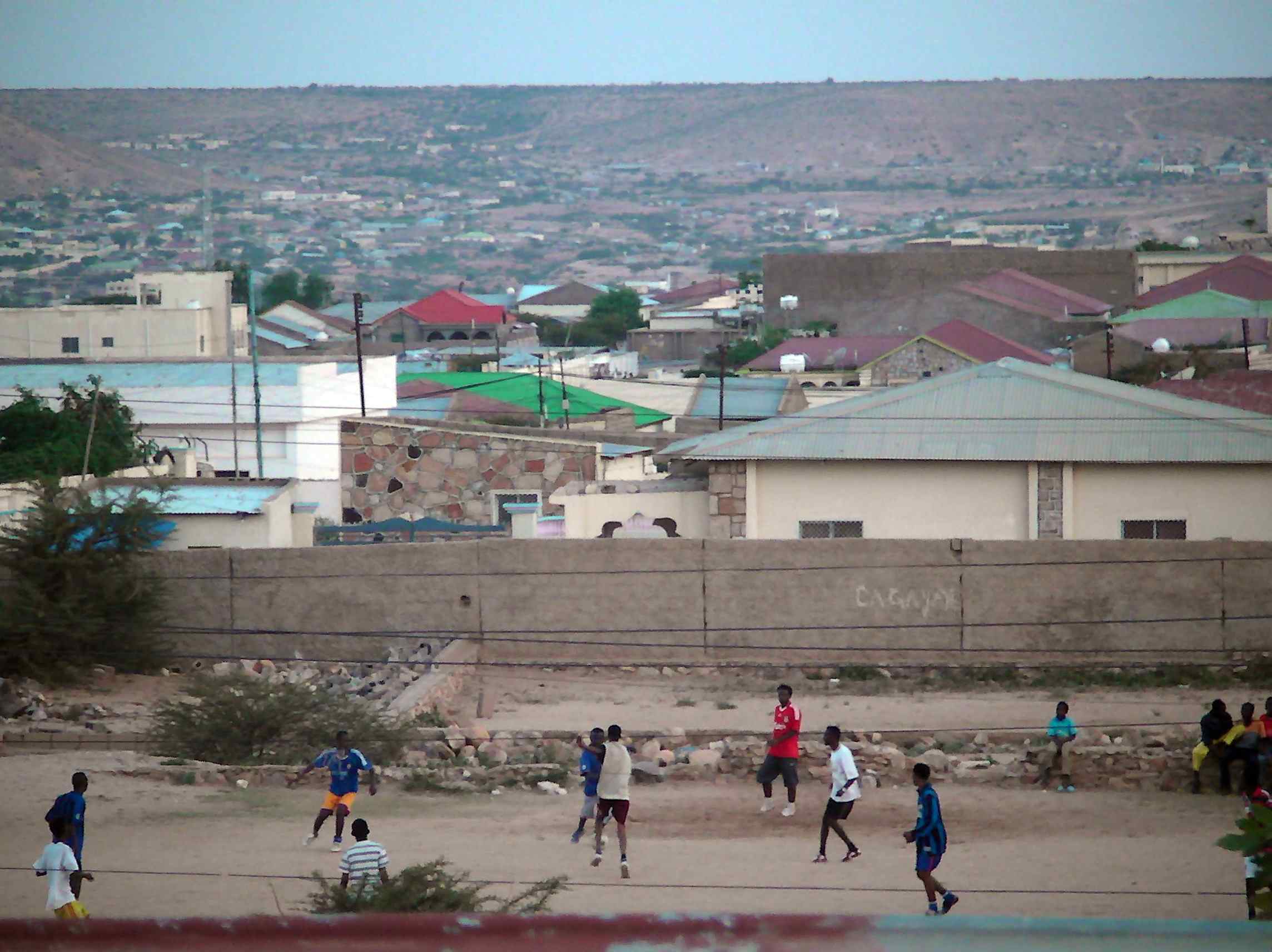
What the people of Somaliland have achieved, dubbed as Africa’s best kept secret, in a relatively short space of time is the envy of others. The country is a fully functioning relatively peaceful and bustling one. The markets open early in the morning with items from all over the world for sale. There are buses and taxis. Operating airports and a visible police force. There are schools and busy cafes. Children play football in the streets but they also beg on the same streets. The global economic crisis has had its ramifications in Somaliland. There is desperation as the cost of living has gone up and the current government is accused of corruption. The country is a growing haven for other ethnic Somalis escaping the violence in Somalia. Across Somaliland there are camps for IDPs (internally displaced people) who depend on aid.
The next posts will focus on the plight of some of those people as well as on the impending elections in Somaliland.
Photograph of of young people playing football in Hargeisa by me
]]>