Warning: Cannot modify header information - headers already sent by (output started at /home/dh_ueu9qi/beta.frontlineclub.com/wp-content/themes/frontline3.6/functions.php:1) in /home/dh_ueu9qi/beta.frontlineclub.com/wp-includes/feed-rss2.php on line 8
demonstration – Frontline Club http://www.beta.frontlineclub.com Championing Independent Journalism Mon, 24 Apr 2017 07:29:09 +0000 en-US hourly 1 https://wordpress.org/?v=6.9.4 Street Spirit: The Power of Protest and Mischief http://www.beta.frontlineclub.com/street-spirit-the-power-of-protest-and-mischief/ http://www.beta.frontlineclub.com/street-spirit-the-power-of-protest-and-mischief/#respond Tue, 17 Jan 2017 17:08:01 +0000 http://www.beta.frontlineclub.com/?p=59927 Human rights campaigner Steve Crawshaw has been an eye witness to some of the most dramatic demonstrations of recent years.  His forthcoming book, Street Spirit: The Power of Protest and Mischief provides unique commentary on the power of non-violent protest, drawing on Crawshaw‘s experience reporting on the east European revolutions, the collapse of the Soviet Union and the Balkan wars — as well as a clutch of unusual examples from his work with human rights activists in recent years.

Among the many instances of imaginative defiance explored, Crawshaw discovers the surprising impact of Lego figures in Siberia, red-hatted dwarves in Poland and a donkey holding a press conference in Azerbaijan – not to mention the story of how Darth Vader helped to effect a global arms treaty.

But how effective are humour and creativity in bringing about social change?

Discussion chaired by Channel 4 News Correspondent Fatima Manji.

Steve Crawshaw is a senior advocacy adviser at Amnesty International.  He was previously London director and UN advocacy director of Human Rights Watch. He joined The Independent at launch and reported on the east European revolutions,  the collapse of the Soviet Union and the Balkan wars. Interviewees ranged from Slobodan Milosevic to Aung San Suu Kyi. His previous books include Small Acts of Resistance (co-authored with John Jackson, 2010, foreword by Vaclav Havel), Easier Fatherland: Germany and the Twenty-First Century (2004) and Goodbye to the USSR (1992).

Fatima Manji is a News Correspondent and regularly reports on a range of national and international stories. Her broadcasting has included telling the story of the migration crisis from the borders of Europe, interviewing victims of ISIS atrocities in Iraq and challenging politicians here in the UK during the referendum campaign. She also occasionally presents the programme from the studio. Fatima has won a number of awards for her journalism and in 2015 she was a finalist for the Royal Television Society’s Young Journalist of the Year. During the last General Election she presented Britain’s first ever Alternative Election Debate featuring young party leaders facing a live audience on Channel 4. Fatima joined Channel 4 News in 2012 and previously worked as a reporter and video journalist at the BBC.

]]>
http://www.beta.frontlineclub.com/street-spirit-the-power-of-protest-and-mischief/feed/ 0
Screening: Everyday Rebellion + Q&A http://www.beta.frontlineclub.com/screening-everyday-rebellion-qa/ http://www.beta.frontlineclub.com/screening-everyday-rebellion-qa/#respond Wed, 13 May 2015 12:58:29 +0000 http://www.beta.frontlineclub.com/?p=50537 Arman Riahi.]]> This screening will be followed by a Q&A with director Arman Riahi.

Everyday Rebellion is a cross-media documentary about creative forms of nonviolent protest and civil disobedience worldwide.

What does the Occupy movement in New York have in common with the Spanish Indignados protests or the Arab Spring? Is there a connection between the struggle of the Iranian democracy movement and the nonviolent uprising in Syria, and what is the link between the Ukrainian topless activists of Femen and an Islamic society like Egypt? And to top it off, what do Serbia and Turkey have to do with all of this?

The reasons for the various people’s uprisings in these countries may be diverse, but the creative nonviolent tactics they use in their struggles are strongly connected. So are the dedicated activists who share these strategies, new ideas and established methods. Everyday Rebellion is a story about the richness of peaceful protest, acted out everyday by passionate people from Spain, Iran, Syria, Ukraine, the USA, the UK and Serbia.

These methods are inventive, funny and unrelenting. And the activists who use them believe that creative nonviolent protest will triumph over violence in the effort to challenge dictatorships and the crushing power of global corporations. Everyday Rebellion is a tribute to the creativity of nonviolent resistance, and to a modern and rapidly-changing society in which new and inventive forms of protest are conceived every day.

Directed by Arman T. Riahi & Arash T. Riahi
Duration: 118′
Year: 2014
www.everydayrebellion.net

]]>
http://www.beta.frontlineclub.com/screening-everyday-rebellion-qa/feed/ 0
Splitting heads and hairs, Sri Lankan style http://www.beta.frontlineclub.com/splitting_heads_and_hairs_sri_lankan_style/ http://www.beta.frontlineclub.com/splitting_heads_and_hairs_sri_lankan_style/#comments Wed, 10 Jun 2009 19:09:54 +0000 http://www.beta.frontlineclub.com/dev/splitting_heads_and_hairs_sri_lankan_style/ “Thanks to you and others, who was taking pics world can remember the sufferings!”. The words are from an email a stranger sent me recently, and should be heart-warming for an old photojournalist who’s packing up to leave struggling Sri Lanka for a while. But the message is about a war that ended 15 years ago on the other side of the world. There won’t be many such emails to photographers from Sri Lankans who suffered during the war here, now or later. The occasional “thanks for trying”, perhaps, but in photojournalism trying equals failure.

The final stages of the defeat of the LTTE Tamil Tigers must have been an epic chain of events with thousands of people suffering and dying. But there is no independent photographic documentation of it. The dubious “photographic evidence” handed out by both sides as propaganda will hopefully forever gather digital dust. That leaves only the cold clinical satellite images recorded by superpower technology, and the highly volatile visual memories of those who were there and saw it themselves. 
 
Meanwhile, Sri Lankan journalists have more pressing concerns. Dozens of them took to the streets of Colombo today wearing black masks printed with “Stop Media Suppression” over their mouths, and carrying posters of Poddala Jayantha, the Secretary of Sri Lanka Working Journalists Association, who was abducted and assaulted by unknown assailants on June 1st, in what is becoming an all too familiar pattern here.
 
Although working conditions in Sri Lanka are difficult for foreign media too, we rarely feel threatened. But a BBC interview with Poddala Jayantha does hint at things literally getting a bit hairy, and army commander general Sarath Fonseka didn’t help: 
“So, especially the media people should behave well and set an example to others. To me, those who stage protests with unshaven beards, long hairs and wearing costumes like in fancy dress competitions are not scribes who are clamouring for media freedom but a gang of thugs”.
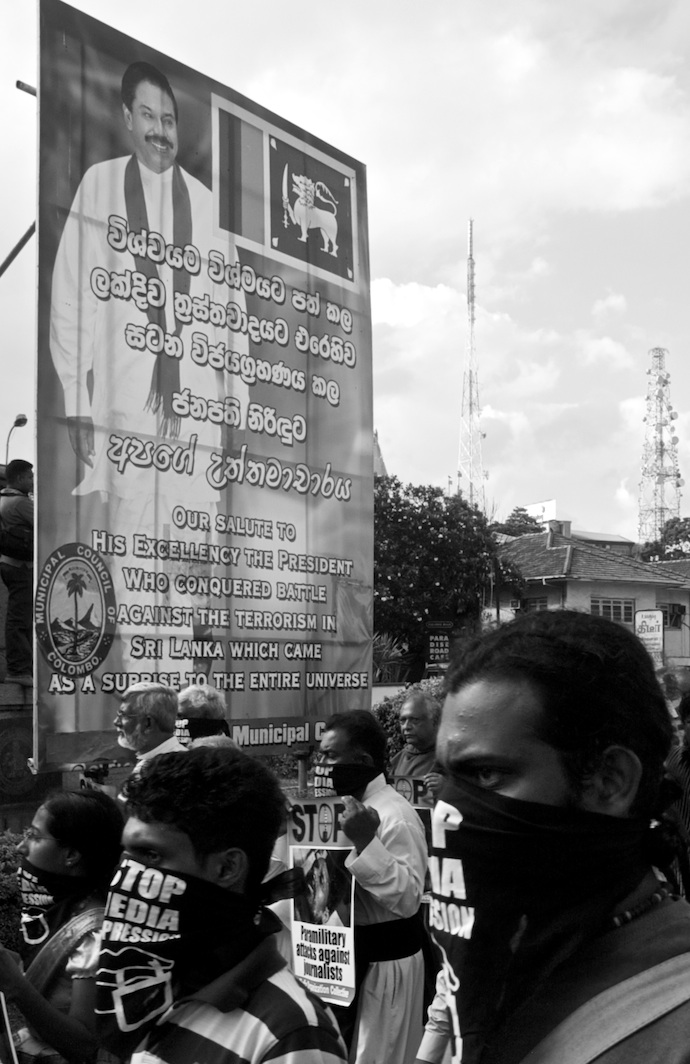
I’m keeping my ponytail for now. It’s become a matter of freedom of hair. 
 

MH102609.jpg

]]>
http://www.beta.frontlineclub.com/splitting_heads_and_hairs_sri_lankan_style/feed/ 1