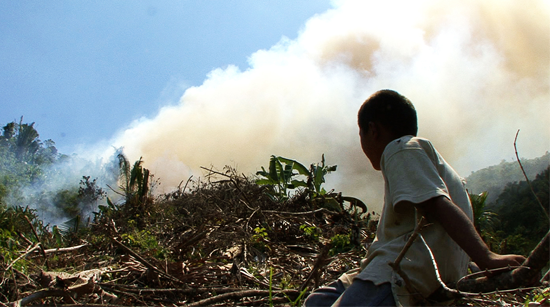
by Sam Bavin
Up In Smoke, from director Adam Wakeling, is screening on Mon 25th July at Frontline. The film follows revolutionary ecologist Mike Hands across the globe as he attempts scale back slash and burn agriculture – one of the biggest contributors to global warming and deforestation in the world today.
Wakeling’s first feature length offering effortlessly combines Hands’ scientific research with the trials of Honduran slash and burn farmers Faustino and Aladino – one of which has already adopted Hands’ pioneering technique ‘alley cropping’, the other waiting to be convinced.
Encompassing both the life and death struggle of impoverished farmers who can’t afford to risk adopting a new farming method and our driving need to change the fate of our planet’s endangered rainforests, the film plays out Hands’ struggle to get people to understand his revolutionary method and the pressures that prevent its implementation.
Up In Smoke’s dramatic, globetrotting path finally leads to the Copenhagen Climate Summit in 2009 where Hands’ attempts to draw international attention to a truly global issue reach their climax. Not to be missed, Wakeling’s film is a bold address of the complex moral questions about saving the planet for future generations as well as protecting the livelihoods of those living today.
More details about the screening are here. There will be a Q&A after the film with Director Adam Wakeling and Ecologist Mike Hands.
]]>It’s been several weeks of what — granted I’m a newbie here — seems like completely abnormal weather for the season. And with the lack of rain comes unbearable heat, the kind we normally only suffer through in April-May and that is now dragging on. In June, I should have a raincoat permanently in my bag; I haven’t even bought one yet this year.
The rainy season started early actually, with downpours in April that had you wading through thigh-high waters. The meteorology services warned that that could mean an early drought in July and recommended farmers use fast-growing rice varieties. I wonder how they’re doing… I got a chance to go to northwestern Cambodia last week (around Battambang and Siem Reap), where there are large plains of rice fields, and fortunately, it’s much wetter and greener there. Hopefully, only us city folks are suffering.
Children in rice paddies, early June 2009, somewhere in Kompong Thom province, Cambodia
A reason for all this? I’m no scientist. It could be just a freak year as have existed throughout Earth’s history. It could be a consequence of Cambodia’s anarchic use of timber ressources: one theory for the demise of Angkor is that it got so big and deforested so much for its economic development that it disturbed its own rain patterns and fizzled from a lack of water. It could be just one more anecdotal evidence of global climate change.
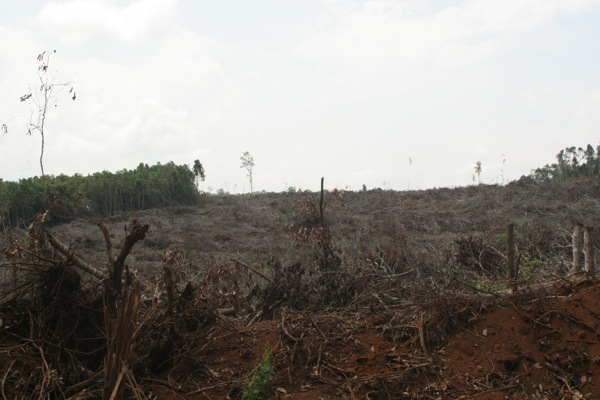
Deforestation looks like this! The Bolaven plateau, in southern Laos, here photographed on a motorcycle trip last March, is famous for its coffee. To make way for Vietnamese-owned, industrial plantations, the little-developed plateau is being slowly stripped of its primary forest.
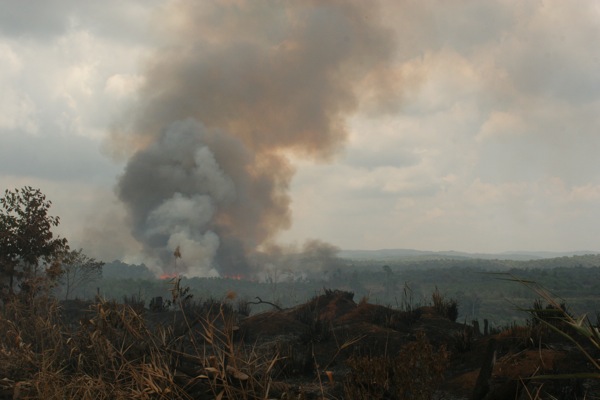
Slash-and-burn is the traditional method of culture on the Bolaven plateau. As traditional as it may be, it’s not very sustainable, and when it’s used on an industrial scale like here, it’s a vision of environmental apocalypse. Flames were coming right up to the road: an inferno of heat and smoke to drive through. And live in for all the indigenous population there.
If you’re not convinced, I recommend watching Home, a film granted a tad formulaic in its visuals (Yann Arthus-Bertrand sticks to his proven formula of graphic earth views from a helicopter… the same shot, albeit beautiful, repeated over and over for 90 minutes) but also a needed wake-up call. Tracing the history of earth, man and climate, it goes from science lesson to scary movie (images reminiscent of The Matrix, only it’s real Earth. Enough to bring tears to my eyes.) to inspiring conclusion. "It’s too late to be pessimistic." So go plant a tree and give us rain.
(Where was I? Let’s just say under a bit of a gag order for professional reasons. I am now in a new job, happily learning documentary film-making, and fully back to blogging. More coming soon from Cambodia…)
]]>