Download this episode
View in iTunes
Watch the event here.
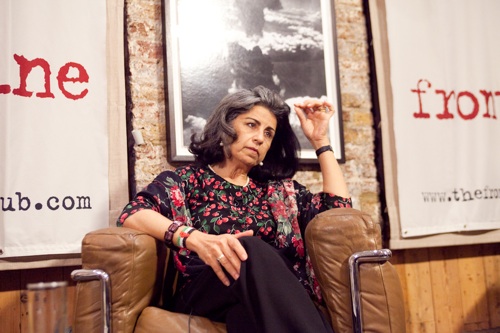
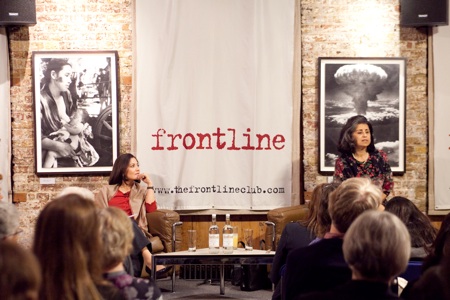
The revolution in Egypt was “a moment whose time had come” said author and commentator Ahdaf Soueif at the Frontline Club on Wednesday.
The author of the bestselling Map of Love told BBC News presenter Mishal Hussein how she had been in Jaipur in India at a literary festival on 25 January when the first protests took place but returned in time for the Friday “day of anger” on 28 January.
We were waiting, [in Embeba] basically loitering near the small mosque there and the preacher went on forever at the end. Before he finished a shout went up, it was one of the young men on the shoulders of another one or two and all in all it was about 15 people.
The sound was that mix between a shout or a chant or cheer that you must have heard if you were following the Egyptian revolution. It’s very rousing and makes your heart go with it. We started moving through the streets and the idea was that this core group goes through the neighbourhood and the particular chant that was used was one that was designed to attract people and make them come down from their homes and join the protest.
-thumb-350x233-2615.jpg)
Soueif described how groups had been “hanging about” in several locations in Cairo and elsewhere in the country, waiting for the right moment at the end of Friday prayers. The scale of the protests had surprised everyone, she said.
What had begun as a young people’s movement was joined by “everybody” said Soueif who added that “four generations” and all sectors of society took part, from those who worked for daily wages to those “who parked their Mercedes by the opera” to join protests. Rural and urban people were also represented by delegations sent by other cities and towns.
It was accepted that decisions would come out of Tahrir and so they were there to give it legitimacy and be part of the process of decision making.
In those 18 days in Tahrir square people formed circles on the ground and by evening time you would see 150 people sitting talking about politics and ideas and when a group agreed on something it would pass over to other groups and eventually there was a central point, what they called ‘Broadcasting House’ where there was a microphone with people in charge of it.
An idea, if it was good enough, would reach the microphone and would be broadcast and it would be either booed or cheered and hence rejected or adopted.
The decision to send in “the cavalry and the one camel that was supposed to defeat the revolution” was “completely strange” and made the people in the Square even more determined, said Soueif.
They resented how the regime claimed that they were not ready for democracy and that without the regime to “sit on our necks permanently, then you’re going to get a society so fanatic, so extreme, so violent, there will be rivers of blood that will wash across Europe”
The Egyptian people had been pleased to “find themselves” and “re-find their image and redefine it and declare it, said Soueif:
Suddenly we go from a progressive people who know what they want and are demanding dignity and freedom to being attacked with camels in best Orientalist Daniel Pipes fashion.
Fiction and film had allowed people to “exercise their muscles of empathy” towards the Egyptian people and that partly explained why there was so much support for them and their protest.
Another thing is that the spectacle of the revolution was done with such grace, it was so relaxed and it was so nice to look at and if you understood the jokes it was funny, yet it could raise its game and defend itself when they came at it with bullets or with stones.
On the night they attacked, the peripheries of the Square were fighting a battle, a very efficient and ferocious battle against the paramilitaries and in the heart of the Square there were stand up comics.
What you saw in Egypt was humanity in diverse forms at its best and that was very attractive, and not because it’s Egyptian, but because it’s a human spectacle. It’s humanity at its best in diverse forms.
Picture credit: Sophia Spring
If you want to hear more about the revolution in Egypt there is a fantastic opportunity to hear some of the key players at tonight’s event at the British Institution Protest, technology and the end of fear.
]]>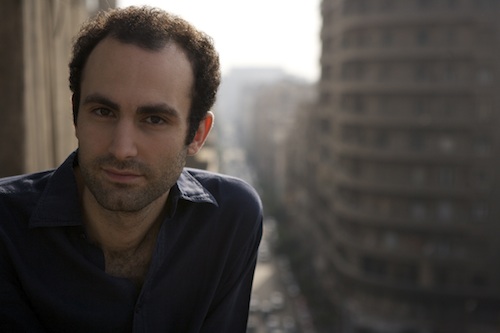
British-Egyptian actor and producer Khalid Abdalla flew from London to Egypt soon after it became clear that the protests of 25 January were gathering momentum and was there for the Friday ‘Day of anger’ on 28 January.
The Kite Runner star, whose other credits include Green Zone and In the Last Days of the City, was memorably interviewed from Tahrir Square by Channel 4 News’ Jon Snow while his father Hossam Abdalla was in the studio.
The co-founder of Zero Production, a film and documentary production house based in Cairo is currently setting up a non-profit media centre called Mossireen (Adamant) to support filmmakers and citizen journalists through the revolution.
Like everyone in Egypt I did not expect anything to happen like in Tunisia
Tunisia, it felt to me, had massively rejuvenated the narrative of popular protest in the Middle East, but having filmed almost every protest in Cairo over the last two years as part of an independent film called ‘In the Last Days of the City’, I thought Egypt’s watershed moment was a while away.
I discovered I was completely wrong at about 5pm, on a phone call to a Lebanese friend who asked me if I’d seen the images of Tahrir. It wasn’t until the following afternoon that I felt the full force of what was coming.
The images of Tahrir being dispersed and news of my friends continuing their protest through to 6am in Shubra was heartening. It was the shock of protests continuing the following day that made clear to me that this time was different. I’d seen plenty of demonstrations in Cairo and faced a minor arrest once. I’d never seen demonstrators take on the authorities no matter what, directly in the line of fire.
I booked my plane knowing that Friday would make or break the movement
From that moment I became a protester and an activist. Prior to that I was neither a blogger, nor a political activist, I had no Facebook account, and I dreaded the idea of Twitter. I had on the other hand been a filmmaker and actor working in the alternative scene in Cairo. Which is to say that the fight for a new Egypt, in my opinion, is not and was not just a political one.
It is a movement spearheaded by everyone who was willing to make a personal sacrifice of whatever kind to create their own version of Egypt, against and despite Mubarak’s regime as it was, and sadly, still remains.
Prior to 25 January I couldn’t bear the idea of new media in my life
Being ‘followed’, or sought as a ‘friend’ was not something I wanted because my privacy was important to me, not to mention the fact that even with a smartphone addiction, I suffered from a regular email backlog that made me guilty enough.
When the revolution came, it became clear that social media was a way for me to join the dots. It took a while because within hours of my arrival in Cairo, all forms of communication had been cut.
Social media helped manage the balance of access to truth
The need to bear witness and share opinions in a political context in which the voice of the majority is opposed by the lies of state media at worst, and the economic interests of commercial media at best, means free social media is essential.
Without the myriad of bloggers and individuals using Twitter, Facebook, and YouTube, fighting alongside high quality reporting made by respectable journalists across all forms of media, the media war in this revolution would have been lost.
I joined Twitter and Facebook because it became clear to me that they were the best tools I had as an individual to access and benefit from as many people as possible. It was also an opportunity to do my bit in trying to convince others to protest or at least let them share in my thoughts.
In my opinion, the power of new media has been both over and under-estimated in its importance to what happened in Egypt. Under-estimated as a source, over-estimated as a mobilising force.
The Facebook generation did not create what happened in Egypt
A second and third generation of political activists used social media as an important tool in a heavily weighted fight that was only counterbalanced when consensus on the street about an unjust regime became fearless. Tunisia broke the back. Social media helped the frenzy build in the run up to 25 January and fought as best it could against the state media afterwards.
But it was the spirit of generations of activists, demonstrators, workers and unions fighting as a shunned minority, under the most difficult circumstances, that meant a flame remained to light the fire when the time came. Mubarak’s idiocy, alongside that of his regime’s, was a big help too.
As we look forwards, the current situation puts into context both the power and limitations of new media. Despite the many gains won by the 25 January movement, the regime still stands, for the moment.
New media has temporarily lost the power of its audience
Consensus doesn’t exist anymore about anything – strategy, parties, the army, even torture. With the movement having lost the power of consensus, Facebook has lost its ability to draw primetime audiences, if you like. Meanwhile, the state remains in the hands of the regime and its interests (at home, and abroad), and most people are worrying about how to feed their families.
It is the army that hangs in the balance
From the very beginning they have had to choose between the millions that rose up, and the regime and its interests. Whenever they have chosen to be an obstacle to people’s demands for social justice, civil liberties and democracy, they have been met with an outcry that has forced them to give ground, and threatened to turn them into a target.
If they continue as they are, torturing, putting civilians on trial in military courts, banning protest and not bringing heads of the former regime to justice, I’m convinced that revolution stage two will come. An unstoppable force was unleashed on 25 January, in a just cause.
The present challenge is to organise ourselves
That is starting to happen. The losses our movement has incurred have been on account of our inability post-February 11th to act in unison, with clarity of purpose. Once we have achieved that, finishing this will be a matter of months, if not days.
]]>