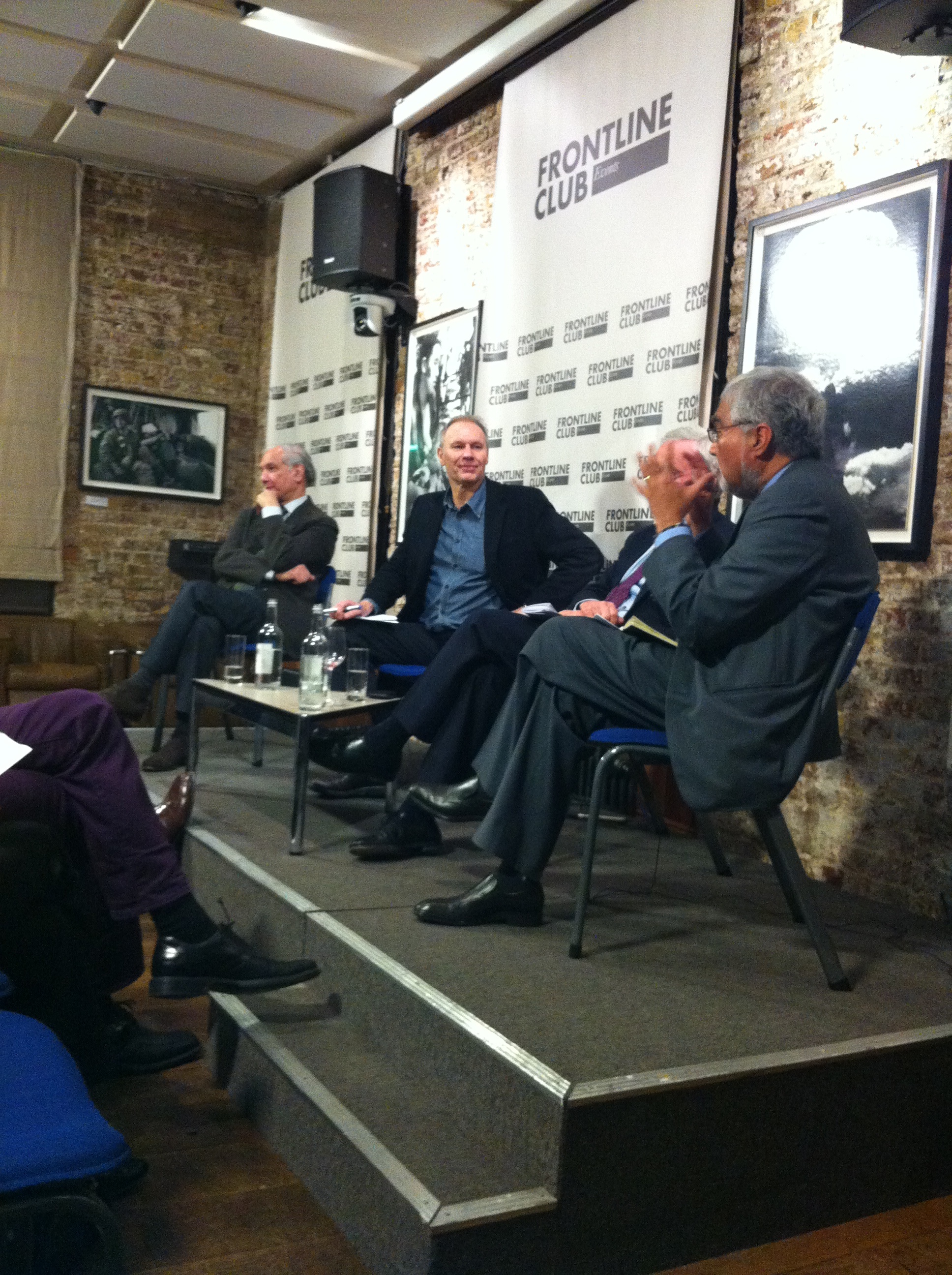
United Nations Special Envoy for Global Education and former Prime Minister Gordon Brown joined chair of the Global Partnership for Education and former Australian Prime Minister Julia Gillard and the Overseas Development Institute’s Executive Director Kevin Watkins at the Frontline Club on 25 January 2016 to discuss Funding for Syrian Child Refugees, on a panel moderated by foreign correspondent David Loyn.
Former PMs @JuliaGillard @OfficeGSBrown campaigning for 1 million school places for young Syrians #auspol @SBSNews pic.twitter.com/Jw2Fr97rgr
— Brett Mason (@BrettMasonNews) January 25, 2016
The panel discussed the aim of the new UN International Commission on Financing Global Education, chaired by Brown, to provide one million school places for Syrian refugee children in neighbouring countries, as well as the wider challenge of educating refugees globally. The Frontline event took place ten days ahead of a major UN-sponsored Syrian relief conference in London.
“At our current rates of change,” said Gillard, “it won’t be until 2111 that the world first sees a generation of sub-Saharan African girls who universally have a primary and lower secondary education. That means no one in this room will live to see it. It’s too long to wait.”
Since 2010, the enrolment of Syrian refugee children in regional schools has increased from 60,000 to 200,000, “largely down to the advocacy work that Gordon has done,” said Watkins.
“It has both demonstrated what is possible, and allows us to hang our heads in shame at what we’ve allowed to happen. It’s taken an entire primary school generation to stop us sitting on our hands,” Watkins continued.
Many of the school places found for the refugees are in “double shift” schools. Existing schools double the number of students that can learn by running the same programme twice in one day. Typically, the existing students join one shift and the refugee children join another.
“Four years ago, an average Syrian child had the same prospects of getting through primary school as a kid in a high-performing middle income country like Thailand,” said Watkins. “In the space of a single generation, they’ve gone to education indicators close to Sierra Leone and South Sudan. You can see these consequences on streets across the region – there’s an epidemic of child labour. They’re forced into labour markets and early marriage.”
Watkins quoted from Graça Machel’s 1996 report on children in conflict: “It’s difficult to imagine greater depths to which humanity can sink when you look at the violation of rights and freedoms of children in conflict.”
“Half the children who are out of school in the world are in conflict zones,” said Brown. “It’s now said it is safer to be a soldier in a conflict zone than to be a girl because of the risk of child marriage, child trafficking and child labour.”
Gillard emphasised that increasing education for refugee children isn’t just about more school places, but about raising the quality of the education the children receive.
While there are “121 million children of primary and lower secondary age out of school” in the world, she said, there are “250 million who get access to some schooling… but still can’t do most basic literacy and numeracy tasks.”
“Is there a great deal of point in having kids go and sit in this thing called a school if they aren’t learning? In many countries where we’re trying to improve education systems, there are nowhere near enough trained teachers. It requires us to think how… to deliver education in a systemised way. We’re thinking about some breakthrough models that can be scaled up and rolled out in some of the poorest places on earth.”
Brown said: “it is almost ridiculous to think that when you’re in desperate need, it’s only the public sector who’s going to contribute. We need foundations, we need charities, philanthropists, businesses to make their contribution to humanitarian aid.
“We need to find other governments who are prepared to take this up. Both Julia and I tried to make our governments pro-education in the global development sphere, but we need more governments to take up the cause, and we need to find philanthropists and foundations. People are prepared to give to education in their own country, but when it comes to global education – very little.”
Intimate event at @frontlineclub w @JuliaGillardGPE, Gordon Brown & @kwatkinsodi on #education funding for #refugees pic.twitter.com/sNzCAveOXJ
— Sophie Gaston (@sophgaston) January 25, 2016
Audience member Dr Mairead Collins from Christian Aid raised concerns of families in Lebanon that the late timetables in double shift schools prevented them allowing their daughters to go to school in the dark, for safety reasons. How does the commission address these obstacles, she asked?
“Safe transport to schools is a well-understood problem,” said Brown, and money will be directed towards it. “Safe schools are a very important concept now,” he said. “We have assumed schools are safe havens without doing anything about it. But you’ve got to make the schools safe.”
Gillard agreed, saying “overwhelmingly, funds for education come from domestic governments, and for many domestic governments, until they’ve got robust taxation systems you’re always going to be running behind the curve.”
Augustus Della-Porta, trustee of Educate a Child International, said he has an eight-year-old niece in the besieged town of Yarmouk in Syria who has never been to school. What about education for the children still in Syria?
Chris Gunness, spokesman for UN Relief and Works Agency (UNRWA), said children in Palestine often tell him that they hear education offers hope – but there is no political situation in which this hope can be realised. “In Gaza, there’s 44% unemployment”, Gunness said, “and in Lebanon, Palestinians are banned from more than 100 professions. What does it mean to have education in the absence of a political process?”, he asked.
“Education isn’t the solution for every problem,” said Gillard, but “it’s hard to imagine a problem that isn’t advantaged by the benefits that education brings.”
“If people are educated, there is more capacity to negotiate differences and find solutions to conflict, to look for peace and stability, and to build institutional government systems.”
Brown said there are “new proposals for economic zones in these countries so that people denied the chance to work as refugees are finally given a chance to work within economic zones. The World Bank is now involved in Jordan and Lebanon, and I think will be involved in Turkey… [These proposals] will prevent a lot of child labour. Because [at present] children become the only income earners.”
“Despite the failure of the political process, we cannot leave these children without an education,” Brown said.
“We cannot allow them to become not just a lost generation, but a discontented and dispossessed generation, with all the implications that 200 million young people growing up in the Middle East have for the security of that region and the rest of the world.”
]]>On a panel moderated by David Loyn, Gordon Brown, Julia Gillard and Kevin Watkins discussed funding education for Syrian child refugees.


A panel discussion focused on The Fight Against Daesh made for a timely first First Wednesday of the year at the Frontline Club. The packed event on 6 January was chaired by David Loyn, foreign correspondent for the BBC for over 30 years. The speakers included Richard Spencer, Middle East editor of The Daily and Sunday Telegraph; Shiraz Maher, research fellow at the International Centre for the Study of Radicalisation at King’s College; and Robin Yassin-Kassab, journalist and author of The Road From Damascus and most recently co-author with Leila al-Shami of Burning Country: Syrians in Revolution and War. Completing the panel was Azadeh Moaveni, lecturer in journalism at Kingston University and former Middle East correspondent for TIME magazine, and author of Lipstick Jihad and Honeymoon in Tehran.
Fantastic debate @frontlineclub last night about what’s happening with Isis/Daesh…Always better live than on TV! pic.twitter.com/jBMWx6JbmI
— The CollectiveLondon (@Collective_Lon) January 7, 2016
From the outset, the panel approached discussions on Daesh with a thorough evaluation of the developments in Syria and surrounding region. The discussion took a turn away from the media hype surrounding Daesh towards the geo-political realities and factions at play. From Islamist and moderate groups within Syria to Saudi Arabia, Iran, the Western allies and Turkey, few stones were left unturned.
Yassin-Kassab and Spencer affirmed the widely-accepted notion that Daesh was created by the vacuum left after the destruction of Iraq, and directly enabled by Bashar al-Assad’s timely decision to release prominent jihadis from prison. Yassin-Kassab summarised the effects: “He [Assad] needed to terrify the West and he has been very successful at that. Here we are tonight discussing what to do about the enemy Daesh and not what to do about the man who has killed 95% of the people in Syria over the last 5 years: Bashar al-Assad.”
Jabhat al-Nusra, the Al-Qaeda affiliate operating in Syria, was discussed at some length. The panelists agreed that, unlike Daesh, Jabhat al-Nusra’s more tolerant and classical grassroots approach would remain deeply embedded in Syrian society in the longterm. It was also agreed that Al-Qaeda more generally has had to reassess its tactical boundaries in order to distance itself from the relentless barbarianism of Daesh.
Maher said: “Al-Qaeda over the last 15 years has been on an incredibly steep learning curve. They have learnt far more about warfare, insurgency and human terrains than we have and that’s why, to put it very bluntly, they are winning.”
Yassin-Kassab used Russia’s ongoing bombardment in Syria – supposedly targeting Daesh – to argue that outside players are worsening the situation. He said: “80% of Russian strikes have fallen on the people that drove IS out of their areas.”
Iran was also scrutinised for its relentless military support of Assad. However, when asked by Loyn if there were circumstances under which Iran would “dump” its long term alley Assad, Moaveni said: “Absolutely, I think Iran would dump Assad in a moment if it comes to that… For them, it’s important to keep some key supply routes open to some political faction that is friendly to Tehran.”
When Spencer disagreed with Moaveni – suggesting instead that Iran was more dependent on Assad than Russia was – Moaveni pointed to the double standards of Western relations with Saudi and Iran. She said:
“It’s only in the last year or two that things are shifting a bit, that you have open discussions in editorial pages about the reliability of Saudi as an ally and if it makes sense to keep Iran permanently at a distance.”
The recent decision by the UK government to bomb Syria decidedly split the panel. Maher supported the notion and warned of the danger of outsourcing the UK’s security program in not acting militarily. He said: “Daesh is a counterterrorism problem as far as we are concerned; Syria is a much bigger problem which we are not going to fix.”

L-r: Azadeh Moaveni, Shiraz Maher, David Loyn, Robin Yassin-Kassab and Richard Spencer
Moaveni, Spencer and Yassin-Kassab expressed their skepticism of how bombing Daesh could be effective in the long term. Spencer said: “Bombing IS without a strategy for the whole Middle East is a disaster… If the Western allies – Britain, France, America – don’t stick together and form common policies then western policy will fall apart.”
Yassin-Kassab criticised the dismissive approach the West maintains towards the Southern Front, the Syrian opposition unaffiliated with Islamic groups. He said: “They [Southern Front] are dependent on aid from a military operations room in Jordan, and the West, the Americans, keep telling the Jordanians and Saudis not to allow them the anti-tank and particularly anti-aircraft weapons that they need now.”
One audience member asked the panel what they predicted for the region in the future. The panelists agreed that Assad would remain in some shape or form, but Moaveni predicted a “vast kingdom emerging” in the Persian Gulf, united under a Sunni leadership. Maher, on the other hand, saw a “federalised system of government” in the Levant. Yassin-Kassab preferred not to speculate, saying: “you can’t tell what direction we are going as we are going into so many directions at once.”
]]>On Wednesday 18 November, Gulwali Passarlay enlightened a packed audience at the Frontline Club into his journey as an unaccompanied child refugee from Afghanistan to the United Kingdom. Joined by former Afghanistan correspondent for the BBC David Loyn, and Nadene Ghouri who co-authored his book The Lightless Sky, Passarlay was keen to address the complexities of the refugee crisis from both a personal and political perspective.
“My mother sent me away- she saved me but she lost me too”- @GulwaliP who left Afghanistan aged 12, running for his life (@frontlineclub)
— Maeve McClenaghan (@MaeveMCC) November 17, 2015
Loyn began the discussion by offering context on the current refugee crisis. “There are many Gulwalis in the world. Almost 60 million people are displaced, between 10 and 15 million people a year move from their homes and Afghanistan is the second largest country people flee from – 800,000 people are internally displaced.”
Passarlay began his journey when his mother paid smugglers to help him escape from Afghanistan after his father and grandfather were shot by US soldiers. “For a mother to decide to send her 12 and 13 year-old children away is extraordinary. I am sure she did not understand the implications and the dangers that I would face along the way. Neither did I,” said Passarlay. “Throughout my journey, my biggest issue and fear was uncertainty.”
Loyn asked Passarlay: “Why do you think your mother trusted your life with smugglers? And what was in it for the smugglers to keep you alive?”
“Smugglers need to maintain their reputation. The system of smuggling is more effective and efficient than the government! She was faced with a difficult circumstance, and through family friends she found a smuggler that was her only hope in giving her sons a better life,” answered Passarlay.
During the harrowing journey Passarlay was separated from his brother, which he referred to as a significantly traumatic experience. “My mother said to not let go of each other, but in Peshawar we were so quickly separated. For the rest of my journey, I had three things to do: I wanted to look for my brother, I needed to get across and I desperately missed home.”
Even arriving in Italy after a life-threatening boat trip from Greece, Passarlay was determined to get to England and find his sibling. “I am forever grateful to the people of Italy who genuinely wanted to keep me safe and welcomed and wanted to help me. But I had to find my brother.”
Responding to Loyn‘s question on why many refugees and migrants have their sights set on the United Kingdom as their final destination, Passarlay said: “I would have loved to have settled in Italy, but the language barrier was far too difficult. Whenever I talk to people from the right-wing, I tell them it’s a great thing for people to want to come to seek refuge in their country. Why? England embodies ideals of hope and opportunity; English is an international language and holds a historical and cultural connection to many countries thanks to the British Empire. But some also believe that Britain was involved in the conflict that exists in their country, such as Afghanistan, so migrants feel Britain has a moral responsibility to take them in.”
Passarlay concluded that he eventually managed to reach England and survive his journey thanks to fellow refugees, who have become his “brothers.”
“As the youngest, I needed help more than anyone. I tried not to show my innocent side, so I acted tough and put on a brave face – but this was not the case. The thousands of people I met were all literally in the same boat as me. We needed each other’s companionship and partnership.”
Loyn then directed the discussion towards Passarlay‘s difficult journey into Greece by boat, when his vessel almost didn’t make it. “Hearing that 2,000 migrants sunk earlier this year kept me awake at night. I feel their pain. I know exactly what they are going through. We were stuck [in the overcrowded boat] for 49 hours.”
Speaking on her experience of writing The Lightless Sky with Passarlay, Ghouri said: “It was a privilege to work with him. The story of unaccompanied refugee children is one I have always wanted to tell, and Gulwali is amazing for deciding to give a voice to many others who have been in his situation.”
@frontlineclub thank you for giving us the opportunity to have this evening' event for #TheLightlessSky it was great pic.twitter.com/8iJKOtqKSZ
— Gulwali Passarlay (@GulwaliP) November 18, 2015
In response to a question from Loyn on his advice for the Home Office, Passarlay commented: “What we are doing right now is not enough.”
An audience member from the Office of the Children’s Commissioner for England commended Passarlay for his courage in reporting his story, and said that his book should be used by the Home Office as a guide into how to better process unaccompanied child refugees. The audience member said: “I believe that things have gotten worse since you made your journey Gulwali. My organisation has churned numbers and figures to notice that since December 2014 to March 2015, over half of unaccompanied minors have their age disputed… Local authorities need to rise to the challenge.”
Ghouri agreed that the response to the refugee crisis by both the government and the media had been far from acceptable. “The British press do not report the full picture on the migrant crisis, so people in this country do not understand what is happening. There are only 3,000 people in Calais, but the press makes it feel like there are much more.”
More information about The Lightless Sky is available here.
]]>On 25 February, a panel of experts convened at the Frontline Club for a discussion on the war in Afghanistan and its ongoing legacy. Chaired by BBC Afghanistan correspondent, David Loyn, the debate spanned the period from 11 September 2001 to the present day.

L-R: Mike Martin, Jawed Nader, David Loyn, Major General Jonathan Shaw and Jack Fairweather
Jawed Nader, director of the British and Irish Agencies Afghanistan Group (BAAG) who has worked with both the Afghan Government and Afghan civil society, began by commenting on his experience of foreign military intervention post 9/11. He said, “At the beginning we didn’t know what to make of it. We were upset that all these people were being killed, but then we also thought maybe Afghanistan is becoming important for the international community.”
Loyn asked Nader whether he thought war in Afghanistan was unavoidable. He responded, “I think it was inevitable, and in some ways we really wanted that war to take place. Afghanistan was in war for many years before that and we thought there would be no end to it, and then now a superpower was coming and we thought it would be a decisive war.”
On the subject of public support of the intervention, Loyn provided the audience with an American poll figure which conveyed the staggering shift in opinion. “At the time, 93% [of Americans] were in favour of the action, and last month for the first time Gallup recorded negative support for the war in Afghanistan.”
Jack Fairweather, former Baghdad and Gulf correspondent for the Daily Telegraph and currently fellow of the Centre for Middle Eastern Studies at Harvard University, commented on US strategy in the region. “They [the US] took a very stripped down view of what should be done. ‘Light footprint’ was the sort of catchphrase that was doing the rounds.”
The issue of aid was also discussed in depth, as multiple aid agencies flooded Afghanistan following the outbreak of war. Nader commented that “the aid agencies wanted to do good,” but also recognised that “there was an issue that the Taliban or the ordinary people will not be able to identify who were military personnel aids and who were aid agencies… The other issue was a lot of wastage of aid.”
Major General Jonathan Shaw, recently retired from the British Army after 32 years commanding operations in Iraq, Afghanistan and the Balkans, questioned “did we understand Afghanistan? The real problem is that we didn’t…the ahistorical nature of our approach was just remarkable.”
“I think we went into Afghanistan and Iraq in denial of the lessons of history, launching ourselves on an American crusade.”
Helmand was discussed in great detail, and was described as a “historical accident” by Lyon. “What the British decided to do was put in huge amounts of soldiers and very little aid and wondered why it upset the locals,” added Shaw.
“Prediction about Afghanistan is very difficult, especially if it’s about the future”. Jawed Nader at @frontlineclub
— Chris King (@DocChrisKing) February 25, 2015
Former British Army Office and pushtu-speaker Mike Martin, who served and undertook extensive research in Helmand during the war, commented on the damage inflicted in the province by UK and US military forces.
“Helmand seems to be a microcosm or a slightly extreme version of what happened elsewhere in Afghanistan…. We completely misunderstood what was going on… In Helmand what you saw was a civil war, it had nothing to do with the Taliban or the government. All of the Helmandis understood that we understood the conflict as a dichotomous good/bad government/Taliban…
“We made it worse: rather than clamping down on the violence we actually made it more violent.”
Shaw spoke on the relationship between the armed forces and Whitehall. “The problem is connecting the military instrument to the political objectives. The military were the wrong tool for the job… The military should have been support of the political plan.”
Nader then moved the discussion onto the West’s tendency to misinterpret the needs of Afghanistan.
“We compare Afghanistan with high standards, of European standards I believe, whereas Afghanistan should be compared with its regional countries,” he said.
Nader closed the debate with a hopeful view of the future of Afghanistan.”Today Afghanistan has changed in three main ways. One, Afghanistan is a better place to live, Second, Afghanistan is more diverse…And third, Afghanistan is more self aware, more critical.
“All of these positive changes would not have happened had you not gone to Afghanistan to topple a very draconian regime, the Taliban.”
Listen and watch back below:
url=https%3A//api.soundcloud.com/tracks/193024169&color=ff5500&auto_play=false&hide_related=false&show_comments=true&show_user=true&show_reposts=false” width=”100%” height=”166″ frameborder=”no” scrolling=”no”>
]]>By Nicky Armstrong
Last night’s event at the Frontline Club saw a heated debate between the expert panel and the audience on the UN’s presence in Darfur. Chaired by Patrick Smith, editor of Africa Confidential, the discussion bought up many of the tangled complexities surrounding the conflict in Darfur. With the recent expulsion of the former UN head in Sudan and tensions rising in the Nuba mountains the UN has come under scrutiny, charged with failing the people of Darfur.
The discussion opened with Sir John Holmes, a former British diplomat and UK ambassador for France and Portugal. He claimed the UN had been given an impossible task dealing with a political system that was obstructing the UN, recounting the situation when he first arrived in Sudan:
“There were still regular attacks on villages by the Janjaweed, there was tribal fighting of different kinds, occasional rebel attacks form these forces and a very unstable security situation…the overall security situation was stuck, it wasn’t really moving, it was stagnant, there was no real progress and frankly it stayed that way throughout my time and its pretty much the same way now.”
Dr. Mukesh Kapila CBE went on to discuss the failures of not only the UN but of a collective failure on behalf of the international community:
“My journey did not start in 2003, it began exactly 10 years before in Rwanda…and there I saw for myself what happens when an international response system basically implodes because there are contradictions…if there is a failure it is a collective failure…this is all extremely relevant to why we failed in Darfur…. all the lessons of enquiry on Rwanda which were big enquiries of the system and produced a big report, all of [these] were forgotten.”
The deafening silence from the UN and lack of response to memos was described as an ‘amnesia’ from the very top as they remained seized up on the matter of Darfur.
Dr Ahmed Al-Shahi offered his opinion on why the UN has failed. When asked who was the principal author by an audience member, Al-Shahi went on to describe a number of factors, but it was apparent that a lot of the problems lay with the political system under President Omar Al-Bashir and his regime in Khartoum.
China’s involvement in Darfur and why the UN is not reacting as it has recently in Libya were just some of the issues raised. It seems the issue of Darfur shall remain complex, with the situation not reflecting well on the UN.
Mukesh made a poignant closing statement:
“The UN should honestly admit its failure and its paralysis, for the reasons we have been debating. But it’s a mother bearing child relationship, you can’t make yourself redundant, what it should not do is be false prophet, launch misleading missions, which distract and bring false hope…I think we should be honest, that’s what I am saying and I think the UN is bound to fail…we are talking about the 21st century with twitter and globalisation and we are dealing with an instrument that I think is a relic to the Second World War, and conflict after conflict it has proven that it can’t succeed.”
Click Here to read the Amnesty International 2011 Sudan report.
]]>
Join us at the Frontline Club to discuss the actions of the UN and whether they are still failing Darfur.
]]>https://soundcloud.com/frontlineclub/nine-years-on-is-the-un-still
Since the start of the 2003 conflict in Darfur, questions have been raised about the role played by the United Nations and the viability of its mandate.
With the recent expulsion from Chad of the former UN head in Sudan during the original outbreak of violence in Darfur, and the crisis edging towards its first decade, is there any more that the UN can do? Or has the situation reached a level that is beyond resolution?
After the UN came under fire for not having done enough to help civilians during recent attacks, we will be discussing how the enduring situation in Darfur reflects on the UN.
Join us at the Frontline Club to discuss the actions of the UN and whether they are still failing Darfur. What could be done to reduce the possibility of future failures?
Chaired by Patrick Smith, editor of Africa Confidential.
With:
Dr. Mukesh Kapila CBE, former Under Secretary General, National Society and Knowledge Development for the International Federation of Red Cross and Red Crescent Societies based in Geneva. He has worked extensively in the Sudan where he was previously UN Humanitarian Coordinator and UNDP Resident Representative. He is Special Representative for The Aegis Trust.
Sir John Holmes, a British diplomat for over 30 years, serving as the UK’s Ambassador to France and Portugal, and as Overseas Adviser to both Tony Blair and John Major when Prime Minister. He was Under-Secretary-General for Humanitarian Affairs and Emergency Relief Coordinator at the United Nations in New York from 2007-2010, and visited Sudan five times during that period. He is now the Director of The Ditchley Foundation.
Dr Ahmed Al-Shahi, Research Fellow and Co-founder of the Sudanese Programme at St Antony’s College, Oxford University.
In association with the Aegis Trust.
Image Credit: Babasteve / Flickr
]]>The acclaimed book chronicles the work of the Frontline news agency, founded by journalists Rory Peck, Peter Jouvenal, Vaughan Smith and Nicholas Della Casa.
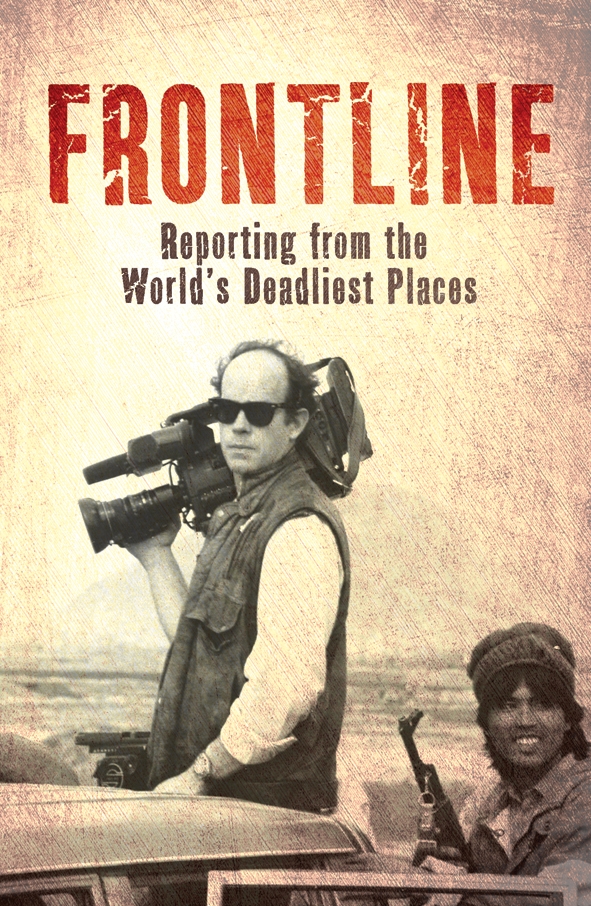 First published in 2005, the latest edition features a foreword from BBC world affairs editor John Simpson, who writes that the book is “the history of a moment in television news, which was brief enough, yet so bright it will stay in the minds of everyone who experienced it, like staring into a torch-beam on a dark night.”
Frontline Television’s reporters were motivated to document the true horrors of war and courageously went where other news organisations feared to tread. Risking everything to show the truth, they travelled the world’s most dangerous places in a quest to live life to the full, a quest some paid for with their lives. (Two of FTV’s founders, Peck and Della Casa, are now dead: killed in action.)
Between them, this colourful collection of adventurers and ex-army officers captured some of the key images at the end of the Cold War, and the fractured, fissile world which emerged.
The way they lived and died was an anachronism; they were eccentrics who might have been happier fighting wars in the British Empire a century before. Instead, they brought back pictures from the worst war zones the late twentieth century had to offer. And it suited them.
For the men of Frontline, how things were done was as important as what was done. All four of the founders, and those they recruited, shared the same panache, wit, and disdain for authority, planning the next trip to the Hindu Kush in the bar of the Ritz.
Their story reads like a latter-day Rudyard Kipling adventure. But while their lives may have been lived as if they were still playing the Great Game, they also cared passionately about their work and the truth it conveyed.
Part Bang Bang Club, part Flashman, Frontline is the gripping story of lives lived to the full in some of the worst places on earth.
The book can be purchased by visiting this link.
***************
Praise for Frontline:
“Loyn does a terrific job. His methodical, journalistic approach is perfect for grounding out a yarn that nobody would dare make up” Time Out – Book of the Week
“A gripping story, splashed with devil-may-care colour and scarcely credible tales of derring-do” The Guardian
“Girls, booze, physical hardship and flying bullets … Loyn keeps his narrative rattling along nicely” Daily Mail
“Barnstorming non-fiction. Every page is full of the kind of chutzpah, grit and valour that makes your own nine-to-five seem gut-wrenchingly futile.” Arena
“Hugely entertaining … the nearest thing to a Victorian adventure romp of empire against a background of fine marijuana, ‘Hotel California’, and the wheep and chirrup of satellite technology” Literary review
]]>Tonight we discuss the roots of turmoil in Pakistan at the Frontline Club. As usual we start at 7pm GMT/11am PST. If you can’t make it to the Club in person, please join us online on the Frontline Club live channel, on this blog or on the Club events page. Feel free to embed the discussion on your own blog too, leave a comment or email me if you would like some help doing that.
The military offensive against the Taliban near its border with Afghanistan has been viewed as critical for Pakistan’s credibility as the US steps up demands for increased effort in fighting terrorism.
In a new book Making Sense of Pakistan Dr Farzana Shaikh, associate fellow at Chatham House, claims that ultimately Pakistan’s ability to respond to demands that it “do more” to resist terrorism lies in its response to deeper issues about its identity and its relationship with Islam.
Join us at the Frontline to discuss Dr Farzana Shaikh’s claim that uncertainty about Pakistan’s identity lies at the heart of its social and political decline and that its leaders will only be able to combat terrorism once the country’s vexed relationship with Islam is resolved link
Taking part will be; David Loyn, the BBC’s Developing World Correspondent, Dr Farzana Shaikh, associate fellow, Asia Programme, Chatham House, Bronwen Maddox, chief foreign commentator for The Times, Victoria Schofield has been reporting as a writer and broadcaster on Pakistan and South Asia for thirty years and Owen Bennett-Jones, BBC World Service presenter of Newshour and The Interview. He was also the BBC’s correspondent in Pakistan for three years till 2001.
]]>2009 promises to be a crucial year for the war in Afghanistan. While the latest independent report indicates that the Taliban have significantly increased their political and military control to around 75% of the country, and shows that 2008 has been the deadliest for US troops since the 2001 invasion, President-elect Obama has pledged to make the fight against the Taliban and Al-Qaeda his top priority. He’ll be sending more troops to the region, has proposed an additional $1 billion in non-military assistance each year, and seems committed to preventing corruption.
But will these additional resources and commitment from the US government be enough to reverse this war and beat the Taliban? Is it realistic to think that the corruption so endemic to the country, can ever be significantly reduced or wiped out? How important are Pakistani policies and their alliances to British and US governments to this war? And given that more than two-thirds of Britons think that UK troops should leave Afghanistan within a year, will lack of popular support for this war impact on British government policy out there?
James Appathurai is a spokesperson for NATO
Col Stuart Tootal was a Commander of 3 Para Battle Group in Afghanistan before resigning from the army at the end of 2007 following his promotion to Colonel. He is now pursuing a career in corporate banking security and is also a media defence and security commentator. Col Tootal was selected to command the 3rd Battalion of the Parachute Regiment (3 PARA) in 2005. This included commanding the first UK Battle Group of 1200 soldiers to be sent to Helmand Province in Southern Afghanistan in 2006, for which he was awarded the Distinguished Service Order. On returning to the UK, he set up the 3 PARA Afghan Trust charity.
Christina Lamb has been a foreign correspondent for almost 20 years, living in Pakistan, Brazil and South Africa first for the Financial Times then the Sunday Times. Christina is a frequent commentator on Afghanistan and the war on terror on radio and television in Britain, Canada, Austaalia and the US and has given talks to schools, MPs, NATO and the military, and taught literary non-fiction at the Arvon Foundation. Her work inspired the book Zahir of multi-million selling author Paulo Coelho.
Alastair Leithead reported from Afghanistan as the BBC’s Kabul correspondent from 2006 to 2008, and is one of very few journalists to have remained in the region throughout the recent hostilities. He is soon to take up his new post as BBC News’ South Asia correspondent, based in Bangkok. Alastair is now working on his first book, provisionally entitled Three Bloody Summers, a first-hand account of recent events in Helmand province.
David Loyn is the BBC’s International Development Correspondent with extensive experience in Afghanistan. His first book, Frontline was shortlisted for the Orwell Prize in 2006. Butcher and Bolt: Two Hundred Years of Foreign Engagement in Afghanistan is a history of foreign engagement in Afghanistan beginning with the first British mission 200 years ago.
]]>