
On Friday 5 June 2015, the News Impact Summit, a free of charge digital journalism conference will take place in the Sheikh Zayed Theatre on the LSE campus in London. This summit will centre on the theme – The Social Impact of Digital Storytelling – and shed a light on how digital age journalism plays a role in resulting the social impact, whether it is during the general election, natural disasters or humanitarian conflicts.
The Frontline Club has joined the international consortium of the organisers led by the European Journalism Centre, the News Lab at Google, LSE’s Polis think-tank. Participants will be offered free lunch and drinks during this event as well as a networking opportunity with the guests from the leading international and UK media outlets.
Speakers:
– George Arnett, data journalist, The Guardian
– Charlie Beckett, director, Polis at LSE
– Fergus Bell, head of newsroom partnerships and innovation, SAM
– Wendy Betts, director of eyeWitness, The International Bar Association
– John Burn-Murdoch, data journalist, The Financial Times
– Matt Cooke, European lead, News Lab at Google
– Evangeline de Bourgoing, programme manager, Global Editors Network
– Matthew Eltringham, editor, Journalism BBC Academy
– Miranda Green, freelance journalist
– Steve Herrmann, editor, BBC News Online
– Rohan Jayasekara, technology hub adviser, Internews
– Christoph Koettl, adviser on technology and human Rights, Amnesty International
– Megan Lucero, data journalism editor, The Times and Sunday Times
– Jason Mills, head of digital, ITV News
– Paul Myers, researcher, BBC
– Gavin Rees, director, Dart Centre Europe
– Allison Rockey, engagement editor, Vox.com
– Wilfried Ruetten, director, European Journalism Centre
– Frédérik Ruys, data journalist for ‘Netherlands from Above’, VPRO
– George Sargent, producer, Thomson Reuters
– Rina Tsubaki, European Journalism Centre
– Julia Ziemer, Polis at LSE
Partners:
Frontline Club
GEN
Amnesty International
Dart Centre Europe
eyeWitness
Internews
Reuters Institute for the Study of Journalism
SAM
Foreign Press Association
For further details see here or contact the organisers via info@newsimpact.io
Hashtag: #nisldn
Website: http://newsimpact.io


In Iran it is reported that the government are building a national intranet that adheres to Islamic values and is isolated from the World Wide Web, in the UK the government is proposing a communications bill that will see an increase in monitoring of emails and social media by the police and intelligence agencies'.
With companies' interests lying in the commercial gains of data and governments' in the ability to monitor populations, join us as we ask to whose hands internet governance should be entrusted.
]]>
In Iran it is reported that the government are building a national intranet that adheres to Islamic values and is isolated from the World Wide Web, in the UK the government is proposing a communications bill that will see an increase in monitoring of emails and social media by the police and intelligence agencies’.
Authoritarian states have long seen the freedom of the internet as a threat and have tried to restrict it, but recent develops suggest a move towards increased tracking and control of what the public do and see online across the world.
With companies’ interests lying in the commercial gains of data and governments’ in the ability to monitor populations, join us as we ask to whose hands internet governance should be entrusted.
Chaired by Kirsty Hughes, the Chief Executive of Index on Censorship – an international freedom of expression non-governmental organisation. Previously she has worked at Chatham House, IPPR, the European Commission and most recently she was head of Global Public Policy and Advocacy at Oxfam and Senior Associate Fellow at the Centre for International Studies, University of Oxford. Twitter: @IndexCensorship
With:
Birgitta Jónsdóttir MP, a member of the Icelandic Parliament for The Movement and chairperson of the International Modern Media Institution. She has worked as a volunteer for various organisations including WikiLeaks, Saving Iceland and Friends of Tibet in Iceland. Prior to becoming an MP she has been an activist, writer, first icelandic woman to work as web developer and publisher. Twitter: @birgittaj
Jacob Appelbaum, an accomplished photographer, software hacker and world traveler. He works as a developer for The Tor Project and trains interested parties globally on how to effectively use and contribute to the Tor network. He is a founding member of the hacklab Noisebridge in San Francisco where he indulges his interests in magnetics, cryptography and consensus based governance. He was a driving force in the team behind the creation of the Cold Boot Attacks; winning both the Pwnie for Most Innovative Research award and the Usenix Security best student paper award in 2008. Additionally, he was part of the MD5 Collisions Inc. team that created a rogue CA certificate by using a cluster of 200 PlayStations funded by the Swiss taxpayers. The “MD5 considered harmful today” research was awarded the best paper award at CRYPTO 2009. Twitter: @ioerror
Karl Kathuria, an independent media technology consultant, specialising in Internet distribution and streaming media. Prior to this, he spent over 10 years at the BBC, managing the distribution of World Service Internet content to a global audience. In this role, he faced the challenge of delivering news content into countries where censorship is prevalent. As a result of these efforts, he was invited to the Munk School of Global Affairs in Toronto to work with the Citizen Lab team in 2011 on an independent research project. During this period, he studied the effects of the BBC’s content distribution strategies in China and Iran, and made recommendations for the propagation of circumvention software into these markets. His current projects include working with Psiphon Inc., the Canadian provider of network software aimed at preserving security, privacy, and access to content that may otherwise be blocked.
Dr Ian Brown, associate Director at the Cyber Security Centre and Senior Research Fellow at Oxford Internet Institute (OII). His work focuses on public policy issues around information and the Internet, particularly privacy, copyright and e-democracy. He also works in the more technical fields of information security, networking and healthcare informatics. He has consulted for the US Department of Homeland Security, JP Morgan, Credit Suisse, Allianz, McAfee, BT, the BBC, the European Commission, the Cabinet Office, Ofcom, the National Audit Office and the Information Commissioner’s Office.
]]> The ‘post-Leveson’ question becomes ever more pressing, as identified at yesterday’s University of Westminster conference, attended by a range of international media researchers, as well as regulation and legal specialists.
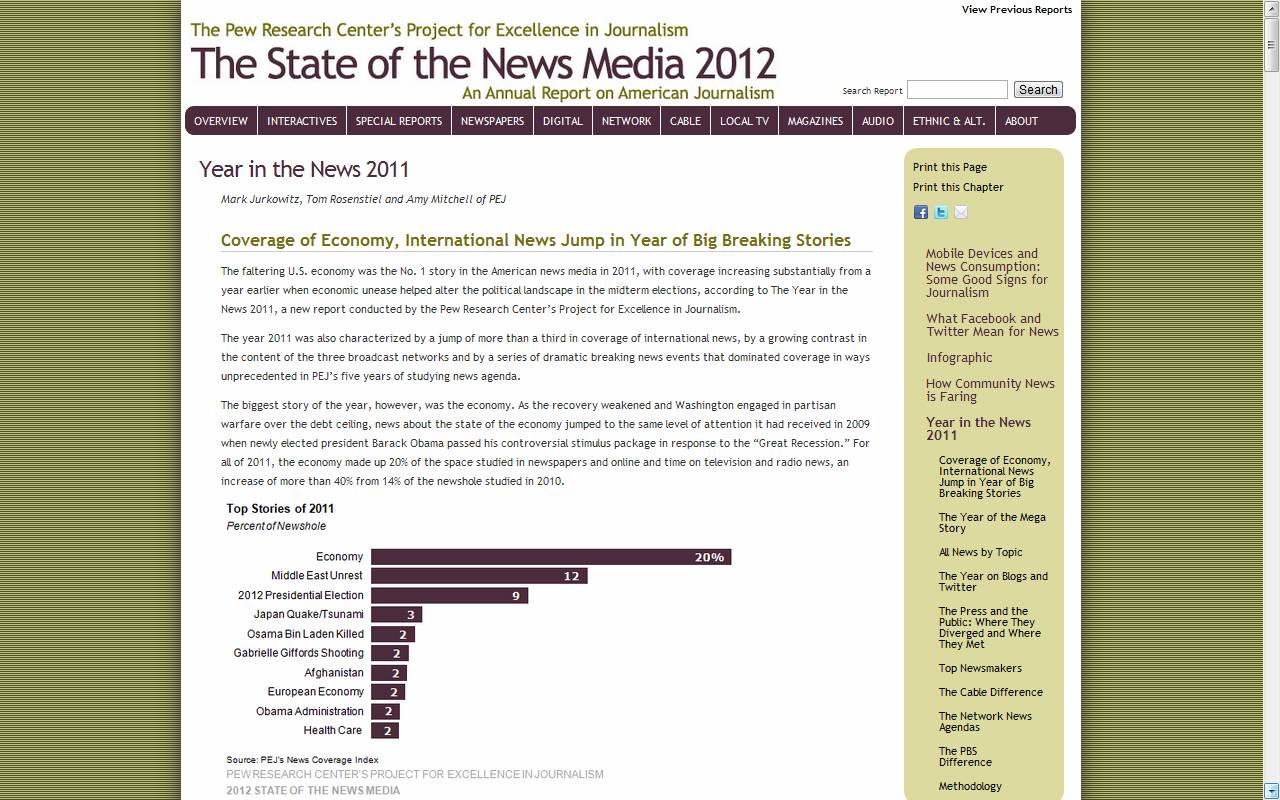 One section of the report offered a comprehensive understanding of which stories and topics were regarded as newsworthy by American journalists and included data for news being shared by bloggers and Twitter users.
Data helps journalists paint a more compelling and complete picture – but only if they can interpret and present that data effectively. That was the message from journalists with extensive experience of the benefits, challenges and pitfalls of data and journalism at the Frontline on Wednesday.
If you couldn’t make the event, you can watch the whole thing here:
The Guardian’s Datablog editor Simon Rogers dismissed accusations that using data isn’t proper journalism: “None of the stuff we talk about is particularly new, it’s the way we do it and the tools we have that are.”
He described how Guardian readers helped analyse thousands of documents on MPs’ expenses and how the paper has gradually developed new ways to visualise data, such as the 92,000 documents on the Iraq and Afganistan wars released by Wikileaks.
Times programmer and editorial developer Julian Burgess showed how computer code can be used to present data as diverse as the body mass index of Playboy playmates and pager messages sent from the World Trade Center on 11 September 2001. He recommended free tools such as Google Docs or MySQL that can be used to work data into stories.
These tools can be used by journalists to tackle data themselves, but programming is still reliant on the quality of the data, he said. “Things are often very easy with programming, or impossible practically.”
David McCandless, writer, designer and author of the Information Is Beautiful blog, emphasised the use of design in moulding data to tell a story. Well-designed visualisations can not only present data appealingly, but can also highlight interesting links that might go unnoticed, he said.
As an example, he showed how a simple graph showing peaks in news coverage of violent video games coincides with the anniversary of the Columbine school shootings.
Michael Blastland, a freelance journalist and creator of BBC Radio 4’s More or less programme, closed the session on a cautionary note by highlighting the dangers of not interrogating official data or questioning its creation. He cited the use of a single test result – in a sample of 1,500 – as the basis for estimating that three million people in the UK were affected by the Winter vomiting norovirus bug. He also described how valuable sources of data such as the Office for National Statistics often involve huge margins of error.
Finding your data is tough, knowing what kind of data you are finding is even harder. But I think you do need to know what data does, how it behaves and how it misbehaves in order to start making sense of it and start doing some of the wonderful things that my colleagues have been showing us how to do.
This event was part of our On The Media series, in association with the BBC College of Journalism. The next in the series is on 12 October and asks what the future holds for TV journalism in a connected age. More details and ticket booking here.
]]>Speaking via Skype at a discussion hosted by Paddy O’Connell, presenter of BBC Broadcasting House, Assange said the New York Times articles and its portrayal of US soldier Bradley Manning had been "disgusting".
Assange confirmed that Wikileaks would publish some of the 15,000 documents held back when 70,000 were published on 25 July in conjunction with the New York Times, The Guardian and Der Spiegel. But it was an "expensive time consuming process" checking the material and they were only "half way" through, Assange said.
"So far there has been no help despite repeated requests, from the White House or the Pentagon, or in fact any of the three press organisations we partnered with for this material," said Assange, who added that the cost could be up to £750,000. "They decided not to take responsibility for getting the raw data out to the public, that is in fact what appears our role, to get the raw data out as opposed to the cherries the organisations decided selectively to give out in relation to their stories."
Simon Rogers, editor of the Guardian’s Datablog said they had thought "long and hard" about the decision whether to publish all of the raw data: "Often it’s our job to choose what we think is interesting and important. On the legal side we are based in London and you can find us."
Media lawyer Mark Stephens, who said that Wikileaks’ release of documents represented "a new challenge to the traditional form of journalism" added that news organisations may move to find the most sympathetic jurisdictions.
"They may have to move or segregate themselves, so the Guardian may still be in York Way but the internet part or data dump will have to be based in Iceland."
The demands of the Pentagon in a press conference last week that Wikileaks hand over documents raised questions about the world’s press, said Assange: "Is it going to be a serious response or is it going to simply put its head in the sand?"
The Wikileaks case also reinforced the fact that journalists "could no longer afford to be innumerate," said FOI journalist and author Heather Brooke. "If you don’t know how to deal with electronic data you are only half way literate."
Brooke also argued that the release of the documents showed us that we have to renegotiate the way we view people in power and also showed up some of the weaknesses of the mainstream media:
"The media has generally abdicated its responsibility as the fourth estate and in a number of ways it has let down the public, it doesn’t act in the interest of the general public, it’s become coopted by special interests and people in power."
Watch the full event here:
]]>