By: Will Turvill
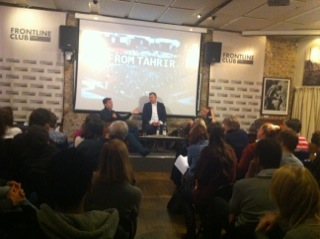
The Frontline Club last night hosted an exclusive screening of an Al Jazeera documentary Tweets from Tahrir.
The film, set to be broadcast on the network for the first time on Thursday, portrays the uprising in Egypt from the perspective of five Twitter users active in the Tahrir Square protests.
After the screening, three men heavily involved in the creation of the film took part in a question and answer session with the audience.
For this, cameraman David Niblock, who had introduced the film, was joined on stage by director Damian Clarke and Adib Nessim, the producer and editor.
One of the more pressing questions on the lips of audience members was how and why, out of all the people involved in the Egyptian uprising, were these five individuals chosen for the documentary.
Clarke admitted there was some bias involved. He said: “This all started from reading Nadia [Idle] and Alex [Nunns’] book Tweets from Tahrir. There were quite a few – about 20 I think – tweeters in there and so we picked from them.
“Obviously these people tweeted in English, owned smart phones and so were quite middle class, but we tried to get a variety. In the five we’ve got one blogger and political activist, two revolutionary socialists, a micro-blogger and an internet specialist.”
Nessim added: “And actually, we chose the specific people because of the interesting personal stories they had as well.”
Niblock, though, pointed out that this should not take anything away from the film, and that it was not designed to be portray an entirely objective view of the events of Tahrir Square.
He said: “When you set out to make films like this you have to concentrate, to put it very simply, on one slice of a cake. We know this one slice isn’t representative but try to tell the truth of this one particular viewpoint on the uprising.”
Asked if any progress has been made in Egypt since the film was made, the trio were keen to impress that the country’s revolutionary fight was far from over.
Nessim said: “We stopped filming a matter of weeks ago so this really is as up-to-date as it can be.
“This is a long term project, and the tweeters are aware of that. A revolution won’t happen overnight.”
Screenings from the Frontline with Al Jazeera is a new initiative to contextualize the news and working experiences of journalists and filmmakers reporting out of the political hotspots of our time.
]]>A year ago Cairo’s "Twitterati" tweeted their revolution for 18 days in and around Tahrir Square. Young, urbane and highly motivated, their tweets revealed the truth of the scale of the uprising which Egypt’s state media sought to hide. It gave a street-level minute-by-minute account of the bravery and persistence of the Egyptian people which resulted in the downfall of a dictator. A year later Al Jazeera talks to some of those who posted on twitter to hear in more than 140 characters what they thought then, and what they feel now about developments since the heady days of February 2011. The film film is based on a book by Alex Nunns and Nadia Idle of the same name and published by OR books. For more information on the book see: http://www.orbooks.com/catalog/tweets-from-tahrir/
Screenings from the Frontline with Al Jazeera is a new initiative to contextualize the news and working experiences of journalists and filmmakers reporting out of the political hotspots of our time. It aims to bridge the gap between the British audience and the biggest events taking place in modern history by showing a pre-broadcast special report with the presence of people involved in making them. Each screening pays homage to the groundbreaking work of filmmakers and journalists that risk their lives to provide in-depth reports to people across the globe as and when the events occur.
Director: Damian Clarke
Length: 48′
Year: 2012
]]>What made Mohammed’s story different was that his cousin filmed the immediate aftermath on his mobile phone and posted the video on Facebook. Hundreds and then hundreds of thousands saw stark evidence of both the brutality of the regime and their shared sense of despair.
Death of Fear examines how the self-immolation of a penniless fruit seller in Tunisia first ignited mass revolt in the country, then across the region in what we now call The Arab Spring.
Directed by Damian Clarke
2011
48 mins
]]>