The month of Ramadan is usually a time for festivities and celebration but in Syria there is little to rejoice about. The United Nations has estimated around 93,000 Syrians have died since the civil war began in 2011 and the number of refugees fleeing the country recently exceeded 1.5 million.
On Wednesday 17 July, the Frontline Club hosted a discussion with four leading journalists to dissect recent developments on the ground in Syria, in the international community and to analyse the role the media has played in reporting the conflict. The event was chaired by the BBC’s Chief International Correspondent Lyse Doucet.
A consensus was made early on that the Syrian conflict has reached an impasse. James Harkin, director of think-tank Flockwatching and a journalist who has covered the Syrian conflict for numerous publications, argued that despite recent media analysis that President Assad is winning the war, the reality is a stalemate:
“On the ground the regime forces are regaining Homs. They may even be able to recapture the whole of Homs, but if they do their combined forces . . . won’t be able to hold the city for very long. There simply aren’t enough government forces to recapture the whole city. As for government forces marching on Aleppo, that is propaganda puff… ”
Patrick Cockburn, a Middle East correspondent for over forty years who has written for the Financial Times and The Independent, agreed with Harkin but focused on how poor reporting has led both governments and the public to have a skewed idea of what is happening on the ground:
“At the beginning of this conflict, the idea of the citizen journalist . . . was taken somehow as being neutral, but it’s not citizen journalists or citizen activists, it’s citizen propaganda. It gave an impression early on that the government was on the verge of defeat. . . . Giving the impression that Assad was going to go down at any time.”
He further argued that no side would gain any “conclusive victory” over the other which will mean no solution for Syria.
“Cutting to the chase, I don’t think there will be successful negotiations. There may be a ceasefire and maybe you can do it in two hops. Until you have a ceasefire you have what we called in Northern Ireland ‘the politics of the last atrocity’ where everyone is so het up about things that no one can really talk until the level of violence is reduced.”
Anthony Loyd, an award-winning writer and current roving foreign correspondent for The Times, concurred with the previous two speakers in that the north of the country has now reached a bloody stalemate, but recent successes by government forces will “make them even more intransigent to negotiations.”
For Dr Halla Diyab, an award-winning screenwriter, producer and broadcaster from Syria, the question of who will win is a relatively unimportant one. What is happening in Syria now is simply war:
“These people have killed what ordinary Syrians want… What we need to work on now is how to end this conflict… We need to strengthen the political opposition in Syria – where are the future Syrian leaders, ministers, MPs? Where are the people who will stand in future elections? The West has to order a ceasefire and bring Assad and the opposition to the negotiating table and find strategies to contain violence and extremism in the country.”
Diyab further opened up the debate by arguing that Syria has now become a proxy war for other countries – Qatar, Saudi Arabia, Egypt, Turkey, Russia and America – all weighing in and supporting their own national and ideological interests.
There was disagreement on various issues including on whether and how the rebels should be armed, with reference to the arming of the Mujahideen in Afghanistan as an example of how one can never be sure who one is arming and where the weapons may end up.
Diyab and Harkin also disagreed strongly on the role Salafism is playing in the country, especially with younger Syrians.
The debate finished with all parties predicting a gloomy near future for Syria.
https://soundcloud.com/frontlineclub/syria-conflict-developments-on
]]>
In a couple of days she’s rocketed up from a handful of followers to around four thousand. So far, we’ve heard of her ariel acrobatics, as her husband pilots the royal helicopter – we’ve found out about her taste in films and her struggle to be a mother and queen. And it’s all written in irritating txt spk.
It seems to be the real deal. CNN’s Octavia Nasr is sure it really is Rania logging-in to Twitter.
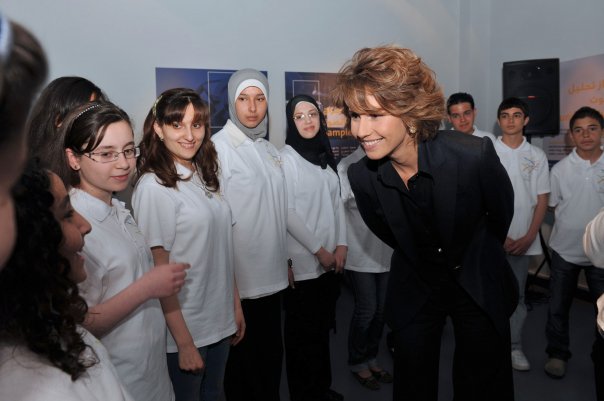
North of the border, Syria’s First Lady Asma Al-Assad is also jumping on to the technological bandwagon. She’s on Facebook, talking about her charity work. Appropriately, she’s helped launch a project to get disadvantaged children online.
Let’s face it, politics is a popularity contest. And with the absence of Western-style free and fair elections in the region, what better way to measure their appeal than by social networking sites. Queen Rania comes in at 4000 Twitter followers (although she just registered a couple of days ago, so that figure will grow). Asma Al-Assad tops the lot with 9000 on Facebook.
]]>It takes a very unusual national outlook to celebrate a war that was far from victorious, but that’s exactly what the Tishreen (October) War Panorama museum does. The impressively intimidating building, which resembles a medieval citadel and was constructed with the help of some Commie buddies from North Korea, opened its doors on October 9, 1999 – exactly 26 years after Israel began pushing Syrian troops back over the pre-war border after initial advances made in a surprise attack.
With the Golan Heights still partly occupied by Israel, and a buffer zone controlled by the UN Disengagement and Observer Force, the memorial ignores the many negatives and concentrates instead on the ‘heroic’ storming of the town of Quneitra by President Hafez Assad’s troops – even though the town was eventually retaken by the Israelis.
After the security had questioned myself and my two American friends about our occupations – I’m a student, honest – we were assigned a pleasant enough Syrian tour guide and shown into the main museum building. After seeing a few paintings depicting various monumental moments in the country’s history we were whisked into a small cinema packed full with schoolchildren. Having just taken our front-row seats we were ushered to stand once again as the children bellowed out the national anthem as the ‘documentary’ began rolling.
The film was a collection of original black and white footage showing Syria’s ‘brave warriors’ launching a counter-attack on a ‘Zionist’ watchtower overlooking Quneitra. Other than a short burst of subtitles explaining who the goodies and baddies were, it was essentially 10-minutes of hardcore war porn and the schoolchildren cheered in all the right places.
To avoid the inevitable post-film scrum, our guide pulled us out just as the credits began to roll and led us to the museum’s main attraction – a 360° panoramic oil painting of Quneitra. We sat on the rotating seats and our guide pointed out the destruction wreaked by Israeli bombardments, including the obligatory burning schools and hospitals. To be fair, those North Korean artists are clearly very talented and the painting is a pretty impressive feat.
After a quick look at photographs of Assad Snr with various world leaders, including Margaret Thatcher, Richard Nixon, Omar Bashir and, of course, Kim Il Sung, we were taken outside to what many consider the real reason to visit the memorial – a collection of Syrian and Israeli military hardware from the war. On the Syrian side there are various Russian-made tanks and armoured vehicles, rockets and a plane and on the Israeli side there are a couple of tanks, a truck and two piles of remains from what were apparently warplanes.
While we wandered over to the Israeli ‘booty’ I explained to the tour guide that I was British, not American, thinking he might reveal some anti-US feelings. Instead he pointed over to one of the Israeli tanks and said: “That’s English-made. Do you feel proud?” Doh.
]]>"Less fortunate young Syrians who [didn’t go to the American school] used to look forward to movie night at the [American] Cultural Centre every Wednesday. … Movie night was a refreshing two hours of enriched entertainment in a city where American culture is hard to come by."
The problem is, the op-ed is littered with factual errors which drill a hole through Rasha Elass’s central argument.
She rightly mourns the closure of the American Cultural Centre – shut in retaliation at the US army’s attack on a village near the Iraqi border last year. But to say that Syrians would flock there to get a rare glimpse at life in the land of milk and honey is just wrong.
American culture is everywhere in Damascus. This is not North Korea. Walk down any Syrian street and it won’t be long before you come across a shop filled from floor to ceiling with American DVDs – films, documentaries and TV series, all subtitled, all costing pennies, and many available here before they come out in the States.
Read the rest of this post on Sasa’s blog.
]]>Over the course of the last three days I have been to five hospitals. Given the local and international media coverage of Mexico’s current flu outbreak, I was expecting to find lines of people, all of them coughing into their government-issued face masks, winding around the block. Not so. Read more on Deborah’s Mexico City blog.
Nairobi based Rob Crilly continues to wrestle with mortality statistics as he battles his way towards a November deadline for his first book on Darfur,
Why does any of this matter? A lot of people have died in Darfur so why get bogged down in numbers? Well, using the wrong number hands Khartoum another excuse to trot out its own underestimate and using inflated figures can push us towards the wrong solutions – overinflated numbers tending to increase the urgency of no fly zones and so on. Still, at least we can agree on the area of Darfur… about the same size as Turkmenistan, right? Read more on Rob’s blog from Kenya.
Meanwhile, please welcome the latest addition to the Frontline blogging stable, the London and Damascus based Sasa, who will be reporting on and from the Syrian capital,
American culture is everywhere in Damascus. This is not North Korea. Walk down any Syrian street and it won’t be long before you come across a shop filled from floor to ceiling with American DVDs – films, documentaries and TV series, all subtitled, all costing pennies, and many available here before they come out in the States. Read more on Sasa’s Syria blog.
These are just three of the highlights from the blogs this past week. We’re adding new bloggers all the time; all journalists, all working in interesting places and all talking about interesting things, so please come and check them out. If you use the popular microblogging tool Twitter, here’s a list of Frontline bloggers who are active on Twitter. For all the latest news from the Frontline Club, the world of foreign correspondents, war reporters, life on the frontline and the job of journalism. Follow @frontlineblog on Twitter.
"Less fortunate young Syrians who [didn’t go to the American school] used to look forward to movie night at the [American] Cultural Centre every Wednesday. … Movie night was a refreshing two hours of enriched entertainment in a city where American culture is hard to come by."
The problem is, the op-ed is littered with factual errors which drill a hole through Rasha Elass’s central argument.
She rightly mourns the closure of the American Cultural Centre – shut in retaliation at the US army’s attack on a village near the Iraqi border last year. But to say that Syrians would flock there to get a rare glimpse at life in the land of milk and honey is just wrong.
American culture is everywhere in Damascus. This is not North Korea. Walk down any Syrian street and it won’t be long before you come across a shop filled from floor to ceiling with American DVDs – films, documentaries and TV series, all subtitled, all costing pennies, and many available here before they come out in the States.
Elass bemoans the lack of up-to-date Western newspapers. It takes three or four days, she claims, before they clear the state censors. True enough, but even in Beirut the papers are at least two days old. And it’s cheaper and easier to scan through the articles on the internet, surely.
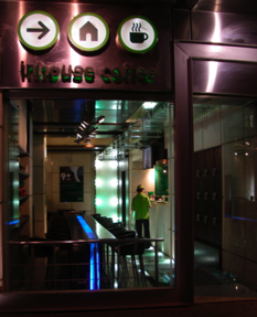
But Elass didn’t have much luck with the web. Sitting in her upmarket cafe called InHouse – whose green and grey colours, comfy sofas, and students spread across the tables make this place a identikit copy of Starbucks (there’s that American culture again) – she found that three of the five websites she logged on to were blocked.
Even the staff in InHouse could’ve helped her download a little program which runs in the background on your computer, and lets you visit any site you like – blocked or not.
Wifi is becoming so popular in Damascus that it’s hard to find a cafe without bright young things tapping away on Facebook (yes, that’s Facebook – the site that’s ‘banned’ in Syria). Although Elass tells us that InHouse is one of the few places you can log on.
Syrians are a lot more connected than she’d have us think. According to the International Telecommunications Union, the internet penetration rate is actually 17% – not a measly 3%.
And that’s not the only thing she underestimates. She quotes an average monthly wage of $40 – that’s the weekly wage, not the monthly. And that only applies to government employees – in the private sector it can be considerably higher.
Syria is a country with an active blogging community, high mobile phone usage, and growing level of English-language skills. To claim Syria’s youth is covered in a cloak hiding the outside world from their innocent eyes is painfully short of the mark.
]]>