The announcement by the Department of Defense is the first time a single policy has been used across all branches of the Armed Forces and effectively reverses a Marine Corps ban on access last August.
Speaking to a Bloggers Round Table yesterday, Price Floyd, the Principal Deputy Assistant Secretary of Defense for Public Affairs, said he encouraged serving soldiers to open up a Facebook page or a Twitter account. He also wanted to see more blogging from the front lines.
Floyd described the formation of the new policy as a learning process (a diplomatic way of saying he faced some opposition as revealed by a fellow social media advocate) that took six or seven months. Floyd believed further cultural change was necessary particularly within the middle ranks of the Armed Forces.
While the default position might be switched to ‘open’, the policy still allows for "temporary" blocks on access.
Concerns were raised on the Bloggers Round Table about maintaining Operational Security (OPSEC). Floyd said social media was "not an OPSEC free zone" and that OPSEC concerns essentially hadn’t changed, before rather paradoxically adding that they had become more important.
He urged those in uniform not to say anything you wouldn’t say in front of your boss or your grandma and reminded them that the potential impact of these sites is so much greater than a letter or a telephone call.
Floyd also addressed concerns about available bandwidth, often cited in the past as a reason why certain websites cannot be accessed. He acknowledged that this was still an issue:
"This policy does not add bandwidth. It might add to the strain on the existing bandwidth…in places like Afghanistan that’s a struggle."
This was a point taken up by one of the commenters on the DoD’s Roundtable blog who claimed that since the policy has been in place 15% of the bandwidth from the Combined Joint Operations Area has been going to Facebook.
We’ll have to wait and see what other changes the policy will bring about in practice. In the meantime we can expect further guidance on the Department of Defense’s Memorandum on social media to be published in 180 days.
]]>Yes, the US Marines did ban Twitter, Facebook, and MySpace from being used on their own military network. But the end of that sentence – their own military network – is rather important as Blackfive and this blogging Marine have demonstrated.
It does seem reasonable for operational security reasons to not allow Marines to use these sites on the same computers that they are accessing sensitive military information. Blackfive also highlights considerations of bandwidth and productivity.
But this doesn’t mean the Marine Corps is going to disappear from social media. (At least not yet.) Indeed, what some have described as a ‘blanket ban‘ has a provision to allow certain personnel to apply for a waiver to use social networking sites.
Lieutenant Craig Thomas, a spokesman for the Marine Corps, told AFP that Marines working on criminal investigations, press relations and recruiting need to use social media and would usually be granted access.
So I would still expect to find MarineCorpsNews on Twitter in the future. And Marines will still be able to access these sites on their own computers and recreational computers at military bases.
That’s not to say there isn’t a story here. While Lt Thomas said that "social networking sites have always been banned from government computers", US Strategic Command is nevertheless reviewing social media policy on Defense Department computers.
It seems rather strange to carry out a review unless there is something to review – like potentially significant security breaches on DoD computers or serious concerns about the possibility of hackers gaining access to sensitive information through social media sites.
]]>
Today, I’ve been multi-tasking: spending some time spying (with permission, I should add) on the BBC’s news operation, keeping one eye on the tennis, and reading a very interesting paper on the media and the Russian invasion of Georgia.
I can’t really talk too much about the former (yet) and I don’t suppose many of you read this blog for its sports coverage so that leaves the key points of a paper in the Small Wars and Insurgencies journal by Margarita Akhvlediani.
Refreshingly she focuses on the local and national media in Russia and Georgia rather than the Western media. It’s not a particularly uplifting read: she argues that a cocktail of fear, censorship, jingoism, cyberwar, PR, and threats to journalists led to chronic misinformation during the Russo-Georgian War last summer. Here are some of the key points:
"Two separate simultaneous conflicts"
While local media in Georgia and Russia were prime sources of information for Georgians, Russians and especially South Ossetians, they were fed "two separate simultaneous conflicts" in August 2008. Reporters in Georgia characterised Russia’s intervention as blatant aggression; Russian media claimed troops were aiding South Ossetians and preventing ethnic cleansing. In short, "media coverage in both countries was skewed in favour of the official version".
BBC
Akhvlediani claims that the BBC "made its contribution to the confusion". She criticises a report by Tim Whewell, in which Whewell ‘balanced’ a grief-stricken Ossetian mother, with the Georgian Minister of Foreign Affairs, while providing "no information" from grieving Georgian families. (Worth checking out whether you agree with this assessment). She points out that there was a spat between Whewell’s two fixers, one a Georgian and the other a North Ossetian about the content of the report.
The ‘other side’
Journalists did not report the other side of the conflict and there was a "slide of journalism into propaganda". Censorship, political pressures, and patriotism all contributed to journalists’ failure to represent different points of view on the conflict. Misinformation abounded in a climate of unchallenged facts and figures. Russian media repeatedly used a figure of 2,000 dead in South Ossetia. In the autumn of 2008, the official figure was reduced to 162. Meanwhile Georgian media over-emphasised the extent of US involvement inaccurately suggesting that the United States was offering military as well as humanitarian assistance.
The dangers for journalists
Part of the problem was the conditions faced by journalists attempting to do independent reporting. Akhvlediani says journalists had equipment and material confiscated. They were arrested, deported, shot at, wounded and killed. The Committee to Protect Journalists recorded three fatalities and ten wounded during the conflict.
Cyberwar
On 8 August, Yuga.ru says South Ossetian websites came under a large DDoS attack. Georgian websites like Civil.ge, Media.ge and Interpressnews.ge were also blocked and the cyberwar spilled over into the Ukraine where several media websites reported problems.
PR War
The battle for the support of the international community was a key part of the information war. Both sides employed significant PR operations in an attempt to woo international media and Western governments.
Blogs
Interestingly, Akhvlediani claims that "with no real differences in public alternative information, Internet blogs became a crucial way of checking what really happened". Although blogs are "a very new social phenomenon in the Caucasus" they are becoming increasingly influential. New blogs and forum topics were started to discuss the war.
But Akhvlediani suggests the potential of blogs and forums to provide accurate alternative information might have been undermined by the attentions of the secret services and PR campaigns.
Fog of War
Akhvlediani’s paper suggests that there are many stories of the Russian invasion of Georgia still to be told and many others that need correcting, revising and updating.
Even in the information age, the truth remains an elusive adversary. And even more so in times of conflict.
Photo: Dmitrij Steshin, Licensed under Creative Commons Attribution ShareAlike 3.0 Licence: http://creativecommons.org/licenses/by-sa/3.0/
]]>
On today’s agenda we have:
– A key note from Nik Gowing on the ‘new tyranny of shifting information power in crises‘.
– A discussion between General Sir Mike Jackson, Ed Mortimer and Alastair Campbell setting the military and political background.
– A panel on the current problems and opportunities in the field of strategic communications.
– An address and Q&A with Alastair Campbell.
– A panel on information ecologies and grass roots campaigns.
Hopefully, I’ll be able to put up another blog post (or two) later in the day. But I’ll have to see what the wireless/power situation is like at the event before I make any rash promises…
]]>Have Your Say team interact with Twitterer.

Global Voices (15 June).

Building Trust
 First, they broke an age old rule of effective propaganda or information operations: trust needs to be established. This is necessary both for genuine attempts at imparting reliable information and also for operations in deception.
If you are setting out to accurately try to tell the truth in an honest and open way then it’s far better to build up a reputation for doing so, before you have a major, highly contested conflict on your hands.
Launching a Youtube channel, blogs and Twitter feeds just prior to an invasion of Gaza automatically arouses suspicions of the nature and purpose of these new communication outlets.
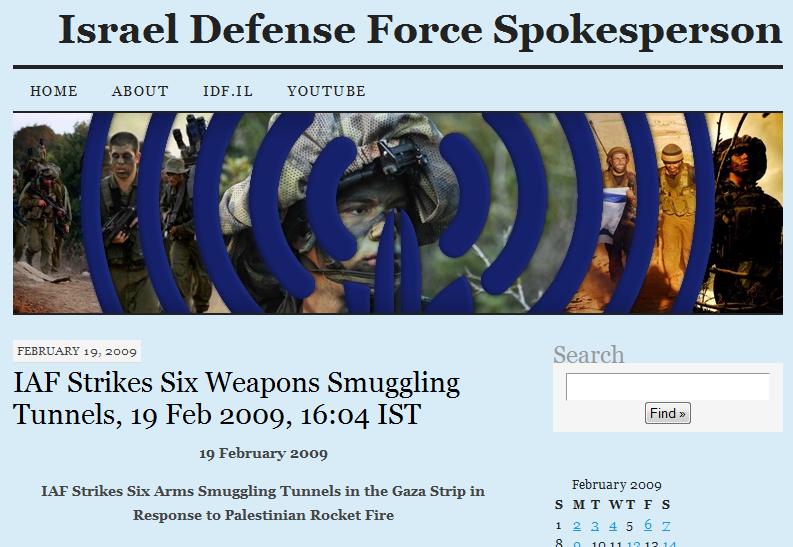
Airstrikes over the Gaza Strip began on the 27 December 2008. The IDF Spokesperson blog started the day before with a list of rockets fired into Israel. The Youtube channel was launched on the 29 December 2008. And the Twitter feed looks like an afterthought, beginning on the 3rd January 2009.
It would have been far better to have started these new ventures months beforehand at a time when the only obvious purpose could have been legitimately claimed as being a desire to engage in the social media space.
Through accurate reporting on blogs, Youtube and Twitter, the IDF could have built up a reputation for trustworthy and credible information which could have been verified by other media outlets. When war breaks out, audiences might have been far less sceptical of the information provided on these new forms of media.
As it was, the sudden appearance of these new information channels on the eve of a conflict instantly suggested a serious IDF propaganda campaign.
Of course, a base of trustworthy information could also be used as a means of employing successful information deception. Although I’m not advocating this approach and am not suggesting this is what the IDF would do, it is plain that deception operations have long been used by militaries, and the militaries of democratic nations are certainly no exception.
If you have a reputation for being accurate and trustworthy, when you do decide to start twisting the truth (or blatantly lying) you are far more likely to be successful in achieving the necessary deception. (Though obviously this carries significant long term risks).
Execution
In addition to this failure, the IDF has simply grafted all the old ways of information campaigning into new formats, without any specific regard for the conventions of social media.
Calling a blog ‘IDF Spokesperson’ is a hark back to impersonal, corporate, official voices. Who is this IDF Spokesperson? Why should we believe him, her or them? The IDF Spokesperson sounds like a scary non-descript Orwellian voice telling us what to think.
At least Mark Regev, an Israeli government spokesman, who did lots of radio and TV interviews, has a human face (and voice) with which we might empathise.
This Youtube explanation of the bombing of the UN schools in Gaza also demonstrates a failure to understand social media.
The statement, and it is a statement, by Capt. Benjamin Rutland takes place in a washed out ‘non-place’ with the Israeli flag propped up against the wall. Why not ‘casually’ film it ‘somewhere’. I’d suggest where Capt Rutland works, though anywhere would be better and the whole style needs to be much more informal. Much more real, open, honest and genuine. (Even if the content is not real, honest or genuine).
And all approaches suffer from a lack of community engagement. Whether this is possible for military organisations is highly debatable. Can you imagine the response on the IDF Spokesperson blog if the comments were turned on!? But the point is that social media without the ‘social’ aspect is often highly uncompelling.
P.S. I have emailed the IDF on several occasions for comment on this piece but they have so far failed to respond.
P.P.S. Here’s an excellent look at various aspects of the social media battle waged during the recent conflict in Gaza.
Author Jaron Gilinsky explores the Help Us Win campaign, and the Israeli Defence Force’s use of Youtube. He also speaks to Gazan blogger, Sameh Habeeb, who became a one-man news agency.
]]>Adrian Monck assesses Israel’s online propaganda operation. He notes:
“Back in January 2008, 26 IDF ‘combat cameramen’ held a fortnight long exercise with US military camera teams, and were “drilled in the use of wireless image transmission technology.”
Which is interesting. You can’t help but think that the IDF must have had a look at the US military’s Web 2.0 offering, even if it was only on an informal basis and not comparable to the cooperation in the exercise above. Although the US military have work to do (like this) they are still ahead of other militaries in the social media sphere.
The US Department of Defense set up a new media programme at the beginning of 2007, launched a Youtube channel in May 2007, recently set up Trooptube and launched this interactive recruitment site.
More links on this:
Israel uses YouTube, Twitter to share its point of view – CNN.com
Gaza: secondary war being fought on the internet – Times Online
Cyberwar and Forums
Hacking websites was a feature of the Russo-Georgia war in August 2008. Will McCant’s excellent blog provides a list of Israeli and Jewish websites that the Ansar al-Mujahideen Network claim to have hacked.
Will has also translated some of the reaction to Gaza from Islamist web forums into English.
Twitter and War
Nathaniel Whittemore, Director for the Center for Global Engagement, claims the conflict in Gaza is the first war to be reported in 140 characters or less. Although he does express some limited optimism at this development he concludes:
]]>“It’s the pessimist who recognizes how hard it is to overcome the feeling that average citizens don’t have much of a hand in foreign policy. It’s the pessimist who recognizes that “humanitarianism” is often used as a euphemism for war, and who recognizes the truth of the quote that there are “no humanitarian solutions to humanitarian problems.”
It’s the pessimist in me who recognizes that social media can just be another propaganda tool. And it’s the pessimist in me who recognizes that even technology that gives us the opportunity to be close to pain and suffering does not provide those who would rather avoid it a reason to open themselves to that pain.”
The full report put together by the 304th Military Infantry Battalion can be viewed here (pdf) and Wired magazine has a good summary of the main points.
In the first half, the report talks about online forums, and the use of GPS functions on mobile phones. In the second half, it considers how these technologies might be used with Twitter for intelligence, surveillance, carrying out attacks and evasion of capture.
The report cites the example of how a group of people protesting at the Republican Convention in September used Twitter to update one another about the progress of the protest and avoid arrest by police.
Some people have already questioned why terrorists would want to use Twitter as it can be easily accessed by anyone on the Web and is a very open form of communication.
While this is usually the case, employing a little more imagination might help us think about how terrorists could use Twitter. Let’s not forget that Twitter is not necessarily open – protecting updates and the use of direct messages is also possible. Yes, Twitter might be able to access them but presumably they aren’t going to monitor them on a regular basis.
What’s more, I assume it wouldn’t be too hard to use code words? When the IRA planned attacks they used mobile phones to coordinate attacks which were inevitably tapped. But they didn’t say: “I’m just planting a bomb” – it was all much more obscure than that. So the seemingly innocent “I have just finished breakfast” might not be a tweet about breakfast at all.
So hypothetically, yes, I suppose terrorists could be using Twitter now or in the future, but it’s important to note that this report doesn’t present any evidence that they actually are. ]]>

Last week, I was speaking on a panel at a departmental conference about new media and war.
It was great to meet Tim Stevens, one of my co-panellists, who gave a fascinating talk on violence and warfare in ‘virtual’ worlds like Second Life.
I put virtual in inverted commas because one of the points Tim made throughout his presentation was the way the ‘real’ and the ‘virtual’ are merging.
He showed us how some Second Lifers used an in-world uprising to protest against Linden Lab, the owners of Second Life, and how the virtual spills over into the real world – the most obvious example being the ability to trade Linden Dollars, Second Life’s currency, against the US Dollar.
If you want to find out more about what Tim thinks about terrorism, insurgency and information environments then you can find him on the Complex Terrain Laboratory website or on his personal blog, Ubiwar.