Harriet Agerholm sat down with The Guardian‘s migration correspondent and author Patrick Kingsley to discuss his latest book, The New Odyssey: The Story of Europe’s Refugee Crisis.
Filmed and edited by Adam Barr.
]]>Over the course of a year, Emmy Award-winning director Mani Yassir Benchelah made this intimate portrait of Syrian refugee children forced to flee from the violence of civil war to neighbouring Lebanon. Funded by friends of Save the Children, the film tells the stories of the children’s lives in their own words and captures the moving truth of how they deal with loss, hardship and dashed hopes.
While her younger brother fetches water, Aya talks about how a soldier pressured her to provide information about her father. Little Nouredine lived through the siege of Homs and, stuttering, explains how he believes that President Assad’s soldiers are following him everywhere. Thirteen-year-old Layim harbors feelings of vengeance, although he actually likes nothing better than to help people, for example by handing out rations.
Nearly all the children look forward to returning home one day, but Fatima, who is disabled, is thriving in Switzerland where she feels fully acknowledged for the first time. Mustafa desperately wants to study, but he has to work to support his family. Through the prism of their testimony, we gain perspective on the fate of millions of Syrian refugees, half of whom are children.
Speakers:
Julia Kirby-Smith is a filmmaker and journalist with a special interest in social impact and digital engagement. She has worked on Channel 4 News, Dispatches and various current affairs series, as well as being Managing Editor of digital journalism agency Newzulu and running the Asia office of indie Make Productions. She now runs her own comms and video production company, Make Waves.
Jess Crombie heads a team of filmmakers, photographers, picture editors, designers and writers who shoot, craft and create all kinds of powerful, effective and award winning communications materials for Save the Children. Previous to Save the Children Jess was at WaterAid, travelling the globe producing all of their overseas shoots; Magnum Photos, heading up their Creative unit; and almost ten years in advertising as a shoot producer for Wyatt-Clarke & Jones and Publicis advertising agency amongst others. Jess has an academic background in representation theory and lectures at LCC on this and other areas.
Directed by: Mani Benchelah
Produced by: Charly Feldman for MAKE Productions
Runtime: 56′
Country: United Kingdom/Lebanon/Switzerland
On the evening of 11 June 2013, the Greek Prime Minister Antonis Samaras pulled the plug on ERT, Greece’s public broadcaster, after 75 years of continuous operation. Both TV and radio frequencies fell silent, making screens broadcast black and the FM to buzz.
The closure of ERT was an unheard-of political act that shocked Greek citizens, bringing back memories from the dark period of dictatorship. The silencing of public television resulted in a political conflict and provoked protests in a country already divided. It also caused a fierce international outrage from all around the world.
Directed by Yorgos Avgeropoulos
Duration: 65′
Year: 2013
By Nicole Hunt
Spanish Prime Minister José Luis Zapatero is scheduled to request the dissolution of Parliament on Monday to make way for early elections on 20 November. Spain was not due to hold elections until March next year, but Zapatero has come under heavy criticism amid debt and budget problems, with persistent rumours that Spain will be the next country to ask for an EU bailout.
In St John’s, Antigua, Kaniel Martin and Avie Howell are set to be sentenced after being found guiltyon 27 July of the murders of Welsh honeymooners Ben and Catherine Mullany exactly two years earlier.
Ukrainian opposition leader Yulia Tymoshenko’s abuse of power trial resumes on Tuesday after a 15-day hiatus. Tymoshenko is accused of misspending some $280m while she was Prime Minister in 2009, charges which her supporters say are politically motivated.
Embattled Greek Prime Minister George Papandreou meets with German Chancellor Angela Merkel as his country faces increasing pressure from the IMF, the European Central Bank, domestic trade unions and other European leaders. Papandreou’s government has to come to an agreement with its lending troika to secure the next €8bn tranche of its loan before 10 October, when it’s estimated the country will run out of money to pay its bills.
In Conakry on Wednesday, Guineans mark the two-year anniversary of the 28 September, 2009 stadium massacre in which at least 157 people were killed when security forces opened fire on tens of thousands of people demonstrating against the junta government. The anniversary is the first since President Alpha Condé was elected in November last year, taking power from the leaders of the 2008 coup d’état.
In Manama, 21 Bahraini activists and members of the opposition who were convicted in June of plotting to overthrow the government and collaborating with a terrorist organisation are scheduled to find out whether their appeal against life sentences has been successful.
The verdict is the first of two high-profile decisions the court is expected to make this week; on Thursday, 47 medical staff accused of attempting to topple the monarchy and inciting hatred against the regime learn whether they have been found guilty.
Saudi Arabia holds its second-ever municipal elections on Thursday, which were delayed from 22 September. The polls were finally scheduled earlier this year as an olive branch from the government as fears mounted that the Arab Spring could spread to the country.
Following a Constitutional Court decision earlier this month ruling that Germany’s commitment to the EU bailout fund is legal, the German Parliament votes on a bill approving new powers for the European Financial Stability Facility which will increase its lending capacity and authorise it to buy government bonds.
On Friday, the International Criminal Tribunal for Rwanda in Arusha, Tanzania delivers the long-awaited judgement in its ‘Government II’ trial, in which four former cabinet ministers are accused of genocide, war crimes and crimes against humanity. The trial began in September 2003, and the defendants were acquitted of several charges in October 2005.
It’s a relatively quiet weekend: China celebrates Chinese National Day on Saturday, and the seven Italian scientists charged with manslaughter for failing to warn L’Aquila residents about the April 2009 earthquake return to court.
The next session of United Nations Framework Convention on Climate Change talks open in Panama City on Sunday.
Closer to home, the Conservative Party autumn conference opens in Manchester, with unions and anti-cuts activists planning a march to protest government policies.
]]>
This could be a very perfect news piece otherwise – embroiled in infamous clashes of civilizations and suffering from religious and cultural intolerance, the world could be relieved by this generous act, as the Cathedral of Our Lady of Strasbourg was relieved from ongoing global economic crisis maybe. However, back at home, things are not so comforting.
Since the start of 2009, the secular Shia state of Azerbaijan has demolished three mosques (all Shiite ones), while closed Baku’s main Sunni mosque. Another Sunni mosque remains closed since the summer of last year, when a grenade exploded inside killing two worshippers and wounding the imam.
Now, people in the streets ask a legitimate question – what is the logic behind the closure and demolition of mosques at home and a lavish donation to a church abroad?
Ironically, Baku is declared the Capital of Islamic Culture of 2009 by the Organization of the Islamic Conference.
To read more about closed and demolished Baku mosques visit these:
]]>
The current financial crisis has found its way to unimaginable places. While most Brazilians remain optimistic – after all the crisis was created far, far away from here by economies much more dependant on the financial markets – the fact is that it has brought consequences to many people who don’t even know what the financial market is and who have never heard of subprime mortgages and foreclosures (and never will).
The man who told me their story is not an economist, or a journalist. He is João Câmara, a cab driver who drove me home some days ago. He started by complaining that he did not know his way around: he’d been out of the taxi business for 15 years. What had happened, I asked. I had opened my own business, he replied.
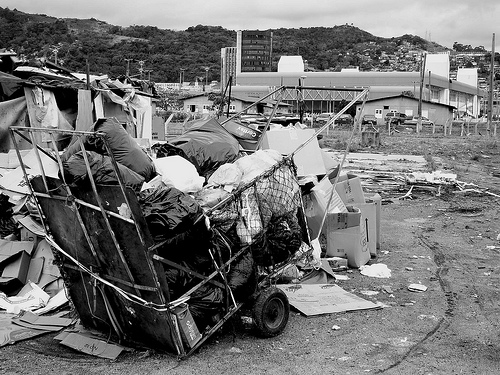
He ran a centre for selection of recyclable materials in São Paulo. Scrap collectors would come with their wooden carts and sell the stuff they’d gathered – paper, plastic bottles, aluminium cans – to be cleaned, selected and then sold to major recycling companies. In other words, he was a middleman.
Read the rest of this post at Natalia Viana’s blog.
]]>
The current financial crisis has found its way to unimaginable places. While most Brazilians remain optimistic – after all the crisis was created far, far away from here by economies much more dependant on the financial markets – the fact is that it has brought consequences to many people who don’t even know what the financial market is and who have never heard of subprime mortgages and foreclosures (and never will).
The man who told me their story is not an economist, or a journalist. He is João Câmara, a cab driver who drove me home some days ago. He started by complaining that he did not know his way around: he’d been out of the taxi business for 15 years. What had happened, I asked. I had opened my own business, he replied.
He ran a centre for selection of recyclable materials in São Paulo. Scrap collectors would come with their wooden carts and sell the stuff they’d gathered – paper, plastic bottles, aluminium cans – to be cleaned, selected and then sold to major recycling companies. In other words, he was a middleman.
In Brazil, 90% of the materials recycled go though the hands of a scrap collector. It’s hard to know precisely how many they are. Figures vary between 800,000 and 1.5 million. These are workers who walk around all day going from trash can to trash can to collect, organize and clean everything that no-one wants anymore. And they have been deeply affected by the crisis.
João Câmara told me that prices of used plastic slumped so much he had to give up his job and go back to being a cab driver. Many scrap collectors are seeing their earning cut by almost half, he said.
He is right. According to the National Movement of Recyclable Materials Collectors, collectors who used to earn up to 350 dollars per month are now unable to make more than 200 dollars. Prices paid for the materials have dropped by 60% in some cases. In September 2008, a kilo of cardboard was about 0.22 dollars. Now the price is 0.06 dollars. The price of plastic fell from 0.50 dollars to 0.30 dollars.
Being a middleman, João Câmara had the opportunity to drop the industry and go cab driving. He’s starting anew, and faces the future in a very Brazilian way. What can one do, he said, that’s life. But for most scrap collectors, there is no other choice – they will have to work harder, maybe twice as much as they did before, to afford food for their tables. Figure if the US financiers ever thought of that.
Photograpah: Carroça, CentroSul, Florianópolis / cart, convention center, Florianópolis, Brazil by MMMarcelo2008
]]>Six years ago their financial system melted and almost overnight a sophisticated economy became a basketcase, turning millions in the middle class into paupers.
What did Argentines do? In brief, this: they got angry, they got depressed, they improvised, they coped, they rebounded – and they stayed worried.
"Argentines are used to a more unstable form of capitalism than in Europe or the United States. As a result, they are more creative in their responses," said Marcela Lopez Levy, author of a book ‘We Are Millions’, about Argentina’s collapse.
If so, northerners better start acquiring some Latin dexterity. Step one, it seems, is to let the anger froth.
From sleek Buenos Aires to wilderness Patagonia Argentines had reason to be furious: banks froze savings, the peso lost three quarters of its value and more than half the population slid into poverty.
Millions marched to demand politicians’ heads; the president duly resigned (fleeing the palace in a helicopter), as did three successors. The demonstrations morphed into formal protest groups with drums, saucepans and road blocks the preferred weaponry of the aggrieved picketers, the ‘piqueteros’.
These social movements reflected profound alienation, said Sergio Berensztein, a political analyst. "They demonstrated a complete rejection of the political parties and a desire to replace the government."
The famously neurotic citizens of Buenos Aires rival New Yorkers in their attachment to therapy and when the crisis hit demand for psychological care rocketed.
"The public mental health centres were very busy," said Hector Basile, of the Argentine Association of Psychologists. "The middle-classes were more nervous than ever but they didn’t have the money any longer to go to a private psychiatrist."
Rates of suicide and serious mental health problems did not soar, however, partly thanks to step two: community solidarity. Marooned by imploding state services, people huddled on street corners to devise solutions and debate everything from organising soup kitchens to writing manifestos denouncing global capitalism.
More than anything, these so-called "neighbourhood assemblies" helped vent frustration at the crisis. "They were like group therapy on the street," said Lopez Levy, the author.
Necessity bequeathed step three: invention. With cash devalued to a third of its initial value money was eschewed in favour of barter. Some 5,000 barter or ‘truque’ clubs, operating by word of mouth and the internet, had well-heeled professionals swapping goods and services with blue-collar workers. Some $7m of paper scrip went into circulation and reportedly $400m in goods was traded.
The clubs were an improbable safety net for the middle class, said Ibsen Martinez, a journalist, and the system collapsed after thieves stole million of barter coupons and went on a shopping spree.
A boom in recycling proved more enduring. Groups of collectors known as "cartoneros" scoured bins for glass, paper, cardboard and other salvageable material. Buenos Aires subsidised a train to transport them in from outlying shantytowns.
Another innovation was worker-run cooperatives in which laid-off employees took over idle businesses. "We took it back," said Ricardo Ruiz, of Cortidoros Unidos Limitada, a leather processing plant. "We broke the locks, turned on the lights and started the equipment up. We´re running things now."
Many cooperatives failed but some thrived. "I can quote you Marx or Lenin but this is not about ideology. It is about what works. And this is working," said Luis Caro, a leader of the National Movement for Recovered factories, which boasts 10,000 members.
An export-led commodity boom helped resurrect the economy, halve poverty and boot out the hated IMF, whose policies contributed to the crisis. As the country regained its shine many emergency initiatives petered out.
To countries now facing their own financial meltdowns Argentina is a hopeful example. Its swift recovery, however, has not extinguished the trauma. Argentines are braced for another crisis, said Lopez Levy. "They don’t expect things to change so they just try and weather the storm as best as possible."