We’ll be discussing the credit crisis, financial journalism and scaremongering with Financial Times Assistant editor and journalist of the year Gillian Tett at the Frontline Club tonight. Gillian will be in discussion with BBC economics editor Stephanie Flanders. We start at 7.30pm GMT and as usual we’ll be streaming the event live above and on our new Livestation channel where we will also be fielding questions from viewers, so please join in. And don’t forget to download the Livestation software to watch in great quality on your PC or fed through to your TV,
]]>When she picked up her prize for journalist of the year at the British Press Awards recently, the Financial Times’ Gillian Tett claimed the accolade was a vindication for “the geeks” and “anoraks”. The assistant editor of the Financial Times has been documenting the rise of credit derivatives banking since she was appointed in 2005 to cover the the rather unglamorous capital markets patch. But it was only after the full consequences of the risks bankers had been taking became so catastrophically apparent that Gillian Tett was promoted from “geek” to luminary, regularly making appearances on TV and radio. link
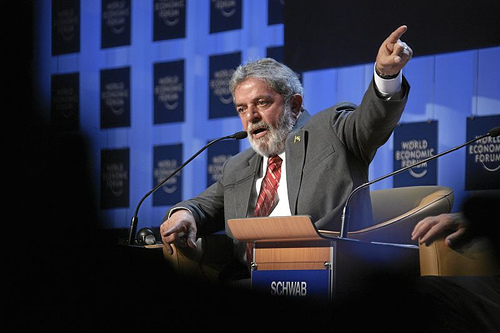
The President Luiz Inácio Lula da Silva announced today that Brazil will lend 10 billion dollars to the International Monetary Fund. The money is part of a $1.1 trillion package agreed at the end of the G20 summit in April to boost international financial institutions, international trade and economies that are struggling with the economic crisis.
Lula told Reuters agency that the deal was settled with the Treasury Minister Guido Mantega on Tuesday. According to Lula, the action will give Brazil the "moral authority" to demand changes "much needed" in the IMF and other multilateral organisms.
Lula advocates for a stronger voice for the emerging economies in organizations such as the IMF and World Bank in order to make them truly multilateral.
The negotiations had been going on for some time. At the G20 meeting, Lula had said he wanted to be the first Brazilian president to be able to lend money to the IMF. "Don’t you guys think it’s very ‘chic’ for Brazil to lend money to the IMF?", he asked reporters.
In 2005, Brazil paid off its $5.5 billion debt to the IMF two years ahead of schedule.
Photograph of President Luiz Inácio Lula da Silva by World Economic Forum
]]>Tonight we’ll be in discussion with Paul Mason, BBC Newsnight’s Economics Editor, about the financial crisis as we ask the question – Is this the end of the age of greed? Paul will be talking with Michael Wilson, Business Editor of Sky News. As usual, we’ll be livestreaming the event on the Events page and on the Frontline Club live channel. We start at 7pm GMT/11am PST tonight April, 23,
]]>Paul Mason talks about the ongoing financial crisis that has brough the global economy to the brink of depression. Gordon Brown hailed the result of deregulation as the ‘golden age’ of banking in the UK. Mason will give insights into how deregulation is at the heart of the collapse of the banking system in September and October 2008 and how it led to expanded subprime mortgage lending, an uncontrollable derivatives market, and the lethal fusion of banking and insurance.
In his latest book Financial Meltdown and the end of the Age of Greed Mason goes on a journey from the trading floors of the New York and London stock exchange, to the meeting rooms of HBOS and Lehman Brothers and the minds of senior government officials. Meltdown explores the roots of the US and UK’s financial hubris, documenting the real-world causes and consequences, from the Ford factory, to Wall Street to the City of London. link
The current financial crisis has found its way to unimaginable places. While most Brazilians remain optimistic – after all the crisis was created far, far away from here by economies much more dependant on the financial markets – the fact is that it has brought consequences to many people who don’t even know what the financial market is and who have never heard of subprime mortgages and foreclosures (and never will).
The man who told me their story is not an economist, or a journalist. He is João Câmara, a cab driver who drove me home some days ago. He started by complaining that he did not know his way around: he’d been out of the taxi business for 15 years. What had happened, I asked. I had opened my own business, he replied.
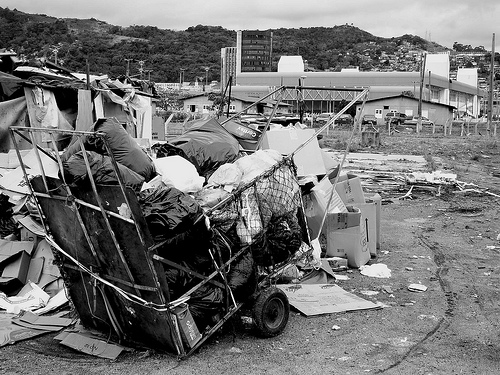
He ran a centre for selection of recyclable materials in São Paulo. Scrap collectors would come with their wooden carts and sell the stuff they’d gathered – paper, plastic bottles, aluminium cans – to be cleaned, selected and then sold to major recycling companies. In other words, he was a middleman.
In Brazil, 90% of the materials recycled go though the hands of a scrap collector. It’s hard to know precisely how many they are. Figures vary between 800,000 and 1.5 million. These are workers who walk around all day going from trash can to trash can to collect, organize and clean everything that no-one wants anymore. And they have been deeply affected by the crisis.
João Câmara told me that prices of used plastic slumped so much he had to give up his job and go back to being a cab driver. Many scrap collectors are seeing their earning cut by almost half, he said.
He is right. According to the National Movement of Recyclable Materials Collectors, collectors who used to earn up to 350 dollars per month are now unable to make more than 200 dollars. Prices paid for the materials have dropped by 60% in some cases. In September 2008, a kilo of cardboard was about 0.22 dollars. Now the price is 0.06 dollars. The price of plastic fell from 0.50 dollars to 0.30 dollars.
Being a middleman, João Câmara had the opportunity to drop the industry and go cab driving. He’s starting anew, and faces the future in a very Brazilian way. What can one do, he said, that’s life. But for most scrap collectors, there is no other choice – they will have to work harder, maybe twice as much as they did before, to afford food for their tables. Figure if the US financiers ever thought of that.
Photograpah: Carroça, CentroSul, Florianópolis / cart, convention center, Florianópolis, Brazil by MMMarcelo2008
]]>Six years ago their financial system melted and almost overnight a sophisticated economy became a basketcase, turning millions in the middle class into paupers.
What did Argentines do? In brief, this: they got angry, they got depressed, they improvised, they coped, they rebounded – and they stayed worried.
"Argentines are used to a more unstable form of capitalism than in Europe or the United States. As a result, they are more creative in their responses," said Marcela Lopez Levy, author of a book ‘We Are Millions’, about Argentina’s collapse.
If so, northerners better start acquiring some Latin dexterity. Step one, it seems, is to let the anger froth.
From sleek Buenos Aires to wilderness Patagonia Argentines had reason to be furious: banks froze savings, the peso lost three quarters of its value and more than half the population slid into poverty.
Millions marched to demand politicians’ heads; the president duly resigned (fleeing the palace in a helicopter), as did three successors. The demonstrations morphed into formal protest groups with drums, saucepans and road blocks the preferred weaponry of the aggrieved picketers, the ‘piqueteros’.
These social movements reflected profound alienation, said Sergio Berensztein, a political analyst. "They demonstrated a complete rejection of the political parties and a desire to replace the government."
The famously neurotic citizens of Buenos Aires rival New Yorkers in their attachment to therapy and when the crisis hit demand for psychological care rocketed.
"The public mental health centres were very busy," said Hector Basile, of the Argentine Association of Psychologists. "The middle-classes were more nervous than ever but they didn’t have the money any longer to go to a private psychiatrist."
Rates of suicide and serious mental health problems did not soar, however, partly thanks to step two: community solidarity. Marooned by imploding state services, people huddled on street corners to devise solutions and debate everything from organising soup kitchens to writing manifestos denouncing global capitalism.
More than anything, these so-called "neighbourhood assemblies" helped vent frustration at the crisis. "They were like group therapy on the street," said Lopez Levy, the author.
Necessity bequeathed step three: invention. With cash devalued to a third of its initial value money was eschewed in favour of barter. Some 5,000 barter or ‘truque’ clubs, operating by word of mouth and the internet, had well-heeled professionals swapping goods and services with blue-collar workers. Some $7m of paper scrip went into circulation and reportedly $400m in goods was traded.
The clubs were an improbable safety net for the middle class, said Ibsen Martinez, a journalist, and the system collapsed after thieves stole million of barter coupons and went on a shopping spree.
A boom in recycling proved more enduring. Groups of collectors known as "cartoneros" scoured bins for glass, paper, cardboard and other salvageable material. Buenos Aires subsidised a train to transport them in from outlying shantytowns.
Another innovation was worker-run cooperatives in which laid-off employees took over idle businesses. "We took it back," said Ricardo Ruiz, of Cortidoros Unidos Limitada, a leather processing plant. "We broke the locks, turned on the lights and started the equipment up. We´re running things now."
Many cooperatives failed but some thrived. "I can quote you Marx or Lenin but this is not about ideology. It is about what works. And this is working," said Luis Caro, a leader of the National Movement for Recovered factories, which boasts 10,000 members.
An export-led commodity boom helped resurrect the economy, halve poverty and boot out the hated IMF, whose policies contributed to the crisis. As the country regained its shine many emergency initiatives petered out.
To countries now facing their own financial meltdowns Argentina is a hopeful example. Its swift recovery, however, has not extinguished the trauma. Argentines are braced for another crisis, said Lopez Levy. "They don’t expect things to change so they just try and weather the storm as best as possible."