The decision to go into Afghanistan was necessary as a kind of “acting out” to restore American national confidence and pride in the wake of the terrorist attacks of September 2001, but it was done with little idea about what was to be achieved by it.
That was the claim of Jean MacKenzie, senior correspondent for GlobalPost and previously programme director for the Institute for War & Peace Reporting in Kabul, about the decision of president George Bush to send troops into Afghanistan less than a month after the terrorist attacks of 11 September, 2001.
"We had to go in, America had to kick ass because we had been attacked and we had to prove that we were big guys, and there was very little resistance to going in to Afghanistan, Afghanistan was a very convenient ass to kick, because it was not being really defended," said MacKenzie.
MacKenzie, who was taking part in a recent discussion titled: Counterinsurgency and the "War on Terror": Doomed to fail? agreed that America had to react to the terror attacks in New York and Washington. The problem was not the decision to intervene, but the fact that it was done without a clear idea of what it would accomplish, she said:
"We didn’t need to go in with this open-ended brief of we’re going in there to get rid of al-Quaeda, now we’re going in there so that little girls can go to school and maybe we’re there so women don’t have to wear burqas and now we’re there, as Time magazine tells us, so that women’s noses are not cut off. Where does it stop? We needed to define our goals from the very beginning."
There was also a lack of clarity about who the enemy was, said MacKenzie, who claimed local groups could manipulate NATO or the International Security Assistance Force into fighting their battles by claiming their opponents were Taliban:
"We go into an area, like in Kunar, where two groups are fighting over logging rights – another gets close to us and says they are the Taliban. We start fighting them and they fight back and as soon as they do, they become an insurgency."
As a result of the lack of clarity the rhetoric about the US mission in Afghanistan had taken on a life of its own, MacKenzie argued:
"It’s a very broad statement but I think we are now fighting the Afghan people, the Afghan society. We say the Taliban stone women for adultery, the Taliban stone young couples, the Taliban throw acid in the faces of school children.
But in most of these cases, if you unravel it, it’s not the Taliban, it is the community that has done these things. So if we are fighting those manifestations of Afghan culture, we are not fighting the Taliban, we are fighting Afghan society, we are fighting a culture that we find noxious. That, I think, is quite a bit beyond our brief."
Ten years on, the mood in Afghanistan was one the “darkest despair”, said MacKenzie, adding that there is little trust on the ground in the ability of the Afghan forces to protect the people. In addition, things have gone "way beyond the point" when outside nations could impose anything on the country:
"There was a point at the beginning when there was a certain amount of hope and goodwill among Afghans, but I don’t feel it there any more," she said.
"The Afghans are more and more pessimistic, they have given up on their own government, how do you fight counterinsurgency when you have no legitimate government to partner with? How do we begin to do anything?
Yet the US is likely to leave Afghanistan with "honour and dignity in the strategic communications sense," said MacKenzie, who predicted that from now until the end of 2014 the US administration was going to be "busily engaged in painting a narrative of victory":
All that is required for us to have won is for the media to pack up and go home so there’s no focus on what’s actually happening and for us to redefine victory and to move the goalposts as it were."
Malte Roschinski, a security consultant, political analyst and author who reported from Afghanistan for AFP news agency, was also pessimistic about the future of Afghanistan and said he believed the best that the US could do was to "come up with a good PR strategy and hope for the next six months or so it’s going to stay fairly quiet".
]]>"After that the media focus will have moved away from the country. There will be stories afterwards but the media works in cycles and public attention has just so much bandwidth anyway so it’s just going to be a PR exercise."
Watch event here.
If you want to take part in further discussion about the impact of the War on Terror on our world today and how it might shape our future, come along to our FIRST WEDNESDAY SPECIAL: Changing world – conflict, culture and terrorism in the 21st century on Wednesday, 7 September.
The purpose of the invasion of Afghanistan in 2001 in the wake of the 9/11 attacks was ill-defined from the beginning, according to panelists taking part in a discussion last night that gave little grounds for optimism about the country’s future.
Asked by David Loyn, the BBC’s international development correspondent who was chairing the event when it was that the mistakes were made after the attacks on the Unites States of 11 September, 2001, the answer from Jean MacKenzie, senior correspondent for GlobalPost was: “September 12,”
The former programme director for the Institute for War & Peace Reporting in Kabul, said the major problem with the operation in Afghanistan was a lack of definition about what it was setting out to achieve:
“I think when we went into Afghanistan, the major problem with our invasion, or intervention, was that it was ill-defined as to scope, ill-defined as to purpose and we really had no clue what we were trying to accomplish there. The people who carried out the attack on the United States were not the Taliban and those who did, namely al Quaeda and Osama bin Laden had left by November 2001, said MacKenzie.
“They’re gone, we’re still there and we’re fighting [without knowing] who the enemy is, we don’t know how to define the enemy and we don’t know what the enemy is fighting us about, and I think our central mistake is to get involved with a war with a country that we don’t understand, with a goal that we never bothered to define.”
Malte Roschinski, a security consultant, political analyst and author who is based in Germany, said the “players” who drew up the December 2001 Bonn Agreement on the future of Afghanistan were not representative of the country because the Taleban were left out.
“We might not have liked them but they were the decisive actors in Afghanistan at that time,” said Roschinski, who as a journalist with AFP news agency reported from post-Taliban Afghanistan in late 2001.
He was also critical of the way that different countries took responsibility for different areas and of the German approach of institution building at the cost of providing security for the people:
“The international community never got around to creating a unity of action, which is obviously very important if you want to be successful. If eventually 44 countries are playing single ball games then you will not really come to decisive conclusion because you have 44 different strategies, as well as the civilian players, the development agencies.”
Frank Ledwidge, author of Losing Small Wars said it was “a matter of record” that it was “right within the purview” of al-Quaeda operators and Osama bin Laden that western governments, and the United States in particular, be drawn into wars in the Islamic world that they could not win.
Discussing Britain’s presence in Afghanistan’s Helmand Province, Ledwidge said a “very well informed” Helmand Plan put together by the SAS and well-placed Afghan civilians might have been successful, but had never been implemented:
“We went there looking to create a Belgium in Asia and right now, the truth is we’d be lucky to get a Bangladesh,” said Ledwidge, whose military record includes serving in the the Balkans conflict.
“Success and failure has to be measured against cost and the cost that we’ve sustained, the very least of which is national reputation, then military reputation, then the lives and limbs of our own soldiers and of Afghans and the money, I simply can’t draw a success from that.”
To come: What difference have counterinsurgency strategies made to the life of the Afghan people and in Iraq?
]]>Tomorrow evening we will be joined by photographer Toby Smith who has recently returned from China where he was documenting the fight against escalating energy and environmental problems for his project China’s New Energy Pioneers.
An African Election on Friday reveals the political, economic and social struggle of the 2008 presidential election in Ghana as the country worked to prove the credibility of its democracy.
With all eyes currently on Libya, we will be bringing the focus back to the beginning of the Arab Spring in Tunisia and Egypt to assess how successful their revolutions have been and what challenges lie ahead for both countries.
Follow us on Twitter and catch up on any events you missed on the Forum blog or download our podcasts on iTunes. ]]>
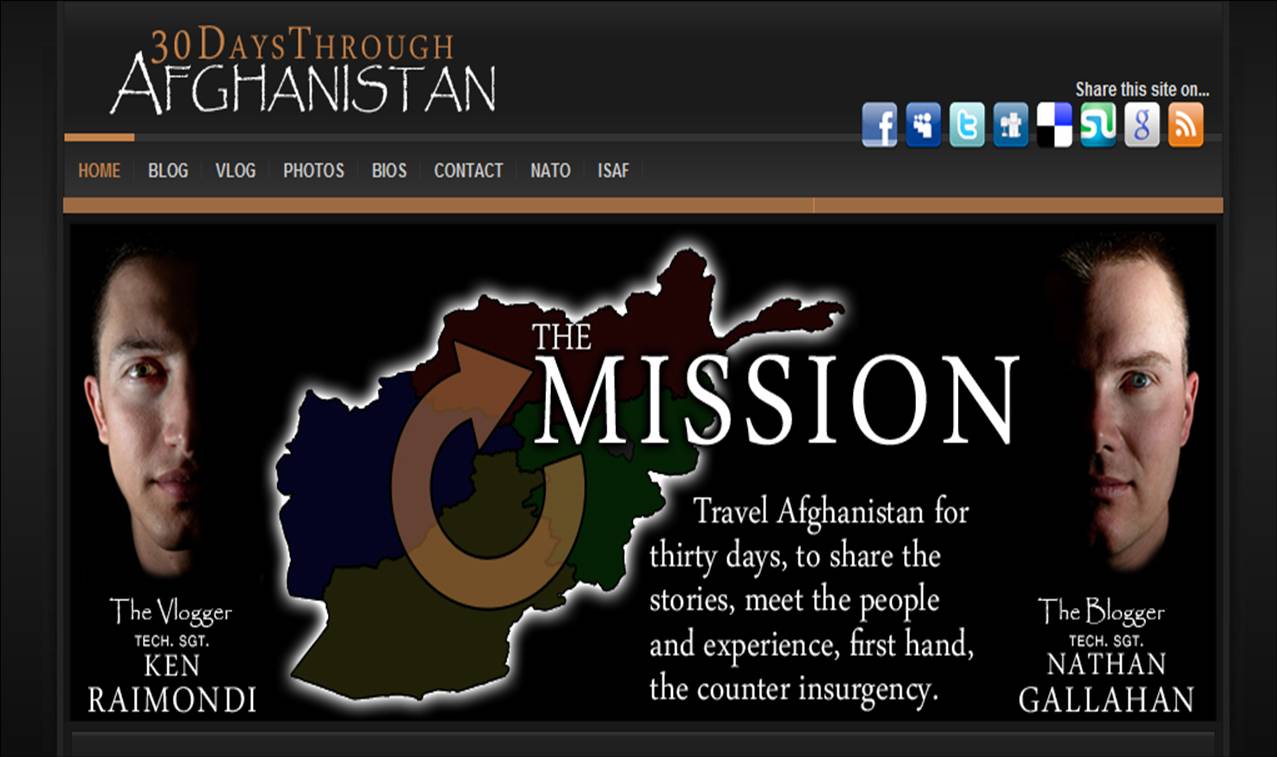
This looks like an interesting new blog which apparently kicks off today. US Tech Sergeants Ken Raimondi and Nathan Gallaghan are going to travel through five regional commands in Afghanistan blogging and vlogging along the way.
Unsurprisingly, they think the story of counterinsurgency in Afghanistan isn’t being covered by the media:
"We want to show you what life is like out there, not just for service members, but for the Afghans we’re all here to free from the grip of war. From past experience, I can tell you the lives of people here are hard. Sleeping in small rooms packed to the ceiling with cots and bunk beds with platoons of soldiers who haven’t showered in a week.
"But they’re here for a reason; they’re working for a greater good. A greater good I feel isn’t covered enough in the mass media. I want to answer the question, why are we doing this? Why are service members and civilians out there being killed, wounded and suffering miserable lives? And I want to cover it from an “average” perspective, talking about it in normal speak so everyone can see this war as those on the ground see it."
I do wonder what sort of access they will have to Afghan voices on their hectic 30 day tour but fair play to them for going in with the intention of covering more than merely the military side of the story. It’s a NATO project though so don’t expect anything from too far ‘out of left field’.
Indeed, I’d be very surprised if they manage to access the sort of material you see in this recent post on the blog of photographer, Holly Pickett. (Warning: contains disturbing images from inside Mirwais Hospital in Kandahar).
It almost goes without saying these days that you can catch Raimondi and Gallahan on Twitter as well.
]]>When war takes place among the people, using military force is problematic so the priority is to win the support of the local population by providing security and services and building relationships with village elders.
That’s (a very simplified version, that doesn’t really do justice to) the theory. But here’s what it might mean in practice courtesy of Afghanistan Shrugged:
]]>"The purpose for us coming here is a shura an afghan term for gathering or meeting. This shura is [in] honor of opening two schools in the area...
"Just in our operational area we’ve built four schools, numerous wells, water retention walls and various other projects. We’ve also treated over 700 cases in 9 months…
"The group talks for a long while, drinking chai and then we adjourn to another room for lunch. As I come into the room, I’m hit with dread. It’s covered in flies as is the food. One of my no shit rules is that I NEVER refuse any food or drink given to me by an Afghan. It’s insulting to them. So, I’m going to have to eat.
"I do and pay for it two days later with violent vomiting and diarrhea that makes a claymore mine seem like a fire cracker. 10 lbs and 6 bags of IV fluid later I’ll be fine and my relationship with the elders is intact. A small price to pay for good relations."
It includes thoughts from Grim at Blackfive, Michael Yon, and David Kilcullen among others on topics such as the ‘lesson learned’ process; organisational change; the development of informal networks through blogging and fora; the impact on military doctrine; the use of Youtube; information operations; and the military’s relationship with the mainstream media.
The mini-project was inspired by this post from Andrew Exum, a PhD colleague of mine at King’s and author of the ever-excellent, Abu Muqawama blog. In a review of Tom Rick’s latest book on Iraq, he listed a lack of discussion of the impact of new media as a ‘curious omissions’ which sparked the debate.
]]>