The rise of the Islamic State (IS) has once again thrown into question how governments deal with the threat of terrorist organisations. Around the world governments consistently proclaim that they will never ‘negotiate with evil’. And yet is the public rhetoric always in line with what is actually going on behind closed doors?
Jonathan Powell has spent nearly two decades mediating between governments and terrorist organisations. In his new book Talking to Terrorists, he argues that no conflict – however bloody, ancient or difficult – is insoluble.
He will be joining us in conversation with roving foreign correspondent for The Times, Anthony Loyd, to reflect on the current situation with IS and how governments have reacted, both on the public stage and behind closed doors. Looking back on his own experience he will be discussing how we can use the lessons of a history of clandestine communication.
Jonathan Powell has spent half a lifetime talking to people and organisations labelled as terrorists. He runs Inter Mediate, a London-based charity for negotiation and mediation that focuses on the most difficult, complex and dangerous conflicts, where other organisations are unable to operate. In 1997 he met Gerry Adams and Martin McGuinness and became instrumental in negotiating peace in Northern Ireland. In 2008 he suggested publicly that western governments should open talks with the Taliban, Hamas and al-Qaeda. Today, he works on different armed conflicts around the world and is the UK Prime Minister’s special envoy to Libya. He is the author of two books, Great Hatred, Little Room and The New Machiavelli.
]]> On Boxing Day 2004, a deadly tsunami originating in the Indian Ocean struck Indonesia, Sri Lanka, India and Thailand. The results were devastating: almost 250,000 people died and scenes of the tsunami striking and the aftermath dominated the news. It became one of the most well-documented natural disasters in history.
A decade on, what has changed, both in the way natural disasters are communicated and in the way the humanitarian industry responds to them?
For a two-part evening, in partnership with Christian Aid, we will be reflecting on the developments we have seen since the Indian Ocean tsunami and how communication around natural disasters has evolved.
1. Every time I see the sea
In August 2005, photojournalist Tim Hetherington was commissioned by Christian Aid to travel to India and Sri Lanka and produce a set of photos representing the organisation’s post-trauma, rehabilitation and rebuilding work, for a multi-media exhibition in London to mark the first anniversary of the Indian Ocean tsunami.
For the first part of the evening Joseph Cabon, senior photo editor who commissioned Hetherington, will present the images, many of which have not been published before. He will be talking to photographer Giles Duley about the use of photographic representation during difficult and testing times.
Joseph Cabon helped set up the photographic unit at Christian Aid more than 30 years ago. During his time with the organisation he has commissioned several hundred photo trips with a range of talented photographers, including well-known established names like Sebastião Salgado, Don McCullin and Chris Steele-Perkins.

2. Documenting disasters
For the second part of the evening we will be bringing together a panel of journalists and members of the humanitarian sector to examine how communication around natural disasters has developed.
We will also be looking at the way affected communities are now using social media to document unfolding disasters and how journalists are utilising this to gather information and represent on the ground community views.
Chaired by Giles Duley, a documentary photographer who has worked in Angola, Sudan, Nigeria, DRC, Bangladesh, Afghanistan and Lebanon among others, covering humanitarian and conflict stories. He has partnered with charities such as MSF, Handicap International, MAG and EMERGENCY and his photographs have been published in The Sunday Times, Observer, GQ, Vogue and Esquire.
The panel:
Nick Guttmann is head of humanitarian division at Christian Aid. He has worked in the humanitarian sector for over 26 years and has significant experience at field, HQ and alliance levels.
Imogen Wall is a freelance communications consultant who focusses on policy, advocacy and use of communications technology in disaster response. She arrived in Banda Aceh six weeks after the tsunami and stayed for 18 months, working for UNDP and UNOCHA on both tsunami response and post conflict communications projects.
Brendan Paddy is the head of communications at the Disasters Emergency Committee (DEC). He has led the media work of the DEC member agencies in the immediate aftermath of the Haiti earthquake, Pakistan floods and the East Africa food crisis. Previously he has held positions at Amnesty International, Save the Children, Childline and Age UK.
Atika Shubert is an award-winning CNN correspondent based in London. She has extensive reporting experience in Asia, the Middle East and Europe. She was one of the first correspondents to report live from Aceh, Indonesia, the area closest to the epicentre of the Indian Ocean tsunami.
Pictures: Tim Hetherington, Every time I see the sea

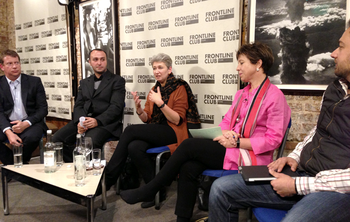
The conflict and humanitarian issues Syria faces is at the forefront of many peoples minds at the moment, this was reflected by the full house that gathered at the Frontline Club’s panel discussion, Communicating about Syria – A humanitarian perspective on 10th October.
Lindsey Hilsum, Channel 4 News’ International Editor chaired a panel which included Hicham Hassan from the International Commitee of the Red Cross (ICRC); Lyse Doucet, BBC Chief International Correspondent; Ben Parker, head of the UN Office for the Coordination of Humanitarian affairs (OCHA); and Fadi Haddad from the Mosaic Initiative for Syria.
Hilsum started things off by asking Doucet to set out the current situation in Syria, where over a million people are now displaced within the country, 50% of which are children.
There can be no doubt that when it comes especially to war we [journalists] take the side of the people. And sadly it’s ugly terrible bloody wars that drag on there’s a lot of people that are affected and Syria is no different…And of all those people that are stuck in the middle one of the other sad realities of the Syrian conflict is that most of them are children.
Parker, who was only in London by coincidence on a break from his post in Syria as head of OCHA then spoke about how the problems in Syria are unlike any he has faced before.
I’ve never in my career spoken less to journalists. It’s a very unusual situation; aid agencies want to talk to the media for three things: 1. Cash. 2. To make sure that the attention doesn’t go away, and 3. We also have advocacy, in the sense that we want the people with power to take a certain course of action. In Syria, none of these three really work. In terms of the course of action, nobody has the answer. And what is the course of action? Stop the violence? ok…We’re heading into unknown territory.
There’s normally criticisms that we’re too tight with journalists… but here I can’t help you [journalists] at all, I can say maybe you should check out that school, but you being associated with me makes your job even harder. The state of Syria feels that the humanitarian people need to be watched just as much as the journalists because they have the potential to delegitimise and confuse and be instrumentalised by hostile forces.
Hassan who is the Middle East spokesperson for the International Commitee of the Red Cross (ICRC) said that the humanitarian aid is not there to solve the problems in Syria:
A very good friend of mine said: “The solution in Syria is not humanitarian because the problem in the first place is not humanitarian; it is political so don’t you think you guys are there to solve the problems.” It is true, we are not there to solve the problem, humanitarian aid is just there to push the limit a bit more and a bit more and a bit more.
Haddad from the Mosaic Initiative for Syria who works directly with human rights defenders and NGOs inside Syria and neighboring countries, gave some insight into how he gets supplies to people in Syria by foot through Turkey, but how even that is getting more difficult.
I’ve been targeted now more than the Free Syrian Army, if they know that there’s a field hospital in a place, they will try to shut it straight away. It’s getting more stressful.
When you’re dealing with these groups you need a good relationship with the local community and this is where journalists have to help us, as they go inside they know these communities so our mission is to work in partnership with them and to work like a middle agent between the international NGOs and the people on the ground.
Melissa Flemming, chief spokesperson for the UN High Commission of Refugees (UNHCR) was in the audience and Hilsum asked her to give her take on the situation. She finished with a final thought about the displaced people of Syria, before the discussion was opened to questions from the audience.
They’ve all lost family and they’ve all got horrendous stories to tell and they’re living in places like Lazatri camp which is inhospitable because of the landscape…It would be like any one of you who is used to living in an apartment having a high standard of living, and from one day to the next having to pick up everything probably having lost a lot and run for your lives across the border and try to make a life for yourself in a tent.
Listen to Lyse Doucet talk about the current state of affairs in Syria:
Listen to Lindsey Hilsum talk about the different kinds of people who have been caught up in the Syrian conflict:
Listen to Fadi Haddad talk about the problems he faces when getting aid to the people who most need it in Syria, he also tells the story of one man he couldn’t get aid to quick enough:
Watch the full event here:
]]>The humanitarian situation in Syria has dramatically worsened over the past weeks and the plight of the Syrian people has drawn international attention and concern as well as condemnation of the Syrian regime. Access to the country for humanitarian organisations has been restricted by violence and insecurity that has killed five Syrian Arab Red Crescent volunteers and staff members in the past 12 months.
There is clearly an obligation for humanitarian agencies and journalists to share their perspectives on the humanitarian situation on the ground to ensure it is understood as clearly as is possible and decisive action can be taken. This must, however, be weighed by many actors against their own concerns of security, access and safety.
Join us to discuss the humanitarian efforts being made in Syria and the many challenges that are faced. How do journalists and humanitarian agencies share information in such a complex conflict situation? We will analyse the balance between openness and the ability to continue to provide vital assistance on the ground in a conflict such as that in Syria.
Chaired by Lindsey Hilsum, Channel 4 News’ International Editor and author of Sandstorm, Libya in the Time of Revolution,
With:
Hicham Hassan, the International Committee of the Red Cross spokesperson for the Middle East.
Lyse Doucet, BBC Chief International Correspondent.
Ben Parker, the head of the UN Office for the Coordination of Humanitarian Affairs (OCHA) in Syria.
Fadi Haddad, director of the Mosaic Initiative for Syria, a non-governmental, not-for-profit organisation working directly with human rights defenders and NGOs inside Syria and neighbouring countries.

Could Multimedia Story-telling be the new journalism? Who are its clients and how can it work commercially?
Brian Storm, founder and executive producer of multimedia production studio MediaStorm, came up with some assured answers during a most informative and positive presentation about journalism and its future at the Frontline Club.
Storm touched upon some ways to structure a multimedia story to make it compelling viewing: establishing empathy with the character(s); using body language, which makes up 80 percent of communication. Storm spoke about ‘back-timing’, having a visual element in the imagery that challenges a statement that has just been made.
Visual sequences should be little essays, moving without extreme cuts from wide to extreme close-up. The viewer’s eyes should be able to stay in the same place and remain on the point of interest when cuts are made. Storm also advised taking tills in the same format as the video, 16:9, to avoid letter-boxing or crops in the edited piece, and as much ruthlessness in editing by subtraction as you would be when selecting your portfolio.
Being passionate about still photography, Storm had been shocked to learn that newspaper readers spend no more than 0,6 seconds looking at an image. Embedding images in a multi media story encourages viewers to engage with photography beyond a cursory glance, he said.
Storm described the four strands of the agency’s work; publication, project specific agency work, production work for others, and teaching online and workshops.
Editorial work for partners has developed as NGOs and non-profit organisation begin to seek partnerships with journalists rather than straight marketing to get their message out. They are more frequently turning to journalists for their skills and are often prepared to pay better rates for projects than regular editorial clients.
A question about photographers ‘crossing over’ raised the issue of video work compromising the stills photography. Storm replied that one needed to allow enough time for ‘hunting’ (getting the right stills) and ‘fishing’ (filming).
]]>