On Wednesday 1 October, several experts told a crowd at the Frontline Club about the unprecedented and horrific impact that the Ebola epidemic is having in West Africa.
The panel — moderated by Ade Daramy, chair and spokesperson for the UK Sierra Leone Ebola Task Force — tackled the international community’s response to the outbreak and assessed the situation on the ground during the Frontline Club’s First Wednesday: The Fight Against Ebola.

From left: Meinie Nicolai, Professor David Heymann, Ade Daramy, Colin Freeman, Dr Ike Anya and Dr Tim O’Dempsey in conversation at the Frontline Club. Photograph: Mackenzie Weinger
“This is an equal opportunity killer,” Daramy said.
In particular, the experts gathered at the Frontline Club’s discussion zeroed in on the damage the epidemic has inflicted on the health workforce.
Dr Tim O’Dempsey, who was seconded to WHO as clinical lead for the Ebola Treatment Centre in Kenema, Sierra Leone, this summer, told the packed house: “One of the things that probably isn’t on the radar at the moment in terms of the impact of Ebola is the impact on the health workforce and the loss of these very valued members of society.”
“Ebola,” he said, “has torn through the health infrastructure.”
And Meinie Nicolai — president of MSF Belgium and MSF’s operational directorate in Brussels, who recently returned from Liberia and Sierra Leone — called both the scale of MSF’s operations and the outbreak itself entirely “unprecedented”.
MSF is continually reinventing its Ebola response and has even done what they “never do”, which is to call for state actors to come in and get involved, she told the Frontline Club. “Throwing money is way too easy.”
The situation on the ground is absolutely devastating, she said. “People are dying at our front door”.
As for the media response, there have been few journalists on the ground covering this crisis, Colin Freeman, the chief foreign correspondent for the Sunday Telegraph, noted.
Freeman — who recently returned from West Africa and said his time on the ground offered “no shortage of dreadful horror stories” — put it down to the fears this particular virus has raised.
“Stories of this sort ring alarm bells in office health and safety managers because I’ve got to come home to the office and then go in and work in a building with 3,000 people. If I get a bullet wound, it doesn’t matter,” he said.
Still, the nature of Ebola does demand that a journalist do his or her job in a very different fashion, he added. “What you have to do is just make sure nobody comes too near to you, which is the opposite of what you normally do when you’re trying to report and get in people’s confidence,” Freeman said.
And Ebola isn’t slowing down.
“The frightening thing for everybody involved in this is the accelerated epidemic that we’ve seen occurring in Liberia,” O’Dempsey said. “That is likely to be mirrored with about a six-week lag in Sierra Leone.”
But there are areas that offer some hope, he said. “The survivors, I think, are going to be a great asset when it comes to the epidemic response.”
As the evening came to a close, Daramy took a moment to remind the crowd that, “Even in the midst of Ebola, people are making jokes.”
“In Sierra Leone, they don’t shake hands, they touch elbows — and they refer to it as ‘elbowla’,” he said, to laughter from the crowd. “And also, they’re saying in the last few days is that if you don’t want to get Ebola, it’s as easy as ABC, which is ‘Avoid Bodily Contact’. So, you know, people can still smile. They can still smile.”
Watch and listen again here:
]]>In late 2008, Daily Telegraph correspondent Colin Freeman and Jose Cendon, a Spanish photographer travelled to Somalia to investigate the recent spate of piracy attacks that were terrorising shipping in the Gulf of Aden. Their aim was to track down some of the pirates and secure an exclusive interview.
They were double crossed by their body guards and what followed was a nightmare 40 days in captivity. Force-marched into the desolate hills they were held in a succession of caves by a gang of armed men, all paranoically high on the amphetamine-like local plant, khat. The gang’s hideout was attacked by rival pirates, Freeman was subjected to mock execution by one of his captors and the threat of being handed over to Islamists who would undoubtedly execute him was constant lingering fear.
Colin Freeman, who is now chief foreign correspondent for the Sunday Telegraph will be joining us at the Frontline Club to discuss his new book Kidnapped: Life as a Somali pirate hostage in which he recalls the experience.
Chaired by Inigo Gilmore, award winning journalist and filmmaker who has worked across the world, with extensive experience in the Middle East, Africa and Asia. He won the Royal Television Society Award in 2011 for his work in Haiti last year, following earthquake.
]]>There are still a few tickets left for this Saturday’s unique opportunity to hear WikiLeaks editor-in-chief Julian Assange in conversation with renowned Slovenian philosopher Slavoj
]]>There are still a few tickets left for this Saturday’s unique opportunity to hear WikiLeaks editor-in-chief Julian Assange in conversation with renowned Slovenian philosopher Slavoj Žižek. The discussion, which will be moderated by Democracy Now!’s Amy Goodman, will focus on the ethics and philosophy behind the work of WikiLeaks and its effect on political institutions globally.
Next week Colin Freeman will be recounting his experience of being kidnapped by Somali pirates and Peter Greste who has recently been in the country for BBC’s Panorama will be talking about the Somali people’s struggle to forge a life in a lawless land.
For July’s First Wednesday, a panel of experts will be discussing the expansion of kill/capture missions in Afghanistan, their effect on the ground and how they level with counter-insurgency hearts and minds strategy.
Follow us on Twitter and catch up on any events you missed on the Forum blog or download our podcasts on iTunes.
ALL EVENTS ARE OPEN TO THE PUBLIC
]]>
Colin Freeman, the Chief foreign correspondent with the Daily Telegraph, talks to ABC News about what it’s like to be kidnapped in Somalia. I’ve posted a snippet of the discussion below. You can see Colin’s initial reaction upon release in the news report above. For a longer analysis of Somalia and what it’s like to be kidnapped in that country, see the video clip from the Frontline Club in discussion with Colin below,
Why Do You Think You Were Taken? Was It All About the Money?
Freeman: We are not sure in our case. We were on land and we were just taken because we were there. Certainly, when you are talking about people at sea, it does seem like it is primarily the crews that they are after, opposed to the cargo. It is kind of opposite to the old days where the cargo would be taken and the crew would be of lesser interest.
Gallego: Tell us a bit about the experience.
Freeman: It was manageable, we were well treated in general, most of the time. As you can imagine it is a frightening experience, mainly because you don’t know what is going to happen. We had a couple of occasions when the pirates became aggressive to us for various reasons, often it wasn’t explained to us why and you are always concerned that you are going to be the unlucky party or people where it all went wrong, where the pirates decide to kill you or they panicked and decided to do something unpleasant to you; and it is that fear of the unknown that dogs you every minute of the day … most of the people of these ships will be going through that, as well.
Gallego: What could you make out about your kidnappers?
Freeman: Not a lot, really. They couldn’t speak English and we couldn’t speak Somali, we only spoke Arabic, which we both could mutually understand but that was not much more than a few words. Some of them were young kids, some of them were not much older than me, around 35 to 40. I think they were desperate people. For example, one told us how they had tried to get to Europe in a people-smuggling boat across the Mediterranean, Italy and Greece. You know they are, people who have not much else to lose in life. Life in Somalia is pretty brutal and pretty nasty. Therefore, risking your luck on the high seas is a pretty logical lifestyle choice to some of them.
Gallego: How did your release come about?
Freeman: I don’t really know there were a lot of people working around the clock for 40 days and 40 nights while we were there, trying to assist us. We had a lot of Somali politicians in Northern Somalia calling for our release. There was a lot going on behind the scenes, some of which I was not party to. I should point out that there are a number of hostages out there and if I discuss that too much, it could prejudice or complicate their chances of getting released themselves. So I would rather not.
How Did You Feel When You Heard You Were Going to Be Released?
Freeman: We made a phone call to an intermediary in London. They allowed us to make phone calls from time to time, and one of them told us, ‘Right now, you are free to go.’ He didn’t say that in English … he said that in Arabic, which is ‘allom,’ which is ‘today’ in Arabic. We had a few false starts before where we were told we would get released, then we didn’t and that gets hard after a time. But on this particular occasion they said yes, then the next day we were driven to a top of a mountain pass with around 50 guys, some of them armed with RPGs [rocket propelled grenades], some with guns mounted on jeeps and so on, a small army of people. Then we were handed to a group of clan elders, who in Somalia often act as intermediaries. There were around eight or nine of them, and then we were driven off to the nearest large town, which is where we had been kidnapped in the first place. link
Freelance journalists Amanda Lindhout and Nigel Brennan remain held as hostages in Somalia some eight months after they were abducted.
]]>Colin Freeman, who was kidnapped in Somalia in November 2008 and held for six weeks, is at the club tonight to discuss his experience and the future for the “failed state” in the Horn of Africa. He’s joined by Mary Harper, a BBC Africa correspondent and Mike Thomson, chief foreign correspondent for the BBC Today programme. As usual we’ll be streaming the event live on the Frontline Club events page and on the Frontline Club live channel, We start at 7pm GMT/11am PST
]]>With a new government in the process of being formed in Somalia, are we going to see a new era of peace and stability after eighteen long years of violence and warlordism? Or does the new Prime Minister Sharmarke – himself a moderate Islamist – now have an impossible task ahead of him in trying to form a unity government and start a dialogue with Islamic militant group Al-Shabab? Will the recent withdrawal of Ethiopian peace-keeping troops simply serve to create more opportunity for the Islamists to cause chaos? And with piracy and kidnapping incidents on the rise, how are journalists to report from Somalia?
We hear from Colin Freeman about his experiences being kidnapped in Somalia last year as well as Mary Harper, Africa correspondent for the BBC on the wider political landscape. link
Six months ago today the first reports came in of the kidnap of Canadian freelance journalist Amanda Lindhout, freelance photographer Nigel Brennan and their fixers and driver. The team were reportedly abducted just outside Mogadishu. The fixer and driver were subsequently released, but Lindhout and Brennan remain hostage.
A ransom demand of $100,000 was recently reported, down from an alleged $2.5 million some months earlier. There were also reports of an attempted escape, but since then there has been no news.
British journalist Colin Freeman and Spanish photographer José Cendón were also kidnapped in Somalia on November 26, 2008. They were reporting on pirates in Bosasso. However they were released some six weeks later. While I hope for a speedy release of Lindhout and Brennan, I do sometimes wonder whether there is one rule for freelancers and one for staffers in these situations.
The above interactive dipity graphic is a timeline of the Lindhout/Brennan kidnap created from news reports. I will continue to update it as and when I receive any news updates.
UPDATE: There is an online petition to put pressure on the Canadian and Australian governments to help to finally pay the bloody ransom and free the two freelancers.
CNN International talk to Colin Freeman and José Cendón about their kidnap ordeal in Somalia. The duo were kidnapped on November 26, 2008 and held for some six weeks. The pair don’t appear to have feared for their lives and seem remarkedly relaxed about their experience, although it seems unlikely they’ll be heading back to that particular part of the Horn of Africa any time soon. No word has been made of any ransom payments in the case
Canadian freelance journalist Amanda Lindhout and Australian photographer Nigel Brennan who were kidnapped in August 2008 are still being held hostage in Somalia. Abdifatah Mohammed Elmi and Marwali, who worked as the duo’s fixer and driver respectively, were released in January 2009. We contine to follow the plight of Lindhout and Brennan on this post. The contrasting experience of the two kidnap cases does make you wonder if there is one rule for freelancers and one for staff journalists.
]]>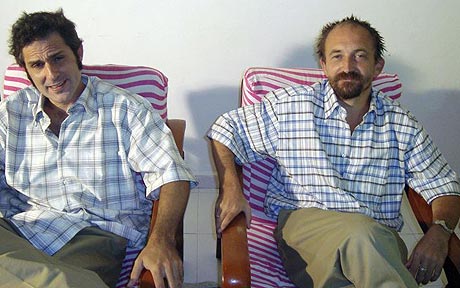
"The two journalists are free after their ordeals," said the head of Puntland police, Abdullahi Said Samatar. "They’re taking some rest now and they will be available later. I’m happy to see them recovering their freedom." link
The release was confirmed by the Spanish government in Madrid, whose ambassador to Kenya was en route to Puntland from Nairobi.
We previously reported on the abductions back in November, but agreed to pull coverage after discussions with those involved in negotiations with the kidnappers. The decision to pull posts I previously published about Colin Freeman and Jose Cendon wasn’t made easily especially after our previous discussion about the Mellissa Fung kidnap case in Afghanistan.
The ongoing saga of freelancers Amanda Lindhout, Nigel Brennan and Abdifatah Mohammed Elmi is always in the back of my mind when linking to these stories. Are freelancers, like Lindhout and Brennan, always at far more risk than their staffer colleagues?
No doubt this is something Sean Langan, Channel 4 journalist, Frontline Club member and recent kidnap victim, will be discussing at the Frontline Club at the end of January. I will be at the event on January 30 and hope to report on Sean’s kidnap in full.
UPDATE: The Daily Telegraph has more,
"We’re absolutely fine and delighted to be out. We’ve absolutely no problems at all ether physically or mentally… We survived on rice, goat meat and Rothmans," said Freeman. "I gave up smoking in 1992 and somehow decided now would be a good time to start up again." link via Press Gazette Twitter.
Photo from the Daily Telegraph.
]]>