THE EXILE tells the extraordinary story of the almost ten years that Osama Bin Laden evaded intelligence services and special forces units, drones and hunter killer squads. Through the eyes of those who witnessed it, Scott-Clark and Levy offer an insider’s account from bin Laden’s four wives and children, his deputies and military strategists, his spiritual advisor, the CIA, Pakistan’s ISI, and many others who have never before told their stories.

Having gained unique access to bin Laden’s inner circle, Scott-Clark and Levy, recount the flight of Al Qaeda’s forces and bin Laden’s innocent family members, the gradual formation of ISIS by bin Laden’s lieutenants, and bin Laden’s rising paranoia and eroding control over his organisation. They also reveal that the Bush White House knew the whereabouts of bin Laden’s family and Al Qaeda’s military and religious leaders, but rejected opportunities to capture them, pursuing war in the Persian Gulf instead, and offer insights into how Al Qaeda will attempt to regenerate itself in the coming years.
The sporadic release of documents by the Defence Department in recent years only represented about 1 percent of the million-plus document trove recovered in Abbottabad. “We need more detail and not less. We require more nuance and understanding if we are to ever tamp down a bloody conflict that threatens the globe,” write Scott-Clark and Levy, “And it is from this place— a desire for a contemporary, complex, untidy, knotted, verbal history, where no one is regular or consistent, and where allies are murderously betraying their friends, in which good men make poor choices, and switch sides, and wives become double agents—that this book begins.” While we think we know what happened in Abbottabad on May 2, 2011, we know little about the wilderness years that led to that shocking event.
Chair- Owen-Bennett Jones

Owen Bennett-Jones is a journalist for the BBC and one of the hosts of Newshour on the BBC World Service. He has reported from over 60 countries, including Pakistan. In this time he gained unprecedented access to interview members of Al Qaeda. In 2008 Bennett-Jones won the Sony journalist of the year award and in 2009 the Commonwealth journalist of the year. He is the author of ‘Pakistan: Eye of the Storm’ (2010) and a contributor to the Lonely Planet’s ‘Pakistan and the Karakoram Highway’. Bennett-Jones is a regular contributor to the Financial Times, the Guardian and the London Review of Books.
Speakers
CATHY SCOTT-CLARK

Is an award-winning journalist, author and film-maker, reporting over the past twenty five years for the Sunday Times, Guardian, BBC and Channel 4 from places as varied as Jordan, Saudi Arabia, Bosnia, Rwanda, Serbia, Russia,, China, Bangladesh, Burma, Vietnam, Thailand, Pakistan, Sri Lanka, Afghanistan and Iran.
ADRIAN LEVY

Is an internationally renowned and award-winning investigative journalist who worked as a staff writer and foreign correspondent for the Sunday Times for seven years before joining the Guardian as senior correspondent. He has reported from South Asia for more than a decade, and now lives in London.
]]>
For this first event of the series we welcome photographer Edmund Clark and counterterrorism investigator Crofton Black, in conversation with Max Houghton, who have assembled photographs and documents that confront the nature of contemporary warfare and the invisible mechanisms of state control.
Since George W. Bush’s 2001 declaration of the “war on terror” until 2008, more than one hundred people disappeared into a network of secret prisons organised by the U.S. Central Intelligence Agency. These so-called “high value detainees” were transferred across the globe on contracted business jets, without legal process – otherwise known as extraordinary renditions. Their movements were never made public. Some were sent to Guantanamo Bay or released; others remain unaccounted for.
In a new volume of work, Negative Publicity: Artefacts of Extraordinary Rendition, Clark and Black have recreated the network that links CIA ‘black sites’ – travelling worldwide to photograph former detention sites, prisoners’ homes and government locations; and assembling a paper trail that exposes the weak points of this unlawful system hidden in plain sight.
This event will be moderated by Max Houghton, senior lecturer in photography at London College of Communication, University of the Arts London. She previously ran the documentary photography MA at the University of Westminster, and edited the photography biannual 8 magazine for six years. She writes regularly on the arts for publications including FOAM, Photoworks, 1000 Words and The Daily Telegraph.
Crofton Black has spent over six years carrying out in-depth international investigations into counterterrorism tactics on behalf of the human rights group Reprieve, the Bureau of Investigative Journalism, and other organisations. He has a doctorate of philosophy from the University of London on the topic of early modern hermeneutics and was formerly an Alexander von Humboldt Fellow at the Freie Universität Berlin.
Edmund Clark is an award-winning photographer whose work links history, politics and representation. His series Guantanamo: If the Light Goes Out (2010), Letters to Omar (2010) and Control Order House (2012) engage with state censorship to explore hidden experiences and spaces of control and incarceration in the global “war on terror.” More recently, with The Mountains of Majeed (2014) he reflects on the end of Operation Enduring Freedom in Afghanistan. He has received worldwide recognition for his work, including the Royal Photographic Society Hood Medal for outstanding photography for public service and the British Journal of Photography International Photography Award. He teaches at the University of the Arts, London. His work is the subject of a major solo exhibition, ‘Edmund Clark: War of Terror’, at the Imperial War Museum from 28 July 2016 to 28 August 2017.


This screening will be followed by a discussion with journalist Ed Vulliamy and Dan Jolin of Empire Magazine.
After rising through the ranks of her male-dominated profession, idealistic FBI agent Kate Macer (Emily Blunt) receives a top assignment. Recruited by mysterious government official Matt Graver (Josh Brolin), Kate joins a task force for the escalating war against drugs. Led by the intense and shadowy Alejandro (Benicio Del Toro), the team travels back-and-forth across the U.S.-Mexican border, using one cartel boss (Bernardo Saracino) to flush out a bigger one (Julio Cesar Cedillo).
Sicario was nominated for 3 BAFTA Film Awards, as well as the Palm d’Or at the 2015 Cannes Film Festival.
Ed Vulliamy is a writer for The Guardian and The Observer. In 2013, he won the award for literary reporting named after the Polish writer Ryszard Kapuściński for his book Amexica: War Along the Borderline, a vivid dissection of the violent US-Mexico ‘war on drugs’.
Dan Jolin is Features Editor of Empire magazine, the world’s biggest movie magazine. He has been working in film journalism since 1997.
Directed by: Dennis Villeneuve
Country: United States
Year: 2015
Runtime: 120′
Rating: R

Since the attacks of 11 September 2001, drones, or as the military prefers to call them “unmanned aerial vehicles,” have winged from an obscure surveillance tool to a central weapon in conflicts in Afghanistan, Iraq, Libya, Yemen, Pakistan and Somalia.
To explain why, investigative journalist and Martha Gellhorn Journalism Prize-winner Chris Woods spoke about his new book Sudden Justice: America’s Secret Drone War at the Frontline Club on Wednesday 15 April with Mark Urban, diplomatic and defence editor for BBC Two’s Newsnight.
Woods, whose work has followed the development of drone warfare since 2011, described speaking with spies, soldiers, victims, and advocates to understand how these remote weapons have affected not only civilians and conventional battlefields, but the legality of secret assassination.
Today, with one in three RAF strikes against the Islamic State carried out by reaper drones, he looked ahead to how the technology will impact warfare in years to come.
A Brief History of Drones
Drones had been in the works for decades before 9/11. But had the attack not happened, the CIA’s Predator drone would probably have been sent back to the drawing board, said Woods, adding that it turned out to be quite good at two things: surveillance and assassination.
“When I spoke with a lot of elderly generals, they told me that there used to be this huge rift between the war fighting bit of the Air Force and the intelligence gathering Air Force,” he said. “They didn’t want to arm surveillance aircraft.”
But that changed when the CIA began using weaponised drones to strike in Pakistan in 2004. “By 2008 they pretty much destroyed Al Qaeda,” Woods said. But “the CIA’s drone program in Pakistan began being used as cover for a much more conventional drone program across the border [in Afghanistan], much more like the bombing of Laos and Cambodia in Vietnam, but under the name of ‘targeted killing’,” he continued.
The CIA “did things in Pakistan that would not be tolerated on a conventional battlefield,” he said, adding that even under Obama “the CIA was deliberately bombing rescuers and mass funerals attended by hundreds of people.”
Is ‘targeted killing’ with drones legal?
Drones were a heavy presence in the 2014 war in Gaza. However, when it comes to ‘targeted killing’ programs the Israelis, unlike the Americans, have worked out a legal framework that went all the way to their Supreme Court.
“The Supreme Court judgment in 2006 was quite interesting and said that assassinations weren’t lawful nor unlawful, each had to be judged on its individual merit,” said Woods.
Watch and listen back:
America, by contrast, has “really blocked the examination of their program at every possible turn,” he said. “And, in fact, the Department of Justice puts ridiculous effort in preventing the U.S. federal courts from engaging on the lawfulness of the American program,” he added, suggesting the assassination program “comes out of that same legal black hole” as Guantanamo and extraordinary rendition.
Under Obama, ‘targeted killing’ becomes “just another plank of American foreign policy,” he said. But “there is still a huge question mark about whether this is somewhere where we want to go,” and, “whether this is somewhere we want other nations to go.”
Where are the drones headed?
In the fight against the Islamic State in Iraq and Syria, US Central Command claim they are not killing civilians. But this feeds into the “fiction of the perfect war” that drones create, said Woods.
In the past, U.S. National Security Council spokeswoman Caitlin Hayden has said “we can’t give guarantees that we’re not going to kill civilians,” said Woods. “I think that’s honest. That’s a grown up way of dealing with it,” he continued. But “in terms of accountability, can we hold the coalition members to account for what’s happening in Iraq and Syria?” he asked.
Proportionally, drones are killing fewer civilians than weapons 20 years ago, “and a hell of a lot less than we were 50 years ago,” Woods argued. But it’s a challenging question to answer whether this has an impact on radicalisation. “That is the problem, and we just don’t know what the implications of that will be ten years, 20 years down the line,” he said. “We’re telling a lot of people we’re doing the right thing at the moment without really knowing what we’re doing. We may yet reap what we’re sowing.”
]]>
Jesselyn Radack and Thomas Drake
Whether they spoke out against torture or mass surveillance, government officials who blew the whistle on the deplorable changes made to U.S. legislation after the 9/11 attacks have been left bankrupted, broke and broken.
The documentary Silenced, directed by James Spione and screened at the Frontline Club on Monday 9 March, follows the cases of three prominent whistleblowers who confronted and made public the unlawful practices of U.S. authorities.
Focusing closely on former CIA analyst and case officer John Kiriakou who spoke out against the CIA’s use of torture, Silenced shows the impact on Kiriakou and his family in the lead up to his nearly two year imprisonment, which ended in early February 2015.
In a Q&A following the screening, two of the film’s protagonists – activist and retired NSA executive Thomas Drake, and former DOJ Ethics Advisor Jesselyn Radack, director of National Security & Human Rights at the Government Accountability Project – discussed their struggles as whistleblowers and how journalists can help foster change.
.@SilencedFilm @frontlineclub Q&A: knowing what you know now would you do it again? @Thomas_Drake1: yes, but I’d go to the press earlier.
— Jen Robinson (@suigenerisjen) March 9, 2015
What Could Have Been Done Differently?
Thomas Drake said that both he and the government should have done things differently before and after he blew the whistle on the dubious legality of NSA dragnet surveillance. “I would have gone to the press a lot sooner,” said Drake.
“Despite the huge personal costs, what price do you put on freedom and liberty? We don’t have to forsake the future of freedom and liberty for all. Are there threats to civil society? Yes. It doesn’t mean that we turn everybody into suspects, even if it’s virtual. What it means to be free and what it means to have liberty means more to me now than ever.”
He responded to an audience question about how methods of surveillance could be changed to protect privacy. “You certainly don’t have to go outside of the constitution,” Drake said. “The U.S. unchained itself. Because they had failed to protect Americans, they decided they would unchain themselves from the rule of law. Five days after 9/11, Cheney said ‘we’re going to the dark side.’”
Both before and after bulk surveillance was introduced, Drake said he had continuously advocated for the use of a program called ThinThread, which would have protected the privacy of American citizens.
Foundation of Courage
Much has changed since Radack and Drake first spoke out, not least of which are the mass surveillance revelations by Edward Snowden, who brought international attention to the act of whistleblowing.
Radack praised the establishment of the Courage Foundation last year, set up to help financially support whistleblowers as they navigate the expensive court cases that stem from their revelations. “That foundation is now supporting legal defence for [Edward] Snowden, other clients of mine, other clients of other attorneys. None of that existed back when I blew the whistle and when Tom and John were going through their ordeals,” she said. Even if a whistleblower is found ‘not guilty,’ Radack added, “it’s very hard to recover,” and “there’s still such a price” financially.
Panel discussion with two of the “Original 7 #Whistleblowers” who were prosecuted under #Obama @frontlineclub pic.twitter.com/RiIOrpgBeH
— Luigi Rappallo (@LuigiRappallo) March 9, 2015
Double-edged Media
The media is both a key aspect in “demonising and vilifying the whistleblower,” Radack said, and at the same time their “saving grace” since “robust investigative journalism has been a tremendous help to whistleblowers.”
Whistleblowers “are always painted as being out for fame, or profit, or revenge,” she said. “Some journalists in the U.S. act more like the government lapdog than the government watchdog. And they very much care about maintaining their contacts.”
But the war on whistleblowers is really a backdoor war on journalists, Radack maintained. “There’s been a war on whistleblowers, a war on journalists, a war on hacktavists, and an overall war on information… because information is the currency of power, especially in the digital age.”
When leaks come from official sources, such as in the recent Hillary Clinton email controversy that has seen the former Secretary of State release State Department emails to the public, and former CIA Director David Petraeus’ leak of classified material to his lover, “they’re very self serving,” said Drake. “Whistleblowing is done in the public interest. The whistleblowers, the truth tellers, are really the canaries in this democratic liberty and freedom coal mine.”
Visit the Silenced website for more information on the film and upcoming screenings.
]]>What happened to the man who exposed the CIA’s use of waterboarding? And what are the consequences of making public illegal intelligence gathering techniques by the US government? In this revealing documentary, three prominent whistleblowers explain the radical changes that occurred following 9/11.
John Kiriakou (former CIA), Thomas Drake (former NSA) and Jesselyn Radack (lawyer and former ethics consultant to the American Department of Justice) talk candidly to filmmaker James Spione about their leaks: how they made public the illegal criminal practices of their own government and faced a choice between career and conscience that put their very lives at risk.
Following their revelations they were fired, isolated, cast into a financial abyss and even tried and incarcerated. The stories of these whistleblowers are told through interviews, excerpts from media appearances, official documents and re-enacted scenes. Spione’s film shows how the world view of this courageous trio changed forever. In the words of John Kiriakou, “I’m not sure anymore who the good guys are.”
Directed by James Spione
Duration: 104′
Year: 2014
On 2 May 2011, America’s public enemy number one, Osama bin Laden, was killed by Navy SEALs in a compound in Abbottabad, Pakistan. The raid only lasted 40 minutes, but the hunt for bin Laden took two decades.
For 20 years, a small team of female agents known as “The Sisterhood” tracked the activities of al-Qaeda. They were trying to take down bin Laden before most of us even knew his name. Piecing together scraps of intelligence, they uncovered a secret terrorist organisation, al-Qaeda, and warned Washington of this new impending threat. Their warnings were repeatedly ignored, until the 9/11 attacks, when all the rules changed.
In Manhunt, director Greg Barker takes the viewer through the process that eventually led to the discovery of the world’s most wanted terrorist, giving a peek into the hidden world of the US intelligence community, which turns out to be populated by ordinary people wondering whether waging war is really part of their job description.
Directed by Greg Barker
Duration: 103′
Year: 2013
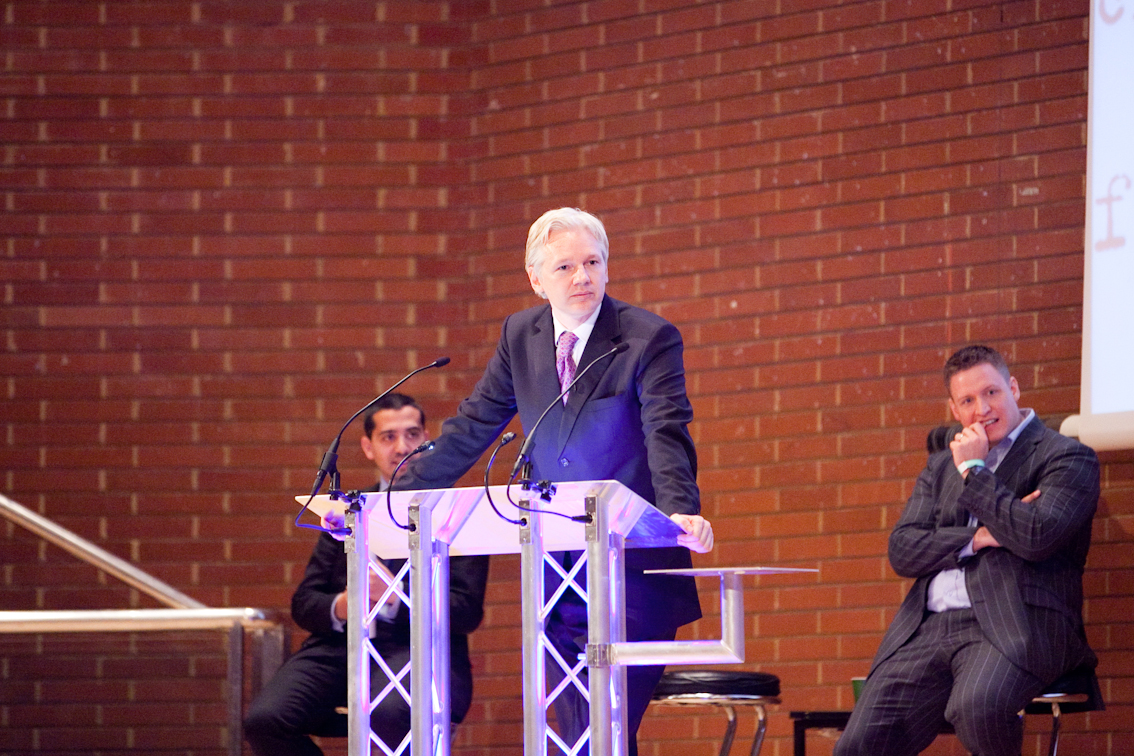
WikiLeaks editor-in-chief Julian Assange makes his case at Kensington Town Hall. Photo by Sophia Spring.
You can view the full event here.
This is part II of our report on the special debate, “whistleblowers make the world a safer place,” organised by the Frontline Club in collaboration with New Statesman magazine. Part I can be found here.
Bob Ayers
It was always going to be fascinating seeing former CIA agent Bob Ayers share the stage with Julian Assange. It is well documented that the WikiLeaks editor-in-chief has been trailed by intelligence agents many times before – but rarely has he engaged with one head on in a public debate.
Ayers, now an international security analyst, spoke quietly and calmly. His argument was nuanced, raising his voice only briefly at one point to tell Assange to “sit down” as he attempted to make an interjection. “As people, we’ve developed a very rich language that describes people who reveal secrets,” he said. “We call them a ‘snitch’, a ‘rat’, a ‘squealer’, a ‘traitor’ or a ‘whistleblower’.”
Unlike his fellow panelist Sir David Richmond, Ayers made no concessions. His argument appeared critical of anyone who broke what he repeatedly referred to as “an oath.”
Reaching his conclusion, he seemed to take a veiled pop at Assange and WikiLeaks, asking: “Individuals, or organisations, who encourage us to break that oath, or facilitate our breaking of that oath, or promote us breaking that oath … are they just as guilty as the person who breaches the oath itself?”
The whistleblowers
After Ayers, there was a brief interlude for the input of two prominent whistleblowers, Paul Moore and Annie Machon. Machon, an ex-MI5 agent who in 1996 revealed, among other things, an illegal MI6 assassination attempt against Colonel Gaddafi of Libya, was first to talk about her experiences. Machon spoke about her shock at uncovering criminality within the British intelligence services and said revealing the information to the public was the right thing to do. When challenged by Douglas Murray over signing the Offical Secrets Act, she quickly retorted: “We signed the Official Secrets Act to protect secrets, not crimes.”
Former head of risk at the bank HBOS, Paul Moore was next. Moore spoke out in 2009 after being made redundant for blowing the whistle on alleged recklessness at HBOS. Quoting the bible, he said that whistleblowers are necessary as we are “transformed by truth”. Expressing his disapproval that a whistleblower was not on either panel, Moore also blew a whistle on stage in protest. “Whistleblowers prevent disasters but they get treated like toxic waste or lepers,” he said.
Questions
After contributions from the whistleblowers, chair Jason Cowley read out a question submitted by the audience. The question was based on a common criticism leveled against WikiLeaks – that the information they have published could, in some instances, put lives at risk. What about the “collatorial damage”? Cowley asked Assange.
The 39-year-old Australian stepped forward and confidently proclaimed his belief that “WikiLeaks has never got it wrong”. The Pentagon, Assange said, had more blood on its hands than WikiLeaks.
(Assange then told the audience to Google “Pentagon” and “blood on its hands”, and compare the results with “WikiLeaks” and “blood on its hands”. It is a far from scientific measure, but interesting nonetheless … the WikiLeaks search gets around 30,000 results and the Pentagon 125,000.)
Mehdi Hasan
Next to take centre stage was Question Time heavyweight, New Statesman senior editor and Ed Miliband biographer Mehdi Hasan. A natural orator, Hasan’s passionate speech was immediately hailed on Twitter as the best of the evening (even before the final speaker, Douglas Murray, had got his chance to speak).
Hasan began by talking about Joe Darby, the former US soldier who exposed horrendous abuses of Iraqi prisoners at Abu Ghraib prison in Baghdad. Quoting Darby, he recounted: “’They say ignorance is bliss, but to actually know what they were doing – you can’t stand by and let that happen’ …
“That is what whistleblowing is all about,” said Hasan, “and that is why it is so important.
“In a perfect world, of course we wouldn’t need whistleblowers, we wouldn’t want whistleblowers. But, surprise surprise, we don’t live in a perfect world … We live in a very imperfect world, where out governments and others lie to us, repeatedly.”
He continued: “They engage in corrupt backroom deals, they break the law at home and abroad and then they demand our trust … and then they say, ‘well you don’t need whistleblowers’ … well stop lying to us and we won’t have any whistleblowers!”
Hasan then questioned the political right’s fear of whistleblowers, urging support for the motion “whistleblowers make the world a safer place” for the sake of the whistleblowers themselves.
“Whistleblowers empower us all by exposing the truth,” he concluded.
Douglas Murray
A ubiquitous commentator, author and journalist Douglas Murray is often touted as the UK’s only neoconservative. Murray began slowly, building up his argument towards a gradual crescendo.
At first he acknowledged there were flaws inherent in western democratic governments. “It is perfectly true that democracies and democratic governments can be and in most cases are at some point dishonest,” he said, “and yes, they can be corrupt.”
Reiterating a similar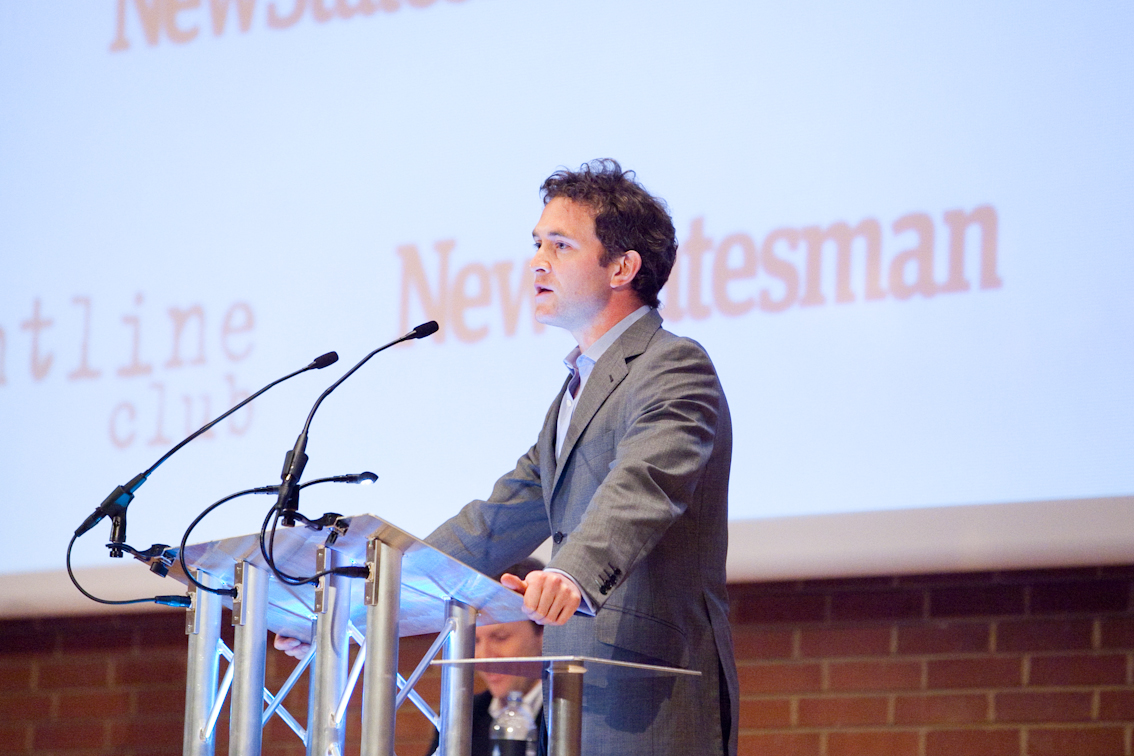 line of argument taken by his fellow panelist Sir David Richmond, Murray spoke about “checks and balances” and said he didn’t believe it should be up to “leakers” to decide what we know.
Looking at Assange, he then went on the attack. “Do the leakers – do WikiLeaks – know what they’re doing?” he asked.
“My own personal feeling is this: when you unleash thousands and of documents that were never meant for the public eye, were never meant for your opponents eyes, were never meant for foreign intelligence agencies eyes – you introduce an element of chaos. It’s like war. It’s very hard to contain once you start it. You may think you know what you’re doing … but what about the collateral damage in your campaign.”
Straying from the discussion about whistleblowers, Murray rattled off a number of questions in Assange’s direction. He asked why WikiLeaks has never
exposed wrongdoing in countries such as Russia and asked about WikiLeaks sources of funding.
“Who works for you?” Murray asked. “Who are you involved with? Where are you even based? …
“What gives you the right to decide what should be known to governments and what should not?
“Governments are elected. You, Mr Assange, are not.”
Midway through his speech, each member of his opposition – Assange, Swisher and Hasan – attempted to make an interjection, but were sent back to their places by a firm Murray.
Assange was eventually allowed to make a ‘point of information’ when Murray repeated a claim – made by the Guardian’s David Leigh – that he had stated Afghan informants deserved to get killed.
Assange said he was taking legal action over the remark, and asked Murray if he wanted to “join the cue” of those he was suing. (Note: David Leigh has since stated there has been no law suit filed against him or the Guardian.)
Cowley then asked Assange: “Should the great champion of open society use libel law to sue newspapers?”
Assange responded: “Lies have no social utility, the truth has a social utility. The abuse of libel laws is a terrible thing. That is why I was involved in constructing the world’s strongest libel legislation, in Iceland, to protect us all from the abuse of libel laws, and have complained constantly here in the UK.
“But actual lies, by powerful organisations that abuse the size of their megaphone in the industry, must have recourse. And that recourse is in the courts and in the court of public opinion.”
By the time Murray neared the end of his speech, there was little time for more contributions or points of information. He accused Assange of thinking he was “better than our governments”, to which someone in the audience retorted, “that’s because he is!”
Moments later, due to the delays at the start of the event, Assange was forced to leave the stage early in order to meet the conditions of his bail. A vote was cast while he was still on the stage, which showed little change in the audience’s opinion.
The motion, “this house believes whistleblowers make the world a safer place,” was passed overwhelmingly and the debate was concluded.
Many thanks to all those who came along and made the event a great success!
Full video footage coming soon. All photos by Sophia Spring.
Citing an Al Qaida statement, they say: Abu Dujana al-Khurasani (real name Hammam Khalil Abu Milal) ‘the famous propagandist and writer on the jihadi forums,’ carried out the attack in Khost which left at least eight Americans dead.
The news that the suicide bomber was a regular contributor to jihadi forums has apparently caused a frenzy on message boards.
Jihadica say the incident "is sure to galvanize the online jihadi community, and would represent the most dramatic case to date of the potential for virtual-to-actual jihadi activism".
]]>US intelligence, he argued, is overly focussed on the enemy, unable to answer basic questions about local political, economic and cultural dynamics and is "only marginally relevant to the overall strategy". He also claimed that US military culture was "emphatic about secrecy but regrettably less concerned about mission effectiveness".
The fact that the report was published via the Center for a New American Security (CNAS) rather than through conventional military channels has also raised a few eyebrows.
I’ve selected a couple of interesting blog posts on the report which understandably has invited a significant level of comment:
1. Tim Lynch runs an Afghanistan based security firm. He’s a retired Marine and is not too keen on the intelligence techniques of the CIA in Afghanistan:
"Our vaunted CIA never leaves the wire under any circumstances even in tame places like Jalalabad so all their intel comes from people who walk into the FOB’s. How good is the product they are producing using these risk averse intelligence gathering techniques and procedures? It is worthless – or as the general in charge of military intelligence put it ‘marginally relevant.’"
(It’s worth visiting Lynch’s blog just to check out the slightly alarming comment under a photo of a guard searching people entering a British base in Helmand).
2. Similarly, this civilian advisor based in Regional Command South reckons the authors of the report are spot on:
"There’s lots of information out there about the civilian population in Afghanistan. Where is the closest market? What are the roads like between here and there? Is there a district governor? Does he come to work? What tribe is he from? How many people get “night letters” from the Taliban? Who “controls the night?”
But the problem is that the people who are supposed to collect and analyze intelligence don’t think those questions are important."
3. The Small Wars Journal has a good list of other posts if you’re interested.
]]>