On the release of his new book Holy Lands: Reviving Pluralism in the Middle East, we will be joined by writer and Jerusalem correspondent for The Economist Nicolas Pelham – and others – to discuss his optimistic and vivid reportage that spans the region, from Israel and Palestine to Bahrain and Saudi Arabia. We will discuss the roots of today’s sectarian tensions and how they have come to characterise the region as a whole – often without a full recognition of historical context, socio-economic factors, or the rich differences of the countries contained within it. We will look to the future and assess hope for a recovery from conflict and a return to religious plurality.
This event will be chaired by Iraqi-British journalist and political analyst Mina Al-Oraibi, a senior fellow at the Institute of State Effectiveness and a Yale World Fellow. She is a member of the Global Agenda Council on the Middle East and has written extensively on US and European policies in the Middle East, in addition to conducting several high profile interviews including with US President Barack Obama and Iraqi Prime Minister Haider Al-Abadi.
The panel:
Nicolas Pelham is The Economist’s Middle East correspondent, and a writer on Arab affairs for the New York Review of Books. He spent five years as a senior analyst for International Crisis Group, covering the growing power of regional national-religious movements in Iraq, Lebanon and Israel/Palestine, and has worked as a consultant for the United Nations in Gaza. He was The Economist’s correspondent in Iraq during the 2003 American invasion and in the Maghreb. He is the author of A New Muslim Order (2008), which maps Shia resurgence in the Arab world, and co-author of A History of the Middle East (2004).
Patrick Cockburn is an Irish journalist who has been a Middle East correspondent since 1979 for the Financial Times and, currently, for The Independent. He was awarded Foreign Commentator of the Year at the 2013 Editorial Intelligence Comment Awards, and is the author of several books on Iraq’s recent history, including The Occupation: War and Resistance in Iraq, Muqtada Al-Sadr and the Battle for the Future of Iraq and most recently The Jihadis Return: Isis and the New Sunni Uprising.
Safa Al Ahmad is a Saudi Arabian journalist and filmmaker, and joint winner of the 2015 Index on Censorship Freedom of Expression Award for Journalism. She has been reporting on Yemen since 2010, and was one of only a handful of journalists reporting from inside the country for a Western news organisation as the crisis escalated. She has directed numerous documentaries for the BBC and PBS, including Al Qaeda in Yemen: A New Front (2012), Saudi’s Secret Uprising 2014), and more recently, Yemen Under Siege (2016).
Firas Abi Ali is a Senior Principal Analyst for IHS Country Risk, with a focus on forecasting political and violent risks in the MENA region. His expertise includes Islamic finance in Syria, Lebanon, Libya and Egypt, with a concentration on political stability and the rise of Islamist militant groups, as well as the likely evolution of conflicts and ensuing risks across the region. He makes regular appearances in the media, including interviews with Reuters, Bloomberg, the BBC, Newsweek and CNN.
]]>On Monday 26 October, renowned Egyptian writer, feminist and activist Nawal El Saadawi joined journalist Wendell Steavenson and a packed audience at the Frontline Club for a discussion that spanned the topics of linguistic philosophy, feminism and globalisation – all of which were explored in the context of El Saadawi‘s own life experiences and recent developments in Egyptian politics.
Sitting in same room as legend #NawalElSaadaei @frontlineclub pic.twitter.com/93hzphE6My
— Nahla Al-Ageli (@NahlaInk) October 26, 2015
The discussion began with a focus on the United States’ continued military aid to Egypt. This was something El Saadawi felt passionately against, not just in Egypt’s case but on a global level. “Fair trade, not aid,” she said.
“The 2011 revolution was hijacked by the United States working with Egyptian politicians. Hilary Clinton came to Tahrir Square as soon as the revolution began. Why?”
The conversation then moved onto the subject of globalisation, and how colonising powers have always played the game of “divide and rule.”
El Saadawi expanded: “When Sadat and Reagan came, they brought the Muslim Brothers. Why? They wanted to fragment the country by religion. They wanted to fragment the country by class. They wanted to fragment the army. What is the difference between Syria and Egypt now? Syria is completely fragmented, because the army is fragmented. And this is why we are unified in comparison. This is why the Americans are against Sisi.”
When Steavenson questioned her about the way the Egyptian government has been punishing members of the Muslim Brotherhood with imprisonment and death sentencing, El Saadawi said: “I am against the death penalty. I am against putting anybody in prison. I am against all that. But I am also against a religious state. Whether Islamic, Jewish, or Christian. We cannot have true equality in any religious state, because all religions oppress women.”
She continued by explaining the extent to which gender inequality has been rooted in religion: “In the three major monotheistic religions, Adam was set free as an innocent, while Eve was a sinner because she ate from the tree of knowledge. Women are not expected to be equal. Why do you think I’ve had three husbands? Because they hated my intelligence. They wanted a stupid woman.”
Even though El Saadawi‘s main work and research focus revolves around injustice, she revealed her enduring optimism in the face of adversity. “I am always optimistic. I learned very much about this in the experience of prison. The women I was with were very pessimistic, because Sadat told us he will kill us. So every day they woke up crying, and I started dancing. I told them we will live and be free; just to have that idea gave me hope. When you have hope, you inspire people with hope, and hope is power. In the worst situations, I am hopeful.”
Steavenson asked about the moment when her sense of justice came into being, and why she initially became motivated to challenge injustice.
El Saadawi explained that when she was 7 and 8 years old, she felt something was not right in the way that she was treated in comparison with her brother. Her older brother was lazy and spoilt, whereas she was hardworking and neglected.
“During Eid, I received half the money that my brother received in gifts. I asked my parents why. They said because God said so. They thought they would shut me up by saying ‘God’. So my first letter ever when I was 8 years old was to God, but I still haven’t got an answer!”
]]>Download this episode
View in iTunes
By Nicky Armstrong
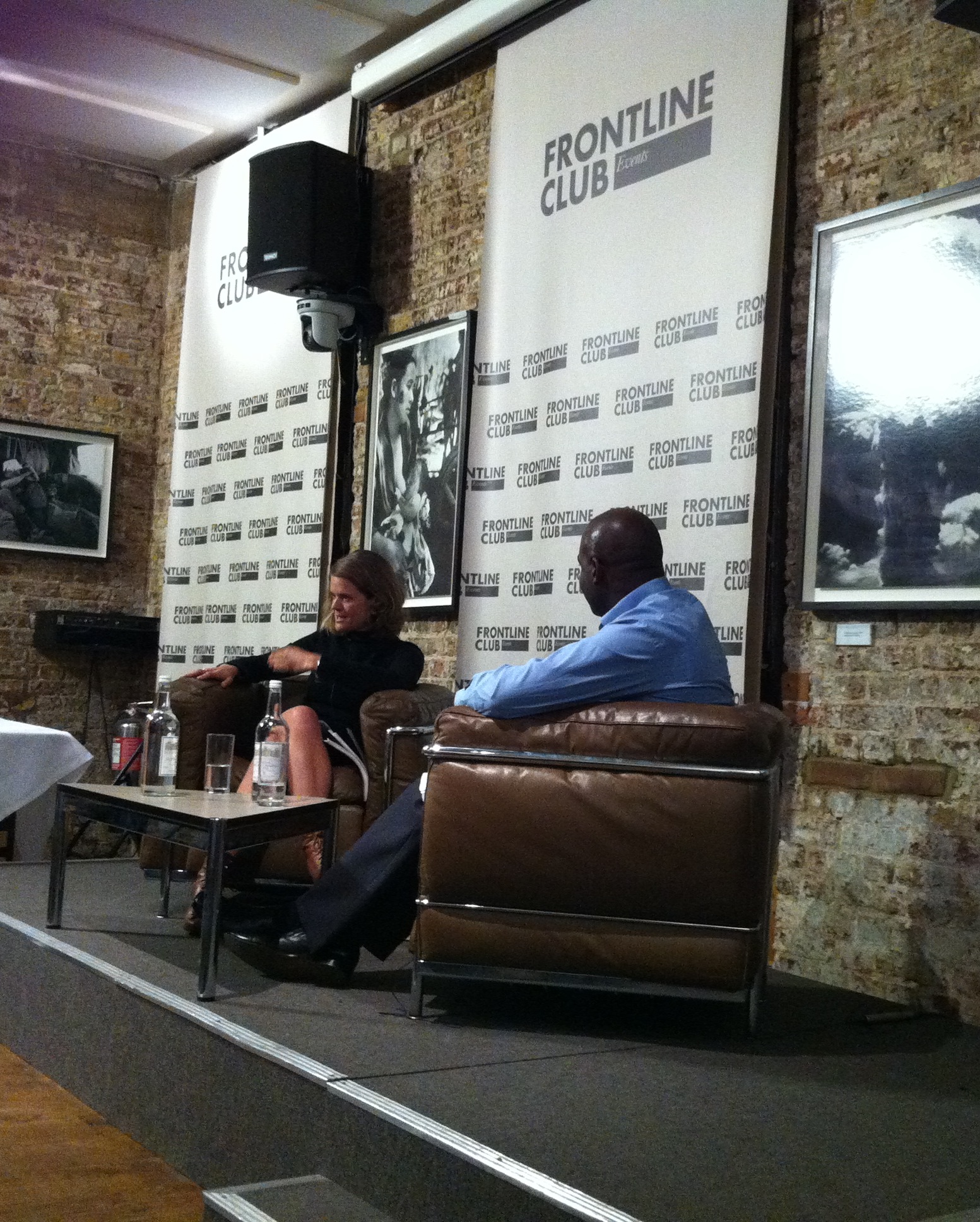
Solomon Mugera, the BBC’s Africa editor began by describing the balance where Islam and Christianity collide as ‘a delicate pendulum’. For the past seven years award-winning journalist and poet Eliza Griswold has travelled 9,000 miles along this line of collision known as the Tenth Parallel, meeting the people living on this divide between North and South, hot and wet, Muslim and Christian; observing how religion plays into their daily lives and why it is a cause of conflict. Starting West in East Nigeria, Sudan, Somalia, Ethiopia and Kenya and then across the Indian Ocean to Indonesia and the Philippines.
Griswold recounted stories of people she had met – speaking of Dr Hawa Adbi a soviet trained gynecologist in Somalia who turned her small family run farm into a refugee camp for 100,000 people.
“She has run this camp for the past 20 years, and just last week, al-Shabaab, the militant group in Somalia came and took part of her land and took thousands of children to rally in the name of al-Qaeda to show that these children supported [them]. Dr Abdi is right now trying to wrestle with holding onto what used to be her own family farm”
Griswold’s study has followed the journey of religion, the routes of Christianity and how Islam has spread further south in Africa. On the reason for conflict Griswold talked of many interrelated factors that must be bought to bear regarding religious conflict.
“I didn’t find one single so called religious conflict that didn’t have a worldly or secular trigger, not one, whether that was a fight over land, oil, water, a political election or even chocolate”
The loss of identity through religion being forced upon people has fractured its routes, radicalising it and twisting it into a form or power often being used politically, turning democracy and politics into a ‘numbers game’.
“National identity was superimposed by a colonial administrator and it never made any sense, so what other forms of identity do make sense? Well it means nothing to be a Nigerian because the nation means very little; nation means even less if you think that government is embezzling between 4 – 8 billion dollars a year, so government is corrupt, not just absent and you have to survive against your government[….] the way in which people ensured their right to mutual survival was through identity”
Griswold ended the event by commenting on the idea of collective identity and how this could affect the future for religion and conflict
“What does it feel like to be more than one person at one time and to wear those identities lightly”
Watch the whole event here:
]]>
Join us to discuss Africa's fault line with New York Times bestseller
From Senegal in the West to Somalia in the East runs a fault line, ‘the knife edge where Islam and Christianity meet’. This area of land separates the continent’s 400 million Muslims from its 500 million Christians.
In her New York Times bestseller The Tenth Parallel: Dispatches from the Fault Line Between Christianity and Islam, award-winning journalist and poet Eliza Griswold spent seven years exploring the relationship between religion and conflict along this circle of latitude 10 degrees north of the equator.
Religious beliefs are deep rooted and in areas such as Northern Nigeria this fault line has seen violent clashes between Muslims and Christians. But many believe this fault line presents a chance to develop peace and prosperity between faiths.
Join us to discuss Africa’s fault line with:
Eliza Griswold, award-winning journalist, poet and author of New York Times Bestselling and 2011 Anthony J. Lukas prize winning The Tenth Parallel. She is currently senior fellow at the New America Foundation and former Nieman Fellow at Harvard University. She reports on religion, conflict and human rights. Her reportage and poetry has appeared in The New Yorker, The Atlantic Monthly, The New York Times Magazine, Harpers, The New Republic, among many others.
Chaired by Solomon Mugera, the BBC’s Africa Editor.
Picture Credit: Seamus Murphy
]]>