By Nicky Armstrong
Last night’s event at the Frontline Club saw a heated debate between the expert panel and the audience on the UN’s presence in Darfur. Chaired by Patrick Smith, editor of Africa Confidential, the discussion bought up many of the tangled complexities surrounding the conflict in Darfur. With the recent expulsion of the former UN head in Sudan and tensions rising in the Nuba mountains the UN has come under scrutiny, charged with failing the people of Darfur.
The discussion opened with Sir John Holmes, a former British diplomat and UK ambassador for France and Portugal. He claimed the UN had been given an impossible task dealing with a political system that was obstructing the UN, recounting the situation when he first arrived in Sudan:
“There were still regular attacks on villages by the Janjaweed, there was tribal fighting of different kinds, occasional rebel attacks form these forces and a very unstable security situation…the overall security situation was stuck, it wasn’t really moving, it was stagnant, there was no real progress and frankly it stayed that way throughout my time and its pretty much the same way now.”
Dr. Mukesh Kapila CBE went on to discuss the failures of not only the UN but of a collective failure on behalf of the international community:
“My journey did not start in 2003, it began exactly 10 years before in Rwanda…and there I saw for myself what happens when an international response system basically implodes because there are contradictions…if there is a failure it is a collective failure…this is all extremely relevant to why we failed in Darfur…. all the lessons of enquiry on Rwanda which were big enquiries of the system and produced a big report, all of [these] were forgotten.”
The deafening silence from the UN and lack of response to memos was described as an ‘amnesia’ from the very top as they remained seized up on the matter of Darfur.
Dr Ahmed Al-Shahi offered his opinion on why the UN has failed. When asked who was the principal author by an audience member, Al-Shahi went on to describe a number of factors, but it was apparent that a lot of the problems lay with the political system under President Omar Al-Bashir and his regime in Khartoum.
China’s involvement in Darfur and why the UN is not reacting as it has recently in Libya were just some of the issues raised. It seems the issue of Darfur shall remain complex, with the situation not reflecting well on the UN.
Mukesh made a poignant closing statement:
“The UN should honestly admit its failure and its paralysis, for the reasons we have been debating. But it’s a mother bearing child relationship, you can’t make yourself redundant, what it should not do is be false prophet, launch misleading missions, which distract and bring false hope…I think we should be honest, that’s what I am saying and I think the UN is bound to fail…we are talking about the 21st century with twitter and globalisation and we are dealing with an instrument that I think is a relic to the Second World War, and conflict after conflict it has proven that it can’t succeed.”
Click Here to read the Amnesty International 2011 Sudan report.
]]>

Join us at the Frontline Club to discuss the actions of the UN and whether they are still failing Darfur.
]]>https://soundcloud.com/frontlineclub/nine-years-on-is-the-un-still
Since the start of the 2003 conflict in Darfur, questions have been raised about the role played by the United Nations and the viability of its mandate.
With the recent expulsion from Chad of the former UN head in Sudan during the original outbreak of violence in Darfur, and the crisis edging towards its first decade, is there any more that the UN can do? Or has the situation reached a level that is beyond resolution?
After the UN came under fire for not having done enough to help civilians during recent attacks, we will be discussing how the enduring situation in Darfur reflects on the UN.
Join us at the Frontline Club to discuss the actions of the UN and whether they are still failing Darfur. What could be done to reduce the possibility of future failures?
Chaired by Patrick Smith, editor of Africa Confidential.
With:
Dr. Mukesh Kapila CBE, former Under Secretary General, National Society and Knowledge Development for the International Federation of Red Cross and Red Crescent Societies based in Geneva. He has worked extensively in the Sudan where he was previously UN Humanitarian Coordinator and UNDP Resident Representative. He is Special Representative for The Aegis Trust.
Sir John Holmes, a British diplomat for over 30 years, serving as the UK’s Ambassador to France and Portugal, and as Overseas Adviser to both Tony Blair and John Major when Prime Minister. He was Under-Secretary-General for Humanitarian Affairs and Emergency Relief Coordinator at the United Nations in New York from 2007-2010, and visited Sudan five times during that period. He is now the Director of The Ditchley Foundation.
Dr Ahmed Al-Shahi, Research Fellow and Co-founder of the Sudanese Programme at St Antony’s College, Oxford University.
In association with the Aegis Trust.
Image Credit: Babasteve / Flickr
]]>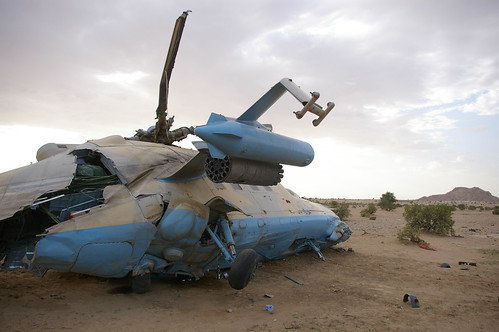
Crashed Chadian helicopter. David Axe photo.
by DAVID AXE
On April 16, a Chadian helicopter with at least three people aboard crashed in Adre, a town abutting the border with Sudan in the desert region shared by the two countries. One person died in the crash, while two were injured. The incident was an unwelcome reminder of five years of conflict between the two impoverished nations — even as that conflict finally shows signs of winding down.
On April 17, the two countries re-opened their official border crossings. “Sudanese taxis are going back and forth and so are the people,” a government official in Adre told AFP.
Until a dramatic thawing in tensions that began this winter, Chad accused Sudan of harboring rebels aiming to bring down the government in N’Djamena. Likewise, Sudan accused Chad of aiding insurgents targeting Khartoum. Both sides relied heavily on helicopters to pursue rebel groups in the expansive desert border region, helicopters those rebels have sought to shoot down to register their resistance.
Rebels apparently downed a Russian-built Chadian gunship back in 2008, injuring the two Ukrainian mercenaries at the controls. Just last month, rebels in Sudan’s western province of Darfur claimed to have destroyed two Sudanese helicopters. So there might have been a moment when observers feared the crash in Adre was also the work of insurgents — and a potential blow against a fragile peace. After all, there had reportedly been “many bandits” around Adre, according to Mahamat Tahir Issa, an independent Chadian correspondent.
It turned out the helicopter crash was “an accident,” Issa said. “Everything is quiet for the time being.” But political complications and continuing security concerns, on both sides of the Chad-Sudan border, threaten the newborn peace.
]]>
By DAVID AXE
Tribal fighting in South Sudan killed nearly 200 people on Sunday. Murle tribesmen reportedly attacked an encampment of refugees from the Lou Nuer tribe, killing 185, mostly women and children, but also including soldiers from the Sudan People’s Liberation Army, the U.S.-backed armed force of the breakaway Government of South Sudan. The soldiers were assigned to protect the refugees.
So far this year, more than 1,000 people have died in fighting over farmland and pastures. A persistent drought affecting all of Central Africa means there is less and less acreage to support crops and animals. The violence has a domino effect. Fighting over one parcel of land displaces thousands of local residents: 50,000 were scattered when the Murle and Lou Nuer did battle in March. The refugees settle somewhere new and begin looking for farmland and pastures. This puts them at odds with the locals, who have probably already claimed all the good ground. Fighting results. The losers flee, and set in motion the same tragic phenomenon in a new area.
This problem is not confined to South Sudan. We see it in Chad and Central African Republic, as well — and similar tension over resources has helped fuel the Darfur crisis, as well. Borders mean little to famines and clans.
Simply put, there are too many people in Central Africa, and there’s too little viable land. The absence of strong institutions to mediate conflict means many confrontations over land escalate into bloodshed. Breaking the cycle requires establishing government that can forge compromise between clans, enforce stability, and begin eeking more out of Central Africa’s dwindling arable land.
In Chad, the U.N. has stepped in to mediate clan conflicts. But that’s easier said than done. Most U.N. operations in Central Africa fall under the umbrella of the High Commissioner for Refugees, whose mandate is to care for refugees. That means the U.N. provides land, equipment and agricultural services to displaced peoples, but not necessarily to non-displaced people. That gives refugees an advantage over native populations on local markets. In southern Chad, the U.N.-assisted refugees began putting local farmers out of business last year. The tension got so bad that the U.N. had to begin offering services to non-refugee populations, too, just to level the playing field.
In Central Africa’s “vortex of violence,” even trying to help, can hurt. The only thing that might offer broad relief, is rain. But global climate change might have permanently altered the region’s weather patterns. The current drought might be permanent. And that means the violence will continue.
(Photo: David Axe)
]]>
by DAVID AXE
The U.S. Air Force Special Operations School in Hurlburt, Florida, last week launched its inaugural "Building Partner Aviation Capacity Course." The training course in basic aviation planning "included representatives from the U.S., Costa Rica and Sudan," the Air Force reported.
Costa Rica, sure. But Sudan? Since Washington does not have formal military ties to Khartoum, in this case "Sudan" can only mean one thing: the breakaway region of South Sudan, which signed a peace treaty with Khartoum four years ago, ending decades of bloody civil war.
American ties to South Sudan are deep and getting deeper. The U.S. State Department pays an American mercenary firm to train the South’s Sudan People’s Liberation Army, pictured. Washington’s envoy to Sudan, retired Air Force general Scott Gration, visits Khartoum and Juba (the South’s major city) as though the latter were also the capital of a widely recognized sovereign state. The SPLA buys many of its arms from Ukraine, with Kenya as a key facilitator: Washington seems unhappy with this. Still, South Sudan is Washington’s wild card in any future Central African crisis.
South Sudan stood up its air force just last year. It’s not clear if the SPLA air wing even has any aircraft yet. But if and when it does, it will be able to draw on well-educated aviation experts, trained right here in the USA.
(Photo: Boston.com)
]]>
It wasn’t much more than a speck. A tiny, white fleck in the wide blue sky above us. Our 4×4 lurched to a halt as Yahia, the driver, peered through the 10 inches of windscreen scraped clean of the mud that camouflaged the rest of the vehicle. Then we were off again, lurching over the rutted earth of North Darfur in a straight line for the nearest cover: nothing more than a spindly thorn tree.
We parked up with the car barely hidden by the branches and the three rebels and I sat down in the dust, shaded by other trees.
The Antonovs were out hunting. After guerrillas with the Justice and Equality Movement seized the town of Kornoi the government planes were out on the hunt every morning and evening. We had been spotted. Maybe it was a glint from the RPG launcher hanging from the wingmirror or the plume of dust that we kicked up pelting helter-skelter through the desert. Either way the Antonov high above was turning in tighter and tighter circles overhead.
Read the full blog post on Rob’s blog.
]]>
Let’s be perfectly clear about this: deploying Western forces to establish a no-fly zone over Darfur is a bad idea, and would only further entangle foreign powers in a war in which they have no clear interest. Not to mention, the logistics and rules-of-engagement would be nightmares. Fortunately, the U.S. Air Force doesn’t seem terribly enthusiastic about such a deployment, according to a report by Marc Schanz for Air Force magazine:
According to Gen. Roger Brady, head of US Air Forces in Europe with administrative control of 17th Air Force (Air Forces Africa), a component of the new US Africa Command, planning for such a contingency has not left the gate yet. “I don’t think that idea is probably well enough developed for us to start counting heads as to who might or who might not [participate].”
(Photo: EUFOR)
]]>
U.N. officials and aid workers are gathering in eastern Chad to discuss preparations for an alarming contingency. With the recent arrest warrant for Sudanese President Omar Bashir and his subsequent ejection of foreign aid groups from Darfur, the U.N. and Chad’s humanitarian community are worried that thousands of Darfuri refugees currently living in camps in western Darfur might flee to eastern Chad.
Problem is, with 300,000 refugees in a dozen major camps, eastern Chad is already full up. The existing refugee population has strained water and wood resources to the breaking point; additional thousands of refugees will exacerbate conflict with native Chadians over resources.
Some foreign officials have mulled a partial military response to Bashir’s moves. Considering Sudan’s heavy reliance on its small air force to bombard rebels and their haven villages in Darfur, Secretary of State Hillary Clinton and others have proposed a multi-national air deployment to enforce a no-fly zone over Darfur. The Swedish air force has already prepared its Gripen fighter squadrons to support such a deployment, if requested by the U.N.
Chris Albon at War & Health says the U.S. Air Force should send fighters, perhaps even F-22s. If a U.N. no-fly zone were a good idea — and it’s not clear that it is, considering it might only escalate a conflict in which we have no clear interest — F-22s are the last fighter I would send. Why? Consider the picture above, snapped by a French helicopter pilot at the major airbase in eastern Chad, where any no-fly force would likely be based. Can you imagine what that sand would do to an F-22’s stealth coating?
(Photo: via EUFOR)
]]>Notable among the winners were Goran Tomasevic’s image of a US soldier in action against the Taleban in Afghanistan, named as Photograph of the Year.

Belgrade-born Tomasevic began working for Reuters during the Bosnian conflict in the 1990s the agency says.
Ukrainian Gleb Garanich took the Reuters prize for Photojournalist of the Year, awarded for his series of images from the Russia-Georgia conflict.
And veteran Africa hand Emmanuel Braun was an interesting winner – he was named Video Journalist of the Year but, according to his citation on the Reuters website, he is held in high regard for the strength of his still photography and text reporting as well. Impressive stuff, even if he did have the backing of a large and wealthy organisation.
]]>
 bodyguards, provided by the popular Shamo Hotel, perhaps were behind the crime.
It was a shocking rumor, not least because I know the hotelâ€
s owner and staff quite well. Manager Ajoos Sanura was my main fixer in Mogadishu late last year.But the rumor persists, and no one at the Shamo has responded to my desperate pleas for a denial. Now Somali news Website RealGedo is claiming that the weapons and vehicle used in the abduction indeed have been connected to the Shamo. Hussein provided this translation:
RealGedo has come to known who are the kidnappers of two freelance journalists who were abducted on August while traveling between Mogadishu and Afgoi [sic] to cover the life status of the internal displaced people. RealGedo confirmed that some individuals working for Shamo hotel are behind the abduction of the two journalists.
RealGedo has no business to do with the clan of the kidnappers, but it is there to submit the real fact. What we can also assure is that the landcrusier which these two journalists were traveling in belongs to the brother of the Hotel owner Mr. Shamo. The guns [with] which these two freelance journalists were abducted also belong to the legal owner of the Hotel Mr. Shamo.
On a side note, I want to publicly thank Mohamed Omar Hussein for his generous assistance reporting the abduction story. Heâ€s a good friend and a fine and brave reporter. Husseinâ€s brother tragically was killed by a mortar attack during the recent spike in fighting in Mogadishu, one of some 10,000 Somalis to die since the Ethiopian invasion in 2006. Iâ€m raising money to help the family. Any donations to my personal Website over the next month I will send directly to Hussein via wire transfer. If youâ€ve benefited from our Somalia coverage, please consider donating.