
Secrets of the Vatican director, Anthony Thomas.
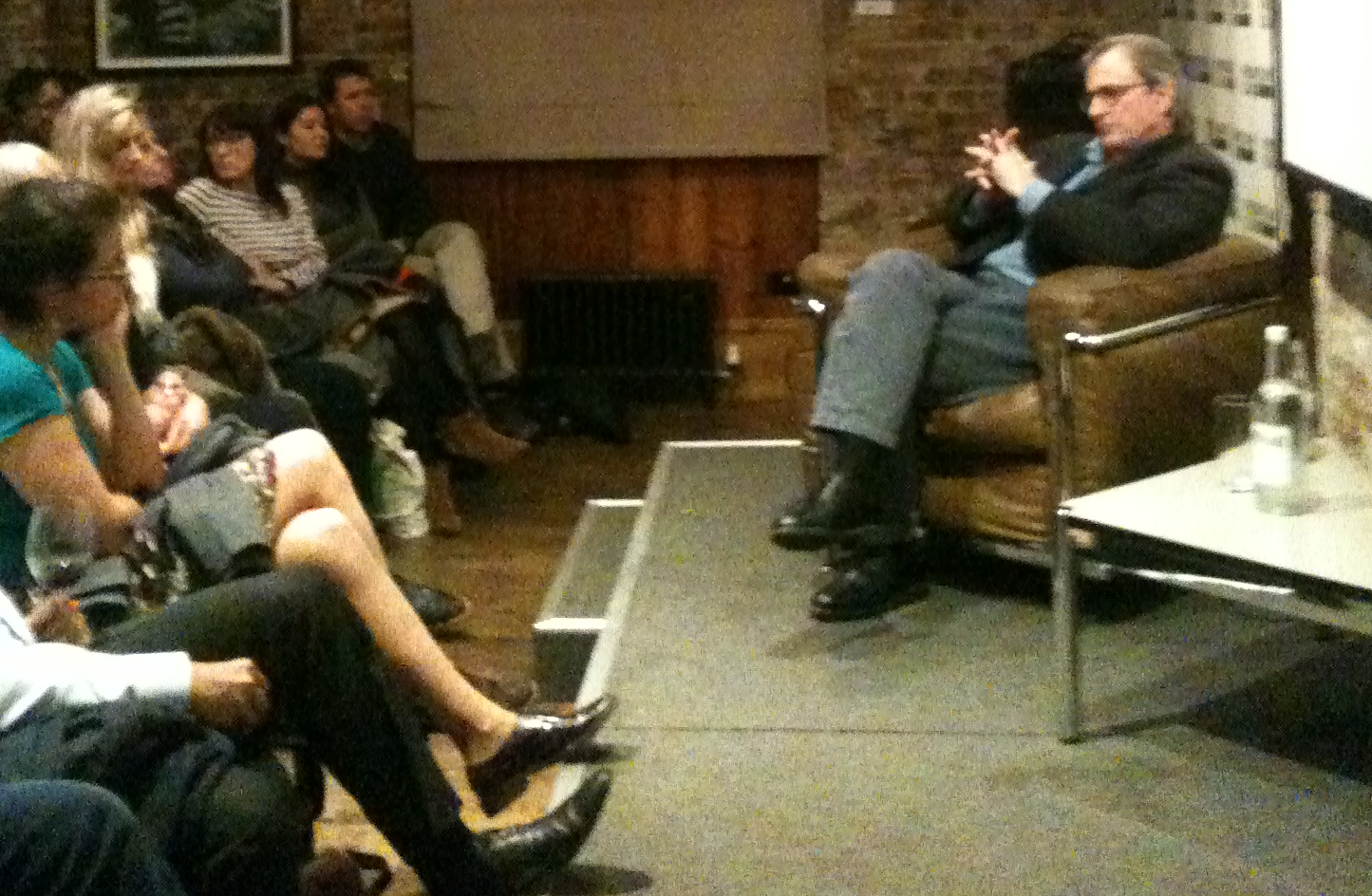
On Monday 2 June, the Frontline Club hosted a screening of Secrets of the Vatican, which was followed by a Q&A session with the film’s director and producer, Anthony Thomas. The film focuses on the sexual abuse scandals that emerged from within the Vatican during the time when Pope Benedict led the Roman Catholic Church, and looks to the future with Pope Francis. It hears testimonies from people who have been abused by Roman Catholic priests, as well as members of the clergy and also journalists and experts on the Vatican.
This screening was the only UK screening of the director’s cut of Secrets of the Vatican. Although Channel 4 recently aired a shorter version of the film, Thomas told the audience that too much had been changed.
“I couldn’t identify with that film and, in the end, asked for my name to be removed.”
Many of the audience questions focused on possible difficulties or obstacles he faced when making the film. One audience member noted that the film had four legal advisers, and asked Thomas whether he had encountered many legal barriers?
Thomas admitted that the film did need extensive legal advice due to the nature of its subject and the power that the Vatican holds, but said that the role of the lawyers was mostly to ensure that the film was accurate and that there was nothing in the narration that could be misinterpreted.
Addressing questions about challenges faced, Thomas said that the biggest challenge was in finding witnesses and building their trust. There were many Vatican insiders who didn’t want to be misrepresented, and many victims who needed confidence in coming forward on film. Thomas said, though, that he had been “very well served by the people we interviewed”.
Many people in the audience had had direct experience of the Vatican, or had researched this topic deeply for their own projects, which provided many different angles on this issue to the Q&A.
One audience member had also made a documentary on this topic for the BBC which focused on Pope Benedict’s first year and looked at how the Vatican had responded to the sex abuse scandals. He told Thomas that he felt he had been “too soft” on Pope Benedict in the film, considering the role that he had played as cardinal, investigating the sex abuses, and his knowledge of the corruption and cronyism within the Vatican, and his central role in re-drafting a document prohibiting any bishop from disclosing knowledge of abuse outside the Vatican, before he became the pope. This audience member asked if this was because Pope Benedict had “come good” after he became pope, to which Thomas replied, “No.” He also agreed with several people in the film who had described Pope Benedict as a weak leader with an “inability to administrate”.
Another audience member commented that the Vatican had been behaving like governments or multinational corporations when confronted by accusations of corruption, in their refusal to fully address the scandal and provide justice for the victims. Thomas agreed and said that the words used by the Vatican when addressed the scandals has been “evasive, and the worst kind of corporate speak”.
When discussing Pope Francis, Thomas shared the widely-held optimism in his good intentions and ability to facilitate positive developments in improving the structure of the Vatican. He referred to a statement that Pope Francis had made regarding the place of celibacy in the Catholic priesthood, saying that:
“Pope Francis has said that he favours celibacy, but the door is open for change.”
However, he also discussed the growing opposition to Pope Francis’ approach, which is gradually building up within the Vatican, and pointed out that at 77 years old, he is not sure how much longer Pope Francis can maintain this strength in his determination to change the corrupt systems with the Catholic Church.
Secrets of the Vatican continues to play all over the world; it was screened last week in Germany. It was originally shown on PBS in America and is currently available to watch online. Note: it is not available to watch online from the UK.
]]>
 "He was there!" Director Thomas O’Connor said of English author and journalist Graham Greene (1904-1991), the subject of his documentary Dangerous Edge: A Life of Graham Greene, which was viewed by a full house at the Frontline Club on 1 October.
"There, you know, for 70 years, from one place to another, in these hot spots."
Greene – whether meeting with the Pope, giving a speech to Gorbachev’s Kremlin, conversing with Latin American rulers, or journeying in the 1930s through the hinterlands of Mexico or Liberia – had his finger on the very pulse of the 20th century: its crimes of foreign policy, the inner angst of its inhabitants.
In his own life, Greene left his wife and two daughters early on, indulged in drugs, prostitutes and affairs, suffered from bipolar disorder, and fought powerful suicidal urges, often admitting to his own yearning to die.
"Dear Vivien," he wrote to his wife, "the fact that must be faced, dear, is I have been a bad husband. You see, my restlessness, moods, melancholia, even my outside relationships, are symptoms of a disease, not the disease itself. Unfortunately, the disease is also one’s material. Cure the disease and I doubt whether a writer would remain."
"He was a tremendously courageous writer and journalist," O’Connor reflected, sharing that a driving motivation to make the film was that he "worried about journalism [today]," that future generations would lack voices as brave and voluminous as Greene’s.
"Some writers write their novels," O’Connor said, "and then every once in a while a letter to the Editor. Greene had a whole book of letters to the Editor!"
His eyes searing with intelligence and sensitivity, Greene asked readers to see more deeply into the world around them. He challenged the injustices of big business, globalization, Soviet totalitarianism, and British and American interventionism.
"I would go to any lengths to put my feeble twigs into the spokes of American foreign policy," Greene wrote.
His 1955 novel The Quiet American paired the damage done by a naive American idealist with that by a cynical English journalist like himself, both living in Saigon and desiring the same Vietnamese woman. The work so touched a nerve that, as O’Connor highlighted, even George W. Bush could not help mentioning it in a 2007 speech to American war veterans.
O’Connor wished Greene had been alive to challenge the narrative that led to the latest invasion of Iraq.
]]>"We still need writers," he argued, "as [Greene] famously said, ‘with a sliver of ice in their heart,’ and willing ‘to be a piece of grit in the state machinery.’"