Chair: Charles Glass

Glass is an author, journalist and broadcaster specialising in the Middle East and the Second World War. He began his journalistic career in 1973 at the ABC News Beirut bureau with Peter Jennings. He covered the October Arab-Israeli War on the Egyptian and Syrian fronts. He also covered civil war in Lebanon, where artillery fire wounded him in 1976. He was ABC News Chief Middle East correspondent from 1983 to 1993. Since 1993, he has been a freelance writer in Paris, Tuscany, Venice and London, regularly covering the Middle East, the Balkans, southeast Asia and the Mediterranean region. In 1986, Glass interviewed the hostage crew of TWA flight 847 on the tarmac of Beirut Airport. He broke the news that the hijackers had removed the hostages from the plane and hidden them in the suburbs of Beirut, causing the Reagan Administration to abort a rescue attempt. In 1987, Glass himself was abducted and held hostage for two months before escaping from his Shiite Muslim captors. In 1988, he exposed Saddam Hussein’s then-secret biological weapons program. The U.S. government rejected Glass’s claims, until Iraq invaded Kuwait in 1990. In addition, Glass was the only U.S. television correspondent in northern Iraq covering the entire Kurdish rebellion in 1991. He has covered wars in the Middle East, Eritrea, Rhodesia, Somalia, Iraq and Bosnia-Herzegovina.
Speakers
Ian Black

Black is the former Middle East editor at the Guardian, where he has worked since 1980 as a reporter. In recent years he has reported extensively on the Arab uprisings and their aftermath in Syria, Libya and Egypt. 2017 marks the publication of Black’s new book, Enemies and Neighbours: Arabs and Jews in Palestine and Israel, 1917-2017, which traces the history of conflict in the region including important milestones such as the Balfour Agreement. Black joined the LSE Middle East Centre as a Visiting Senior Fellow in August 2016. In 2010, he was awarded a Peace Through Media Award by the International Council for Press and Broadcasting at the International Media Awards in London.
Ghada Karmi

Karmi is a Palestinian doctor of medicine, author and academic. Ghada was born in Jerusalem and was forced to leave her home with her family as a result of Israel’s creation in 1948. They moved to England where Karmi eventually practised as a doctor for many years, working as a specialist in the health of migrants and refugees. Karmi is the author of several books, including her memoir In Search of Fatima, Jerusalem Today, What Future for the Peace Process? and The Palestinian Exodus 1948-1998. She has held a number of research appointments at SOAS and the universities of Durham and Leeds. From 1999 to 2001 she was an Associate Fellow of the Royal Institute of International Affairs, where she led a major project on Israel-Palestinian reconciliation. In 2009, she became a Fellow of the Royal Society of Arts. Currently Ghada Karmi is a Research Fellow at the Institute of Arab and Islamic Studies, University of Exeter.
Lord Leslie Turnberg

Lord Turnberg is a medical professional, author and Labour peer. Leslie Turnberg graduated in medicine from Manchester University in 1957. He was appointed President of the Royal College of Physicians in 1992 and received a knighthood in 1994 Birthday Honours for services to medicine. He continues to be active in medical affairs in the House of Lords and is a member of the Committee on Sustainability of the NHS. He was a Jewish Medical Association (UK) founder patron. In 2008 Lord and Lady Turnberg, in partnership with the Academy of Medical Sciences, established the Daniel Turnberg Memorial Fellowships. These fellowships are in memory of their late son, a doctor and researcher with a keen interest in fostering links between the UK and the Middle East. In recent years Lord Turnberg has turned his attention increasingly to the thorny problems of the Israeli-Palestinian conflict. He has used his experience in research and in large organisations to analyse the reasons behind the inability of the Zionists and the Arabs to reach a compromise. As a Labour Peer he focuses on the problems that abound in the Middle East in his interventions in debates in the House of Lords. In April this year, Lord Turnberg published his book Beyond the Balfour Agreement marking the anniversary of the landmark letter and the misconceptions surrounding the declaration ever since.
Dr Jacob Norris

Jacob Norris is a social and cultural historian of the modern Middle East. He completed his PhD in 2010 at the University of Cambridge where he spent a further 3 years as Research Fellow, before coming to Sussex in 2013. Jacob’s research is mostly focused on Palestine in the 19th and early 20th centuries, albeit within global and transnational frameworks. His monograph, Land of Progress: Palestine in the Age of Colonial Development, 1905-1948 was published in 2013 by Oxford University Press.
Featured image: From left to right: Lord Allenby (commander of British forces in Palestine 1917), Lord Balfour, and Sir Herbert Samuel, first British High Commissioner of the Mandate attending the 1925 opening of Hebrew University.
]]>
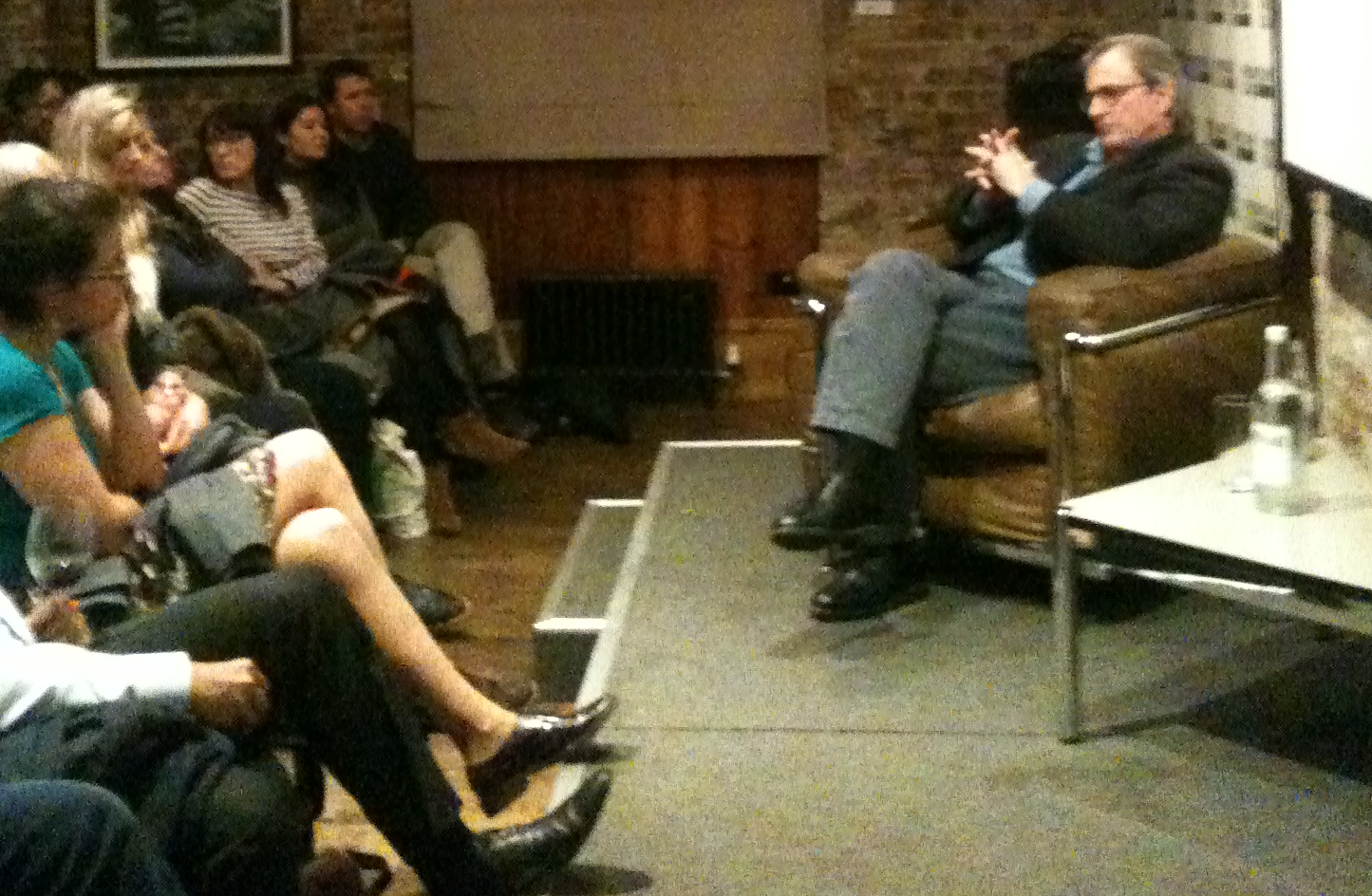 "He was there!" Director Thomas O’Connor said of English author and journalist Graham Greene (1904-1991), the subject of his documentary Dangerous Edge: A Life of Graham Greene, which was viewed by a full house at the Frontline Club on 1 October.
"There, you know, for 70 years, from one place to another, in these hot spots."
Greene – whether meeting with the Pope, giving a speech to Gorbachev’s Kremlin, conversing with Latin American rulers, or journeying in the 1930s through the hinterlands of Mexico or Liberia – had his finger on the very pulse of the 20th century: its crimes of foreign policy, the inner angst of its inhabitants.
In his own life, Greene left his wife and two daughters early on, indulged in drugs, prostitutes and affairs, suffered from bipolar disorder, and fought powerful suicidal urges, often admitting to his own yearning to die.
"Dear Vivien," he wrote to his wife, "the fact that must be faced, dear, is I have been a bad husband. You see, my restlessness, moods, melancholia, even my outside relationships, are symptoms of a disease, not the disease itself. Unfortunately, the disease is also one’s material. Cure the disease and I doubt whether a writer would remain."
"He was a tremendously courageous writer and journalist," O’Connor reflected, sharing that a driving motivation to make the film was that he "worried about journalism [today]," that future generations would lack voices as brave and voluminous as Greene’s.
"Some writers write their novels," O’Connor said, "and then every once in a while a letter to the Editor. Greene had a whole book of letters to the Editor!"
His eyes searing with intelligence and sensitivity, Greene asked readers to see more deeply into the world around them. He challenged the injustices of big business, globalization, Soviet totalitarianism, and British and American interventionism.
"I would go to any lengths to put my feeble twigs into the spokes of American foreign policy," Greene wrote.
His 1955 novel The Quiet American paired the damage done by a naive American idealist with that by a cynical English journalist like himself, both living in Saigon and desiring the same Vietnamese woman. The work so touched a nerve that, as O’Connor highlighted, even George W. Bush could not help mentioning it in a 2007 speech to American war veterans.
O’Connor wished Greene had been alive to challenge the narrative that led to the latest invasion of Iraq.
]]>"We still need writers," he argued, "as [Greene] famously said, ‘with a sliver of ice in their heart,’ and willing ‘to be a piece of grit in the state machinery.’"