By Thomas Colson
On Monday 30 November, a panel of acclaimed documentary filmmakers came together to discuss the difficulties and rewards of character-driven documentary.
Beadie Finzi, one of the founding directors of non-profit film foundation BRITDOC, moderated the discussion and was joined by filmmakers Brian Hill, David Sington, and Edward Lovelace.

At the start of the discussion, the panellists elaborated on the moments at which they initially decided to pursue their latest documentary projects.
The Confessions of Thomas Quick, Hill‘s latest film which premiered this year at Sheffield Doc/Fest, tells the story of Sweden’s most notorious serial killer. Hill explained to the audience that he decided to make the documentary ten minutes after meeting Quick, who, despite having confessed to 39 “gruesome murders”, was for Hill “completely honest – or as honest as I needed him to be for the film.”
David Sington’s The Fear of Thirteen, which premiered at the 2015 BFI London Film Festival, also focuses on a convicted criminal – a man named ‘Nick’ who had spent over 20 years on death row. Sington said that the most memorable part of the film occurred just minutes into the first interview. “I realised that he wasn’t telling me about himself. He was reliving and reenacting his story… It was a performance. He was doing other voices, actions,” he said.
The performative nature of Sington’s protagonist also contributed to the documentary’s distinct format. “The film is an unusual film because it’s a monologue,” said Sington. “So he’s the only contributor, he’s really the only face you see and the only voice you hear.”
Edward Lovelace, one half of the directing pair D.A.R.Y.L., placed an entirely different type of character at the heart of his film, and enjoyed a different kind of filmmaker-subject relationship with him.
“I love him,” Lovelace said of Edwyn Collins, the singer-songwriter whose recovery from a stroke is the subject of Lovelace’s critically-acclaimed The Possibilities are Endless. While Collins’ speech seemed like it would initially be an issue, Lovelace determined that his subject’s poetic approach to his predicament would be worth waiting for, “even if it might take three years – which it did.”
The discussion also covered the issue of consent. How to frame the opportunity to a potential subject when the filmmaker has no idea how much exposure the film will enjoy? Hill said that “all you can do is be very open with people… I always tell people to think about the consequences for them.”
Ultimately, “you have to treat people like thinking adults,” Hill added.
Sington responded that this issue is often resolved in his broad approach to filmmaking. “When you’re making a film, you’re inviting somebody into the audience’s life. So I want the audience to think, ‘I’m really glad I met that person’. For that reason I only make films about people who I, in some sense, admire and like,” he said. In that sense, he added, “I would never call myself a journalist.”
The frequently blurred line between journalism and documentary filmmaking was also highlighted.
Sington said that his “obligation is to tell the truth,” “even though it can be painful” for subjects and interviewees with whom he had become close. “If you’re telling the truth, I think they recognise the truthfulness of it, even if it wasn’t very flattering.”
For Lovelace, the editing process gives documentary filmmakers a unique power. “It’s crazy what audiences believe,” he said.
Whilst he agreed that truth was the ultimate purpose of his filmmaking, he argued that you can reach it by manipulation during the editing process.
Sington agreed, and argued that “the edit is really a process of writing a screenplay from the material.”
Ultimately, Sington said, “documentary is fiction in the service of truth.”
]]>“Every journalist who is not too stupid or too full of himself to notice what is going on knows that what he does is morally indefensible.”
Janet Malcom, The Journalist and the Murderer
Hosting a debate on the role of fiction/nonfiction in documentary storytelling, David Wilson, founder of True/False film festival, chaired a panel of past True/False filmmakers Kevin Macdonald, Sarah Gavron and Beadie Finzi. He began by asking them all what it was that guided their decision making process that ultimately skirted the line between fictional representation and factual accuracy.
“When you find yourself in a position where you are investigating how to shape a story, how to shape a narrative, how do you determine whether you are going too far or you have not gone far enough . . . that this is right and this is wrong?”

Photo by Dogwoof
Finzi, co-founder of BRITDOC, claimed this was a question of the internal moral code of a filmmaker.
“This is a grey area, a spectrum. Whenever you make a film you’re making a representation of somebody, crafting an impression of them and there is license in that. We all recognise when you are guiding the story for effect by manipulating the characters or enhancing them in a way which crosses a line.”
Filmmaker Macdonald disagreed that this is a line that is clearly defined and recognised by both filmmaker and audience/reader alike, and that the relationship between filmmaker and protagonist remains complicit.
“By selecting and counterpointing elements in any story you are changing what they are. In the end it comes back to what you yourself are comfortable with.”
Referencing Janet Malcom’s opening line from The Journalist and the Murderer, Macdonald acknowledged that you are ultimately using people’s lives and their personal narratives to make your film and therefore “it is, in effect, all indefensible”.
It is Malcom’s understanding of the ‘relativity of truth’ to which Macdonald alluded when speaking of evidence as part of an argument and the importance that chance and surprise play in the construct of this narrative.
For Finzi, this makes building a film “like surfing the wave . . . you have to adapt”. But these are adaptations that affect the narrative arc and, in turn, the consequence of the story.
“There was no greater example of this bombshell than Citizenfour. Laura [Poitras] had already finished a film about the surveillance state when Edward [Snowden] emailed,” starting a process by which an entirely new film would be found and made.
In the case of Citizenfour, this organic process emerged precisely because Snowden realised that Laura Poitras was the filmmaker who really “understood the issue, who was deeply invested in it, who was authentic and serious and who he, ultimately, felt safe reaching out to”.
Questioned on whether this demand for ‘absolute truth’ represented a gold standard or holy grail and justified or explained the methods utilised in documentary films, Wilson replied that “for me and most filmmakers the closest word is actually honesty – which is a little more gut sense – when we are being honest to our subjects, when we are being honest about our understanding”.
“I certainly don’t know any documentary filmmaker who thinks there is an absolute truth that they are going to present to the world but maybe it’s more a case of truths – plural.”
However, for Wilson, transcending and challenging this line remains problematic.
“When you take a glass of water and mix in a single drop of ink you have changed it entirely. It’s no longer clear and the whole thing has now become murky. As filmmakers you find that it’s not ink at all – it does not dissolve like that – that’s not the right metaphor for thinking about how people include elements of fiction in their work.”
Positioning documentary in relation to journalism, Macdonald suggested a story, “whether it’s in a newspaper, on television or in a cinema, is a construct which is by its very nature selective”, bound by the need to have a beginning middle and end, “which creates some sort of order out of chaos is”.
“That’s how the human brain works, that’s how we understand things. We make life bearable by telling stories in every moment of our lives and so documentary (and to an extent journalism) becomes an extension of that.”
While all acknowledged the cross-over between journalism and documentary, none of the panel chose to define themselves as journalists. However, they did recognise the profession as a broad church encompassing artists, filmmakers and journalists; depending on which affected how you viewed the issue of the truth, “according to who you are and how you see yourself”.
With this shift towards interdisciplinary practice, Finzi suggested that the audience had become more demanding and critical of how stories presented as ‘true’ were represented.
“With audiences now, there is an awareness when they are being lied to.”
For Wilson this comes back to the fundamentals of intermedia literacy.
“Audiences are going to bring their own tools to view the film and the sophistication of those tools is what is going to help them figure out their way as a reader. So from the nightly news to the furthest fiction – the truth can be viewed more as a playing field where it is as important to know where a film started from as where it ended.”
It was such an inspiring meditation on dox thanx @frontlineclub @davidkinofist @finzibeadie @SarahGavron K. Macdonald pic.twitter.com/mVJKi67UpR
— başak ç. (@_ARTvoltage_) November 18, 2014
]]>
This interactive workshop will explore the pitfalls, the logistics, the security issues and ultimately, the impact, of using hidden camera footage in documentary filmmaking. We will discuss its role as an advocacy tool and what responsibility, if any, filmmakers have to distribute this sort of footage beyond the scope of the film.
The workshop will feature a conversation between Oren Yakobovich, co-founder of Videre, and Orlando von Einsiedel, director of Virunga. They will share their respective experiences of working with communities to gather undercover footage of human rights violations and corruption; discussing the process in its entirety from initial scoping through to effective distribution.
The workshop will be moderated by Jess Search, chief executive of BritDoc.
Spaces are limited. To apply to attend this free event please send an email to info@videreonline.org with your name, credits (if applicable) and a brief (no more than 50 words) answer to the following question:
Why are you interested in knowing more about hidden camera footage? If your interest relates to a specific project, please tell us about it.


The Funding Network (TFN) runs regular events open to all, where charitable projects are presented, and donors engage in friendly philanthropy. TFN members are everyday donors from all backgrounds who want to help interesting young charities further their missions. For their first event entirely dedicated to films, they have selected four documentaries connected to strong campaigns, including three recipients of Bertha BRITDOC Connect Fund grants.
The Projects
Virunga: Untitled Gorilla Project, which pitched at Good Pitch Europe 2013, aims to raise public awareness and help save the Virunga National Park – Africa’s oldest and most ecologically diverse national wildlife sanctuary.
A Whole Lott More, which pitched at Good Pitch Silverdocs in 2010, shines a light on the crisis surrounding unemployment levels of those with intellectual difficulties and hopes to encourage audiences to be part of the solution.
No Fire Zone, which has pitched at Good Pitch events in London and Europe over the past year, aims to raise awareness of war crimes committed in the final months of the Sri Lankan Civil War and provoke the international community to investigate them.
Why Me? UK, wants to encourage more victims of crime to access restorative justice by producing a film re-enacting a meeting.
On 4 July, all filmmakers will pitch their project and answer questions from the audience, which is largely comprised of donors. Once the filmmakers leave the room, bids of donaions are taken, with many match funding offers that reach across the room. Learn more about how TFN works:
Tickets £20 for TFN Members – Buy one get one free! £30 for Non Members Buy your ticket today.


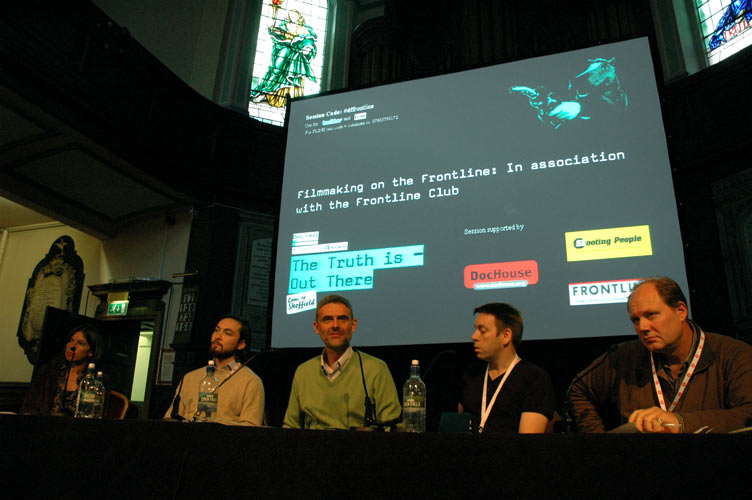
Putting the panel together was extremely difficult as, due to the nature of the job, many of our panellists were either stuck in difficult places filming or had to rush off to film in reaction to sudden changes in the world.
However, it worked out for the best and our final line-up had an incredible array of experience and insight. Joining Frontline Club founder Vaughan Smith were Danfung Dennis, Jules Williamson, John D McHugh and James Mullighan from Shooting People as chair.
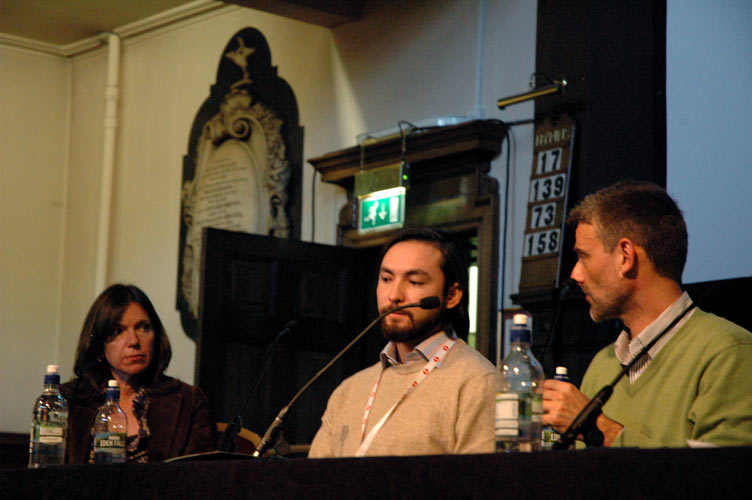
It was a fantastic discussion and all panellists showed clips from their work.
The panel discussed various aspects involved when preparing to shoot in a conflict zone. The resounding advice was explained best by Vaughan who said that fundamentally you should make sure you go on a shoot with a purpose. He went on to caution potential filmmakers that it’s easy to get scared before you go to a warzone when, if you work it out, the risks they could be very low.
John D. McHugh and Danfung Dennis went into greater detail about how to behave whilst on a shoot. John D. spoke of how the more you can think about what you’d do in situations the better you’ll be prepared and not get it wrong and Danfung stressed that telling the story is really important and that you must decide whether you are going for the experience or to tell a story.
Jules Williamson (apologies I don’t have a link to her stunning new film looking into a radio station helping child soldiers, but keep an eye out for it) spoke from the perspective of setting up a shoot and explained how risk assessment is important as it gives you focus, no matter what topic or situation.
It was fantastic to see the club have a greater presence at the festival this year and to bump into the various members attending. We also got a mention at various panels and it was particularly wonderful to hear Jess Search of BritDoc telling a packed room that she loved the club.
A huge thanks to the other organisations that helped us with the discussion. The session couldn’t have been possible without our producing partners DocHouse and the help of Shooting People.
John D’s Rory Peck nominated film can be seen in full here
You can see the trailer for Danfung’s new film here:
]]>