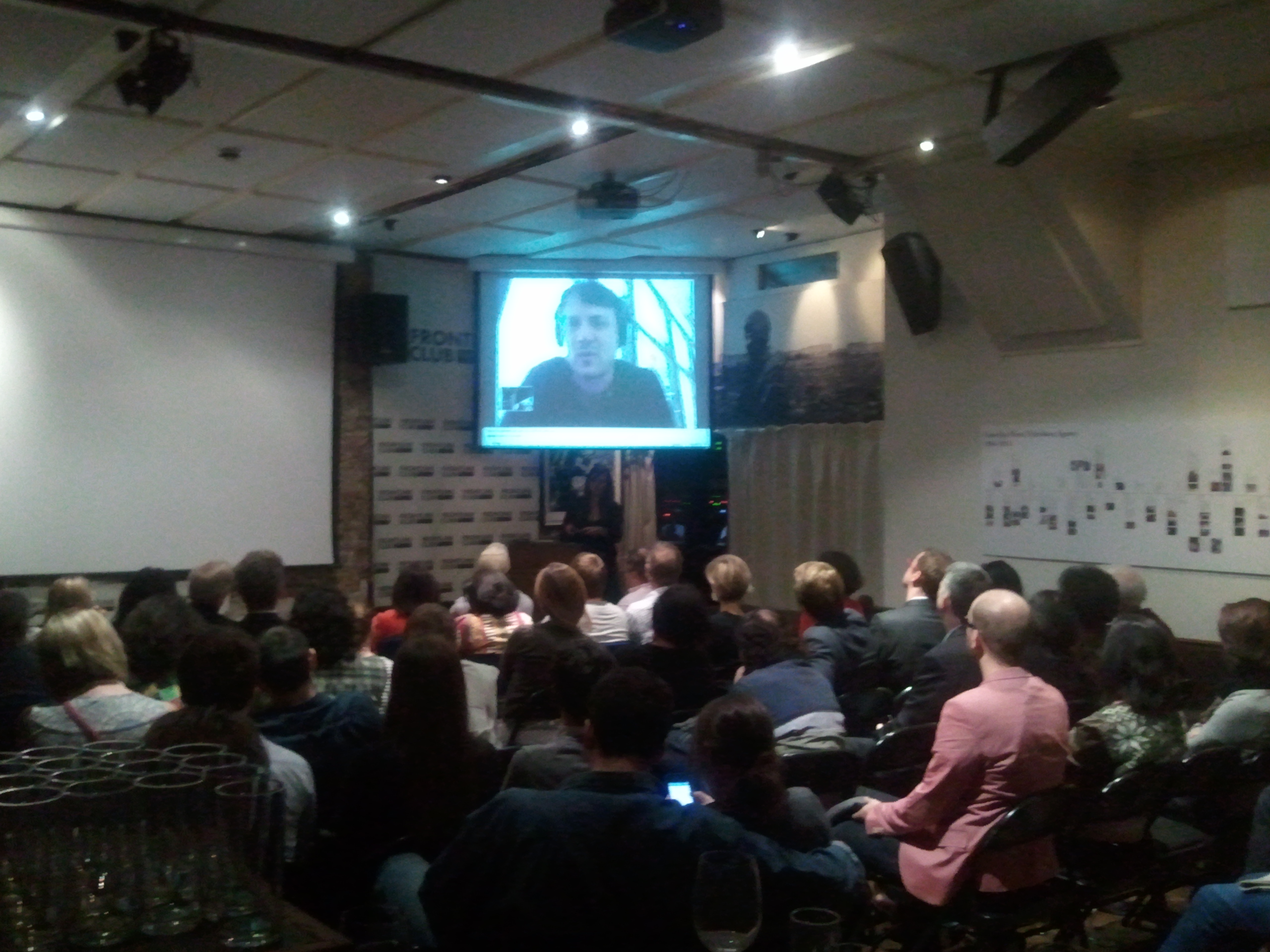
Following the screening of The Internet’s Own Boy – The Story of Aaron Swartz at the Frontline Club, director Brian Knappenberger, speaking via Skype, began by charting the genesis of the film. Engaging with hackers and hactivism through his previous project, We Are Legion, which screened at the Frontline Club in 2012, Knappenberger described how he was exposed to the outpouring and frustration that came from the death of Aaron Swartz who committed suicide following a two-year investigation by the US government.
“I was on a panel the week after Aaron died, everyone there knew him… had a personal story about him, and it was right at the very beginning of this tsunami of grief and anger and frustration that was coming out of the internet.”
While Swartz foresaw the revelations of the NSA’s surveillance programme, for Knappenberger, “one of the great tragedies is that we don’t have [Aaron] for this debate … on the topic of both government surveillance and big corporations… but I think
he would have been a big part of that discussion and the debate going on right now in Europe over the right to be forgotten.”

Touching on the subject of net neutrality, Knappenberger cited Tim Berners-Lee’s decision not to monetize the web as fundamental to its emergence and development, whilst at the same time acknowledging that over the past couple of years the issue has become of concern to a significant proportion of the online community.
“There’s no question [Aaron] would have fought it. We should all be fighting it. It’s important to anybody who spends any time online that the internet should be fair, it should be a level-playing field and everyone should have equal access. It’s the source of all technical innovations, everything we love comes from the notion that it’s free, that the platform is fair and which ensures that my political message wins on merit. But this critical notion is under threat in the United States.”
However, despite efforts made by the online community and some US politicians, most notably with the drafting of Aaron’s Law to reform and redefine computer and digital copywrite abuses, there has been little legislative success since Swartz’s death.
“There’s a big disconnect in our legislative bodies when it comes to these issues. As the saying goes – it’s NO longer OK to NOT understand the internet – or to not understand the things you are legislating. The internet is not some far off distant home of geeks and hackers… it’s the place where we all live, so everything we care about: freedom of speech, the right to assemble, the right to protest, the right not to be monitored or searched by our government without due process, all of these things have new meaning in the internet age and if you are in Congress you need to understand the internet and technology.”
Aaron’s Law itself has recently stalled, as Knappenberger suggests because big tech companies in the US decided that the current CAFA Law which was written in the 1980s suits their objectives. It allows them to go after their smaller competitors and even their own employees if they are seemed to have taken information that is of value to the corporation.
“The law is so big, so broad and vague and that it basically encompasses everybody. It’s an absurd law and is a sign of the disconnect between congress and reality.”
For Knappenberger, this disconnect is best illustrated by the attitude of the federal prosecutors towards Swartz. They were “baffled and confused” by his motives, unable to comprehend that anyone would download millions of pages of academic journals with no intent to profit from it. This demonstrates how the traditional boundaries of what constitutes a criminal action have been distorted in the internet age and as such the law must reflect this.
Thanks @knappB for powerful documentary on @aaronsw and Q&A time (my q on changed govt awareness) pic.twitter.com/ryjkyDEZit
— Andy Piper (@andypiper) August 27, 2014
In the closing lines of the film, Knappenberger described Swartz as a very real victim of this tension being played out between the new digital domain of the internet and the old ‘analogue’ world that is fighting to contain and define it.
“Aaron was the Internet’s own boy… and the old world killed him.”
The Internet’s Own Boy will be released in cinema’s across the UK by Kaleidoscope Film Distribution
View a recent New York Times Op-Doc by Brian Knappenberger on the importance of understanding the Internet.
]]>
We Are Legion tracks the evolution of hacktivism from the ludicrous website 4chan- a mish-mash of memes, revolting images and heated discussions about Manga- through to the formation of Anonymous, which builds its backbone from declaring an international war on Scientology and gains it political purpose from Wikileaks and the battle for free information on the internet. Through interviews with hacktivists, scholars and the victims of hacking, we learn more about what motivates some members of this diverse group of young idealists.
The post-screening Q&A covered a range of issues raised in the film, from the problem of jurisdiction when prosecuting hackers for criminal activities, to Mubarak’s government’s attempts to "shut down the internet" during the Egyptian revolution. Knappenberger was cautious in making predictions about what Anonymous is likely to do next, their very unpredictability has been their defining feature to date, but the audience was left without a doubt that hacktivism is a powerful new force in the world with both high-minded aspirations and a destructive streak, tempted to set the word alight to watch it burn.
Watch a short video of Knappenberger answering an audience member’s question about Anonymous below:
Visit the film’s website and view a detailed timeline portraying the development of hacktivism.
]]>
We Are Legion: The Story of the Hacktivists explores the historical roots of early hacktivist groups like Cult of the Dead Cow and Electronic Disturbance Theater, and tells the story of how they evolved into groups such as Anonymous. Director Brian Knappenberger traces the birth of a powerful democratic online activism which in these rapidly changing times is beginning to make corporations and governments very nervous.
Knappenberger takes us inside the world of Anonymous, the “hacktivist” collective with no defined leadership or structure that has taken responsibility for numerous acts of a new internet-based civil disobedience. In a time when a number of the group’s most prominent activists face long prison sentences, Knappenberger tells their stories and explores the precedents these trials might set for the future.
In the course of the film we hear from a group that began as a forum to share jokes, we learn about the development of their ideology and their ability to mobilize thousands worldwide. Through interviews with current members and those awaiting trial, as well as with other major online figures, writers and academics, we gain an understanding of their motives and what it means to be involved with groups defining online activism.
Directed by Brian Knappenberger
Duration: 89 mins
Year: 2012
]]>