One of the first BBC journalists to start a blog, Mason said during a Reflections event at the Frontline Club last week that he “kind of got” the internet even before he worked at Computer Weekly.
"I got what it could do, it’s the network,” said Mason, who remembers reading the now "famous" article New Rules for the New Economy by Wired founding executive editor Kevin Kelly when it was first published in the magazine in 1997.
"It’s the article now," said Mason. "What does he say? The key innovations in the last ten years have not been in the structure of computers but in the links between them. And that’s the take off point, for me, for the third or fourth, whatever you want to call it, industrial revolution.
"I’d written about the network and its power as a computer journalist and commentator but then suddenly to see social networking. To me it’s the future of our profession, it’s the future of what we do. I was determined to pile into it."
Encouraged by the then Newsnight editor Peter Barron, Mason started his blog Idle Scrawl in the run up to the 2005 G8 conference at Gleneagles and “relentlessly persevered with it”.
While the response elsewhere in the BBC was less enthusiastic – someone in the IT department said that it was not “in the BBC universe” – the blog attracted a wide readership and was twice nominated for the Orwell Prize.
Most significantly what it – and later Twitter did "exponentially" – was increase Mason’s ability to hold a conversation with the audience.
“You’re in a conversation with the audience way before you do your uber journalism, which is your piece,” said Mason.
Mason used one of his blog posts “Dubstep rebellion” about protests in London in December 2010 to illustrate how his mainstream media journalism is now shaped and informed by social media.
“Within about two hours of it going up a bloke had sent me a detailed refutation of the fact that the music on the riot was Dubstep and in fact, within a day, someone had produced a playlist of 10 tracks that were played."
Mason discovered that the music being played during the protest was in fact Grime and its importance to people taking part derived from the fact it was banned from “all the champagne popping black clubs” in London.
"That’s something I’ll know in future and that’s why social media is important, it’s about detail," said Mason.
But the importance of social media is “about way more than the MSM stuff” said Mason, who like growing numbers of people, now follows key journalists and activists on Twitter to find out information before it’s in “the news”.
As Twitter becomes more populated by journalists they will be experimenting with different ways of using it, predicted Mason, who explained his use of the "Twitter Splurge" when the Guardian reported that the Eurozone had agreed a deal on Greek debt. Mason was filming in the United States and didn’t have time to writes a blog post, so tweeted 10 points that formed a "little article" and provoked comments from other financial journalists.
Mason also predicted get there will be greater cooperation between journalists, bloggers and tweeters, with "little coalescences" forming and working together.
The labour historian also demonstrated the role a specialist journalist can play in not only reporting events, but in providing context for others in the network:
He recalled how he asked an Egyptian blogger what she knew about Egyptian history and discovered that she hadn’t heard of the former Egyptian president Gamal Abdel Nasser.
“And yet she’s one of the leading bloggers in the revolution,” he said.
Similarly, young British activists he spoke to who used the hashtag #solidarity had never heard of the Polish trade union Solidarnosc or the union anthem “Solidarity Forever".
"You can also bring that aspect to the people involved in the struggle," said Mason.
]]>
You can view the full event here.
Discussion about the Frontline Club/New Statesman debate on Saturday has continued in blogs and on Twitter, under #fcnsdebate.
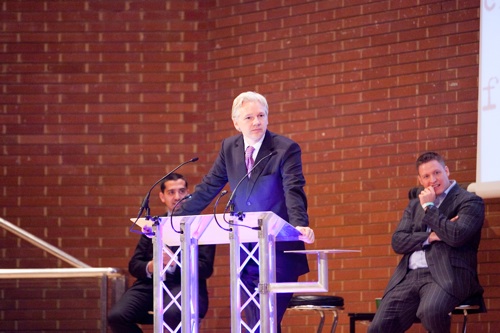
The New Statesman‘s two-part coverage of the event plus video of all the speakers, photo library and live blog is here. Video of WikiLeaks founder Julian Assange speaking, not surprisingly in favour of the motion that whistle blowers make the world a safer place is at the end of this post.
Journalist Patrick Smith, who has included the above widget showing all the #fcnsdebate has written an account of the evening, with audio, of each of the speakers here. He writes that where Assange “is on stronger ground…”
is on the effect Wikileaks has had in Asia, Africa and across the developing world. Certainly among cynical hacks in the London media jungle (or rather, thoses that don’t work for the Guardian), there is a feeling that the “cablegate” leaks didn’t contain much of interest. Though embarrassing for the US State Department, there was a lot of nonsense too, such as the revelation that French premier Nicolas Sarkozy once chased a rabbit around his office.
But Assange pointed out that the Indian national paper The Hindu has put cablegate leak-based stories on its front page 21 times in the last six weeks – Indian readers are fascinated by the revelations on Indian government corruption.
Elsewhere, Assange’s claims about the significance of revelations on WikiLeaks in the development of an anti-corruption movement in India are reported by The Hindu and Times Now.
Here’s what other websites and blogs have had to say about the debate:
The Guardian picks up on Assange‘s claim that WikiLeaks is ‘more accountable than governments’
Dominic Ponsford on Press Gazette’s Wire, focuses on Assange‘s claim that WikiLeaks could have stopped the war in Iraq.
The Register headlines on Assange‘s claim that Google hits ‘prove’ WikiLeaks didn’t have the blood of Afghans on its hands.
Thinq focuses on Assange‘s mention of the Vietnam and Iraq wars and whether WikiLeaks might have prevented them, while Sefrew’s blog quotes ex MI5 agent Annie Machon who was invited to contribute during the debate:
If we lived in an ideal world where we had transparency, freedom of information and real democracy we wouldn’t need whistleblowers. We need some sort of protection for whistleblowers but until then we have WikiLeaks.
Finally, the hindustantimes remarks that on the fact that,
in a land of atheists, as close to 800 people queued outside Kensington Town Hall in west-central London to hear the words of God.
Picture credit: Sophia Spring
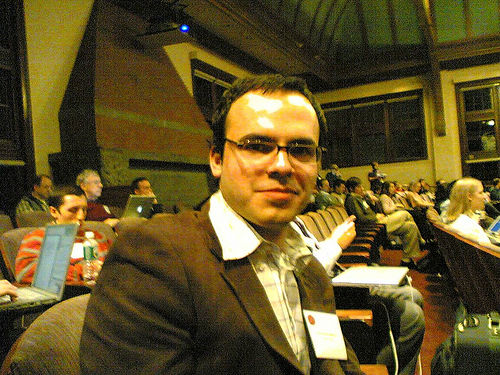
]]>MacGregor, who was responsible for Ken Livingstone’s 2008 mayoral campaign amongst others will be at the Frontline Club to talk about Obama’s web strategy and what political parties in the UK can learn from it.
Blue State Digital’s Thomas Gensemer criticised attempts by UK political parties to engage with voters online when he spoke at London’s City University earlier this year, adding that it was "scary" how little they understood the significance of the internet.
"I struggle to see either party here doing a lot of long-term planning for what will be the primary point of contact with their voters,” he said.
Gensemer attracted considerable attention during his visit to London in February, with features on TimesOnline and in the Guardian’s G2 that posed the question Is this man the future of politics? Already hired by Searchlight to fight the BNP in the European elections Blue State Digital’s move to London backs up Gensemer’s conviction that the Obama strategy could work in the UK. According to Guido Fawkes, who will also be on the panel, McGregor has already been talking to the Labour party.
The Frontline Club’s dinner briefing will be a unique opportunity to get the inside track from McGregor as well as some of the most influential bloggers in the UK and Sky News’ political editor Adam Boulton who blogs here,
]]>
On the eve of World Press Freedom Day, the Committee to Protect Journalists puts together a list of the 10 worst countries to be a blogger. Visit their site to find out more about the 10 countries and the justification for inclusion. The list, in order, is below and Burma comes out worst. Click each country below to learn more about individual cases of bloggers being arrested, harrassed or killed in each place,
1. Burma
2. Iran
3. Syria
4. Cuba
5. Saudi Arabia
6. Vietnam
7. Tunisia
8. China
9. Turkmenistan
10. Egypt
There’s also a short audio chat with CPJ Deputy Director Robert Mahoney on CpJ.org about the thinking behind the 10 worst countries list.
Photograph of Hossein Derakhshan, blogger arrested in Iran in November 2008, taken by Joi
]]>
In May, Armenia and Azerbaijan will mark the 15th anniversary of the 1994 ceasefire agreement which put the conflict over the disputed territory of Nagorno Karabakh, a mainly ethnic Armenian-populated autonomous oblast situated within Azerbaijan, on hold. Since then, international mediators continue to talk of a lasting peace agreement being in reach, but few following the negotiations are as optimistic.
With a new generation of Armenians and Azeris growing up unable to remember the time when both lived together, it’s perhaps no wonder. Nationalists and politicians in both countries continue to exploit the unresolved conflict to further their own political and economic ambitions — and despite the overlaps in culture and history which Thomas de Waal, author of Black Garden: Armenia and Azerbaijan through Peace and War, touched upon during an interview in 2002.
Yet, civil society groups appear to half-heartedly engage in peace-building initiatives, apparently only in order to receive funding from international donors, and change their position depending on local political developments. However, there could be a glimmer of hope if a recent documentary aired on Al Jazeera English is anything to go by. Visiting the Caucasus late last year, journalist Michael Andersen discovered such an example in the Republic of Georgia.
While fixing the Armenia leg of the film, Michael told me about a Georgian village where Armenians and Azeris live, work and study alongside each other. Footage of the school in Sopi is now available online as part of the second half of the 22-minute documentary. Brief it may be, but the sight of teachers and children from both sides working and studying together is encouraging.
Although the two ethnic groups follow different religions, for example, one Azeri child seems hard pressed to name any differences other than language.
In Baku, an alternative voice among the local media went further.
Nowhere in the world can you find two groups of people closer to each other. That is why we often have these stupid disputes between Armenians and Azeris. "This house is Armenian" or "this house is Azeri." Or "this music is Armenian or Azeri." This is exactly because the two have so much in common. […] I normally say, and people don’t like this, that Armenians are just Christian Azeris and Azeris are just Muslim Armenians. That is how much they are alike. […] link
But perhaps that isn’t so surprising.
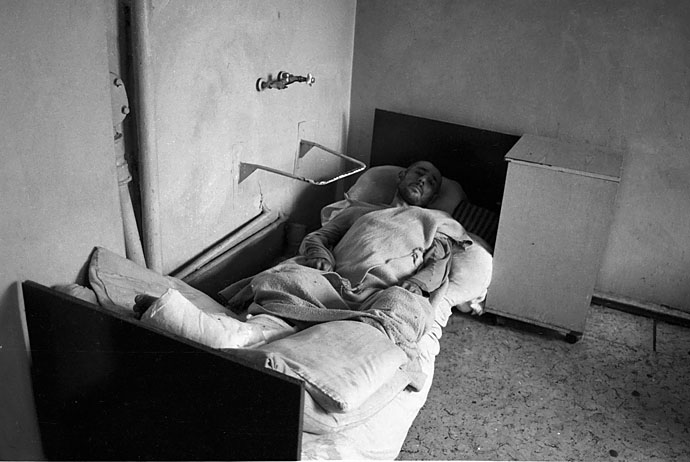
On my first visit to Nagorno Karabakh in 1994 for The Independent, I photographed prisoners of war held in the self-declared republic’s capital, Stepanakert, and remember the Armenian children playing with the kids of Azeri civilians also held hostage. Others would add that not only do both live side by side in Moscow, but in order to reach Tbilisi from Yerevan, Armenians have to pass through the mainly Azeri-populated Georgian region of Marneuli.
They do so without encountering any problems, but the situation in Armenia and Azerbaijan is very different.
Media outlets, civil society groups and political parties alike continue to push propaganda intended only to perpetuate hatred rather than resolve a conflict which arguably holds back the democratic development of both countries and also threatens the long term stability of the South Caucasus. Thankfully, a recent conference in Vienna organized by International Alert finally recognized the problem although the resulting conclusion was long overdue.
Participants in the forum discussed the possibility of holding mutual visits on the Armenian-Azerbaijani border, as well as online discussions and lectures. Details on such initiatives remain in the works. A final document, adopted without the co-chairmen’s participation, agreed with the Minsk Group that "civil society . . . is insufficiently informed and is misinformed." It added that "language of enmity is used increasingly." link
Certainly, the Internet changes the entire situation. Moreover, it had been doing so long before the conference participants owned up to their own failings, as the American University’s Center for Social Media wrote in November.
Bloggers in the South Caucasus are multiplying overnight. As Internet access becomes more common and the first post-Soviet generation grow older, blogs in this region flourish. […]
[…]
[…] With blogging becoming such a popular tool for self-expression, it will be interesting to see if the ripe moment emerges when Georgians, Azerbaijanis and Armenians really do have a reason to unite together. It is my guess the blogosphere will be the place in which it happens. link
Having already met Azeri bloggers in Tbilisi, I’ve also made contact with other bloggers from Azerbaijan online even if I still can’t visit the country on a British passport. At the same time, Facebook and Internet chat has transformed these initial contacts into normal online social interaction. The possibilities are endless, and a new project launched in January hopes to build on that in order to bring Armenian, Azeri and American teenagers together.
As mentioned in a previous post on this blog, DOTCOM has literally harnessed the power of the Internet to circumvent ethnic fault lines. Yes, there are still obstacles that need to be overcome, but the potential for the project funded by the U.S. State Department’s Bureau of Educational and Cultural Affairs and implemented by Project Harmony is there. Already, participants are showing that the issues which concern them most are common to all.
So, when DOTCOM asked whether I would agree to be interviewed along with an Azeri analyst/blogger as a project module for the 90
participants to respond to over the next rwo weeks, I jumped at the chance.
After reading our DOTCOM interview with our two professional bloggers Arzu Geybullayeva and Onnik Krikorian, below, please ask one question (right here in the COMMENTS box) about media, blogging, social change, and citizen action here – and feel free to add to the conversation as it unfolds. link
Of course, it remains to be seen how the online conversation will unfold, but it can only be hoped that DOTCOM and other similar initiatives will achieve results. Fifteen years ago I met my first Azeris held captive in Nagorno Karabakh, but now I am meeting professionals and friends online or in Tbilisi. The Internet keeps lines of communication open even if there are those in both countries who would rather they didn’t exist at all.
Only last week, for example, I spoke to an Azeri friend in Baku over Skype. With telephone communication to Armenia reportedly blocked, it was the first time she had ever spoken to an "Armenian."
Photo: Azerbaijani Prisoner of War, Stepanakert, Nagorno Karabakh © Onnik Krikorian / Oneworld Multimedia 1994
This was originally posted to Onnik’s Frontline blog. You can follow Onnik’s reports from Armenia and the Caucasus here.
]]>Maj Bruhl discusses whether soldiers should be encouraged to write blogs and over the last few weeks he has been developing a number of recommendations on military policy towards blogs.
He concludes:
"By not just allowing but encouraging Soldiers to blog, the Army will improve strategic communications, improve public perception of the institution, and not increase the risk of OPSEC violations. In this paper, it has been shown that of three options – maintain the status quo, ban new media use by Soldiers, or encourage and enable new media engagement – the best thing to do is to encourage Soldiers to engage new media.
"Soldier blogging fits in the principles of strategic communication and public affairs’ fundamentals of information. Additionally, allowing Soldiers to blog not only gets more stories about the Army’s accomplishments out to the public, by having Soldiers rather than public affairs professionals writing the stories improves the credibility of such accounts. This, in turn, will undoubtedly improve the public perception of the Army as an organization that values and trusts its Soldiers."
Others have weighed in on the debate and this seems to be another facet of an ongoing discussion within the US military at the moment.
]]>There has been plenty of debate in particular on the US Army Combined Arms Center site about the role of blogs as a means of strategic communication.
Apparently, ‘the US Army Command and General Staff College requires students to blog, and conduct other media and public engagements’.
Chris Paparone (DLRO Associate Professor, Fort Lee) is concerned that forcing military commanders to blog might ‘backfire’.
In another post, Major Brou, a Command General Staff College student, argues that the requirement for Intermediate-Level Education (ILE) students to publish blog posts is against the Department of Defense’s own blogging policies.
In the comments, LTC Shawn Stroud (Director of Strategic Communication at the Combined Arms Center) defends the importance of telling the ‘Army story’. He believes a change of attitude towards communication is necessary:
"…we should stop considering this as a requirement and instead embrace it as our duty as members of this time honored profession… a duty to continue to share the stories of our Soldiers and their families."
And he highlighted his frustration with media coverage of the Iraq war as a reason why blogging might have an important role to play:
"What I found most concerning during my deployment to Iraq was the lack of information on the accomplishments of our Soldiers, Sailors, Airmen, and Marines. This was problematic with mainstream media as well as with average American citizens, who often stated how frustrated that they felt they were not getting any information from the front."
The debate has spilled over to other places on the Web.
Building Trust
 First, they broke an age old rule of effective propaganda or information operations: trust needs to be established. This is necessary both for genuine attempts at imparting reliable information and also for operations in deception.
If you are setting out to accurately try to tell the truth in an honest and open way then it’s far better to build up a reputation for doing so, before you have a major, highly contested conflict on your hands.
Launching a Youtube channel, blogs and Twitter feeds just prior to an invasion of Gaza automatically arouses suspicions of the nature and purpose of these new communication outlets.
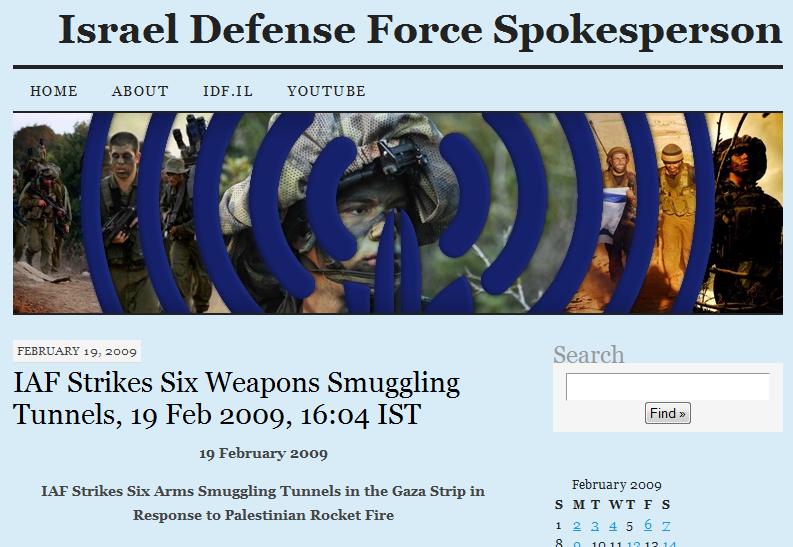
Airstrikes over the Gaza Strip began on the 27 December 2008. The IDF Spokesperson blog started the day before with a list of rockets fired into Israel. The Youtube channel was launched on the 29 December 2008. And the Twitter feed looks like an afterthought, beginning on the 3rd January 2009.
It would have been far better to have started these new ventures months beforehand at a time when the only obvious purpose could have been legitimately claimed as being a desire to engage in the social media space.
Through accurate reporting on blogs, Youtube and Twitter, the IDF could have built up a reputation for trustworthy and credible information which could have been verified by other media outlets. When war breaks out, audiences might have been far less sceptical of the information provided on these new forms of media.
As it was, the sudden appearance of these new information channels on the eve of a conflict instantly suggested a serious IDF propaganda campaign.
Of course, a base of trustworthy information could also be used as a means of employing successful information deception. Although I’m not advocating this approach and am not suggesting this is what the IDF would do, it is plain that deception operations have long been used by militaries, and the militaries of democratic nations are certainly no exception.
If you have a reputation for being accurate and trustworthy, when you do decide to start twisting the truth (or blatantly lying) you are far more likely to be successful in achieving the necessary deception. (Though obviously this carries significant long term risks).
Execution
In addition to this failure, the IDF has simply grafted all the old ways of information campaigning into new formats, without any specific regard for the conventions of social media.
Calling a blog ‘IDF Spokesperson’ is a hark back to impersonal, corporate, official voices. Who is this IDF Spokesperson? Why should we believe him, her or them? The IDF Spokesperson sounds like a scary non-descript Orwellian voice telling us what to think.
At least Mark Regev, an Israeli government spokesman, who did lots of radio and TV interviews, has a human face (and voice) with which we might empathise.
This Youtube explanation of the bombing of the UN schools in Gaza also demonstrates a failure to understand social media.
The statement, and it is a statement, by Capt. Benjamin Rutland takes place in a washed out ‘non-place’ with the Israeli flag propped up against the wall. Why not ‘casually’ film it ‘somewhere’. I’d suggest where Capt Rutland works, though anywhere would be better and the whole style needs to be much more informal. Much more real, open, honest and genuine. (Even if the content is not real, honest or genuine).
And all approaches suffer from a lack of community engagement. Whether this is possible for military organisations is highly debatable. Can you imagine the response on the IDF Spokesperson blog if the comments were turned on!? But the point is that social media without the ‘social’ aspect is often highly uncompelling.
P.S. I have emailed the IDF on several occasions for comment on this piece but they have so far failed to respond.
P.P.S. Here’s an excellent look at various aspects of the social media battle waged during the recent conflict in Gaza.
Author Jaron Gilinsky explores the Help Us Win campaign, and the Israeli Defence Force’s use of Youtube. He also speaks to Gazan blogger, Sameh Habeeb, who became a one-man news agency.
]]>No promises that the President will be doing the blogging himself, (he may have a few other slightly more pressing concerns), but Obama has committed himself to ‘making his administration the most open and transparent in history’.
The first blog post was written by Macon Phillips, the Director of New Media for the White House. He says new media efforts will initially focus on communication, transparency and participation.
There’s talk of slideshows, video, engagement, publication of Presidential decisions, and opportunities to comment on non-emergency legislation. In short, it’s ambitious. (Rather like the rest of Obama’s agenda.)
I was tipped off by Robin Hamman via Twitter though sure others were on it too. Like Adam Tinworth. Here’s Reuters. They feel it’s necessary to say ‘the site features a web-log or blog’ just in case you haven’t been living in the 21st Century these last eight years.
Global Post, a new online news agency, is set to launch on Monday, January 12. The site claims it has 60+ foreign correspondents ready to report from 40+ countries in text, pictures and video. They plan to begin by trying to answer the question: “What does Obama mean to the World?” Charles Sennott, a Frontline Club member, heads the enterprise as Vice President and executive editor. He previously headed up Boston Globe’s Middle East and Europe bureaus.
According to this article in The Phoenix, the global news outlet pays its correspondents $1,000 per month and gives them a 48% share in the company. Global Post aims to make cash by syndicating to online and print news outlets including the Huffington Post along with charging an annual $199 subscription which allows access to extra content not available for the general hoi polloi.
The journalists are “veteran foreign reporters” and the work they do for Global Post will form “a piece of their portfolio, not their whole portfolio”, according to Sennot. The veterans include,
Edward A. Gargan, the former Times reporter and author of China’s Fate and The River’s Tale: A Year on the Mekong, who’s based in China; Matt McAllester, the former Newsday foreign correspondent and author of Blinded by the Sunlight: Surviving Abu Ghraib and Saddam’s Iraq (detailing his own detention in the infamous prison), who’s covering the UK; Josh Hammer, who ran five foreign bureaus for Newsweek and is reporting from Germany; and Seth Kugel, the former Times travel columnist, who’s based in Brazil. GlobalPost also has several thematically focused correspondents — including Stephan Faris, author of Forecast: The Consequences of Climate Change, from the Amazon to the Arctic, from Darfur to Napa Valley, who’s covering (natch) global climate change, and Mark Starr, former Newsweek Boston bureau chief, who’s writing a global-sports column. link
All of which sounds very promising. Especially during these times marked by the demise of the foreign correspondent and the increasingly desperate measures some news outlets are going to to get their foreign news.
If this comment on Frontline blogger Alex’s blog is anything to go by, it appears Global Post also plan to feed blogs into their online offering (Update: as many as 350 blogs). John Whilpers, Global Blog coordinator, is out to find as many blogs as possible to fill the site out with freely available content. Which is where I have a bit of a problem with Global Post: their approach to bloggers – which was earlier described to me as “scatter shot”.
It’s not that difficult to find an email address for Alex, or a Skype or Twitter handle or mobile number come to that. Just Google him. It just looks kinda lazy to dump a comment on a blog and expect a response in this way. More than that, it looks kinda rude when you realise you’re one of at least 69 who’ve received the same message.

In fact, click on any of those search results and I’ll wager you’ll find a name you can Google, an email address you can email, a Twitter handle you can follow etc. all within one minute. Any of which would be a far less clumsy first point of contact than a copy and paste comment. While the global news reporting aims and online focus has to be commended, I think Global Post need to rethink how they go about engaging bloggers. This approach smacks of spam. And no-one likes spam…
UPDATE: It seems like I’m not the only one who finds this approach at odds with the blogosphere.
UPDATE: Mark Glaser over at Mediashift takes a closer look at Global Post and talks to some of the reporters,
While GlobalPost might have no legacy infrastructure, the leading lights of the site have more legacy media experience than online savvy. That could cause problems for a new media startup that will live its life online. link
Mark plans to look over the site next week and report back, so do I.
UPDATE: Chris O’Brien has more at the Next Newsroom blog,
]]>“I’ve covered cops, courts, war zones, huge stories,” Sennott said. “I’ve never done a start-up. I’ve never been so busy in my life. But I’ve never been so excited about an opportunity to try to build something.” link