The most controversial activist organisation of the 21st century, WikiLeaks has attracted strong, divergent opinions from across the political spectrum. Lauded by its supporters for its indispensable role in holding governments, corporations, and human rights abusers to account, its advocates and journalists have been excoriated by opponents as traitors, threats to legitimate governments, and misogynists. Yet so much media attention is focused upon founder Julian Assange, and his ongoing confinement in the Ecuadorian embassy in London, that the broader dimensions of WikiLeaks are rarely aired. Especially critical in these omissions is the role of women, both in the organisation and the more general struggle for information freedom.
The protagonists of the new book:Women, Whistleblowing, WikiLeaks will be in conversation to discuss the themes of their new book and show the various ways they’ve been at the forefront of such activity: acclaimed journalist and human rights advocate Sarah Harrison, Croatian-German theatre director, activist and author Angela Richter, and Renata Avila, a celebrated Guatemalan human rights lawyer and digital rights expert. Ranging widely, from the dishonesty of the mainstream media and its contrasting treatment of Edward Snowden and Chelsea Manning to the terrifying monopolisation of personal data under tech behemoths such as Facebook and Google, join us for an ongoing debate around digital activism.
Link to book can be found here.
Chair
Pamela Anderson has a portfolio of work that encompasses entertainment and activism. She is a supporter of the Courage Foundation, that supports whistleblowers including Edward Snowden, Julian Assange and Chelsea Manning. She is a board member of both PETA and The Sea Shepherd Conservation Society. The Pamela Anderson Foundation supports organisations and individuals that stand on the front lines, in the protection of human, animal, and environmental rights
Speakers
Renata Avila is a Guatemalan human rights lawyer and digital rights expert. She has played a central role in the international team of lawyers representing WikiLeaks founder Julian Assange and his staff. An access to knowledge activist, she is on the Board of Creative Commons and is a trustee of the Courage Foundation.

Sarah Harrison is a renowned British journalist and human rights defender. A former researcher with the London-based Centre for Investigative Journalism and the Bureau of Investigative Journalism, Harrison left to work at WikiLeaks during the height of its groundbreaking publication of US military and State Department documents in 2010. She is also a co-founder of the Courage Foundation.

Angela Richter is an acclaimed Croatian-German theatre director, activist and author. She founded the Fleet Street Theatre in Hamburg in 2001, and was house director at the Cologne National Theatre Schauspiel Köln from 2013 to 2016. Her interest in WikiLeaks led to the 2012 theatre piece “Assassinate Assange.” In 2015, Richter staged the large scale transmedia-project “Supernerds” in co-production with German national TV WDR, dealing with mass surveillance. The text was based on conversations with digital dissidents and whistleblowers, such as Edward Snowden, Daniel Ellsberg and Julian Assange. “Supernerds” received the Eyes & Ears Media Award, was nominated for the SXSW Innovation Award in Texas, and is nominated for the BANFF Award in Canada.


Dan Knowles, Nicola Hughes and Michael Blastland discuss data journalism
Blastland, along with fellow data journalists Mona Chalabi of The Guardian’s Datablog, Dan Knowles of The Economist and Nicola Hughes of The Times, chaired by Conrad Quilty-Harper of Ampp3d and formerly The Telegraph, had been brought together by Grapevine to give aspiring journalists an insight into the industry. The evening was a follow up on the organisation’s first event in April 2013 which brought together the country’s top student newspapers.
Read highlights of the second panel discussion here.
It's a full house #fbj pic.twitter.com/QeLUOOZdNz
— Max Benwell (@Max_Benwell) January 23, 2014
Quilty-Harper started the discussion by asking Blastland how data journalism had changed since he published his book The Tiger That Isn’t in 2008.
Blastland:
“The origin of the data does get better, we have a lot more people watching it for a start…[but] there’s huge amounts of uncertainty in recording numbers, there’s great difficulty in the interpretation numbers that go up and down all the time…there’s a lot of data.”
Hughes said that part of a data person’s job is trying to find out where problems can arise and to be constantly asking questions.
“A data person would be able to see whether the numbers are telling the truth or has an agenda. It’s about really understanding the integrity.”
http://twitter.com/bspeed8/status/426445622871605248
Knowles said that a lot of his job is looking at data, which has already been told, and debunking it:
“Mostly it’s just how do you get past the headline statistic and digging through spread sheets and finding a trend that nobody’s spotted… You have to self police and make sure that something that looks brilliant and gives you a fantastic statistic isn’t actually a blip.”
Quilty-Harper added:
“Interrogating the data is an intrinsically journalistic activity. You’re checking verifying, finding out whether it’s true essentially.”
Chabali said that the key to data journalism is going deeper into the story than just the data and interviewing people on the ground:
“They provide us with the backstory of the ‘why’ because so much of what we do is just describing ‘what’.”
http://twitter.com/kathryn42/status/426451235781488640
Knowles added:
“You have to combine it with interviews, it’s not enough to have a spread sheet and go ‘oh this is really interesting’… you have to start with the spread sheet but…then you go visit somewhere and you interview people and then you write the story.”
Oliver Franklin of GQ in the audience asked how has the Internet and social media changed the representation of data?
There are many more ways to tell it Knowles replied:
“The freedom of the internet is that you have an unlimited amount of space. You can have this story told through data visually as well as the text underneath it.”
But with so many ways of representing the data do all journalists need to be able to handle data to some degree?
Hughes:
“What you need is more data journalists to let you deal with the raw ingredients and not wait for the press release or the end result statistics…what they’re [organisations] doing now is they’re releasing the data raw… saying ‘we’ve done what we said we’d do we’re not hiding anything’. The problem previously was access to the data, now it’s too much data.”
The initial problem was that data was inaccessible, now it's that it's overwhelming. #fbj
— Hari Sethi (@Hari_Sethi) January 23, 2014
http://twitter.com/MirrenGidda/status/426450151918813184
Quilty-Harper ended by asking the panel, what are their dos and don’ts for those wanting to get into data journalism?
Chabalis:
Do have an instinct to not merely describe – also analyse why.
Don’t be afraid of being able to master different things, you can’t just be a good writer, you can’t just be familiar with spread sheets, you need to know the basics of coding, you need to know several different tools (or know someone who does).
Do not be arrogant – not only checking other people but check yourself.
Knowles:
Learn to use the ONS (Office for National Statistics) website – that will give you an advantage.
Learn how to find statistics quickly.
Learn how to pick a statistic that’s valid and that can debunk or prove a story.
Hughes:
Do not feel you need to be taught something to be able to do it, do not rely on anyone else to teach you – Google it. There are so many free resources.
Blastland:
“Don’t be seduced by the glamour of exciting flashy stuff, remember that you can produce rubbish very easily and seductively with all those techniques. If you do not have the skills of statistical inference to make sure that you are saying something legitimate, all the rest is rubbish. Exciting rubbish.”
Following the success of their events, Grapevine are launching a data-focused site in the coming months. Get in touch with Harry Lambert (@harrylambert1), Max Benwell (@maxbenwellreal) or Rebecca Choong Wilkins at contact@grapevinevents.co.uk.
Watch and listen back:
]]>Last Thursday, the Navy awarded a new contract to five intelligence, computer and security companies to provide both hardware and “the development, integration, and test of intelligence, battlespace awareness, and information operations applications”.
In other words, the US Navy is embarking on a major new project in the area of surveillance, technology and data acquisition to provide military commanders with a detailed understanding of any conflict area.
According to the Department of Defense’s own definition “battlespace awareness” includes an area’s “environment, factors, and conditions”, “the status of friendly and adversary forces, neutrals and noncombatants” and “weather and terrain.”
The addition of “information operations” in the contract suggests the project will go beyond the remit of geospatial intelligence and may have some capability for commanders to organise messaging campaigns in an attempt to influence various actors in an area of operations.
The contract raises questions over exactly what information the US Navy is intending to collect and in which conflict areas.
The investment can be understood in the context of the influence of ‘network-centric warfare‘ on US military thinking which emphasises the value of a digitally connected force as a means of improving situational awareness and military decisions.
A press release earlier in the year from the Defense Advanced Research Projects Agency (DARPA) calling for ‘big data’ projects noted that:
“the demands for actionable information have spiked as warfighters at every level—whether at the planning table or on patrol—are called upon to make well-informed decisions”.
The battlespace awareness contract was awarded by the Space and Naval Warfare Systems Center and will initially last until August 2013. The US Navy has options in the contract to extend the work to 2017.
The Space and Naval Warfare Systems Center reports directly to the Navy’s Information Dominance Systems Command.
]]> The ‘post-Leveson’ question becomes ever more pressing, as identified at yesterday’s University of Westminster conference, attended by a range of international media researchers, as well as regulation and legal specialists.
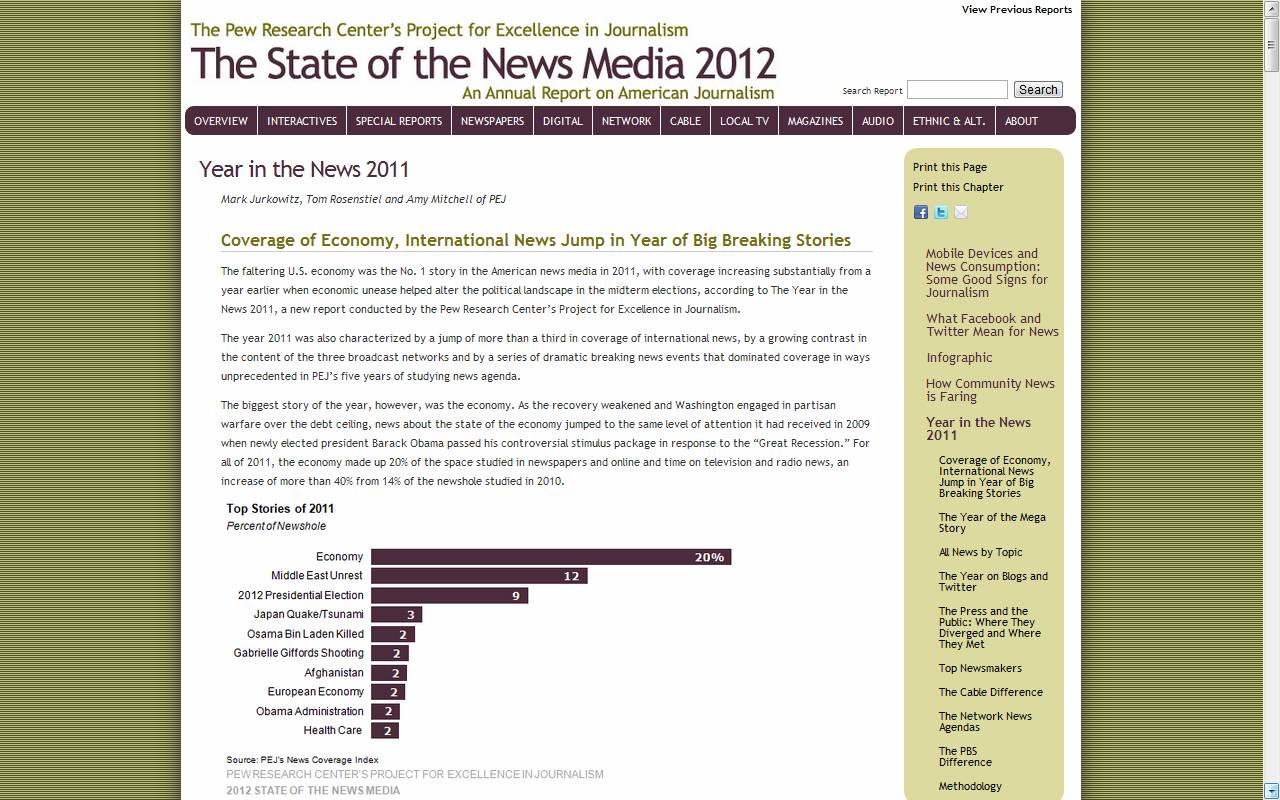 One section of the report offered a comprehensive understanding of which stories and topics were regarded as newsworthy by American journalists and included data for news being shared by bloggers and Twitter users.
Data is the future, if it’s not already the present.
At a recent press conference announcing US military investment in ‘Big Data’ projects, the acting director for DARPA noted that the Atlantic Ocean contains 100 billion, billion gallons of water.
Kaigham Gabriel went on to state that "if each gallon of water represented a byte or character, the Atlantic Ocean would be able to store, just barely, all the data generated by the world in 2010".
Or as Scott Keeter, the director of survey research for the Pew Research Center, put it:
“At no time in history has so much of the public’s discussion…been so accessible to a wide audience and available for systematic analysis…we are just at the very beginning in understanding what’s possible”.
The challenge for militaries, governments, businesses, journalists and publics is working out how to harness it all in a way that also safeguards our privacy and freedom.
On 27 April, I’ll be moderating a panel at Insight 2.0: The Future of Social Media which will begin to chip away at the tip of the iceberg.
The one day conference will bring together experts from academia, business, journalism and the third sector on the ways social media analysis can be applied more intelligently and creatively.
Lawrence Ampofo, the organiser, has been been analysing and interpreting social media data for a long time, before Twitter and YouTube became integral parts of our culture.
He reckons the time is right to explore the boundaries of social media analysis:
If a community of interested parties can start engaging with these questions, then Lawrence believes a more multidisciplinary, socio-technical and markedly more profound way of understanding social media data and human behaviour will emerge.
And if you want to join this exploration into the future of social media analysis, tickets are available here.