Not a seat was free on Tuesday 10 February at the Frontline Club, as a panel of experts convened for a discussion entitled Embedding with Aid Agencies: Editorial Integrity and Security Risks. The ideas of intention and interpretation dominated the evening, with the panel’s arguments and audience comments exposing a relationship of disconnect and simultaneous dependency between aid agencies and journalists. What happens when the two work together? The pros, cons, irritations and limitations experienced by both sides made for a lively debate.

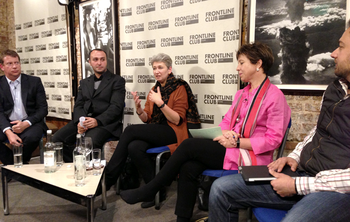
L-r: Lisa Reilly and Siobhan Sinnerton
The event was organised in partnership with the European Interagency Security Forum and chaired by the co-founder and CEO of IRIN, Ben Parker. Speakers included: Polly Markandya, head of communications at Médecins Sans Frontières (MSF); Lisa Reilly, executive coordinator of the European Interagency Security Forum (EISF); Michelle Betz, who works on media development with the UN and other aid agencies; and Siobhan Sinnerton, commissioning editor for news and current affairs at Channel 4.
The discussion began by covering the common ground between NGO workers and journalists. Betz, a former journalist herself, outlined the competitive economic picture. “The aid business really is big business, just as journalism is a business” she said. To a certain extent, NGOs and media outlets often share the same risks and liability issues when working in conflict and hostile environments. Betz experienced this first-hand when she was sentenced to five years hard labour by the Egyptian government for work that she did for an NGO. “It is not just journalists, such as those from Al Jazeera, that governments go after, but NGO workers as well,” she said.
Behind the simplified NGO-journalist dynamic remains a multi-faceted backdrop. Reilly reflected on her experience working at the European Interagency Security Forum (EISF). “Within NGOs we don’t have a consistent view, we often see gaps between the communications department and the rest of operations and programs in the first place,” she said. Nevertheless, when logistics are well planned, NGOs and journalists can work harmoniously with mutually beneficial results.
Sinnerton illustrated this point with a film made for Channel 4’s Unreported World on handicapped Syrian refugees in Lebanon, entitled The Invisible People. Sinnerton explained how Handicap International, the NGO involved in the film, saw a significant rise in donations after it aired. Sinnerton strongly advised that “transparency is the key for things not becoming massively unstuck in the field.” Apart from honesty, which all the panellists agreed was essential between NGOs and journalists, Markandya pointed out that it ultimately comes down to trust. “We have done a number of documentary projects recently and we have had to give up the illusion of control and trust the journalist to do a fair job,” she said.
What happens when the journalists themselves are unable to cover important stories? This was the case with the recent high-risk Ebola epidemic in parts of West Africa. In order that the story reached the general public, Markandya explained how MSF partnered with a production company in order to design customised camera equipment that could be attached to doctors’ protective goggles and could withstand chemical de-contamination. The result was a pressing and highly emotive documentary broadcast by BBC Panorama.

L-r: Polly Markandya and Michelle Betz
However, too often the means of getting a story can taint relationships between aid organisations and journalists. Even when journalists abide by protocol, their good intentions can have a negative impact on the aid organisations involved. Reilly questioned, “should the journalists be saying ‘transport was provided by ‘X’ NGO’? It demonstrates the journalists’ ethics but what does that do to us and our security?”
While journalists go in and out of the field, NGOs often remain there in the longterm. Reilly emphasised how heavily their work relies on the acceptance of local communities, and how that fragile reality can be undone by careless reporters. Injecting the journalistic perspective, Sinnerton spoke in turn of the promises made by aid organisations that often contrasted with hostile receptions towards journalists on the ground. This steered the discussion back towards Markandya’s key argument that NGOs and journalists must work on “managing expectations”.
The dichotomy of protecting the subject versus exposing the story remains a sensitive one, and a number of audience members agreed that these two sides were often in opposition. Audience comments revolved around questions of favouritism between NGOs and certain news outlets, the difficulty of exercising complete transparency in practice, and the need for NGOs to relinquish control over media content. While aid workers and journalists may settle for what Betz called “a mutual mistrust,” the panel agreed that the understanding between the two has advanced. For all the new NGOs that are emerging globally and their young journalistic counterparts, this symbiotic relationship will no doubt continue.
Watch and listen back below:
]]>“Does the Pubic Still Care?” was the poignant title of the discussion on conflict and disaster reporting which was chaired by Ben Parker at the Frontline Club on Thursday 23 October. The event was organised by the Oversees Development Institute and Humanitarian Policy Group. Channel 4 News anchor, Jon Snow, and senior reporter for the People and Power programme on Al Jazeera English, Juliana Ruhfus, were joined by experts in aid and development, Marc DuBois, former head of Médecins Sans Frontières (MSF) and Eva Svoboda, research fellow in the Humanitarian Policy Group at the Overseas Development Institute.

The event was being followed online #crisisreporting
The relationship of dependency and power that exists between aid agencies, the public and the media was the core focus of the evening. Using examples from Gaza to Haiti and East Timor, the panel illustrated the crisis and development each of these elements has undergone and how it has affected the other.
To begin the audience was taken back to the 1984 Ethiopia famine with Michael Burke’s compelling documentary report. Parker, who has worked in media and humanitarian aid for 20 years, opened the discussion with the following question:
“Can a news moment like Michael Burke’s piece happen again? . . . Can it ignite the public? Can it change the course of history in a small way? . . . Does TV in that same way still exist?”
Snow’s initial response was an affirmative yes. He used examples from the last four years of public response to make his case. For example, the 2010 Haiti earthquake saw the emergency fund raise it’s second largest ever donation. Snow said, “The stream is certainly not dry and I would argue that our connected digital world is making it easier for us to draw attention.”
DuBois similarly dismissed public disaster fatigue and focused on the power of compassion, saying “disaster is inherently compelling . . . compassion is alive and well”.
Ruhfus instead argued that the quality of giving has changed. She referred to the lack of clarity and neutrality in today’s media reports and national aid donations.
“The ‘us’ and ‘them’ that was very simple when Michael Burke made his films has totally shifted. . . . I am the enemy. I am no longer the ‘saviour’ and that’s a similar fate that aid agencies are dealing with too.”
Ruhfus implied that in the past aid agencies were able to function in an apolitical sphere. Svoboda’s standpoint was somewhere in between, to her mind although 9/11 had a negative impact on aid agencies they were always politicised. She argued that despite being more complex, today there are more actors, more competition and, importantly, more accountability. All four of the speakers agreed that more people in the world are aware of what is going on around them than ever before.
The discussion turned to the ever-present Ebola crisis and its slow journey to UK headlines. This highlighted the question of responsibility between the aid agencies and the media to expose conflicts and disasters adequately. Snow asked his fellow speakers, “How far did the aid agencies go in persuading governments that there was a crisis?”
In return he was asked by Svoboda and DuBois how many reports were not picked up by the media. Svoboda said, “Very often you will be faced with people who just don’t care, with states that don’t care about their international obligations.”
Snow clarified the media’s stance, “We are not in the field to raise money or bring relief in any form, but to tell the story.”
Despite his positive outlook Snow admitted the failure of the media coverage on Ebola and thus the insufficient pressure on the UK government. He expressed his frustrations as a journalist with failed government policies. Of the current humanitarian crisis caused by ISIS he said:
“ISIS is a direct consequence of our people, by our people I mean us Westerners. Somehow we made this mess. Of course it was there ready to be made but at least we could have left it to them to make it.”
Ruhfus looked to the public as a key factor and blamed too much negative foreign reporting. She said, “We are in a massive trap as news broadcasters. What do we do? We are loosing our audience because we are telling the ugly truth. How do we respond to that? Do we start making the bad news sound good?”
The media’s metamorphosis has prompted aid agencies to create more of their own media bridging the gap between the two. DuBois expressed his belief that traditional forms of media were no longer adequate. “Being detached and neutral does not sell anymore, people want something authentic.”
When the audience joined in the debate, one member called for a separation between conflict relief and disaster aid stating that the public is far less engaged in the former.
Another pressing comparison was made between development versus emergency aid. Svoboda outlined the dilemma of aid agencies regarding this. “You pass from a crisis into this development and state building and you want to believe it and you ignore the facts that it’s not as stable as you want it to be,” she said. She also called for realism and modesty above all else in her field. “Their needs to be honesty about what can be done, and that’s not always easy because aid org need the money to do the work so how do you do that by selling a story.”
Another audience member observed that given the number of critical issues in today’s world the definition of what constitutes a ‘crisis’ is diminishing. Whether it continues to undermine itself is another question. In any case, the evening ended on a positive note with Snow heralding the current ‘golden age of journalism’. While there may not have been clear answers, the right questions had been asked.
You can watch and listen to the event again here:
The conflict and humanitarian issues Syria faces is at the forefront of many peoples minds at the moment, this was reflected by the full house that gathered at the Frontline Club’s panel discussion, Communicating about Syria – A humanitarian perspective on 10th October.
Lindsey Hilsum, Channel 4 News’ International Editor chaired a panel which included Hicham Hassan from the International Commitee of the Red Cross (ICRC); Lyse Doucet, BBC Chief International Correspondent; Ben Parker, head of the UN Office for the Coordination of Humanitarian affairs (OCHA); and Fadi Haddad from the Mosaic Initiative for Syria.
Hilsum started things off by asking Doucet to set out the current situation in Syria, where over a million people are now displaced within the country, 50% of which are children.
There can be no doubt that when it comes especially to war we [journalists] take the side of the people. And sadly it’s ugly terrible bloody wars that drag on there’s a lot of people that are affected and Syria is no different…And of all those people that are stuck in the middle one of the other sad realities of the Syrian conflict is that most of them are children.
Parker, who was only in London by coincidence on a break from his post in Syria as head of OCHA then spoke about how the problems in Syria are unlike any he has faced before.
I’ve never in my career spoken less to journalists. It’s a very unusual situation; aid agencies want to talk to the media for three things: 1. Cash. 2. To make sure that the attention doesn’t go away, and 3. We also have advocacy, in the sense that we want the people with power to take a certain course of action. In Syria, none of these three really work. In terms of the course of action, nobody has the answer. And what is the course of action? Stop the violence? ok…We’re heading into unknown territory.
There’s normally criticisms that we’re too tight with journalists… but here I can’t help you [journalists] at all, I can say maybe you should check out that school, but you being associated with me makes your job even harder. The state of Syria feels that the humanitarian people need to be watched just as much as the journalists because they have the potential to delegitimise and confuse and be instrumentalised by hostile forces.
Hassan who is the Middle East spokesperson for the International Commitee of the Red Cross (ICRC) said that the humanitarian aid is not there to solve the problems in Syria:
A very good friend of mine said: “The solution in Syria is not humanitarian because the problem in the first place is not humanitarian; it is political so don’t you think you guys are there to solve the problems.” It is true, we are not there to solve the problem, humanitarian aid is just there to push the limit a bit more and a bit more and a bit more.
Haddad from the Mosaic Initiative for Syria who works directly with human rights defenders and NGOs inside Syria and neighboring countries, gave some insight into how he gets supplies to people in Syria by foot through Turkey, but how even that is getting more difficult.
I’ve been targeted now more than the Free Syrian Army, if they know that there’s a field hospital in a place, they will try to shut it straight away. It’s getting more stressful.
When you’re dealing with these groups you need a good relationship with the local community and this is where journalists have to help us, as they go inside they know these communities so our mission is to work in partnership with them and to work like a middle agent between the international NGOs and the people on the ground.
Melissa Flemming, chief spokesperson for the UN High Commission of Refugees (UNHCR) was in the audience and Hilsum asked her to give her take on the situation. She finished with a final thought about the displaced people of Syria, before the discussion was opened to questions from the audience.
They’ve all lost family and they’ve all got horrendous stories to tell and they’re living in places like Lazatri camp which is inhospitable because of the landscape…It would be like any one of you who is used to living in an apartment having a high standard of living, and from one day to the next having to pick up everything probably having lost a lot and run for your lives across the border and try to make a life for yourself in a tent.
Listen to Lyse Doucet talk about the current state of affairs in Syria:
Listen to Lindsey Hilsum talk about the different kinds of people who have been caught up in the Syrian conflict:
Listen to Fadi Haddad talk about the problems he faces when getting aid to the people who most need it in Syria, he also tells the story of one man he couldn’t get aid to quick enough:
Watch the full event here:
]]>