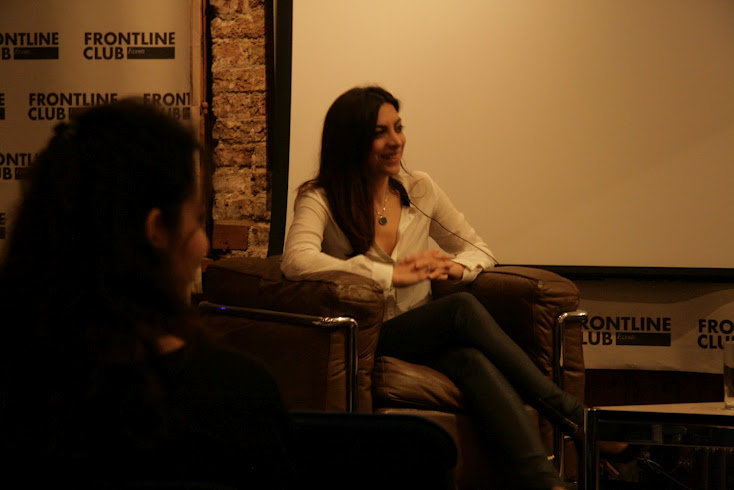
Popularly known as the Paris of the Middle East, Lebanon is said to be culturally liberal compared to most Arab countries in the Middle East. However, such is not the belief of Joumana Haddad, a Lebanese journalist and poet based in Beirut. She says, "I feel liberated but I wear a veil."
The documentary "Jasad", meaning "body", is titled after a controversial magazine, founded by Haddad in 2008. The magazine tackles several issues faced by Arab women such as hymenoplasty, homosexuality, eroticism, feminism, sexual health and virginity, usually considered taboo topics and culturally sensitive.
Captivated by the idea while browsing through the quarterly magazine director Amanda Homsi-Ottoson said, "This film was very personal to me. I still remember how I walked into a library one day and saw this magazine and was then very keen to find the woman behind it."
Having questioned several cultural beliefs growing up in a conservative society, she said, "While I was growing up in Lebanon, this was something I struggled with on a daily basis. Talking to my friends about issues on virginity and sexuality was unthinkable."
"I still look back at some of my early days in my late teens and early twenties and wondered if a lot of people were going through this, I wanted to explore how people felt about this today."
Members of the audience raised several questions on content and were surprised by the wide spread condemnation from the feminists present in the film.
One said, "I thought the feminist group’s views were contradictory to the ideas of Joumana which was quite surprising. I was shocked when some of the women didn’t agree with what Joumana does. There are more naked women on posters in Beirut. Are women meant to be seen as products? "
Another said, "There is a fine line between artistic and pornographic, will she be disillusioned if people are looking at the pictures and not bother to read the text"
"They may see it as pornography but there are so many beautiful stories. Jasad is trying to help women reconcile with their bodies, “said Ottoson
"Content is about freedom of choice, you have to provoke people to wake them up and make them think about things, people are still stuck in their old ideas and that’s what Joumana is trying to do through her magazine."
It wasn’t long before the aspect of distribution came up. Many thought it was quite surprising distribution of the magazine was not halted by the government in Lebanon, especially after the film ‘Beirut hotel’ was banned in Lebanon last year, for similar reasons.
In its fifth year now, despite several controversies the magazine has a large number of subscribers from Saudi Arabia, Jordan, Syria and Dubai. Haddad cleverly seems to have won the approval of the Ministry of Information and the Journalists Syndicate in Lebanon.
"Allowed by the ministry of information, she said she felt quite fortunate. To her luck, also recently the minister had changed, previously it was someone who was much stricter."
"Lebanon is undergoing a lot of change politically. With the Arab spring and revolution in most gulf countries, one may never know about the future," said Ottoson.
]]>
Anderson, who was kidnapped in 1985 and held for six years and nine months, spoke eloquently for over an hour about his kidnapping, the dangers of reporting and the issue of journalists’ impartiality during wars.
While discussing the coverage of Israel’s operations in Gaza in January, Anderson remembered a conversation he had had with an IDF officer in southern Lebanon in the 1980s. Asked why he had written bad things about the Israelis, Anderson replied: ‘Sir, if you stop doing bad things, I’ll stop writing them’, adding, ‘When the truth is one sided, so is the story.’
Anderson, who spent six years in the US Marines before becoming a journalist, said even his neutrality was tested when the Americans landed in Beirut in 1982.
"When the Marines came to Lebanon I knew some of them, I had fought in Vietnam with them. I was there when the barracks were destroyed and 240 Americans died. Did I have sympathy with them? Yes. Once a Marine, always a Marine. Did I feel bad for the commander? Yes. But did I ask him what he had done wrong that had allowed those Marines to be murdered? Yes. That’s my job."
Anderson also spoke of the difficulty journalists face in telling fact from fiction: “The idea is to be fair, to tell the truth as best you can find it. But that’s a very difficult job, particularly in war. Everybody lies. I’ve been lied to by American Marines. I’ve certainly been lied to by Israeli generals. I’ve been lied to by Lebanese. Everybody lies during war time.
After being released in 1991, Anderson began working for the Committee to Protect Journalists and he says it’s this work that kept his faith in journalism alive. "It’s great to work with these people. These are people who go to work every day all over the world, not knowing if they’re going to be coming home that night, if they’re going to be alive, if they’re going to be in jail, if they’re going to be beaten, if they’re going to be kidnapped. And they do it anyway. It’s very inspiring."
"Why do they do it? They do it because they know how important it is. And the people that do that to them, that beat them and put them in jail, they’re not doing it for fun. They’re doing it because they know that it’s important too.”
When asked about the growing influence of social media on traditional media, Anderson, who currently teaches journalism at the University of Kentucky in the US, said that he didn’t think citizen journalists or social networking sites would ever kill off ‘serious journalism’.
"The tools you use have nothing to do with whether you are a journalist or not. They are simply tools. I don’t think blogs, Twitter or Facebook is going to replace journalism. Journalism can only be done by professionally trained, dedicated, ideologically committed people. I love the web, don’t get me wrong. It’s a wonderful intervention.But I don’t Twitter. Or tweet, or whatever."
And on how traditional media will continue to operate financially, he added, optimistically: "If my belief that serious journalism is vital to our society is right, then we’ll find a way to pay for it." As simple as that.
Back in Paddington, meanwhile, John the chef will be happy to hear that on his last visit to London, Anderson said he ate ‘morning, noon and night’ at the club. High praise indeed.
The Issam Fares Centre for Lebanon will soon be publishing the full audio of the Anderson’s talk. As soon as it’s online I’ll link to it from here, so keep checking back. Many thanks to Patrick Galey for providing a rough audio recording of the event.
]]>Some audio from my recent trip to Beirut. This is what celebratory gunfire from within a densely-populated urban centre sounds like – the Lebanese ‘government’ reversed two decisions that had provoked Hezbollah to take over much of Beirut, and people were pretty happy. As always, there were casualties from the large amounts of falling lead (what goes up must come down)…
[Thanks to Graham for doing the video]

“Abu Skandar, who always drives by the university when he comes to Cairo from Heliopolis, has made this passegiata into his personal polling sample to measure the progress or regression of Islamic veiling. I secretly suspect him of privileging the qualitative aspect of the investigation over its strictly quantitative dimensions.
In his defense, it is necessary to admit that one is easily perturbed by the appearance of female students in the Middle East. Cairo, Damascus, Beirut: the explosion of sensuality as one approaches campuses means that even veiling ends up inscribed on the level of the most disreputable fantasies, instead of erasing femininity from the landscape as its partisans wish.
An entirely veiled silhouette opens only through a long slit where black eyes glitter; around her, colleagues shake out their wavy hair and move slowly, their feline walk emphasizing every curve of bodies outlined by very tight clothes. Veiled and ‘naked’ (according to the expressive terminology of the Islamist militants) merely highlight each other, bring each other out, serve as each other’s foil in a perpetually moving game of one-upmanship.” (from Gilles Kepel, Bad Moon Rising
And so it is in Beirut outside the American University. Classes have resumed after term was interrupted by the events of the past couple of weeks. Interestingly, The Daily Star reported on Monday that most of the students to leave the country were Arabs (be it Syrian, Lebanese or from the gulf) and that most foreigners stayed.
I recall even in 2005 that my university back in London considered recalling all its Arabists from Damascus (and the Scandinavians among us did leave) in the aftermath of the Danish cartoon riots.
The Beirut that I returned to last week was a different city from the one we used to visit on long three-day weekends from Damascus. Then, the trip took four hours in an old rusting Mercedes: black leather sofa-like back seats, windows wound down and our only inconvenience the entry and exit forms we had to fill in for both countries.
Arriving in Beirut at Charles Helou station down by the Port, we’d wander round, pop into a bookshop to stock up on novels or whatever piqued our interest, eat fresh fish at a restaurant next to the Mediterranean Sea at sunset…
Call it the ‘Paris of the Middle East’ or whatever you want, the post-civil-war post-Hariri-reconstruction Beirut was never marketed as a backpacker destination. Aiming higher, the idea was (and still is) to appeal to those seeking luxury and a taste of ‘oriental superficiality’. Don’t mention the war, don’t mention Hizbollah, don’t mention the Palestinian refugees. Just pass the wine.
This image keeps snagging on what’s really going on in Lebanon – itself representative of a wider conflict at play in the Middle East and Islamic world. Reading about Hizbollah’s occupation of West Beirut in an internet café in Nairobi, I decided to fly there with Philip to get a sense of how different the city had become since I last visited.
We couldn’t fly directly to Beirut – the ‘opposition’ had blocked the main roads leading to and from the airport – so chose Amman instead.
Arriving in Jordan at three in the morning on the fourth day of the problems in Beirut, we took a taxi up to Damascus (you can’t get a visa at the airport in Syria, but you can at the border), found out that fighting east of Beirut meant the usual route from Syria to Lebanon was closed. We drove north to the border crossing near Tripoli.
Then a quick three-hour drive down to Beirut past the initial deployments of the Lebanese Army to restore calm in the north.

So, the backstory: a general strike supposedly organized in opposition to a Lebanese government minimum wage offer turned into a storm of words between the various political heads, burning tyres on the airport road and skirmishes and street fighting in Beirut itself. The Druze leader Walid Jumblatt – along with members of the US-backed government – had made moves and called for the Shi’a movement Hizbollah (literally ‘the Party of God’) to dismantle its military communications network as well as to sack the head of airport security at Beirut airport, who he claimed had installed a secret camera on one of the runways.
The next few days saw a massive escalation of the conflict; Hezbollah and allied militias swiftly took control of West Beirut from Sunni supporters of the government – itself an indication of considerable prior planning – and fighting spread east outside the city as well as in the north. The deaths of at least 65 people in the worst fighting since the 1975-1990 civil war caused the intervention of the Arab League, lead by Qatar, who helped defuse the crisis and force political players back to negotiations in Doha, where finally rival leaders reached an agreement yesterday at the last minute amid fears no consensus would be reached.
The government rescinded its two decisions that had provoked the crisis, and Hezbollah celebrated forcing the government’s hand. But Hezbollah had turned its guns against fellow-Lebanese, something their leader Hassan Nasrallah said would never happen. This is the main reason Hizbollah have been somewhat reticent these past few days – barring the half an hour of firing-into-the-sky to celebrate the government’s decision to reverse its two decisions.

Philip and I arrived mid-way through the crisis, and as such our arrival was seen as suspicious. The area where I stay in Beirut is very much on a front line (in as much as Beirut’s tall apartment buildings are conducive to the idea of a front line) of the two parties. Shi’a Amal militiamen had set up a roadblock cum checkpoint nearby, and pro-government Hariri’s television station, Future TV, is a couple of hundred metres up the road.
Green Amal flags (see above) marked checkpoints in some areas – manned by members of the notoriously ill-disciplined militia group and Hezbollah’s main Shi’a political rival – but on other streets the green-on-yellow Hizbollah flag was dominant.
The checkpoints and closed-off roads were unexpected, and the most tangible sign of what had changed since I last visited. Gone the feeling of calm, gone the assumptions of safe passage.
I found myself planning out routes between locations and, after a brief but unsettling run-in with Amal, considered leaving. Luckily, the Arab League intervened (led by Qatari Emir Sheikh Hamad bin Khalifa al-Thani) and, four or five days into my stay, the checkpoints were taken down. The flags still fly – I suspect nobody dares take them down.
Last night Philip and I had dinner in Downtown, the chic designer-shopping area previously full of tourists. Lebanese photographers and camera crews were out in force following the “historic peace” declared in Doha following the deal reached at the last minute on Wednesday morning.
Talks had threatened to collapse on Monday evening, but a six-man emergency electoral policy committee meeting on Tuesday evening managed a breakthrough.
A feeling of relief was palpable on the streets in Beirut yesterday evening, therefore, especially with the opposition removing and dismantling their tents at the site of their 18-month sit-in – parliamentary speaker and opposition member Nabih Berri declared that ending the sit in was “a gift” from the opposition to the Doha agreement.
So does this mean everything can continue as normal again, back to the old Beirut? Around 65 people died in the clashes of the past two weeks, and that’s only the most recent issue to consider. The Sunni-Shi’a dimension – part of a wider conflict in the Muslim world – is also left unresolved and festering. An excellent article by Nicholas Blanford for the Christian Science Monitor earlier this week told of Sunnis rearming across the country:
“We were betrayed by Hariri,” says Omar Abed, a resident of the Sunni district of Tariq Jdeide in Beirut. “They should have given us weapons and training so that we could fight back. How can we fight Hezbollah with sticks and stones?”
It was only the non-partisan actions of the Lebanese army that prevailed during the incredible sectarian tensions of early 2007, and these same values were called upon over the past week time and time again as Shi’a Hizbollah groups attacked media outlets of Saad Hariri – the Sunni government politician and son of the assassinated former Prime Minister, Rafiq Hariri.
In both cases, what was not intrinsically a dispute between Islamic sects took on those tones incredibly quickly, this time most notably in fierce fighting in Tripoli, where some of the worst atrocities resulted when supporters of Saad Hariri took revenge on followers of a Syrian-backed party, the Syrian Social Nationalist Party.
Sunni fundamentalists – some of whom are allied to Fath al-Islam, the group that engaged the Lebanese army in a siege over May and June 2007 in Nahr al-Bared camp last year – took advantage of the chaos and confusion to wage their own battles, and even now the threat of the ‘Sunni wildcard’ that continues to cast its shadow over Lebanon.
Even before the Qatar-led Arab League delegation arrived in Beirut, the city was awash with rumours of a Sunni suicide bomber who would detonate himself in the coming days and destroy the fragile peace being held by army. The joke ran that since the Saudi ambassador had just departed on a luxury boat, Al-Qaeda would now be issuing visas to Lebanon on his behalf.
So at the end of this week, General Michel Suleiman will in all likelihood be elected as Lebanese president – the country’s defining political compromise was made in the days following independence from the French in 1943 as by these terms, the president must be a Maronite Christian, the prime minister must be a Sunni, and the speaker of parliament must be Shi’a.
Hizbollah got more or less what they wanted out of the Doha negotiations – even though opposition MP Mohammad Raad said that the agreement was not an ideal one, but nevertheless “enough to take Lebanon from one stage to another.”
And that there is the problem. The political landscape in Lebanon is trying to adapt to the social changes brought about by the July 2006 war with Israel – above all, Hizbollah’s uncertain relationship with the Lebanese state. As veteran political observer Sofia Saadeh puts it:
“Since the Lebanese system revolves around the sects sharing power, this is a very crucial shortcoming. So, every time a sect wants to move forward and upward in the political hierarchy, we end up with strife.”
So peace for now. But surely conflict – whether armed or not – to come.
For me, though, my trip here has come to an end and I’m winding down before heading back home to Kabul. I received an email with photos of my garden there yesterday (see below), and am eager to get back.

Discussion on Al-Jazeera regarding the various ways Lebanon’s problems – as being played out in armed conflict today – are not Lebanese problems, but rather offshoots (“90%” in the words of one contributor to the discussion) of international and regional conflicts.
Travelling to Beirut today (circuitously via Jordan and Syria on account of the airport still being closed in Lebanon) to investigate.