The election of cleric Hassan Rouhani to Iran’s presidency last week has Iranians and the world turning their heads to wonder: is the Islamic Republic changing direction? Will Rouhani’s promised pragmatism and reform replace the hardline conservatism of incumbent Mahmoud Ahmadinejad?
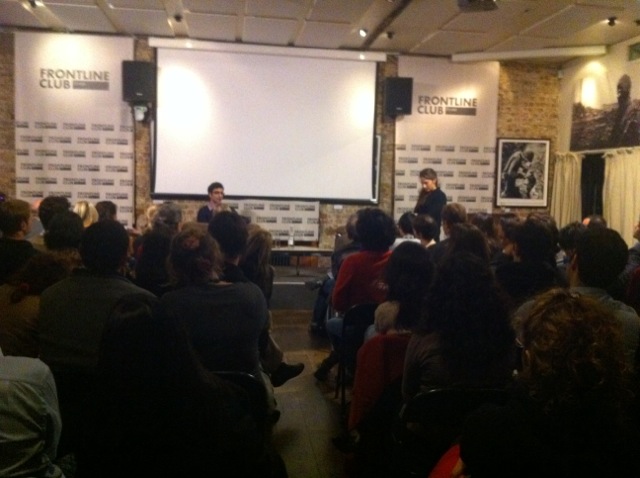
An expert panel convened at the Frontline Club on 26 June, to probe for answers.

Saeed Barzin and Mark Fitzpatrick. Credit: Jim Treadway
CBS Correspondent Elizabeth Palmer, chair for the discussion, observed:
“He’s [Rouhani] had a career which has kept him at the very core of power, very close to the Supreme Leader. So it’s hard to imagine that he will be a radical reformer. And yet, at certain stages in his career he has shown that he is a pragmatist, that he is capable of being flexible.”
During his campaign, Rouhani promised greater engagement with the West while urging the world to “acknowledge the rights” of Iran. His primary promise was to try to ease sanctions imposed on Iran over its nuclear program.
Meanwhile, as Arab Spring upheavals echo across the region, panelists saw the election as a sign that Tehran is tuning in acutely to the demands of the people. Author and journalist Azadeh Moaveni asserted:
“I see Iran changing, and I see the prospects for Iran changing from below. [It] feels differently inside the country. . . This is a break from the police state atmosphere of the last 8 years, which has just been suffocating.”
Saeed Barzin, a longtime Iran analyst now with BBC Persian, agreed:
“What I learned from the elections is that Iranians are getting [ready] for change. That is quite clear in the way that the establishment behaved, the way that the candidates behaved, and the way that people behaved. . . . People are desperate for change. The economic situation is not good: inflation, unemployment, the value of the national currency. But, they want gradual change. They don’t want…a Libya scenario. They don’t want an Egyptian story. They want their new TV at the end of summer, and they want a new fridge for their children . . . gradual, calculated, reasonable, common sense change, and this is what indeed Mr Rouhani is representing.”
“One phrase which did not occur in this election, strikingly, was ‘Islamic Awakening’,” reflected Scott Lucas, a professor at the University of Birmingham and editor-in-chief of EA WorldView.

L-R: Elizabeth Palmer, Azadeh Moaveni, Scott Lucas. Credit: Jim Treadway
Barzin added: “The faction which was defeated in these elections was what I call the right wing of the establishment…which initially brought Ahmadinejad to power.”
With 72% of eligible voters casting ballots, Rouhani won just over 50% of the vote, while his nearest rival, conservative Tehran Mayor Mohammad Qalibaf, received only 16%, and hardliner favorite Saeed Jalili received 11%.
So, will Tehran’s tenor change in nuclear negotiations with the United States? Mark Fitzpatrick, director of the Non-Proliferation and Disarmament Programme at the International Institute for Strategic Studies, commented:
“The [current] nuclear negotiating team was criticizing Rouhani during the election, so they’re all out. But, that’s only a handful of people. My read is that Rouhani will probably bring in more pragmatists, as opposed to hardliners.”
Watch the event here or listen/download the podcast:
https://soundcloud.com/frontlineclub/iranafterahmedinejad
]]>Throughout June, in association with BBC Persian, we will be joined by experts, journalists and commentators to make sure you are up to date with events in the country. We will be offering a portrait of outgoing President Mahmoud Ahmadinejad, analysing the candidates and, following the election, we will be asking what the result means for the future of the country.

Sneak Preview BBC Persian screening: Ahmadinejad – The Populist and the Pariah
Monday 3 June 2013, 7:00 PM
The screening is organised by BBC Persian Service.
Since his election in 2005, Iran’s President Ahmadinejad has become the most well-known Iranian since the founder of the Islamic Republic, Ayatollah Khomeini. Produced by the BBC Persian Service, this documentary looks at the rise of Ahmadinejad and explains how this provincial politician with a PhD in traffic management became a personality to be reckoned with.
Followed by a panel discussion with: Sadeq Saba, head of BBC Persian; Bozorgmehr Sharafedin, filmmaker and journalist and Kasra Naji, special correspondent for BBC Persian TV.

First Wednesday: Who will be the next president of Iran and why does it matter?
Wednesday 5 June 2013, 7:00 PM
On 14 June Iranians will go to to the polls to vote for a president to replace Mahmoud Ahmadinejad, but what significance does this election hold? Join us to analyse the approaching election, the main players and what the result will mean for the future of Iran. With: Kelly Golnoush Niknejad, founder and editor-in-chief of the award-winning Tehran Bureau; Roberto Toscano, Italian Ambassador to Iran (2003-2008); Saeed Barzin, Iran analyst with BBC Persian Service and the BBC Monitoring service since 2006; and Roger Cohen, a journalist, author and op-ed columnist for The New York Times.

Iran after Ahmadinejad
Wednesday 26 June 2013, 7:00 PM
Following the presidential election in Iran, we will be bringing together a panel of experts to deliberate the results and what they mean for the future of the country. In association with BBC Persian Service, we will be taking an in-depth look at Iran’s new president, exploring his affiliations and policies both at home and internationally. With: Mark Fitzpatrick, director of the Non-Proliferation and Disarmament Programme at the International Institute for Strategic Studies (IISS); Saeed Barzin, Iran analyst with BBC Persian Service and the BBC Monitoring service since 2006. Additional speakers to be confirmed.
In association with BBC Persian:

https://soundcloud.com/frontlineclub/iranafterahmedinejad
Following the presidential election in Iran, we will be bringing together a panel of experts to deliberate the results and what they mean for the future of the country.
In association with BBC Persian Service, we will be taking an in-depth look at Iran’s new president, Hassan Rouhani, exploring his affiliations and policies at home and internationally.
Going forward, we will examine how Rouhani will tackle some of the biggest problems facing the country: from the nuclear issue to the economic crisis, and domestic power struggles to human rights.
Chaired by Elizabeth Palmer, CBS News correspondent.
The panel:
Azadeh Moaveni is a former Middle East correspondent for Time magazine who has reported on Iran since 1999. She is the author of Lipstick Jihad, Honeymoon in Tehran, and co-author, with Nobel Peace Laureate Shirin Ebadi, of Iran Awakening. She writes widely on Iran and the Middle East for Foreign Policy, the Washington Post, and other publications.
Saeed Barzin has been an Iran analyst with BBC Persian Service and the BBC Monitoring service since 2006. He has written extensively on Iranian politics, media and society for general audiences, internal BBC customers and UK government officials. Over the past 15 years he has written for a number of current affairs journals and has published several books, including the Political Biography of Mehdi Bazargan which was among the top ten best-selling books in Iran in mid 1990s.
Mark Fitzpatrick is the director of the Non-Proliferation and Disarmament Programme at International Institute for Strategic Studies (IISS). He is the author of The Iranian Nuclear Crisis: Avoiding worst-case outcomes. Prior to joining IISS he had a 26-year career in the US Department of State, where in his final posting he served as Deputy Assistant Secretary for Non-proliferation.
Scott Lucas is professor of American Studies at the University of Birmingham and editor-in-chief of EA WorldView, which specialises in analysis of Iran. A specialist in US and British foreign policy and international relations, especially the Middle East and Iran, he has written and edited eleven books, more than 40 major articles, as well as producing a radio documentary and co-directing the 2007 film Laban!. Formerly a journalist in the US, he wrote for newspapers including the Guardian and The Independent and was an essayist for The New Statesman before founding EA WorldView.
This session is in association with BBC Persian Service.
It’s one of the most corrupt countries in the world and widely criticised for its human rights record but this year Azerbaijan is hosting Eurovision – one of the most glitzy TV music competitions in the world.
But what do we really know about Azerbaijan? What impact will this glitter invasion have on a country unused to being on the international stage? This oil-rich former Soviet republic bordering Iran, Turkey and Russia is undergoing rapid modernisation, forging strong new ties with Europe while retaining its roots in the East.
As Eurovision prepares to come to town, we find out what makes this country tick – exploring Azerbaijan’s rich cultural heritage through the eyes of our Azeri speaking presenter. From music to food, from the winding streets of the old city to the soaring skyscrapers of the modern town.
It’s a country of contrasts and contradictions.
With Eurovision pointing the international spotlight on Azerbaijan young Azeris are hoping for more freedom of expression and genuine moves to democracy. But how realistic is this?
We talk to the bloggers and flashmobbers at the forefront of calls for change – and we put their concerns to an MP.
We find out why the war with Armenia 20 years ago still casts a long shadow – to the point where Armenia has pulled out of the contest.
We look at the challenges of hosting an event like this and ask Eurovision officials whether it should be held here at all.
Duration: 50′
]]>
“Why do we need to give a girl a boy’s face to give her freedom?”
That is the question asked by Azita Rafhat, a former member of the Afghan parliament, who opted for a radical decision to raise one of her four daughters as a boy, having succumbed to the still prevailing social perceptions which dictate that until you bear a son you are a nobody. Taunted by family members and excluded by the wider society.
Tahir Qadiry’s short documentary The Trouble With Girls, produced for BBC Persian, looks at the long-standing but rarely discussed tradition of Bacha Posh – disguising girls as boys.
These girls are dressed as boys, given a masculine haircut and an appropriate name. They are sent to boys’ schools, allowed to play outside and generally are awarded all of the freedoms that girls and women are so often denied in the patriarchal Afghan society.
The mullahs appear to turn a blind eye to the practice and families seem to be contended with this state of collective suspended reality. So deeply entrenched is the desire to have a son that even a temporary optical illusion seems to soothe the tensions.
But what about the girls involved? Most of them have to stop being a boy when they reach puberty, although some parents continue raising them as such until they are fully grown adults. Some contributors, including a women’s rights activist, claimed that being raised as a boy increased their confidence and allowed them to become independent women with jobs and fulfilling lives.
However, The Trouble With Girls offers only glimpses of the psychological damage caused by this sort of an upbringing:
"If my parents force me to get married, I will compensate for the sorrows of Afghan women and beat my husband so badly that he will take me to court every day," says Elaha, who had lived as a boy for 20 years and only reverted to her own gender when she had to go to university.
There was a feeling that a lot was left unsaid and the audience at the screening certainly picked up on that. What emerged was an even more sinister story than the documentary itself implied:
“This practice is still seen as a taboo and not many people want to talk about it. Having access to a family like that is very difficult. However, I was surspised how widespread it was" Qadiry noted.
“Many things we needed to leave out. The lady in the film [Azita Rafhat] is her husband’s second wife. He didn’t have a son with his first wife, so he married her. They only had four daughters, so he was planning to get rid of her and marry for the third time. That’s why she was forced to do this, otherwise her husband would leave her. She may be a breadwinner and educated, but she feels that, if she doesn’t have a husband her life will be a nightmare. And her daughter is the victim of that situation.”
The audience were keen to know how the author find this practice on a personal level:
“I found it quite disturbing. Giving girls all of the freedoms and then taking them away is very challenging. I asked my contributor – ‘don’t you think this is enough? Why don’t you fight with your husband about this?’ She said that was impossible, that is how things are in the Afghan society. You are more privileged if you have a son.”
However, despite all of the difficulties facing women in Afghanistan, it is not all doom and gloom. In the film we were able to see younger women escaping the shackles of traditional roles – they study, work and protest. Increasingly they are joined by men who understand that equality can only be good for the society as whole:
“The younger generations are changing,” says Qadiry, “they are on Facebook for example, Young Afghans for Change, they are saying that men and women are equal. They are taking steps to fight injustices, but it will take time.”
“They are saying that we have to give equal rights to men and women through our constitution, not though the creation of fake identities.”
However, some women in the film talked very positively about their experiences of being raised as boys.
Qadiry said that:
“Maybe they were not telling the full truth, they don’t want to tell you the negative side of it. They may worry you would make fun of them, or disapprove of their family.”
“A more liberal generation is on the rise, which raises their daughters differently, giving them all of the opportunities without pretending that they are boys. Those families exist in cities, and we need to understand that Afghanistan is not only Kabul or Herat, but many other provinces too.”
]]>
Tahir Qadiry's film looks at the issue from a number of different perspectives. He spends time with a girl currently growing up as a boy, talks to a young woman who's still coming to terms with her experience being raised as a boy, seeks the opinion of a mullah and hears from a human rights activist.
]]>Girls can live like this until they are young adults, at which moment they are suddenly expected to revert to being girls, put on a dress and a scarf and conform to all the restrictions and rules imposed on Afghan girls. For many young women it’s very hard to adjust to their new lives.
An female Afghan MP spoke out recently about the difficulties facing girls in this situation, even though she herself admitted bringing up one of her daughters as a boy. The practice raises profound questions about why girls are still so undervalued in Afghan society and how difficult it is even for the new Facebook generation of modern young Afghans to challenge traditional prejudices.
Tahir Qadiry‘s film looks at the issue from a number of different perspectives. He spends time with a girl currently growing up as a boy, talks to a young woman who’s still coming to terms with her experience being raised as a boy, seeks the opinion of a mullah and hears from a human rights activist. He doesn’t judge but the viewer is left with the distinct impression that this is no painless solution for families who feel incomplete without a son.
]]>
by Rosie Scammell
In the wake of intimidation of BBC Persian journalists by the Iranian authorities, last night saw the screening of ‘The Ayatollah’s Seal’ – the first documentary to be made about the country’s Supreme Leader, Ayatollah Khamenei.
Refused access to Iran by the Ministry of Culture (there were more important topics for the BBC, they said), filmmaker Bozorgmehr Sharafedin and his team wove together archive footage with interviews with those whose paths had crossed with Khamenei.
The result is captivating – grainy footage of a pre-revolution Iran sliced with fresh commentary and news-clips from just a few months ago. The Ayatollah of the 1970s is portrayed as the nemesis of his present-day figure; a music-loving academic who listens to poets. Jailed six times, he endured internal exile before returning to a post-revolution Tehran, thrust into the limelight by the 1980 US embassy siege.
While the documentary traces key recent moments in Iranian history from the war with Iraq to the 2009 Green Revolution, its success is the portrayal of an intricate political web; assassinations, allegiances and Khamenei’s tactful rise to the top. The political framework which may seem alien to an audience familiar with a two-party state is carefully unravelled, and it somehow seems possible that this once-rebellious teen could weave his way from the largely symbolic role of president to a Supreme Leader who goes beyond his constitutional role.
Between the interviews and the parliamentary speeches stands the protester – a key player in the Khamenei narrative who is in different scenes a resigning MP, a press freedom marcher, and a Syrian civilian in 2011. While the hour-long film focuses on the seemingly immovable power of the Supreme Leader, the audience’s attention soon turned to his uncertain place in a new era of Middle East politics.
While Sharafedin admitted that the Green Revolution failed to unseat the Ayatollah, he spoke of “a huge legitimacy crisis in Iran” and suggested that current disagreements between Khamenei and president Mahmoud Ahmadinejad are carefully choreographed: “The regime is trying to create an opposition within the conservative base, so now we have this competition between Ahmadinejad allies and the Supreme Leader’s allies. Some people say this is a fake game to bring people to the ballot box, and some people say this is a real competition that might collapse the whole system.”
One audience member reflects that “If anything has been shown in the past year, it’s that deeply entrenched powerful governments can fall very quickly”.
While the Iranian regime in Sharafedin’s view has kept a careful eye on the Arab Spring, and “has learnt its lesson from other countries on how to deal with uprisings”, he remains optimistic that change is imminent.
]]>“The fact is that now people are aware of what is happening in the system and they want a real change,” he says. “They might not come to the streets to fight like Syria, there might not be civil war like Libya, but I think the change is coming. We don’t know how, but we know it’s on the way.”
Who is this man? And how has he consolidated the Revolution?
BBC Persian’s ground-breaking documentary, The Ayatollah’s Seal, charts the Ayatollah’s reign and, through a number of interviews with relatives, biographers and politicians, builds a profile of Iran’s most powerful man.
]]>
A lot has changed in the years since 9/11. The date itself has become emblematic of a change in attitudes towards Islam, perhaps most notably in the country which bore witness to the infamous attacks that day. Popular opinion has shifted, and the land of the free has become an increasingly hostile environment for Muslims. American Muslim: Freedom, Faith and Fear examines what it means to be a Muslim in America today and the consequences of the fact that, for many, the words Islam and terrorism are now permanently intertwined.
The documentary, featuring Karen Zarindast from BBC Persian and Samir Farah from BBC Arabic TV, was screened at the Frontline Club. The team travelled across the length and breadth of the United States in order to examine the lives and experiences of a vast range of American Muslims. They discovered a country in which fear and confusion surrounds Islam, and where politicians and the media often foment unrest in order to further their own objectives. What was once a thriving cultural melting pot where Muslims were welcomed has now developed into a nation over which a sinister and pervasive Islamaphobia has taken hold in the last decade.
A question and answer session followed, during which Darius Bazargan, the film’s producer, Azadeh Moaveni, the author of Lipstick Jihad, and Zarindast discussed the film and some of the key themes that emerged. One of the most important issues was the impact of American foreign policy, as Bazargan suggested in response to the question of whether or not American Muslims will ever be able to escape the dogma associated with 9/11:
“I don’t think there’s any chance of going back to the quiet life, especially because of the impact of American foreign policy in Islamic countries; either through the involvement with Israel or elsewhere. It will be less resonant if there are fewer coffins coming home, and there will be fewer coffins coming home if American foreign policy changes.”
The panel also talked about some of the difficulties faced when filming, including budgetary and time constraints, as Bazargan made clear:
“We had editorial difficulties, you’re a slave to the road in these kinds of documentaries. There were lots of interesting people we had to drop from the final cut simply because they popped up at the wrong point in our journey and didn’t fit the arc of discovery."
As the evening ended somewhat acrimoniously, with conflicting views being raised from the floor over what is clearly an emotive issue to many, Zarindast did offer a consolatory take on her experience:
]]>“I asked people if they would leave the country. They said no. I think it was fascinating, because I spoke to people in Birmingham after some of the recent trouble and they had never been to Pakistan or Bangladesh but they said that they would leave England in an instant. Nearly everybody I spoke to in America said no… this is their country.”
THIS EVENT IS OPEN TO THE PUBLIC
Ten years after 9/11 and a year before what are likely to prove deeply divisive Presidential elections, BBC Global News sent a combined team from BBC Persian and BBC Arabic TV on an epic road trip across the USA to find out what it is like to be a Muslim in America today. America's complicated relationship with Islam is examined through the eyes of two reporters - Karen Zarindast who grew up in Iran and Samir Farah who grew up in Lebanon.
]]>THIS EVENT IS OPEN TO THE PUBLIC
Ten years after 9/11 and a year before what are likely to prove deeply divisive Presidential elections, BBC Global News sent a combined team from BBC Persian and BBC Arabic TV on an epic road trip across the USA to find out what it is like to be a Muslim in America today. America’s complicated relationship with Islam is examined through the eyes of two reporters – Karen Zarindast who grew up in Iran and Samir Farah who grew up in Lebanon.
In a country where Freedom of Worship is guaranteed by the Constitution, the team travelled from New York to Texas to California and points in between. They met American Muslims from all walks of life: from a High class fashion designer in Manhattan, to a Muslim rapper in California, from a Pakistani born Texan "cowboy" to the Imam of the country’s largest mosque in the city of Dearborn — serving a Muslim population of some 30,000.
To a man and woman, all were grateful for the opportunities and freedoms provided by the USA and many were intensely patriotic. Yet set against a backdrop of politically motivated Islamophobia, stoked by some partisan media outlets, many in the American Muslim community now feel under more scrutiny than ever before: they are constantly having to justify their faith and prove their loyalty to their homeland."
]]>