The panel, chaired by prominent investigative journalist Oliver Bullough, examined ground-breaking stories focusing on Arab Spring countries. They explored how kleptocrats from the region have used the services of the British capital to retain and launder their money.
Ala’a Shehabi of Bahrain Watch addressed the Frontline Club, explaining the extent corruption has plagued Bahrain. In recent years, extensive sections of the island’s surrounding waters have been dredged and reclaimed as land, with more than 65 km2 of Bahrain’s land having been privatised in the process ‘the sea was literally disappearing’.
Corrupt Bahraini officials and others exploited this land reclamation as a means to generate vast wealth, selling land and the developments built upon it for enormous profits. The wealth created in the process has since flowed into London, and is particularly prevalent in the capital’s housing market.
‘London is being used to… hide and stash dirty money away. It is a guaranteed safe investment… because it has an accelerating housing market and no one will know who you are. The minute we expose who these people are, the incentives to come to London will disappear,’ explained Shehabi.
Bahrain Watch has worked to expose the financial exploitation committed by the nation’s elites, and has had recent success in revealing the money flowing through the King’s own company ‘Premier Group’. 21 high-end London properties belong to the company’s portfolio, including The Four Seasons and The Marriot on Park Lane. Shehabi described the company as being involved in the ‘alchemy of making money from sand’.
Prior to receiving a leak detailing the corporate structure of the group the information pertaining to the company’s ownership structure and property holdings had been successfully obscured. When Bullough asked her about the difficulty of exposing financial malpractice in Bahrain before she obtained this data, Shehabi said ‘It was a web of information which had been completely obscured. Who owns the sea? This was never registered as public land.’
Shehabi points to the Arab uprising of 2011 as being a pivotal moment for the nation’s people in finally registering their discontent at the widespread corruption that had engulfed the island and its political class. However, she decried the failure of media coverage to pick up on this source of anger as a critical driving force for the political revolt, ‘that’s a story that hasn’t been properly told yet’.
Speaking passionately about the struggles she now encounters in trying to access her homeland, Shehabi concluded by referring to the important work she is now doing in London to combat the flow of wealth out of Bahrain and away from the nation’s own citizens.
Ben Cowdock of Transparency International outlined the sheer scale of the illicit money generated during the Arab Spring, much of which has since flowed through the UK. The National Crime Agency estimates that tens if not hundreds of billions of illicit cash flows through the UK each year.
The misappropriation of state budgets within certain Middle East states in recent years has resulted in huge sums of money being accumulated in the hands of a very select few individuals. Cowdock gave the striking example of Syrian state finances, with Bashar Al Assad’s cousin reportedly owning 60% of the national economy in 2011 according to Transparency International. Illicit money owned by such individuals has flowed into London in vast quantities following the Arab Spring.
Explaining why the capital is a hive of activity for the channelling of such funds, Cowdock said: ‘The UK is a safe haven for corrupt money. It’s a safe haven because it’s a global financial hub, so trillions of pounds come through the UK each year. It’s easy to hide that money within legitimate money. It’s a stable legal environment, you’re unlikely to have your assets taken off you by the government… and has a thriving property market so you’re able to buy gold blocks of bullion in the sky.’
Referring to the network of ‘professional enablers’ that exist within the UK, Cowdock detailed the money being made by professional services in London through the trade of illicit money via property. He highlighted legal firms, banks and estate agents as being just a few of the industries who are generating money as a result of this financial traffic, be that implicitly or explicitly.
The UK’s close links with overseas territories such as the British Virgin Islands and other notable tax havens has made it an increasingly attractive destination for illicit money. Cowdock spoke passionately about the need for the UK to bolster transparency, asset recovery systems and defences against such practice in the future if the capital and the nation as a whole is to combat the problem effectively.
Richard Brooks of Private Eye revealed to the audience the map Private Eye have put together detailing property acquired by overseas companies within the UK from 2005-2014. The map helps to track the flow of dirty money in the UK, designating the ownership details of the vast extent of real estate owned across the nation by foreign companies.
Brooks suggested many of these companies have links to offshore banking and investment programmes, which act as a channel and safe haven for illicit funds.
When asked by Oliver Bullough as to why we put up with such practices, Brooks replied jovially that the UK is keen not to put off entrepreneurs,’we are open for business remember.’
Brooks delighted the crowd when he revealed the case of an underground parking space in Kensington being owned by a company in St Lucia, detailing the truly absurd flow of capital and ownership structure in this instance. His point was well made, he documented to the audience extremely effectively the nature of the high-end property market in London and its murky finances using this and other examples.
Responding to a question pertaining to the importance of greater regulation in this area, Brooks made the moral case for a tighter legal framework, saying: ‘laws serve a purpose of saying we don’t think this is great, meaning such behaviour becomes less socially acceptable.’ Cowdock supported this view, arguing there is a need to ‘create larger disincentives for companies and individuals involved and raise awareness of the moral and financial cost of enabling and facilitating dodgy money transactions.’
When asked about comparisons within Europe regarding the issue of illicit money flows, Brooks revealed that ‘the EU has been a pretty positive force in the last few years regarding financial transparency. It’s certainly dragged along other countries like the UK.’ He expressed concern over the potential impact of Brexit in this area.
The panel united in calling for greater transparency of data from central government, better protections and incentives for whistle-blowers and enlarged anti-corruption budgets.
Cowdock finished: ‘dirty money follows the path of least resistance. Greater regulation raises the obstacles to its passage.’
*This was the second talk in the Frontline Club’s series of Kleptoscope events investigating corruption and dirty money in London: interrogating its origins, its launderers and how it gets spent. The first Kleptoscope event featured three ground-breaking stories focusing on the former Soviet Union, and explored how Russian kleptocrats have used the services of the British capital to retain and launder their money; how London’s property market has become a piggy bank for the world’s corrupt elite; and how ex-Soviet businessmen have covertly funded MPs and parliamentary groups, gaining preferential treatment as a result.
]]>On Tuesday 29 May, the Frontline Club showcased ‘Writing Revolution: the Voices from Tunis to Damascus’, a book which celebrates some of the best new writing to emerge from the Arab Spring.
The collection of articles and essays focusses on what the revolutions, which have rumbled across North Africa and the Middle East over the past three years, mean to journalists, bloggers and activists in the region.

L-R: Matthew Cassel, Layla Al-Zubaidi, Mohamed Mesrati, Ali Abdulemam, Rachel Shabi. Picture Credit: Sayed Ahmed Alwadaei
“The process of finding the protagonists was not easy,” said Layla Al-Zubaidi, editor of Writing Revolution and director of the Southern Africa office of the Heinrich Böll Foundation in Cape Town. She added:
“If you ask revolutionaries to write, it is not easy because they have to sit back and reflect on what they are doing, and for that you need time, space and calm moments. If you’re in the heat of the battle it is hard to find that.”
Al-Zubaidi was joined by Matthew Cassel, a journalist for Al Jazeera English who co-edited the book, Mohamed Mesrati, a Libyan writer and journalist who contributed to the book, and Ali Abdulemam, a Bahraini blogger who agreed to contribute before he went into hiding after a government crackdown. Abdulemam was representing his friend and fellow political refugee Dr. Ali Aldairy, who contributed to the project but was unable to attend the event. Rachel Shabi, a journalist who has written widely on the Middle East, chaired the event. She commented:
“Most of the journalism that came out of the Arab uprisings came from people who rocked up after the revolution started.”
Cassel said that although Western journalists working for mainstream media outlets were a vital part of reporting the Arab Spring, alternative voices could provide a fuller picture of the unfolding events:
“We shouldn’t neglect the young voices that are happening in the country. . . . We need to give a platform to these voices.”
From Cairo to Damascus, Tunisia to Bahrain, the essays and articles highlight the drastic differences between the revolutions which have often been painted with the same brush by the mainstream media. They also explore the histories of the people and their countries, dispelling the myth that the Arab revolutions came from nowhere.
“We wanted to show how much struggle and how much sacrifice happened in the years leading up to the uprisings,” Cassel said, adding that “creative resistance” was a large factor in the uprisings.
Mesrati said that he found it difficult to write down what the Libyan revolution meant to him, when he was commissioned to write a piece:
“When my literary agent said I should write a piece of 3,000 words to 5,000 words, I wanted to write 7,000 words.”
He also mentioned that he wanted to write about Libya’s history and Gaddafi’s influence on the country.
Abdulemam, who went into hiding before he could write his piece, said that he would have focussed on the youth in Bahrain and why they had taken to the streets:
“I would have reflected on youth, what makes them so angry and what they are ready to die for. My essay would try to answer why the youth went out into the street and why until this day they have not gone home. . . . They have this hope that they will bring change. They are sure they will bring it. They don’t want anyone to insult them any more. That’s what makes me sure that change is coming soon.”
Throughout the debate, the editors and writers spoke about the other contributors they encountered along the way.
Aldairy, who was unable to attend the debate, “wrote his experiences from outside the opposition circle”, according to Abdulemam. On the other hand, Al-Zubaidi recalled commissioning a piece from a Syrian writer while avoiding the use of the word ‘activism’, ‘civil society’ and ‘revolution’ on the phone in case it put her in danger:
“She finally said to me: ‘Do you want me to write an article about the revolution? I will say and write what I want. Don’t worry about putting me in danger, I will express myself.’”
Al-Zubaidi continued:
“When [some people] say how disappointing the Arab Spring was, and ask was it worth it, it disregards what these people are doing. You don’t want to risk everything if there’s no hope, and I think these people had hope.”
You can watch the video and listen to the podcast below:
https://soundcloud.com/frontlineclub/writing-revolution-the-voices
]]>https://soundcloud.com/frontlineclub/writing-revolution-the-voices
From Cairo to Damascus, Tunisia to Bahrain, Writing Revolution brings together some of the best new writing born out of the profound changes shaking the region.
We will be joined by the editors and two of the contributors to talk about their work and how it has been shaped and influenced by the historic events unfolding around them. They will be reflecting on what they have witnessed and documented, and the political and poetic engagement with questions of identity and activism.
Bringing together authors, journalists, activists, students, writers and bloggers this collection of writing offers a moving testimony to the hopefulness and the heartbreak that has been witnessed across the Arab world.
Chaired by Rachel Shabi, a journalist and writer, she has written widely on the Middle East for a variety of media including the Guardian, Sunday Times, Independent , Al Jazeera English, Jane’s Intelligence Digest, Foreign Policy, and the New Statesman. She was shortlisted for the 2011 Orwell Prize for political journalism, won the Anna Lindh journalism prize 2011 and was also nominated for the Next Century Foundation’s cutting edge media award.
The panel:
Matthew Cassel is a journalist and photographer based in the Middle East since 2004. Formerly assistant editor of The Electronic Intifada online journal, he is a journalist with Al Jazeera English and a contributor to numerous other publications.
Layla Al-Zubaidi is director of the Southern Africa Office of the Heinrich Böll Foundation in Cape Town. She headed the Foundation’s Middle East Office in Beirut for six years, served as Program Manager at its office in Ramallah and worked for several media and development institutions.
Mohamed Mesrati is a Libyan writer and journalist residing in the UK. He started to publish his short stories online in 2007. He works as a journalist for El Kef newspaper, which has featured his investigative reports on social issues in Libya. An extract from his novel-in-progress Mama Pizza appeared in Banipal No. 40.
Ali Abdulemam is a Bahraini blogger, the founder of Bahrain Online and human rights activist. He took part in protests calling for democracy in Bahrain in February-March 2011. He was amongst the first to agree to contribute to the Writing Revolution project before he went into hiding during a government crackdown on the protest movement. He was sentenced, in absentia to 15 years in prison and recently fled Bahrain to the UK where he’s been granted asylum. He is representing his friend and fellow political refugee, Dr. Ali Aldairy, who ended up contributing to this project but was sadly not able to make it to the UK for this event.
Supported by

This event is organised by Bahrain Pro-Democracy Group in UK and Sayed Alwadaei, political activist in UK.
It is the longest and most peaceful revolution, yet the least covered by the Western media. When the youth of the Gulf island of Bahrain decided to join the Arab Spring on 14 February 2011 they were responding to the call for change that had resonated in the corners of the Arab world. Two years later, they have remained faithful to their revolutions, slogans and human values.
Their daily protests have continued against all the odds, including the political and security support by some Western governments to the antiquated Alkhalifa regime. While the British media was supportive of Bahrain’s pro-democracy protests the UK Government was less enthusiastic towards change in the political structure of a monarchy found guilty of “systematic torture” by its own commission of investigation.
These issues will be debated at a special seminar to coincide with the second anniversary of Bahrain’s 14 February Revolution. A film report highlighting the British role in Bahrain will also be shown.
Chaired by Mark McDonald, a human rights barrister and the director and principle founder of the London Innocence Project. He has lectured extensively on US death penalty litigation and constitutional law. He is the founder of Labour Friends of Palestine and the Middle East.
The Panel:
Dr Ala’a Shehabi, a Bahraini researcher and writer, and founding member of Bahrain Watch, an advocacy group campaigning for transparency and accountability in Bahrain. She is currently an ACSS research fellow and has a PhD in economics from Imperial College London.
Farida Ghulam, a member of the Board of National Democratic Action Society “WAAD”. She is active within the women’s movement and plays a leading role in the political affairs in Bahrain. She is also the wife of the liberal secular left opposition figure and president of WAAD, Ibrahim Sharif, whose 5 years prison sentence in a military court has been upheld twice on appeal.
John Lubbock, a research and advocacy officer for the Bahrain Centre for Human Rights in London. He has a Masters in international politics and human rights from City University, London.
Mike Diboll, currently researching the cultural, generational and social transformation of the GCC region with a focus on higher education. He was professor of Comparative Literature at UAEU 2002-2007, University of Bahrain 2007-2009, Academic Head of CPD, Bahrain Teachers College 2009-2011.
Craig Murray, an author, broadcaster and human rights activist. He was British Ambassador to Uzbekistan from 2002 to 2004 and Rector of the University of Dundee from 2007 to 2010.
]]>At an event hosted by the Frontline Club, an expert panel of speakers shed light on the ongoing oppression of political opposition in Bahrain, one of the most under-reported aspects of the Arab Spring, and the government’s systematic use of Western public relations companies to manage the regime’s global reputation.
In the early months of 2011, thousands of Bahraini citizens took to the streets to demand greater representation and more equitable treatment of the country’s Shia citizens, who make up 70% of the population. Dozens were killed, and hundreds more were incarcerated or went missing.
But, as moderator and The Guardian‘s Comment is Free editor Brian Whitaker explained, the story has been overshadowed by events in Syria and elsewhere in the Middle East, and buried by governments in both the West and the Gulf region that see Bahrain’s royal family as political allies.
“This doesn’t justify the repression that is happening in Bahrain, and it doesn’t reduce the need for people’s rights there,” he said.
Organised by advocacy group Bahrain Watch, the event highlighted the organisation’s efforts to draw attention not only to the brutality of the Bahraini government, but also to its use of international PR firms to hide its activities from the global community.
“Opposition has been suppressed by methods including incarceration and torture, extra-judicial killing and the excessive use of force,” said Marc Owen Jones, doctoral candidate at Durham University and member of Bahrain Watch.
“This has resulted in the death of at least 60 protestors, and probably more.”
The government is using what Jones described as “soft tactics” to influence international opinion, including the recruitment of international PR firms to “delegitimise the pro-reform movement and push the government narrative.”
“Since February 2011, contracts have been awarded to 18 companies, 15 of which total $32.5m – and this is a conservative estimate,” said Jones. “All of them are based in the US and the UK…the largest being M&C Saatchi and Bell Pottinger.”
These activities continue unhindered by the governments of the UK and the US, earning London the unofficial title of the “world’s reputation laundering capital”, said Jones.
“It’s worth exploring whether these companies can be targeted here,” said pannelist Adam Hunt, a human rights solicitor and partner in Deighton Pierce Glynn.
“Companies can be excluded from competing for UK government contracts if they are found guilty of professional misconduct.”
Bahrain’s leader, King Hamad bin Isa Al Khalifah, has set up a commission of enquiry to investigate abuses by the regime. But the panel concluded that although the commission’s findings were important, its report was nothing more than window-dressing.
“There continue to be daily allegations of abuse of protestors and there have been no convictions of anyone with any level of responsibility [within the regime],” said Carla Ferstman, director of international human rights organisation REDRESS.
“The most galling aspect is that they are documenting human rights violations but not doing anything about them,” said Jones. “It’s just a testament to impunity.”
The regime has hidden the worst of its excesses from the public eye and now tortures people in secret detention centres, explained Mohammad Al Tajir, a human rights lawyer who was tortured and detained for more than three months by the regime for speaking publicly in favour of the release of political prisoners.
When Al Tajir was arrested, his bank account was frozen and his wife was told that he was dead.
“The problem is that there is no will to bring justice,” said Al Tajir. “Confession is still the only evidence in most cases. Torture has not stopped. Out of 20 people arrested, 10 will have to go to hospital.”
Asked what they expected of Bahrain in the months to come, none of the panellists had high hopes.
]]>“I’m not optimistic at all,” said Jones. “Maybe we’ll see the release of some prisoners. But I don’t see any sincerity in any of the reforms.”
On February 14 2011 just days after Mubarak fell in Egypt, the Bahraini people began a popular uprising that has been unabated. We will be asking why do we hear very little about events in Bahrain in the media? What strategies has the Bahraini regime adopted to win the media battle, as well as the daily battles on the street? We will also be presenting the findings of a research project on the PR companies employed by the regime.
]]>On February 14 2011 just days after Mubarak fell in Egypt, the Bahraini people began a popular uprising that has been unabated. Nabeel Rajab, the most prominent human rights activist has just been sentenced to 3 years imprisonment, whilst 13 other activists have been sentenced to life imprisonment.
We will be asking why do we hear very little about events in Bahrain in the media? What strategies has the Bahraini regime adopted to win the media battle, as well as the daily battles on the street? We will also be presenting the findings of a research project on the PR companies employed by the regime.
As well as discussing the PR war, the panel of experts will discuss the prospects of accountability for torture and related abuses inside and outside of Bahrain.Officials accused of torture are frequent visitors to the UK, most recently the King’s son, Nasser Bin Hamad was a VIP guest at the Olympics. What kind of legal action can be taken in the UK, given Britain’s supportive foreign policy to the Bahraini regime?
A film report highlighting the plight of detained athletes will also be shown.
Chaired by Brian Whitaker, journalist for The Guardian since 1987 and its Middle East editor from 2000-2007. He is currently an editor on the paper’s “Comment Is Free” section. He runs, Al-Bab.com, about politics in the Arab world and is author of What’s Really Wrong with the Middle East.
With:
Mohammad Al Tajir, a human rights lawyer who was detained last year for his outspoken criticism of Bahrain’s judiciary and defending several detained activists.
Marc Owen Jones, a doctoral candidate at Durham University and member of advocacy group Bahrain Watch. His research focus is on how social media functions as a tool of surveillance and social control in Bahrain. He also writes a blog that documents, among other things, the role PR companies play in marginalising dissent and whitewashing human rights violations.
Carla Ferstman, the Director of REDRESS, an international human rights organisation that assists torture survivors to seek justice.
Adam Hundt, a human rights solicitor and partner in Deighton Pierce Glynn who specialises in cases against the UK government, in particular for migrants and refugees. More recently he successfully represented a client who had been tortured abroad with the knowledge and complicity of the British security services.
]]>By Nicole Hunt
The day after the Bahrain Grand Prix, 21 Bahraini activists, including hunger striker Abdulhadi al Khawaja, are due in court in Manama on Monday to hear the outcome of their appeal against life sentences handed down in June 2011 for conspiring to overthrow the government during last year’s protests. The decision to schedule the hearing after the Grand Prix was a controversial one, as al Khawaja’s deteriorating health two months into his hunger strike raised the very real possibility that he could die before the race took place. UK supporters said al Khawaja’s death would be a ‘stain on Bahrain’.
Burmese democracy leader Aung San Suu Kyi is set to take up her seat in the Pyithu Hluttaw (House of Representatives), following a landslide victory by her National League for Democracy in 1 April by-elections, though there have been suggestions that NLD MPs will boycott the opening over an oath of allegiance that forces them to swear to safeguard the constitution. Suu Kyi’s parliamentary debut comes amid news that she may travel to the UK and Norway in June, where she would be able to see her grandchildren for the first time and finally pick up her Nobel Peace Prize, awarded in 1991.
The late Malawian President Bingu wu Mutharika, who died of a heart attack on 5 April, is laid to rest at his family farm in Thyolo. There is speculation that close ally Robert Mugabe and Sudanese President Omar al Bashir could be among attendees at the state funeral; Malawi came under fire from the International Criminal Court last year when it failed to arrest Bashir during a visit to the country for a regional summit. Bashir is wanted by the court for alleged war crimes in Sudan’s Darfur region.
All eyes stateside on Tuesday as a pre-trial hearing begins at Fort Meade, Maryland, for Private First Class Bradley Manning, who has been charged with a variety of offences, including aiding Al Qaeda, for his alleged role in leaking sensitive military material to WikiLeaks, among which was a video which later became WikiLeaks’ Collateral Murder film.
In New York, Secretary of State Hillary Clinton is due to give the keynote speech at the Time 100 Gala Dinner, being held in honour of those named to Time’s 100 Most Influential People list on 18 April. In addition to Clinton and President Barack Obama, this year’s list also included the likes of Syrian President Bashar al Assad, North Korean leader Kim Jong-un, Italian Prime Minister Mario Monti and, of course, Kate and Pippa Middleton.
And, just for good measure, Republican primaries also take place in New York, Pennsylvania, Rhode Island, Delaware, and Connecticut, though now that everyone is agreed that Mitt Romney will win everything, it’s a less exciting race.
Why will journalists be fighting for a place at the Scottish Parliament’s Economy, Energy and Tourism Committee meeting on Wednesday? Because US property tycoon Donald Trump – who at one point pictured himself being the focus of those Republican primaries – is scheduled to appear to give evidence on government plans to build an offshore windfarm near his £1bn golf resort. In written evidence submitted ahead of his appearance, Trump said the plan would destroy Scotland’s countryside and coastline, and was tantamount to ‘committing financial suicide’ – a jibe that would have stung even more after the controversial Skintland issue of the Economist.
Charles Taylor’s nine-year war crimes case comes to a head on Thursday as the Special Court for Sierra Leone announces its verdict. While media coverage in the summer of 2010 suggested that perhaps Taylor was on trial for giving Naomi Campbell a diamond or two, the former Liberian President has actually been tried for crimes against humanity, violations of Article 3 of the Geneva Convention, and other serious violations of international humanitarian law – including, of course, allegedly giving Sierra Leonean rebels arms in exchange for so-called ‘blood diamonds’.
In a less groundbreaking trial – though one that receives headlines whether models are involved or not (and they frequently seem to be) – former Italian Prime Minister Silvio Berlusconi returns to court in Milan on Friday to face charges of paying for underage sex. While the trial is now over a year old and coverage has been relegated to the Italian press for some time, recent hearings have reignited international interest as the lurid details of Berlusconi’s ‘bunga bunga’ parties have been disclosed.
EU High Representative for Foreign Affairs Catherine Ashton begins a three day trip to Myanmar on Saturday, where she is scheduled to meet with government officials and opposition members (including Aung San Suu Kyi) and is expected to open the EU’s new embassy in Yangon. Her visit follows a meeting on Monday of EU foreign ministers, during which they are expected to relax sanctions on Myanmar in the wake of recent political improvements.
Guinea-Bissau had been scheduled to hold its presidential run-off vote on Sunday, following first round polls on 18 March, but as front-runner Carlos Gomes Junior was arrested as part of a military coup d’état on 12-13 April, the election will not be going ahead. The military junta has announced a two-year timeframe for new elections, which has been agreed by opposition parties but not Gomes’ ruling party.
Sunday also marks the 20th anniversary of the beginning of the Los Angeles riots, which left 53 people dead and over 2,000 in three days of violence following the acquittal, by an all-white jury, of four police officers who were videotaped beating black motorist Rodney King. The anniversary comes amid heightened racial tensions in the US following the delayed arrest of George Zimmerman for the murder of Trayvon Martin.
]]>View in iTunes
“Never has the power of the people appeared so humane, so inspiring, so personal, so determined as in Tunisia, so daring as in Syria, so diverse as in Yemen, so humble as in Bahrain, so courageous as in Libya, or so humorous as in Egypt. If, as one keen observer noted, every joke is a tiny revolution, the Arabs, and most notably the Egyptians, are revolutionaries par excellence.
Marwan Bishara, The Invisible Arab: The promise and peril of the Arab revolution.
The uprisings across the Arab world have often been portrayed by the media as spontaneous acts that were sparked by the death of Tunisian street seller Mohamed Bouazizi after he set fire to himself in late 2010.
In his new book Marwan Bishara of Al Jazeera English challenges this perception, exploring the history and deep-rooted feelings behind the apparently spontaneous takeover of Tunisia’s November 7 Square, Egypt’s Tahrir Square, and Bahrain’s Pearl Square.
These events and others in the region, Bishara explains, were the culmination of a long social and political struggle: countless sit-ins, strikes, pickets and demonstrations by people who risked and suffered intimidation, torture and imprisonment.
Marwan Bishara will be joining senior BBC presenter and special correspondent Lyse Doucet to discuss the roots of the uprisings, how they have evolved from country to country, the shifts they have created in the region and asking what lies ahead as people continue to battle for freedom and justice?
Marwan Bishara is Al Jazeera English’s senior political analyst and editor and host of its flagship show Empirewas previously a lecturer in International Relations at the American University of Paris, and a fellow at the Ecole des Hautes Etudes en Sciences Sociales. His writing has appeared in the Guardian, New York Times, International Herald Tribune, Newsweek, Le Monde, and The Nation amongst other titles.
]]>By Nicole Hunt
Pakistani Prime Minister Yousuf Raza Gilani has been ordered to appear before the Supreme Court again on Monday, this time to be indicted on charges of contempt of court over what prosecutors say is his refusal to ask Swiss authorities to re-open graft investigations against allies, including President Asif Ali Zardari. Whether Gilani actually appears or not depends on the outcome of his last-minute appeal against the order.
The beginning of the week is filled with little bits and pieces that will be closely watched as part of the ongoing EU debt saga. Short-term debt auctions in France and Germany get things started on Monday, followed by the release of Greece’s fourth quarter GDP estimate on Tuesday, the same day the OECD publishes its Economic Survey of Germany.
Tuesday also marks the one year anniversary of the beginning of ill-fated protests in Bahrain. Inspired by the toppling of Zine El Abidine Ben Ali’s regime in Tunisia a month earlier and Hosni Mubarak’s regime in Egypt just days before, protesters took to the streets and Manama’s Pearl Roundabout to demand political reform. The protests were later crushed as a state of emergency was imposed a month later, with the help of Saudi Arabian troops, and the Pearl Roundabout was demolished on 18 March.
As Iranian President Mahmoud Ahmadinejad faces the prospect of having to appear before Parliament in the coming weeks to defend himself against allegations of economic mismanagement and shady friends, the country’s opposition Green Movement has called for demonstrations across the country to mark the one year anniversary of 2009 presidential candidates Mir Hossein Mousavi and Mehdi Karroubi being placed under house arrest for their support of Arab Spring protests.
Back to the EU on Wednesday as fourth quarter GDP estimates are released for the euro zone and Germany.
While recent Arab League meetings have been dominated by what’s happening in Syria and the state of the League’s observer mission there, a lower-profile meeting in Cairo shifts the focus briefly to the Israeli-Palestinian conflict. Members of the League’s Follow-Up Committee are set to discuss the next steps in Palestinian negotiations with Israel, following the passing of a 26 January deadline without any Israeli commitments for a settlement freeze.
On Thursday, North Koreans mark what would have been the 70th birthday of recently-deceased leader Kim Jong-Il. Expect extravagant celebrations and more public mourning, and perhaps another parading of Kim’s son and heir, Kim Jong-un.
Ministers from the 56 countries that make up the Paris Pact Partners meet in Vienna to discuss how to combat the trafficking of opium and heroin from Afghanistan. The UNODC’s most recent Afghanistan Opium Survey, published in January, showed that opium prices in the country soared by 133 per cent last year.
Big celebrations are expected in Libya on Friday to mark the one year anniversary of the beginning of protests against Muammar Gaddafi’s regime. As the initial protests prompted a violent crackdown from Gaddafi forces, the situation in Libya quickly turned into the most global of the Arab Spring protests, with NATO forces beginning action there in March and international action continuing up until Gaddafi’s death on 20 October and the subsequent declaration of liberation by the National Transitional Council.
The Rwandan Supreme Court is expected to announce the fate of two journalists sentenced to prison after being convicted of denying the 1994 genocide, inciting civil disobedience and causing divisions. Agnes Uwimana Nkusi and Saidati Kukakibibi, sentenced to 17 and seven years, respectively, await the outcome of their appeal.
Voters in Latvia go to the polls on Saturday to decide whether to introduce Russian as the country’s second official language. Native Russian speakers account for approximately a third of the population in the former Soviet nation; over 50 per cent of the electorate must approve the measure for it to take effect.
In Cairo, Palestinian Authority President Mahmoud Abbas and Hamas leader Khaled Meshaa get together to iron out the details of a new unity government, which is expected to be announced at the end of their meeting. They’re also expected to confirm a date for elections, which are due to take place around 4 May, one year from the date they signed an agreement ending four years of internal conflict.
Saturday is also the beginning of Rio Carnival!
And on an otherwise fairly quiet Sunday, WikiLeaks founder Julian Assange is back in the spotlight – not in front of the courts, but on TV screens as he makes his appearance on the 500th episode of The Simpsons.
]]>
"With our souls, with our blood, we would sacrifice anything for you Bahrain" people chanted on the streets of Bahrain. In February 2011, while the media glare was firmly focused on the uprising in Egypt, the Bahraini people were left to shout in the dark.
One of their rare witnesses was Al Jazeera’s May Ying Welsh, who went undercover, without the permission of the Bahraini government, to record the people’s desperate and unanswered calls for democracy which started in February last year.
Bahrain: Shouting in the Dark, as its tagline states, tells “the story of the Arab revolution that was abandoned by the Arabs, forsaken by the West and forgotten by the world.” It went on to win one of the most prestigious recognitions in journalism -2011 Foreign Press Association’s Documentary of the Year Award.
On his Twitter account Bahraini Foreign Minster Khalid Al Khalifa criticised Qatar, where Al Jazeera are based:
“It’s clear that in Qatar there are those who don’t want anything good for Bahrain. And this film on Al Jazeera English is the best example of this inexplicable hostility.”
The reaction of the regime is hardly surprising as Welsh has exposed all of the brutality which was, at least at the time, hidden from the eyes of the world.
We see unarmed people shot, beaten, teargassed. We see doctors and nurses, Sunni and Shia, in the Al Salmaniya hospital reduced to tears after treating injured protesters for 48 hours without a break, unable to comprehend what is happening to their country.
We see how the regime’s brutal crackdown against its own people gathers force with the introduction of martial law and media “witch hunts” – all with the help of the military forces from the Gulf states.
We see how the protesters are desperate for their revolution not be portrayed as some sort of sectarian violence between Shias and Sunnis, but as a unified call of all Bahrainis for the end of the authoritarian regime and the introduction of constitutional monarchy.
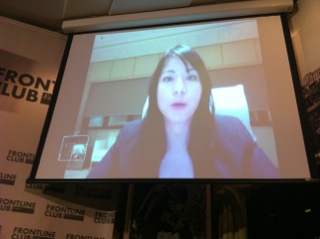
The film’s executive producer, Jon Blair, who moderated the Q&A, asked Welsh, who talked via Skype, to explain how did she found those months living and working in Bahrain.
“Because of the undercover aspect of the filming, I needed to leave the hotel system. I moved into an apartment where the details of my passport were not reported to the interior ministry.”
“I started being monitored by the government through the sim card in my phone so I had to take it out. I did have the police coming to my apartment, a large group of them. There were check points everywhere. I had to wear an abaya and hijab and put my camera in my feminine purse so I wouldn’t look like a foreigner or a journalist.”
When asked why the Western world decided to stand back, when they got involved in Libya for example, Walsh said:
“I think the reason is not being able to afford to upset Saudi Arabia, it’s not so much to do with the US Fifth Fleet presence. That is my opinion at least. If Bahrain were to have a real democracy, that would impact the eastern part of Saudi Arabia where all the oil is and we depend on that oil. Shias living in Bahrain are the same people, the same tribe, who live in that part of eastern Saudi Arabia, they would probably also rise up then and demand change.”
Present at the Q&A session was also an ex-Bahraini MP Ali Mahdi Alaswad who resigned in February 2011, along with 17 other Al Wefaq MP’s, in response to the brutal crackdown against pro-democracy demonstrations.
He said that the situation in his country has hardly improved since then.
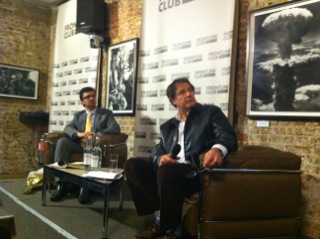
“The clashes are still continuing. If there are casualties, they still can’t go to the Al Salmaniya hospital. The situation is still the same."
“Most of the people who were interviewed in the film are still detained or are out awaiting trial, they cannot travel anywhere.
“The opposition politicians were talking to the Crown Prince, unfortunately he has no power now. People in Bahrain are still demanding. Their demands for reform are still increasing. But the authorities don’t want to upset the Saudis, as about 75 per cent of their income depends on them. The situation is very difficult. But the people are still demanding democracy and they won’t stop until it is achieved.”
With the anniversary of the first Pearl Roundabout protest coming up on February 14, one audience member who lived in Bahrain was worried that there might be another carnage on the horizon. Alaswad hinted that the people are certainly not going to let that day slip quietly.
“People in Bahrain are getting angry now. They don’t want to see politics, they just want to be outside, protesting, they want to express their feelings. Everybody in Bahrain is waiting for February 14. The regime in Bahrain are thinking what to do. We are planning many activities, but I can’t say more now”
You can watch the Shouting in the Dark Q&A here. Click here to watch Shouting in the Dark.
]]>