“This started before Maliki and will go on long after Maliki.”
– Hayder al-Khoei

From left: Zuhair al-Naher, Dominic Asquith, Hayder al-Khoei, Ian Black and Zaid Al-Ali (via Skype).
Opening the panel discussion on recent developments in Iraq held at the Frontline Club on Tuesday 24 June, Ian Black, Middle East editor for The Guardian, asked why the international community and the government in Baghdad had been taken by surprise by the current crisis.
In introducing the panel, Black stressed the need to look at “Iraq itself, the nature of what is going on, the role and significance of ISIS (and whether it should indeed be called that), the sectarian element of the crisis, the legacy of the invasion of 2003, Iran, the US and our [the UK’s] own role in the current situation.”
Hayder al-Khoei, associate fellow at the Middle East and North Africa programme at Chatham House, began by analysing the potential for the crisis to quickly descend “within the next few weeks or even days” into an open Sunni–Shia conflict.
Citing widespread support from local civilians as well as other Sunni militias, al-Khoei stressed that for the most powerful of these insurgent groups their advance had “absolutely nothing to do with winning more rights for the Sunni Arab community . . . or even defending the Sunni Arabs in Iraq despite that being their narrative”.
“It’s much bigger than that. . . . It’s about overthrowing the Iraq government regardless of whether Maliki is prime minister.”
Arguing that while some have chosen to read the rise of ISIS as a direct result of the Iraq invasion, al-Khoei spoke of “a real sense [from talking to people throughout the country] that the jihadist groups and insurgents in Iraq have refused to acknowledge the post-2003 political order” where Shias hold the balance of power.
While acknowledging that Maliki had made mistakes, Zuhair al-Naher, spokesman for the Iraqi prime minster, corroborated this by suggesting that many Sunni politicians “cannot yet understand, or come to terms with the reality that they are a minority”.
While all on the panel agreed that secularism does have a role to play within Iraq, there was also a consensus that this is not yet, at least, a sectarian war. Al-Naher rejected the assertion, propagated in the media and through ISIS, that the Sunnis have been “repressed, downtrodden and marginalised”, citing the positions of power occupied by Sunnis in the military and government and claiming that this was a deliberate attempt by ISIS to define the parameters of the conflict. Most notably al-Khoei cited the objectives of the insurgent groups differing between the ultimate goal of an Islamic Caliphate, as envisioned by ISIS, and the return to a form of pre-2003 secular dictatorship of the Baathists.
https://twitter.com/nicolaannettek/status/481794885448904704
Zaid Al-Ali, a former legal advisor to the UN in Iraq, disagreed that the solution to Sunni unrest was increased “inclusivity in government” – but rather the need to tackle the problems of random arrest and torture faced by ordinary citizens.
Dominic Asquith, British ambassador to Iraq 2006–07, suggested that while insurgents such as ISIS – operating outside centralised urban control command centres – have been ever-present since 2003, the origins of Sunni extremism lay in the lack of any “unifying vision for Iraq”.
“Iraq’s leaders have never combined for something . . . but they have at times taken a united stand against something . . . and it looks as though there is a real risk we will go back to rebuilding a house of cards again.”
Asquith went on to name a potential three-part solution to the current problem. First was to contain ISIS, second was to install a new leadership in Baghdad – one that rejected sectarianism and perhaps embraced de-centralisation – and third was to change the narrative (including the relationship between Iran and the US towards Iraq) of aggressor and victim.
Touching on points by both Asquith and al-Naher, al-Ali agreed that while the responsibility for the crisis was not solely Maliki’s, his eight-year leadership of Iraq meant that there was a need for “a new leader to try their hand”.
Returning to an emerging sectarianism, al-Koehi said:
“Sometimes we over analyse and over read Shia–Sunni conflicts and whether there are regionally backed coup attempts or bribes or a variety of other conspiracy theories. But I genuinely believe sometimes the simplest explanation is the best and, as Zaid [al-Ali] mentioned, this is incompetence.”
To this, Asquith added:
“If you amass the various incompetent decisions taken early on after 2003, we are seeing the effect of those now in terms of creating a confessional system. There was confessionalism instituted right at the outset, there was in retrospect an utterly disastrous de-Baathification process which helped create that distrust between communities and there was a reliance on exiles who didn’t really understand [Iraq]”.
Agreeing that the ultimate aim of ISIS was to provoke an all-out sectarian conflict, the panel concluded by discussing the means by which this might be achieved.
Referencing the ‘hearts and minds campaign’ that ISIS have embarked on and which has emerged from various media outlets, al-Khoei qualified the group’s apparent attempt to moderate themselves as “not coming anywhere near being moderate – it just means they are slightly less extreme”.
For Zaid al-Ali, “it may be that ISIS have been trying to put on a more humanitarian face but they cannot succeed because they are pathologically wired to destroy, kill and terrorise”.
Catch up with the full event here:
]]>
In 2010 U.S. Army Private Bradley Manning committed the largest security breach in US history, handing the classified Afghan War Diary, Iraq War Logs, and 250,000 State Department cables to Wikileaks. Imagery like that of an American helicopter team gunning down citizens and journalists on a Baghdad street in 2007 has been lodged in the global consciousness.
With Manning standing trial before a military court in June, the Frontline Club engaged an expert panel on Monday 15 May to ask what lies ahead for the whistleblower, along with what his experience might mean to governments and the media.

(L-R): Naomi Colvin, Chase Madar, Richard Gizbert and David Leigh. Photo credit: Jim Treadway
Naomi Colvin, a writer, activist and founder of UK Friends of Bradley Manning, declared him a “touchstone for people involved in social justice movements.”
“2011 is one of those years that will go down in history, like 1989, or 1968, or 1848,” she said. “Political action was on a worldwide scale. . . . That spark of enthusiasm started in the Middle East, and the [documents that Manning released] are at least a contributing factor to that.”
Chase Madar, a New York attorney who has written a book detailing Manning’s experience, agreed:
“The State Department cables [were] just a very brutal and candid assessment of corruption in the Ben Ali government . . . Tunisian intellectuals I’ve spoken with have said you really can’t tell the story of the uprising there without at least mentioning Bradley Manning and his leaks.”

The panel rang of frustration with the American media’s failure to cover the Manning story in fairness or depth. Americans “know very little” about his case, Madar observed.
“The New York Times fails to send a journalist to cover the first public hearing with Manning,” lamented Richard Gizbert, Presenter for al Jazeera’s Listening Post, “which even the Times’ own ombudsman said was ridiculous.”
“I got adopted by the staff of a fish restaurant in Glasgow [recently],” Madar recounted. “The bartender and the waiter knew all about [Manning’s case], and it’s because The Guardian’s coverage [has been] much better than anything in the United States.”
David Leigh, the Guardian‘s investigations editor until 2013 and co-author of a book on Julian Assange and Wikileaks, reduced Manning’s trial to “a piece of theatre by the American military to expose, dramatise, penalise and terrorise whistleblowers.”

Even still, Madar harbored optimism for what Manning will ultimately represent:
“He delivered a 35-page statement of intent in court a couple of months ago… it was very impressive… poised, very self-possessed, very thoughtful and reflective, as opposed to the way he’d been demonised as some naricissistic little punk… The more people hear from Bradley Manning in his own words and in his own voice – because someone smuggled a recorder into the courtroom, you can hear him with his own voice – the more they’re going to realise that Bradley Manning is the responsible, ethical citizen; that it’s his detractors in government and the media who are the narcissistic, little, punks.”
You can watch a recording of the event or listen to the audio podcast below:
https://soundcloud.com/frontlineclub/the-case-of-the-us-vs-bradley
“We are going to see people resisting change but it will be a major mistake that will cause a lot of problems if countries see the Arab Spring as a conspiracy,” said Khanfar, who for eight years held managed the TV network that has been credited with having contributed to the ferment that led to the uprisings that swept the region. “Any country that does not accept proper reform and serious constitutional reform will face difficulty.”
With the current perception that the Americans are withdrawing from the region, there are concerns about who will be responsible for protecting the status quo in the region. In this changing landscape, what happens in Syria remains very important, the Palestinian-born journalist told Channel 4 News presenter Jon Snow:
“Syria is not like any other country, it is the cornerstone of a bloc in the region and therefore a lot of countries are worried about what is going to happen in the region when Bashar is out of power. This is why, in my opinion, the Arab world is reluctant about Syria.”
Syria is of particular concern to Iran, because if the revolution succeeds it will no longer be part of the alliance Iran is forming with Iraq and Beirut, said Khanfar, who is now president of the Sharq Forum, a think tank focusing on political development, social justice and economic prosperity in the Middle East.
“If Syria is out of it, you are talking about the decline of Iranian influence in the region and that means they may not become as “dangerous” in the Gulf as they are right now and this will give more confidence and a more relaxed environment for serious changes to take place in the region.”
Al Jazeera, which was launched in 1996, differed from other Arab channels because although heavily funded by Quatar’s royal family, it had not followed the same policy of focusing on the leaders but instead had set out to spread democracy and human rights and to feel the pulse of the region, he said:
“The whole phenomena of Al Jazeera is against the whole custom and tradition of journalism in the Arab world by that time, because it started with a different perspective about news, which before used to be something that was owned by the state and the state tailored what exactly should appear and everyone understood that TV was what the state wants us to know.
In 1996 everyone would watch TV in order to know what the state was talking about.” Asked if he was aware of the significance of what the channel’s stance as people were “flocking” to the screens to watch Al Jazeera, Khanfar said he was aware it was “a matter of life and death”:
“By that time I had seen our office in Baghdad bombed, an office in Kabul bombed, by that time we had a colleague of ours in Guantanamo, another one in court in Spain. Definitely we knew how dangerous the situation was.”
The Al Jazeera audience is “highly politicised” and would notice any change in editorial policy following his departure last year, said Khanfar, who insisted the decision to leave was his own:
]]>“I thought for a long while that eight years was how long I could survive always being proactive and creative, and that’s enough. Also, the Arab world is living a new mood and I feel I could do something as well which Al Jazeera cannot allow me to do, which is becoming part of the transformation of this dynamic region. I would like to speak my opinion and play a more political role.”
By Nicole Hunt
US President Barack Obama hosts Iraqi Prime Minister Nuri al Maliki for talks in Washington on Monday, with discussions focusing on strengthening the ‘strategic partnership’ between the two countries. The summit comes ahead of a looming 31 December deadline for the withdrawal of US troops from Iraq.
Following last week’s European Council meetings, the focus early this week is, predictably, still the euro zone debt crisis. Experts from the IMF, the European Central Bank and the EU begin their sixth review mission to Athens, hoping that this time around they’ll be able to stick around until the scheduled end of the visit on Friday.
The venue changes but the topic stays the same on Tuesday, with Spain, Italy and France in the limelight. Spain’s Congreso de los Diputados convenes for the first time since elections on 20 November, though new Prime Minister Mariano Rajoy won’t formally take up his post until he’s sworn in by King Carlos later this month.
In Rome, Parliament is scheduled to begin debating Prime Minister Mario Monti’s austerity measures, which he issued by decree on 4 December. MPs are expected to approve the measures well before the 60-day deadline.
Meanwhile, French unions have planned a nationwide day of protests against their government’s austerity measures. Thousands are expected to take the streets in Paris, where the largest demonstration takes place outside of the Assemblée Nationale.
Under Egypt’s complicated election laws, another parliamentary vote is held on Wednesday, with polling taking place in nine governates, including Giza and Suez. The elections on 28 November, which were held despite violent protests only days before, covered nine provinces, including Cairo and Alexandria. A third round of voting takes place on 3 January.
In New Orleans, the Bureau of Ocean Energy Management holds the first oil and natural gas lease sale in the Gulf of Mexico since the April 2010 Deepwater Horizon disaster.
A Paris court is expected to issue its verdict on Thursday in the long-running corruption trial of former French President Jacques Chirac. Chirac is accused of misusing public funds and creating false job contracts during his time as Mayor of Paris. He settled a €2.2m civil suit with the city of Paris in August 2010.
Thursday also sees two meetings taking place which will be viewed very differently by Russia. President Dmitry Medvedev attends the EU-Russia Summit in Brussels, but the visit will be coloured by expressions of concern from the EU over allegations of unfair voting practices in Russia’s 4 December parliamentary elections, which saw Medvedev’s United Russia party win a majority despite heavy losses.
Over in Geneva, the World Trade Organisation holds its eighth Ministerial Conference, where delegates are expected to hold a long-awaited vote on Russian accession to the WTO.
TIME Magazine announces its annual Person of the Year on Friday. Facebook creator Mark Zuckerberg was 2010’s winner; leaders in this year’s online poll (which don’t have any bearing on the final choice) include Turkish Prime Minister Recep Tayyip Erdogan, footballer Lionel Messi, The 99%, Anonymous, Steve Jobs, and the Arab Youth.
The US army begins an Article 32 hearing for Private First Class Bradley Manning, which is expected to last just over a week. The hearing is to determine whether there is enough evidence to proceed with a court martial against Manning, who is accused to leaking a 2007 video to WikiLeaks which showed a military operation in Baghdad in which two Reuters reporters were killed.
As Saturday happens to be Manning’s 24th birthday, an international day of solidarity has been organised, with protests planned worldwide. Occupy London protesters have already pledged to take part.
Though it hardly seems possible as Egypt works through elections and protests and killings rage on in Syria, Saturday also marks the one year anniversary of the self-immolation of Tunisian fruit and vegetable seller Mohamed Bouazizi, an event that has been singled out as the catalyst for the Arab Spring movement as it kicked off Tunisia’s Jasmine Revolution.
]]>As a daring and impassioned journalist with a decades-long career, John Pilger has inspired and motivated many to ensure human rights and preserve unfiltered truth.
From films such as Year Zero: The Silent Death of Cambodia (1979) to The New Rulers of the World (2001), he has unrelentingly made this his commitment. This continues with his newest film, The War You Don’t See (2010). In this work, Pilger masterfully presses against those who weaken journalism’s efficacy in the current political climate.
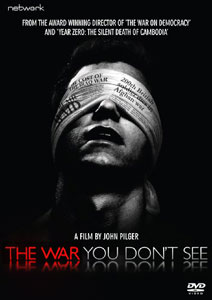
Complementing previous works such as Noam Chomsky’s book on media manipulation, Manufacturing Consent (1988), and Adam Curtis’s films on mass psychology and the politics of fear, The Century of the Self (2002) and The Power Of Nightmares (2004), Pilger lends his experience in media to answer similar questions posed in those works about the role of public relations and media in war, journalists in the advancement of a war agenda and the reporting of war crimes. At its conclusion, the message is and clear: when searching for the truth, always challenge the official story.
Truth be told, The War You Don’t See is remarkably relevant to today’s world. At first, Pilger’s effort details the history of public relations and fuses it with the current backdrop of the dual wars in Afghanistan and Iraq. Concepts such as propaganda and media manipulation are analysed as means of conveying official truths about war.
In a tense and demanding manner, the film’s images of bullet-riddled buildings, explosions and death in Baghdad, Kabul and Palestine shatters the viewer’s outlook on mainstream media like glass. Interviews are conducted in a powerful face-to-face manner that pulls no punches. To that end, it includes a soundtrack of simple yet beautiful orchestral passages that add to the film a solemn character. In total, it makes The War You Don’t See offers a rewarding viewing experience will be detailed more greatly below by theme.
Public Relations: The Facts Don’t Matter Anymore
In The War You Don’t See, the early machinery of media propaganda is detailed at length. From the 1910’s and 20’s work of Walter Lippmann and Edward Bernays, who improved techniques of public relations during the First World War to the Bush and Blair “Shock and Awe” doctrine of in the Iraq invasion of 2003, an understanding of the role of social psychology acts as a foundation to Pilger’s argument.
War Drums Beating
With UK/US official narratives, press releases and statements intertwining with the supposed objective reporting of Western media, the co-opting of the Fourth Estate for official purposes becomes apparent. In his familiar manner of grilling those in power, Pilger highlights government-PR inspired news and the media circus that it generates.
“…I’m not the vice-president in charge of excuses“ – a former CBS anchor Dan Rather
With the cordial commentary and praise of American and British journalists about their country’s leadership in times of hardship, the interest of media to portray conflicts in a favorable manner to governments and business is apparent.
Embedding or In Bed?: Journalists in the Game and Made for TV moments
“…I didn’t really do my job properly. …One didn’t press the most uncomfortable buttons hard enough…” – Rageh Omaar, former BBC world affairs correspondent
According to the film, current wars instigate media circuses and plenty of carefully orchestrated photo ops. In the run up and early years of the Iraq war, the mainstream media appears as a complicit tool of elite power interests, backing prevailing government views despite dissent or independent journalism that strayed from pro-war narratives, or their accompanying iconic images.
Everlasting Images
In occupied Iraq, the tumbling of Saddam’s statue in Baghdad and the placing of an American flag on his head “…gave no sense of the bloody conquest of Iraq that was already underway.” Against the jubilation and news clips of war proponents glorifying American weapons and military might, Pilger places shots of buildings in ruins, adults facing hardship and wounded and killed children.
Independent Journalism Vs. the “Propaganda of Fear”?
Like in his other films, another motif common to the work is the scale of suffering of ordinary people. To that effect, the work of independent journalists Mark Manning and Rana al Aiouby‘s during the Battle of Fallujah, Iraq is featured. It deviates from the official and mainstream portrait of events, using examples from history like Wilfred Burchett’s detail of an Atomic plague, or Dahr Jamail’s revealing and horrific footage of the torture of Iraqi citizens in the second Gulf War.
The propaganda of fear is described as having begun as early as the Vietnam War. To Pilger, it is “…the blueprint for the wars of today” in Afghanistan in Iraq. Pilger asserts: “…As in previous wars, public memory of the Vietnam war was greatly influenced by Hollywood”. In keeping with the tradition of films that aggrandise government war efforts, Iraq war movies attempt to inspire a masculine, aggressive, and staunchly supportive viewpoint of an occupation, with the on-screen Western powers nearly always championing a noble cause against a dim-witted and ultimately unsuccessful enemy effort.
“Modern democracies don’t leave marks” – Phil Shiner of Public Interest Lawyers
Other parts of the Wars We Don’t See also include soldiers abusing Iraqi civilians secretly on tape, as embedded journalism is the point of view of the troops, not the civilians. With that being the case, atrocities by coalition forces can be concealed, shrouding the views of afflicted peoples in official, sanitised manner. The disconnect between western audiences and those announced in death tolls is apparent, as the press “plays down the carnage”, and distinguishes between unworthy and worthy victims, with the latter bizarrely labeled peculiar for disapproving of having their houses invaded and loved ones killed.
A Major Deception
““If you look at every war, or every coup, or every regime that Britain is supporting or involved in…it’s usually accompanied by an increasingly sophisticated public relations operation by the Government…” – Mark Curtis, British historian
Another aspect of the invisible war includes no accountability of media personnel. Able to spit factoids or spin events, governments, acting as information machines, take the view that if journalists are not particularly supportive to their accounts, they could be frozen out of the access, as the apparatus “…would make life harder for them.” This implies why important dissenters to war aren’t heard, for example, Charles Hanley’s analysis of WMD sites and Scott Ritter’s detail of completely eliminated weapon sites in Iraq before Gulf War Two began.
The Narrative of Mainstream Journalism
Pilger encounters the reaction of mainstream media participants that seek to downplay any observed complicity. In this effort, he does not go unchallenged. ”It’s not up to me to make a judgment.” says one Britis
h journalist to Pilger. “We’re there to report what their claims are and hold them up to scrutiny, and to investigate.” Just the same, in this film, investigative journalism is portrayed as a bulwark against conflict.
Preventing wars?
As the film progresses, the media spin of governments is documented as an example of the War We Don’t See. In some countries, after a government crime is committed, intimidation from embassies not to reveal damaging information to host countries covering the incident is apparent. Spokesmen from guilty governments act as spinsters, offering official lies as truth, using doctored sources to strength their claims. Commentators convince the public to go along for the ride.
The UK and US Government reaction to WikiLeaks
According to Pilger, just as some governments spin the truth, the Obama Administration and British Ministry of Defence have attacked “truth-tellers” WikiLeaks, Julian Assange and others who deviate from the official narrative or spectrum of discourse and punditry. To stress this point, Pilger reveals a leaked secret British Government file which sees investigative journalists involved with the propagation of WikiLeaks’ source material as a threat to be neutralised by various means. Leaked material, such as the 2010 release of “Collateral Murder”, is described as an example The War You Don’t See.
“The Public is a threat that needs to be countered…”
"…The more information the public has, the more difficult it is for them (governments) to pursue policies that maybe are abusive of human rights or involving supportive a repressive regime.” – Mark Curtis, British historian
Perhaps what’s most important about this film is its simple message. For John Pilger, the mainstream Fourth Estate is not doing its job properly. Whereas independent journalists are able to articulate the truth in a sophisticated manner, mainstream sources remain disinterested in their work. Time and again, they prefer baseless information, sound bytes and sensational footage of clamoring crowds that rouse emotion to the hard tasks journalists must perform. In Pilger’s final remarks in the film, what remains clear is that more than ever, uncompromised, brave journalism is needed in our world, always challenging the official story, in his words, “however patriotic it appears, or however seductive or insidious it is.”
]]>The British-Lebanese journalist Hala Jaber will be in discussion with the BBC’s Kirsty Lang at the Frontline Club tonight. She’ll be discussing her work as a journalist in Iraq and her new book, The Flying Carpet to Baghdad. We start at 7pm GMT/11am PST and if you can’t make it to the Club in person, please join us online on the Events page or on the Frontline Club live channel,
]]>Hala Jaber has won plaudits for her courageous reporting from around the world, particularly in Iraq, where she was one of the last correspondents to leave Falluja when it came under heavy bombardment by US forces.
Named foreign correspondent of the year for the second year running in 2006, British-Lebanese Hala Jaber has shown continued commitment to reporting from Iraq, co-winning the Martha Gellhorn Prize for her coverage in 2007.
It was during one of her many visits that the Sunday Times journalist met Zahra, aged 3, and Hawra, just a few months old, who were the only survivors of a missile strike in Baghdad in 2003 that killed their parents and five siblings.
In conversation with Kirsty Lang, of BBC Radio 4’s Front Row, Hala Jaber will be talking about her experiences reporting war and her struggle to save the two girls – the story she tells in her new book The Flying Carpet to Baghdad. link
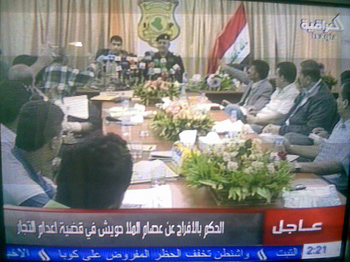
On of the men who allegedly were al-Qaeda members said he didn’t kill anyone but was the driver during a number of assassinations. They would get told who their target is by their leader, a man they called Abu Hawraa.
The other man – excuse me for not taking down names, was in shock by the time I grabbed a pencil it was too late.. anyway the second man called to sit beside the Interior Ministry spokesman said that when they joined they swore to follow and obey so they never asked questions. They were told this person works with the Americans, that person is a spy for the Americans go kill him and they’d go. No questions asked.
The general asked one of the alleged members of this Qaeda cell to name the names of people he’s killed and the guy did. Live on air, I dread to think that someone heard the name of a relative or a friend this way.
My mom and aunt were watching this with me. My aunt’s first comment was "Ya Allah, he looks like a nice kid, what made him do these things?"
We of course don’t know if they did ‘these things’. They have not been brought in front of a court yet and they’re still under investigation according to the general. But I guess they needed to show that they’re on top of things after the last two incidents in Baghdad and Abu Ghraib.
After the general finished his presentation there were questions form the Iraqi journos. One of them asked do you feel remorse for what you’ve done? To which the kid answered yes.. the general looked at him and said "that doesn’t sound very genuine, are you really feeling remorese".. how bizarre.
I know it is important that we see our government doing something about all the madness around us. And it’s great that they’ve achieved this modest level of security in Baghdad but really, how different is this display from what Saddam’s henchmen used to do.
They’re criminals. Try them, stick them in jail and let them rot till kingdom come. But this feels wrong. Many here would disagree though. Many Iraqis want to see faces, who are these people who terrorised, kidnapped and killed. The government delivers. I am most probably in the minority in thinking this is creepy and wrong.
Talking of jail, one interesting fact that did emerge was that one of these guys was held for two years at Camp Bucca, the US detention centre in southern Iraq, then released. None of the journos bothered to ask whether he was actually involved in any terrorist activity before being detained by the coalition forces or was his time in Bucca where he was recruited.
The press conference concluded with the promise of juicier catch to be put on display soon.. including the groups religious leader.
It’s not the first time this has been done on Iraqi TV – there used to be a daily programme of terrorist confessions – and clearly not the last.

The excellent Alive in Baghdad talks to Hassan Fadhel Allah al-Hussaini, the editor of the Rayat al-Arab newspaper, at his office in Baghdad. He talks about his newspaper, the assasination of former colleague Saad Mehdi Shalash, press freedom and the "miracle" of working life in Baghdad. Click the video above to play the interview,
]]>"All Iraqis now are working by way of a miracle," he tells us. "Everyone who walks in the street, every student who goes to school or university…all of them are working by a miracle, because death is pursuing them in every moment and place." link
 Rival cobblers are claiming they sold Iraqi TV journalist Muntazer al-Zaidi the shoes he hurled at President Bush last weekend,
Turkish newspaper Yeni Safak reported Turkish businessman Ramazan Baydan had made the shoes and carried a front page picture of the design, alongside the headline”Made in Turkey.” Baydan said he had designed the style in 1999, and orders from Iraq had increased by 100 percent since the Bush incident. link
But, as the Welt Online article says, the more likely story is, like most shoes in Iraq, Al-Zaidi’s size 10’s are probably Chinese-made.
UPDATE: It appears the shoes have now been destroyed… Bit of a shame really.
]]>U.S. President George Bush had a close encounter with the footwear of an Iraqi journalist this past weekend. Bush was at a press conference during one of his surprise visits to the Iraqi capital when Muntadar al-Zeidi, a reporter with Al-Baghdadiya TV channel, hurled his size 10’s at the outgoing President,
Before guards could wrestle the hostile interrogator to the floor, he got off a second shoe and shouted, “This is from the widows, the orphans and those who were killed in Iraq.” The Iraqi prime minister aided in the defense this time, holding up a hand to try to shield Bush. Bush, uninjured, laughed off the incident: “All I can report is it is a size 10,” he said later. link
Writing on the Modesto Bee blog embedded reporter Adam Ashton, who was in the room when the shoes started to fly, tells it the way he saw it,
]]>As [the press conference] ended, a couple Iraqi security guards in
suits took away two more Iraqi journalists because one of them called
Zaidi’s protest “courageous.” Hammed bravely stood up for the
journalists. Talking to a friend just isn’t a crime. They were released
a few minutes later after some American officials intervened on their
behalf.Some of the security guards started looming over members of the
White House press corps who flew in with Bush, at least until a White
House communications aide shooed them away.The press conference was not aired live. Few political events are here.
Many of the broadcast reporters feared the Iraqi government would
take their cameras and tapes. They expect that things will be tougher
for them next time they cover one of Maliki’s events.“This will have consequences for us,” one reporter told us.
That’s a shame. All the Iraqi reporters in the front row apologized
to Bush. It was a reporter who yanked Zaidi to the ground before Iraqi
or American guards could reach him. link