A sweeping, historical epic set against the brutal backdrop of a stunning Australian landscape, SWEET COUNTRY follows the story of Sam, a middle-aged Aboriginal man, working for a preacher in the outback of
Australia’s Northern Territory. When Harry, a bitter war veteran, moves into a neighbouring outpost, Sam and his family are sent to help Harry renovate his cattle yards. But Sam’s relationship with the cruel,
ill-tempered Harry quickly deteriorates, culminating in a violent shootout. Sam becomes a wanted criminal for the murder of a white man, and is forced to flee with his wife across the deadly outback, through glorious
but harsh desert country. A hunting party led by the local lawman Sergeant Fletcher is formed to track Sam down. But as the true details of the killing start to surface, the community begins to question whether justice is really being served.
Directed by Warwick Thornton (Samson & Delilah), SWEET COUNTRY has so far been the recipient of multiple accolades, including the Special Jury Prize in Venice and Best Film in the Platform Competition at Toronto.


]]>
Such testimonies come from young girls currently detained in Nauru, a remote island in the Pacific, which serves as one of Australia’s offshore detention centres for asylum seekers.
The testimonies introduce us to the hardships endured by those who survived a dangerous journey at sea, but are dying slowly in a land where the living conditions have been described as cruel and appalling.
A panel of journalists, migration experts and human rights advocates gathered at the Frontline Club on 27 September to discuss the Nauru files leak, published by the Guardian in August. The files showcased evidence of child abuse, sexual assault, self-harm and suicide attempts, as well as poor living conditions inside the camp.
The leak, which involved over 2,000 incident reports and is more than 8,000 pages long, sparked immediate international outrage.
Anna Neistat, Senior Director of Research at Amnesty International, tried to get inside the camp for two years when she succeeded she said:
“I was unprepared for the level of horror that I saw there. And I don’t say these things lightly. I have been covering conflict in the last 15 years, working in places from Syria to Chechnya to Afghanistan.
“I have never seen this in any war zone that I have worked in. Almost every person I spoke to say that they either attempted suicide or self-harm (…) and that includes 9-year-old children.”
Ian Woolverton, deputy editor of Guardian Australia, said some of his journalists could not cope with the horrors they had seen on the island over the course of two years and as a result are now suffering from PTSD.
Neistat said: “They claim they are saving lives because [refugees] are not drowning at sea. But they are dying anyway and in some ways more painfully and more slowly.”
In May, Omid Masoumali, an Iranian living in the Nauru detention centre for 3 years, set himself alight during a UNHCR visit. He stayed unattended for two hours before getting medical care.
“What’s the point of surviving at sea if you die in here?” a refugee girl asked a Guardian journalist.
CHANGING THE NARRATIVE
Day in and day out, images of floating life jackets and drowning bodies fill our social media and reports of abuse and institutional negligence make global headlines. However, as the images of human pain and hopelessness have made it to our screens, the panel discussed: Have they really made it into our hearts and minds?
Eiri Ohtani, Project Director of the Detention Forum in the UK, said the overwhelming flow of daily reports may be undermining how much we care.
“I worry that this is becoming too normal,” she said. “When there are so many similar stories out there, how do we then make that story special?”
The panel agreed the Nauru files went largely under reported, especially in Australia. Ohtani said that human rights advocates and particularly journalists have an important role to play by changing the narrative that has formed around refugee-related issues, not only by giving these stories a face, but also by connecting them to a wider political landscape.
Ohtari added that journalists should be very sensitive to the narrative of deserving versus undeserving migrants, which has been forming in the media.
She said: “As an organisation (…) we get quite a lot of requests from journalists (…) that say: ‘Can you find us somebody who has fled from Syria, was in Greece and then has got a wife in Germany and left handed.’ It seems like you have already decided what you are going to say.”
"In prison you count days down. In #detention you count days up and up" @EiriOhtani @frontlineclub #WithoutDetention #ThereAreAlternatives
— Mary Engleheart (@MaryEngleheart) September 28, 2016
Neistat said that since coming back from Nauru only one journalist had asked her the most important question – who are these people?
“I have to say they made an incredible impression on me. They all would be added value to the society and I’m saying it with no hesitation whatsoever,” she said. “None of them would be a burden, they are nurses, teachers, engineers. (…)They could buy their plane ticket and fly either to Australia or some other place, they just cannot.”
It is hard for Western audiences to relate to the horrors they flee from, but Neistat believes that is why it is important to know who they are. “Changing this narrative will affect a lot the public perception, which will in turn define government policies.”
She then concluded: “We need to stop using the term ‘refugee crisis’. It is not a refugee crisis; it is a crisis of refugee protection.”
The Australian government defended their asylum policies by disregarding the documents as false or unverified, and by stating it was an issue for the Nauruan government, despite the Australian government hiring camp employees.
]]>
After the files were published, the Australian government defended their asylum processing policies, suggesting that the accounts in the 8,000 page report were comprised of false accusations of abuse and unverified sources. Immigration minister Peter Dutton has been quoted as saying “Nauru is not part of Australia, so this is an issue for the Nauruan government.”
Will the publication of the Nauru files lead to changes in the country’s asylum policies? We will be joined by a panel of journalists, migration experts and human rights defenders to discuss their initial reactions to the Nauru files, the implications of the reports and how a group of journalists broke a story from within a detention centre that has remained historically off-limits to the media.
Chair:
Emily Wilson has been with the Guardian since 2000, working across news and features. She was network editor of the UK edition of the Guardian’s website before moving to Sydney in April 2014. She is now editor of Guardian Australia.
Speakers:
Will Woodward is Guardian Australia’s deputy editor. He has been editor of G1 (the news section of the paper), deputy national editor, chief political correspondent and education editor, and was a Laurence Stern fellow at the Washington Post.
Anna Neistat is Senior Director for Research at Amnesty International. Over the last fifteen years she has worked in most of the world’s conflict zones and has recently returned from a visit to Nauru.
Ian Woolverton is Head of Media for Save the Children Australia. He works with the media to raise the profile of issues including humanitarian crises, the health of Aboriginal & Torres Strait Islanders, youth justice and asylum seekers and refugees. He has deployed to many humanitarian emergencies, including the 2004 Indian Ocean tsunami.
Eiri Ohtani is Project Director of the Detention Forum in the UK since 2009. She was also European Regional Coordinator of the International Detention Coalition between May 2015 and August 2016. She has over 15 years of experience working with asylum seekers and migrants, including directorship of a specialist legal advice agency.
]]>By Nicole Hunt
The UN Human Rights Committee session opens on Monday in Geneva, with the situation in Iran on the agenda for the first two days.
Meanwhile, Under Secretary General for Humanitarian Affairs and Emergency Relief Coordinator Valerie Amos begins a five day visit to North Korea, which is currently suffering through a major food crisis.
A judge in Courbevoie, France is due to rule on whether L’Oréal heiress Liliane Bettencourt should be made a ward of the state following accusations by her daughter Françoise that she is mentally unfit to manage her €17bn fortune.
South African President Jacob Zuma hosts Brazilian President Dilma Rousseff and Indian Prime Minister Manmohan Singh in Pretoria on Tuesday for a trilateral summit, expected to focus mostly on trade.
The meeting comes on the same day that fellow BRICS country China releases its third quarter GDP figures.
In London, judges reveal the winner of this year’s Man Booker Prize for Fiction; nominees include Julian Barnes, Carol Birch, Patrick deWitt, Esi Edugyan and Stephen Kelman.
The Queen and the Duke of Edinburgh begin a 10-day trip to Australia on Wednesday, heading first to Canberra. During their visit, the royal couple will also take in Brisbane and Melbourne before heading to Perth for the Commonwealth Heads of Government Meeting on 28 October.
Greek public and private sector unions hold a 24-hour strike to protest what they say are ‘barbaric’ austerity measures being introduced as part of the Government’s efforts to meet the conditions of its €110bn bailout from the IMF, the EU and the European Central Bank.
EU Commissioner for Internal Markets Michel Bernier holds a press conference in Brussels on Thursday to present the Commission’s proposals for reforms to the Markets in Financial Instruments Directive and the Market Abuse Directive. The reforms are aimed at strengthening the EU regulatory system and increasing oversight in the wake of the financial crisis.
The European Space Agency is having a more exciting day in Kourou, French Guiana, where the first two Galileo satellites are being test-launched at 12:34pm. The full satellite project is expected to be operational by 2014.
News Corporation holds its annual general meeting in Los Angeles on Friday, amid calls from some shareholder groups to vote against the re-election of CEO Rupert Murdoch’s sons James and Lachlan to the company’s board in the wake of the UK phone hacking scandal.
In Abu Dhabi, Finance Ministers from the Gulf Cooperation Council begin a two-day meeting where they discuss proposals for a single Gulf currency. IMF Managing Director Christine Lagarde attends on the second day.
Remember the apocalypse hysteria back in May? When the world failed to end, preacher Harold Camping revised his prediction, and is now confident that the world will in fact end on 21 October.
Assuming we’re still here, attention turns to Cairo on Saturday where the court hearing resumes for two police officers charged over the death of Khaled Said. The verdict in the case, which prompted widespread protests against police impunity last year, has been delayed twice, most recently from 24 September after new evidence emerged.
Unusually, there’s quite a lot going on on Sunday, beginning with the delayed European Council and Eurogroup meetings in Brussels. Predictably, Greece and the euro debt crisis are at the top of the agenda, with leaders focusing on economic governance and financial regulation.
Following an international uproar over five to 15 year sentences for Bahraini medical staff convicted of inciting hatred against the regime and attempting to topple the monarchy during anti-government protests earlier this year, a civil re-trial ordered by the country’s Attorney General begins in Manama.
There are also four elections taking place across the world: parliamentary polls in Tunisia, which were scheduled in the wake of President Zine al Abidine Ben Ali’s resignation back in January; a general election in Argentina, where incumbent Cristina Fernandez de Kirchner is expected to win a second term; a presidential election in Bulgaria, where current President Georgi Parvanov is not eligible for a third term; and federal elections in Switzerland, where 13 parties are currently represented in parliament.
To top it off, the Rugby World Cup final takes place in Auckland.
]]>
Monday is the beginning of a new month and the beginning of the holy Muslim month of Ramadan.
In Saudi Arabia, the date is doubly significant: following the 18 June beheading of Indonesian maid Ruyati binti Sapubi and the near-beheading of another maid known as Darsem, an Indonesian moratorium on sending domestic workers to the country comes into effect.
There have also been whispers of another women’s driving protest to coincide with the first day of Ramadan, but so far nothing as organised as the 28 June attempt.
Tuesday is debt ceiling day in the US. While one hopes that the increasingly heated negotiations will lead to a solution before then, there remains the increasingly real possibility that the US could default on its $14tn debt.
In Cape Town, Mziwamadoda Qwabe and Xolile Mngeni are due to go on trial over the 13 November, 2010 murder of British honeymooner Anni Dewani. Mngeni was unable to attend the last hearing, reportedly due to surgery to remove a brain tumour, and is unlikely to be in attendance.
All eyes on Egypt on Wednesday, as the trial for ousted President Hosni Mubarak and his sons Alaa and Gamal is due to begin, but looks likely to be postponed. Former Interior Minister Habib al Adly is also tried, after his trial was postponed from 25 July so he could be heard alongside the Mubaraks.
Less dramatic is a Supreme Court hearing taking place in Sydney, where the Australian government is taking legal action against former Guantanamo inmate David Hicks over his 2010 book Guantanamo, My Journey. The government says Hicks is illegally gaining commercial benefit from a crime.
The Food and Agriculture Organization’s (FAO) monthly Food Price Index is released on Thursday, with the July figures of interest as drought and famine continue to ravage the Horn of Africa. US
President Barack Obama celebrates his 50th birthday as the week begins to wind down.
Following the excitement around the final Atlantis mission in July, NASA launches Jupiter explorer Juno on Friday, the first solar-powered spacecraft designed to operate so far from the sun.
Saturday marks the 66th anniversary of the Hiroshima atomic bomb. A commemorative ceremony takes place at the Peace Memorial Park in Hiroshima, and nuclear disarmament campaign groups hold events worldwide.
Voters go to the polls in Cape Verde on Sunday to elect their next President. Incumbent Pedro Pires, who won by less than one percent in the 2006 elections, is not a candidate.
]]>
A write up of a Q&A section with Assange, which followed the speeches, can be found here (part I) and here (part II).
]]>After Assange gave his acceptance speech, there was time for a question and answer session. He spoke in depth in reponse to many questions, giving insight into his position on everything from the role WikiLeaks may have played in the uprisings across the Arab world, to his opinion of the News of the World phone hacking scandal.
You can now find the first half of our edited transcript of the Q&A below.
*****
What role did WikiLeaks have in the creation of the Arab Spri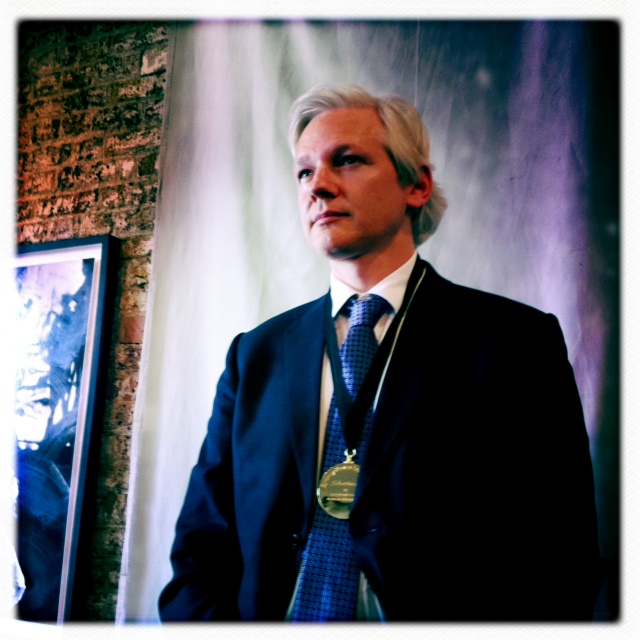 ng?
ng?
Yes it does appear that there was a significant role. I saw a documentary recently interviewing professors and people in the street in Tunisia outlining some of what that role was. We tried very hard to release as much material relevant to that part of the world back in early December. A wonderful Lebanese newspaper by the name of al Akhbar took alot of our material and translated it to Arabic. And other sites also translated it to French and that material then spread. al Akhbar, for its efforts, was attacked and redirected to a Saudi website for 24 hours. It was then attacked by computer hackers using denial of service attacks and then increasingly sophisticated denial of service attacks, and finally, very sophisticated hackers that I attribute to the state intelligence went in and wiped out their entire publishing operation for months. Approximately one month ago, they started publishing again.
In relation to Egypt, I think our most significant role there was to concentrate on the information to do with [former army general Omar] Suleiman and [former president] Hosni Mubarak. Suleiman you may remember was posited as being a vice president who would somehow take over the role of Mubarak. And he … was a long term partner with Israel and the United States. He was a trusted pair of hands as far as they were concerned in relation to the relationship between Egypt and Israel. [He was] involved personally, it is alleged, in the torture of a number of rendered people.
So, by bringing all that information out on a consistent basis when no one else was willing to do so, we made it very difficult for the west to be able to posit Suleiman as an alternative power structure within Egypt […]
We must remember [American] vice-president [Joe] Biden said on the one hand that I was a high tech terrorist and on the other hand that Mubarak was not a dictator.
What do you think about Australia’s hypocrisy championing freedom of speech during the [Arab] revolutions but denouncing yours; and what would you say to detractors who accuse you of hypocrisy, and say you’re all for transparency unless it’s turned on you (in terms of accusations of ego or your court cases)?
There’s a comment I saw on a newspaper article last night that puts it well: WikiLeaks is the most scrutinised organisation per capita in the world. We have something like ten to twenty full time staff and a large volunteer core … We are a very small operation. We had (or have) an 120 man CIA taskforce, operatives here in the UK and in other countries, all scrutinising us – and an extremely contemptive media. Like it or not we are the most transparent organisation in the world. Of course, it is our role to give knowledge to the people about power; it is not our role to prevent people giving knowledge to people about power. In fact, one of our core principles is to protect the identities of whistleblowers. So sometimes one needs to be opaque to protect people. We are an organisation facing extraordinary threats from a superpower. It is absurd that should need to make that statement, but that is the reality.
The reality is that here I am in an absurd situation receiving the Sydney peace medal. I am an Australian citizen and I am receiving it in London. At the same time, I have a state surveillance device attached to my ankle. That is the absurd situation we are in. So this rhetorical threat to try and apply a double standard to us is just that.
And you will notice a similar – this is a basic trick in rhetoric – one was done last year, when we exposed the deaths of 20,000 people in Afghanistan, including many children killed by special forces operations and so on. The response by the United States government to our exposure of all that blood, was to say: Julian Assange has blood on his hands. The first response. Because we were saying that they were wading in blood. And so that is just a basic trick of rhetoric.
If you now Google ‘blood on hands’ and ‘WikiLeaks’ without the word Pentagon, you will see there is approximately 770,000 web pages. If you Google for Pentagon and ‘Blood on hands’, without the word WikiLeaks, you will see there’s about 60,000 web pages. So in terms of the amount of articles that have been published, many talking about the blood of the Pentagon, the blood of WikiLeaks – there has been ten times as many that have been about the blood that WikiLeaks has supposedly caused and yet even these organisations cannot adduce a single case of anyone being harmed by our work over the course of [the last] four years.
What about [recently killed al Qaeda leader] Osama [bin Laden] and the alleged Mush-Bush deal between then US president George W. Bush and then Pakistani president Musharraf? Do you have any WikiLeaks cables supporting the allegation that there was a secret deal between the two presidents at the time? … And what do you make of operation Geronimo?
We have a lot of documents, but the cables along are 285 million words and I do not have them all in my brain at any one point in time. That’s why we’re working with 73 other media organisations … in order that you may do this work that you are able to do more efficiently than us, and directly to your audience. So I don’t have off hand more information about that.
I saw commentary by the former heads of ISI [Pakistani intelligence agency, Inter-Services Intelligence] in the Pakistani press talking about what the relationship should be between the ISI, the Taliban and the United States. And I think that was the clearest description that I have seen. Which is: there are two superpowers in Afghanistan right now: they are NATO (minus Europe) plus the United States. That’s the reality that people don’t want to talk about: that Europe is a superpower. Europe added together spends just over half as much money as the entire United States on military expenditure. Europe is a superpower. And we can see that happening in Libya now, that Europe is acting together with the United States, like a superpower, in the conflict.
So we have two superpowers ensconcing themselves for 10 years in Afghanistan right on the border of Pakistan – and we must understand these borders are a bit artificial; the language crosses over the border and the culture crosses over the border – it is the national incentive of Pakistan, in so far as the ISI is acting in a legitimate way, it is acting to protect the national identity of Pakistan to make sure that those forces eventually leave. And so I assume, in so far as the ISA is acting for the national interest of Pakistan, it is engendering a situation to make sure western forces will leave Afghanistan.
Just a general question on the ethics, and how
you derive the ethics of openness, investigation and privacy. Where does one make the ethical distinction between an operation say, WikiLeaks directed towards powerful institutions and processes and something such as the News of the World phone hacking scandal and the processes therein. What is not merely the contingent ethical decision, but what is the deeper political ethical basis on which one would make those distinctions?
I quite like it [the question]. And this probably horrified my British colleagues and my lawyers, but I wrote about the News of the World phone hacking scandal. And what I said back about a year and a half ago is that the British press should be very careful what they are doing in relation to spending time on that as opposed to all the other injustices that they could be spending their time on. Because we had been involved in something called the Petrogate scandal in Peru just a few months before, where we revealed 87 telephone intercept tapes of Peruvian politicians speaking for businessmen. The famed audio tapes. And that was the biggest political story in Peru that year.
And to engender a climate where that is hard to do is extremely dangerous. Now of course, the media abuses people and misuses its power in approximate proportion to the size of the particular industrial grouping. And News Corporation is a very large industrial grouping, and it uses its power accordingly. But when organisations like the Guardian write over a hundred stories about putting in default passwords in to voice mailboxes – because that’s what we’re actually talking about here – they are taking space from other things and they have other agendas at work. The other agendas at work are: attacking a newspaper rival; the New York Times became involved because similarly it wants to attack the Wall Street Journal.
It is to say, that the interests of the proletariat, which are the readers of the News of the World, are insignificant and are not important, and that the middle class moral majority that embodies itself in the Guardian is to be the arbiter of what is important and what is not important.
The reality is – if readers of the News of the World (and there are very many) find a particular thing to be of significance, to be influential to their lives, about how that person truly behaves … people have a right not to be influenced by people whose external affairs and statements do not mirror their internal affairs and statements. It also seems to me to be a way to get in to the Guardian news about celebrities and tabloid salacious rumours: you can just report on what News of the World are saying.
So generally I say that the public interest is to be determined by what the public is interested in. Because otherwise, who’s going to determine the public interest if it’s not the public? Is it going to be a self-appointed committee of people? Well who appoints those people? Who appoints that committee? Through what process? How do we know that process won’t become corrupted?
That said, I do think there should be redress for libel say, committed by very powerful organisations against smaller organisations. There should be opportunities for redress against large institutions abusing small institutions.
Part II of our Q&A transcript can be viewed here, with Assange commenting on the Lockerbie bombing, distrust between Pakistan and the United States, and the Wall Street Journal’s new ‘Safe House’ leaks site.
]]>Emeritus Professor Stuart Rees, director of the Sydney Peace Foundation, gives his introduction:
Former SBS World News Australia presenter Mary Kostakidis next spoke, before presenting Assange with his award:
Julian Assange gives his acceptance speech:
We will be posting full video of the event soon. A write up of a Q&A section with Assange, which followed the speeches, can be found here (part I) and here (part II).
]]>