August Bank Holiday Weekend
Pippingford Park, East Sussex, UK
Join us at Byline – the world’s first festival for independent journalism and freedom of speech – to debate, discuss, dance, laugh, and change the world.
Throughout the festival Frontline will be running a curated series of talks and documentary screenings exploring two of this year’s festival themes: Defending Democracy and The Power of Journalism.
Frontline Events include:
DEBATE: The Extradition of Julian Assange – Friday 23 August, 3pm
We’ll be hearing from journalist Nick Davies, politician and activist Birgitta Jonsdottir and Frontline’s Vaughan Smith as they debate the legacy and the future for Assange, as the likelihood of his extradition to the USA looms.

TALK: The Parallel state: Truth, Lies & Political Fiction in Contemporary Turkey – Friday 23 August, 4.30pm
What began as a project about Turkish soap operas for award-winning photographer Guy Martin soon turned into a photographic exploration of the fault lines of truth, power and politics in Turkey. Chaired by journalist Jo Glanville.

FILM: Under the Wire – Saturday 26 August, 3pm
On 13 February 2012, war-correspondent Marie Colvin and photographer Paul Conroy entered war-ravaged Syria to cover the plight of civilians trapped in the besieged Homs, under attack by the Syrian army. Only one of them returned. This is their story.
FILM: White Right: Meeting the Enemy – Sunday 25 August, 10.30am
Filmmaker Deeyah Khan meets U.S. neo-Nazis and white nationalists face to face and attends the now-infamous Unite the Right rally in Charlottesville as she seeks to understand the personal and political motivations behind the resurgence of far-right extremism in the U.S. Won 2018 Emmy for best international current affairs documentary.
FILM: Unquiet Graves – Sunday 25 August, 3pm
Sean Murray‘s powerful film tells the story of how members of the RUC and UDR (a British Army Regiment) were involved in the murder of 120 innocent civilians in the targeted terrorising of the most vulnerable members of society during “the Troubles” conflict in Northern Ireland.

FILM: When Lambs Become Lions – Sunday 25 August, 6.20pm
In the Kenyan bush, a small-time ivory dealer fights to stay on top while forces mobilize to destroy his trade. When he turns to his younger cousin, a conflicted wildlife ranger who hasn’t been paid in months, they both see a possible lifeline.
TALK: The Price of Paradise – Monday 26 August, 1.10pm
Investigative journalist and author Iain Overton will be in conversation about his latest book, which looks at the influence of the suicide bomber on modern society from pre-revolutionary Russia to the present day.

The Frontline Cub Tent can be your base between events: take refreshment from our bar, try our delicious Norfolk mezze of food, and enjoy some laid-back entertainment including music, poetry and games.
Travel is just over an hour from London by train so bring your friends, colleagues and family. The festival is family friendly with lots of activities for children of all ages.
Tickets: Day and weekend tickets are available with a specially-discounted weekend rate for Frontline Club friends and members.
Links:
- For more information about the festival, visit the Byline website.
- To keep up to date with news about Frontline events at Byline, sign up to our newsletter.
Speaking at a special Frontline Club event on Saturday alongside renowned philosopher Slavoj Žižek and investigative journalist Amy Goodman, Assange spoke at length about the pressures faced by WikiLeaks amid a political backlash.
He dismissed threats of assassination made against him by prominent commentators and politicians as “wrong and outrageous”, but admitted documents reportedly obtained by WikiLeaks about the Bank of America – who stopped processing payments to the organisation in 2010 – had not yet been released due to a complication.
“We are under a kind of blackmail in relation to those documents that will be dealt with over time,” he said, though did not divulge the kind of blackmail the organisation was facing or from whom, saying only that “there are a range of possibilities.”
The event, held at the Troxy in East London, was attended by almost 2000 people and streamed live across the internet by independent US broadcaster Democracy Now! It was originally set to be held at the University of London’s Institute of Education (IOE), but was moved after the IOE raised concerns over potential controversy.
Discussing the ethics, philosophy and implications of WikiLeaks – particularly in relation to the Afgahanistan War Logs, the Iraq War Logs and Cablegate – Assange said that “what advances us as a civilisation is the entirety of our intellectual record.”
He added: “If we are to make rational policies, in so far as any decision can be rational, then we have to have information that is drawn from the real world.”
The 40-year-old Australian, who has been on strict bail conditions at the Norkolk home of Frontline Club founder Vaughan Smith for over six months, stated his belief that a pervasive element of the mainstream media is “our single greatest impediment to advancement”.
“History is shaped and distorted by the media,” he said. “The journalists themselves having read our material and having been forced to go through it have themselves become educated and radicalised. And that is an ideological penetration of the truth in to all these mainstream media organisations.”
Assange is set to appear at the High Court in London on 12 July over sex-crime allegations made against him in Sweden. His greatest hope for the future, he said, was to see a more civilised world and to change the author George Orwell’s dictum that ‘he who controls the present controls the past.’
“By civilised I mean people collaborating to not do the dumb thing,” he added. “To instead learn from previous experiences … to pull with eachother, together, in order to get through the life that we live in a less adverse way.”
Žižek, who has authored over 50 books and is widely held as one of the most influential living philosophers, spoke passionately about the impact of WikiLeaks on global politics.
“You are not just violating the rules, you are changing the very rules [and] how we are allowed to violate them,” he said. “We may all know that the emperor is naked, but the moment somebody says the emperor is naked, everything changes.”
Part I and II of our reports on the event can be found here and here. Full video can be watched here and you can read our live blog of the event here.
]]>The event, which will take place on 2 July at the Troxy in East London, had originally been tentatively scheduled to take place at Logan Hall, a 900-capacity auditorium hired out by the IOE.
But after expressing strong interest in hosting the event, arranging logistics, and giving Frontline Club staff a tour of the venue, the Institute’s management performed a sudden about turn.
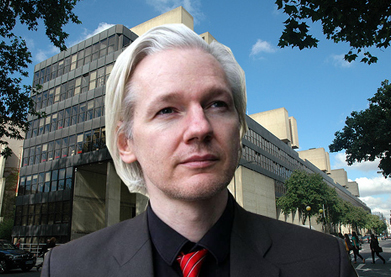
An email sent on 16 May from Michael Walker, the IOE’s Head of Conferences, Catering and Operations, informed Frontline: “There are ongoing issues concerning wi-fi access and the provision of a bar for your visitors, the first of which I feel may be too difficult to resolve at our end.
“This – and the fact that the meeting’s subject is of a nature which may attract considerable controversy – obliges me to inform you at this stage in the proceedings that we cannot offer hire of the Logan Hall on this occasion.”
Frontline Club founder Vaughan Smith was puzzled by the decision.
In an email sent on 17 May, he responded: “We do not feel that the issues with wi-fi and bar would prevent us from using your venue.
“However we are shocked that the Institute of Education would have difficulty accepting our event on the basis of a feeling that it may be controversial.
“The speakers have all spoken in London before several times and both generate significant interest and support from within the public. Neither generate any risk of violence at the event.”
Smith pointed to the IOE’s Research and Governance Policy, which states as part of its mission that it will be “guided by a concern for truth and justice, and make a positive contribution to the development of individuals, institutions and societies facing the challenges of change.”
But in a reply, Walker claimed that it was not the subject matter alone that was the reason for refusal.
“It seems I have mistakenly conveyed the impression that the nature of the event’s subject matter was in itself enough for us to decline to host it,” he wrote.
"This is not the case – and the concerns which have informed the decision centre around our ability to cope with the booking in the event that negative issues (including those connected to public order) are raised by it.”
He added: “The Institute reserves the right to withhold hire of its facilities and although I will certainly refer this matter to the Director of Administration here there will be no change in the position should the decision be ratified.”
Assange, who has been on strict bail conditions at the Norfolk home of Smith for over six months, was informed that the IOE had declined to hire the Logan Hall for the 2 July event on the grounds that it “may attract considerable controversy“.
He said in response: "This is how everyday political censorship works in the United Kingdom, not jackboots at the door, but through tawdry institutional pandering."
Chaired by award-winning investigative journalist Amy Goodman, the event will see Assange and Žižek discuss the “ethics and philosophy“ behind WikiLeaks. It will be broadcast live across the internet by independent US news broadcaster, Democracy Now!
On the same day, the IOE’s Jeffery Hall will host the Association of Church Accountants and Treasurers’ Summer Conference, which will feature a talk from Gareth Morgan, a senior leader at Everyday Champions Church, Newark. Morgan will discuss “the challenges of being an effective church in the 21st century.”
The IOE was founded in 1902 as a teacher training college in London, and says its “history and current mission are rooted in a commitment to social justice.”
It is part of the University of London: a publicly funded institution which was established in 1836, making it one of the oldest universities in England.
A spokesperson for the IOE denied that the event had been turned down because of controversy surrounding WikiLeaks, and stated the decision was taken due to concerns about public safety and ease of access for students and visitors.
"It is true that Mr Assange is a controversial figure at the moment, because of WikiLeaks but also because of attempts to extradite him to face criminal charges," the spokesperson said.
"As such, and given the proximity to Mr Assange’s next court hearing [on 12 July], it was felt that this event was likely to attract a significant amount of external interest from both the media and the broader public.
“While we can understand Frontline’s disappointment at not being able to host this event at the IOE, we must always put the welfare of our students, staff and guests first and we judged that we would not have the resources to safely steward an event of this kind without our students and other visitors having their access to facilities disrupted.”
As part of the build up to the event, which will focus on the ethics and philosophy behind WIkiLeaks, Frontline Club will this week be posting a series of blogs including extracts from essays written by both Assange and Žižek .
Today we are pleased to be posting an edited extract of Assange’s 2006 essay, Conspiracy as Governance. The essay gives an insight in to Assange’s thinking around the time that he founded WikiLeaks alongside others late the same year.
In it, he outlines the problem of authoritarian conspiracies and explains how technology may be able to help create a more humane form of governance…
*****
Conspiracy as Governance
By Julian Assange
To radically shift regime behaviour we must think clearly and boldly for if we have learned anything, it is that regimes do not want to be changed. We must think beyond those who have gone before us and discover technological changes that embolden us with ways to act in which our forebears could not.
We must understand the key generative structure of bad governance.
We must develop a way of thinking about this structure that is strong enough to carry us through the mire of competing political moralities and into a position of clarity.
Most importantly, we must use these insights to inspire within us and others a course of ennobling and effective action to replace the structures that lead to bad governance with something better.
Conspiracy as governance in authoritarian regimes
Where details are known as to the inner workings of authoritarian regimes, we see conspiratorial interactions among the political elite, not merely for preferment or favour within the regime, but as the primary planning methodology behind maintaining or strengthening authoritarian power.
Authoritarian regimes create forces which oppose them by pushing against a people’s will to truth, love and self-realisation. Plans which assist authoritarian rule, once discovered, induce further resistance. Hence such schemes are concealed by successful authoritarian powers until resistance is futile or outweighed by the efficiencies of naked power. This collaborative secrecy, working to the detriment of a population, is enough to define their behavior as conspiratorial.
Thus it happens in matters of state; for knowing afar off (which it is only given a prudent man to do) the evils that are brewing, they are easily cured. But when, for want of such knowledge, they are allowed to grow until everyone can recognise them, there is no longer any remedy to be found.
(The Prince, Niccolo Machiavelli [1469-1527])
Traditional vs. modern conspiracies
Traditional attacks on conspiratorial power groupings, such as assassination, cut many high weight links. The act of assassination — the targeting of visible individuals — is the result of mental inclinations honed for the pre-literate societies in which our species evolved.
Literacy and the communications revolution have empowered conspirators with new means to conspire, increasing the speed of accuracy of the their interactions and thereby the maximum size a conspiracy may achieve before it breaks down.
Conspirators who have this technology are able to out conspire conspirators without it. For the same costs they are able to achieve a higher total conspiratorial power. That is why they adopt it.
For example, remembering Lord Halifax’s words, let us consider two closely balanced and broadly conspiratorial power groupings, the US Democratic and Republican parties.
Consider what would happen if one of these parties gave up their mobile phones, fax and email correspondence — let alone the computer systems which manage their subscribes, donors, budgets, polling, call centres and direct mail campaigns?
They would immediately fall into an organisational stupor and lose to the other.
An authoritarian conspiracy that cannot think is powerless to preserve itself against the opponents it induces
When we look at an authoritarian conspiracy as a whole, we see a system of interacting organs, a beast with arteries and veins whose blood may be thickened and slowed until it falls, stupefied; unable to sufficiently comprehend and control the forces in its environment.
Later we will see how new technology and insights into the psychological motivations of conspirators can give us practical methods for preventing or reducing important communication between authoritarian conspirators, foment strong resistance to authoritarian planning and create powerful incentives for more humane forms of governance.
Reproduced with permission of the author.
The essay, which is in two parts, can be read in full here.
Julian Assange in conversation with Slavoj Žižek, moderated by Democracy Now!’s Amy Goodman, will take place on 2 July at the Troxy In East London. More information and tickets for the event can be found here.
]]>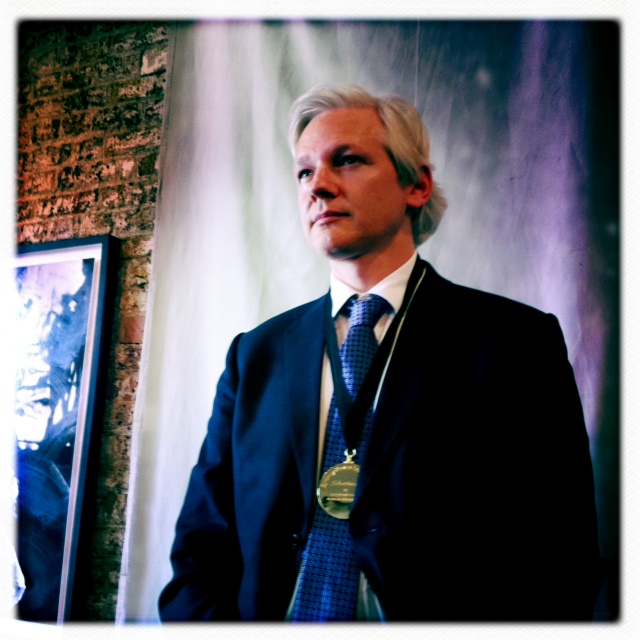 rded the Sydney Peace Prize gold medal for Peace with Justice at the Frontline Club this afternoon.
Assange is now one of just four people to have been given the award. Nelson Mandela, the 14th Dalai Lama Tenzin Gyatso and a Japanese Buddhist leader Daisaku Ikeda are the only others to have received the medal in its fourteen year history.
The awards ceremony was a fairly low-key, invite-only affair, with a small selection of international media present. It began with an introduction from Emeritus Professor Stuart Rees, director of the Sydney Peace Foundation.
“For 14 years we’ve awarded the Sydney Peace Prize, but only on three occasions in 14 years have made an exception to the rule and awarded a gold medal for ‘exceptional courage in pursuit of human rights,’” Rees said. “We make the award for an unusual act that challenges conformity to cultural and political orthodoxy. We don’t seek somebody who’s perfect. Julian – you’ll be very reassured to know that.
“We think that the struggle for peace with justice inevitably involves conflict, inevitably involves controversy. If it was a stumbling towards some kind of consensus nothing would ever happen.
“In that respect we think that you [Julian] and WikiLeaks, have brought about what is a watershed in journalism and in the freedom of information, and potentially in politics. We think you’ve made an enormous contribution to people’s understanding of what democracy might be about in terms of responsibility to hold powerful people accountable, in terms of enthusiasm for freedom of information, and in terms of the presumption of innocence.
“We also think that that commitment to democracy asks many of the rest of us – journalists, lawyers, teachers, academics – to stop being so shy about challenging the establishments; to stop having their thoughts embedded consciously or unconsciously to mainstream points of view.
“Luckily for us there’s been a company of dissenters from Thomas Paine through to Daniel Ellsberg; the independent Australian MP Andrew Wilkie and yourself [Julian], who have told us that the emperor has no clothes, that we shouldn’t be deceived by the false claims of people in government, in corporations or indeed in the military.
“We were also motivated in November to make this award, because we were ashamed of the behaviour of the Australian government. And we wanted in some way to repudiate their cowardice … we were also appalled by the violent behaviour of major politicians in the United States. You will know that some of them said that WikiLeaks should be defined as an international terrorist organisation and that several politicians – among them Sarah Palin – said that you [Julian] should be hunted down like [Osama] bin Laden. Well, we now know exactly what that means.”
Rees also took a moment to speak about the alleged whistleblower Bradley Manning, who has been in prison for ten months without trial – eight of which were in solitary confinement.
“The bestial behaviour of the US government towards that man is more than appalling,” he said. “They don’t seem to understand that the harshest possible punishment and forms of humiliation teaches no one a lesson … it certainly makes no contribution to civility.”
Rees then read out two quotes. One was a message from Noam Chomsky to Assange.
Chomsky wrote: “I thank you profusely for the way in which you have excersied your responsibilities as a citizen of free societies, thus enabling citizens to know what their government is doing.”
The other was a 300 year old quote from the English writer Daniel Defoe:
“Extol the justice of the land who punish what they will not understand. Tell them I stand exalted there for speaking what they would not hear.”
*****
Former SBS World News Australia presenter Mary Kostakidis was next to speak.
She said it was a “great privilege” to honour Assange with the medal and described WikiLeaks as an “ingenious and heroic” website that “exposes what governments get up to in our name”.
“[WikiLeaks has] contributed to enhancing democracy globally,” she said. “It’s ensured that critical evidence is made available to citizens all over the world in their struggle for justice – by providing a safe and secure way for whistleblowers to upload material anonymously."
Kostakidis added that among recent WikiLeaks revelations were cables that showed the Australian government privately lobbied with the United States to weaken a key international treaty banning cluster bombs.
“If we don’t support whistleblowers and their publishers, we will get the society we deserve,” she said. “Many of us have come to journalism because of its core purpose to scrutinise the decisions and actions of those in authority because of the impact of those decisions and actions on the lives of many people … [We need to guard against] arrogance, contempt for truth, contempt for justice, contempt for other people’s lives.”
Kostakidis then presented Assange with his medal. “This award is made infrequently and for extraordinary achievement,” she said.
*****
Julian Assange began his acceptance speech with a “status update”.
The Australian government, Assange explained, this year found that WikiLeaks has breached no laws. It has now halted its inquiry into the organisation. “That is not due to the Australian government,” he said. “It is not due to the sense of the people it was working with in Washington; it is entirely due to the Australian people and the people who fight for us … you’re actions have made a difference.”
But WikiLeaks is still under threat from the US government, Assange said, adding: “The Pentagon publicly declared an 120 man operation into us, working 24 hours a day seven days a week.”
The fact that a CIA task squad has also been assembled to look in to WikiLeaks – and also failed to confirm or deny whether they were plotting to assassinate Assange – has serious implications, he said, for him and for WikiLeaks’ staff and volunteers.
He continued: “The real value of this award is that it makes explicit the link between peace and justice. It does not take the safe feel good option by uttering platitudes. […]
“With WikiLeaks there is no doubt that we are all engaged in a struggle – a generational struggle for the proposition that is no more radical than that citizens have a right – indeed a duty – to scrutinise the state and to scrutinise states."
Quoting the words of the poet Mae Sarton, Assange said, “you have to think like a hero in order to act like a decent human being.”
He went on: “And that has always been our promise to whistleblowers and sources – that if you have the courage to act like a hero, then we will have the courage to act like merely decent human beings as publishers. That is why we have never unpublished anything that we have published, no matter what kind of threats have been levelled against us.
“We are objective but we are not neutral. We are on the side of justice – objectivity is not the same as neutral
ity. We are objective about the facts, when it comes to recording and not distorting facts, but we are not neutral about what kind of world we would like to see. We would like to see a more just world and this means giving people access to the information that is the power behind justice. Without this free flow of information, an organised minority will always dominate the disorganised majority. That means most people cannot participate in power and until people can participate in power we will not have a just world.
“Our work at wikileaks has surprised many people, including some journalists, who have reacted in a hostile manner. And I would argue in a manner hostile to the basic ethics of journalism, which is to hold power to account.”
Paraphrasing journalist John Pilger, Assange said: “it is not WikiLeaks the United States government is afraid of, it is not Julian Assange that they are afraid of. What does it matter what I know, what does it matter what WikiLeaks knows? It matters not at all – what matters is what you know. These organisations are scared of what you know, and they are scared of what the general population knows. They want to put a stop to us because they want to put a stop to you knowing.”
Assange thanked the Sydney Peace Foundation for giving him the award. “Not because it is merely an accolade,” he said. “But because it is a certification to attract the support of people … who are committed to bringing peace with justice.
“It is a sign that we are doing what journalists ought to be doing every day: afflict the comfortable and comfort the afflicted as Chicago writer Finlay Peter Dunne once put it.
“WikiLeaks will always strive to be an intelligence agency of the people. And will always, as long as whistleblowers are willing to act like heroes, act merely like decent people.”
There was then a Q & A section, which you can read here (part I) and here (part II). Full audio of the speeches can be found here & video will soon follow.