John Laurence covered the Vietnam War for CBS News from 1965 to 1970 and was judged by his colleagues to be the best television reporter of the war. His documentary film, The World of Charlie Company, won every major award for broadcast journalism and also the George Polk memorial award for best reporting in any medium requiring exceptional courage and enterprise abroad. He is also the author of “The Cat from Hue: a Vietnam War Story“. It won the Overseas Press Club Cornelius Ryan Award for “best book on international affairs” in 2003.
]]>The subject of Egypt’s tempestuous recent history was brought to the Frontline Club on Monday 19 January in the form of the documentary film, Mubarak’s Egypt. The screening, which was the English language premier following its broadcast in Arabic on the al Arabiya news channel, was followed by a Q&A with director Charlie Smith and executive producer Christopher Mitchell. Poignantly, the screening closely followed the recent acquittal of Hosni Mubarak over numerous charges of murder and corruption allegedly committed during the 2011 uprising.

Unlike other documentaries that have captured the build-up to Egypt’s uprising and subsequent overthrow of it’s authoritarian leader, Mubarak’s Egypt does not approach the subject from the perspective of Egypt’s youth, activists or opposition groups. The film instead gives voice to insights from the old guard, government officials and policymakers. In essence, Mubarak’s Egypt is a portrait of the former President himself, as narrated by those who knew him.
Mitchell commented on the film’s consistent choice of interviewees:
“These are voices that most of us have not heard before, and if you want to understand the Mubarak regime then it’s of value to listen to the people who were closest to him.”
Insights from Foreign Minister Ahmed Aboul Gheit, and Cabinet minister Farouk Hosni, are coupled with US equivalents, such as President Bush’s adviser Elliott Abrams and Secretary of State Mike Posner. Together they portray the former Egyptian President, to varying degrees, as the leader of a corrupt and repressive authoritarian regime.
US- Egyptian relations and the role of the United States in the Middle East at large are likewise a central theme of the film. External developments in the region, largely the 2003 invasion of Iraq and the de-thawing of the Israel-Palestine peace process, directly set America’s tone in this regard. Nevertheless, the consistent US agenda in Egypt, spearheaded by the Bush administration, was one of pluralism and so-called democratisation.
Egypt too was fighting its own battle on this front to no avail. A key figure in the film is opposition candidate and runner-up in the 2005 presidential election, Ayman Nour, who was imprisoned the same year. The film offers a reminder that although the Egyptian people as a mass made history when they marched onto Tahrir Square, individuals too, for better and, too often, for worse dictate its course.
Mitchell was struck by what he called the “fickleness of interests that the Americans had.” A succession of visits between both the US and Egyptian foreign secretaries exposed how volatile these relationships often were. Irritated by Condoleezza Rice’s demands for political reform, the former Egyptian foreign minister, Ahmed Aboul Gheit, recalled his tactics to delay her for meetings and to generally ensure that her visits were not a success. Beneath these amusing anecdotes the question remained, was the United States Egypt’s friend or foe under Mubarak?
While the film’s hindsight offered some clarity, it also exposed the ongoing grey area that continues to loom over Mubarak’s three-decade long rule. The certainty of the hard-nosed military men surrounding Mubarak in contrast with the uncertainty of his successor. While popular belief was that nepotism would prevail, Egypt’s military seemingly opposed to Gamal Mubarak following his father’s footsteps. During the Q&A, a number of audience members questioned why the film only alluded to the army’s pivotal role in dictating Egypt’s socio-economic and political environment. Both filmmakers answered simply that they were limited when it came to access and budget.
Smith said his approach was to, “leave out analysis and let them [the interviewees] speak for themselves.”
Mitchell went on to speak of the difficulties of filming in Egypt when they were there in January 2014.
“The reason we only got five or six [Egyptian interviewees] was because most of them were in jail,” said Mitchell.
In spite of these logistical limitations, Mubarak’s Egypt effectively took advantage of the vacuum that followed Egypt’s brief revolution in order to reopen a discussion which has been closed for too long. Although Mitchell expressed optimism for Egypt’s prospects, he mainly emphasised the need for this discussion to continue.
]]>“How can you have a war on terror when terror is a tactic?” asks one of the American counter-terrorism analysts interviewed in Greg Barker‘s new film, Manhunt, about the decade-long hunt for Osama bin Laden, which was screened at the Frontline Club on Monday 24 November. Director Greg Barker joined the packed-out audience afterwards for a Q&A via Skype.

Greg Barker joins the Frontline Club audience for a Q&A via Skype from LA after the screening.
In the film, we see Barker conducting interviews with retired CIA analysts and operatives.
“We did ask for some current people inside the intelligence community and they were all denied,” said Barker. “There’s a certain healthy rivalry between analysts and field officers, but I think one of the things that was clear to a lot of people is that since 9/11 there’s been a real effort to integrate them more.”
Many of the analysts interviewed in the film were women who had been examining bin Laden and al-Qaeda since the mid-90s with little recognition from their superiors. One audience member asked whether the women felt that it was a culture of silence or a culture of sexism in the CIA which prevented their work from being recognised earlier.
“I think there was definitely a culture of sexism in the mid-90s,” answered Barker. “But I also know from talking to some people who were not on camera, some of the men involved, even the guys overseeing that unit around 9/11, they all felt that they were crying wolf.”
Indeed what becomes apparent throughout the film is that the threat of bin Laden and al-Qaeda was not taken seriously by many of those working for American national security. As Barker pointed out: “The more they [the analysts] raised the alarm the less they were listened to. . . . At that point, the institutions in Washington were still in a mindset shaped by the Cold War so the idea that a group of fundamentalists somewhere off in Afghanistan could pose an existential threat to America’s national security was just kind of laughable actually.”
The conversation then turned to the topic of ISIS and whether there has been again a failure of the intelligence services to spot the warning signs.
“Our focus now has been shaped by the al-Qaeda threat and the bin Laden threat and that’s just not what ISIS is. There’s always a danger of fighting the last war,” said Barker.
One audience member asked whether a decade-long hunt for one man was viewed by those on the inside as a success or a failure. “There was a certain frustration that it hadn’t been done earlier,” said Barker.
He also spoke of his own frustrations at not being able to include a portion in the film detailing the detrimental effect that the Iraq War had had on the hunt for bin Laden: “It was a massive diversion in terms of resources.”
Barker also spoke about his motivation in making the film. “What I wanted to do was give a human face to the people who work in operations . . . so next time something happens we don’t necessarily believe all the rhetoric and we remember that there are these people inside who in many ways are a lot like us, just doing very unusual jobs.”
Manhunt premiered at The Sundance Festival at 2013 and is available for pre-order from HBO.
]]>
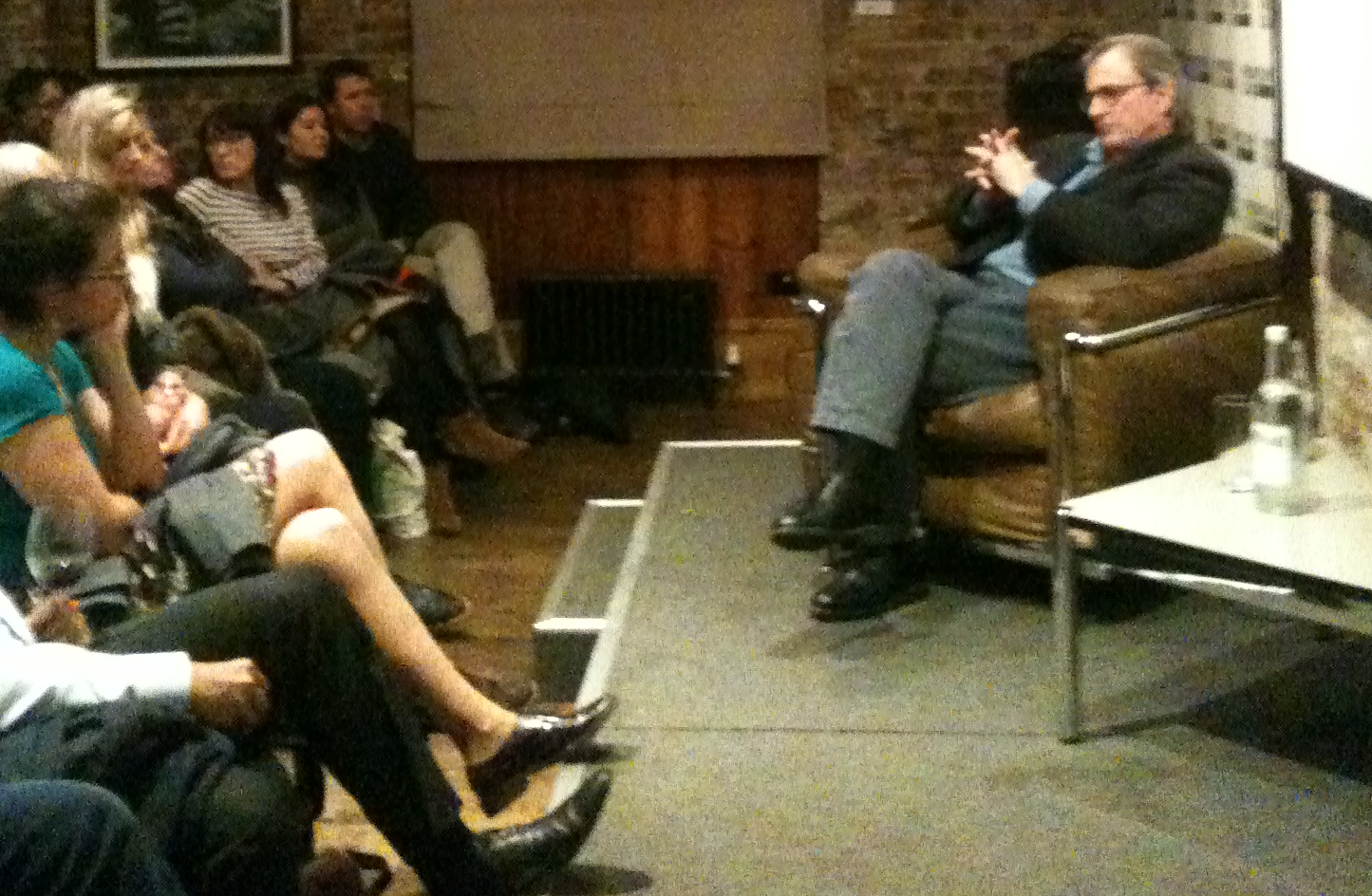 "He was there!" Director Thomas O’Connor said of English author and journalist Graham Greene (1904-1991), the subject of his documentary Dangerous Edge: A Life of Graham Greene, which was viewed by a full house at the Frontline Club on 1 October.
"There, you know, for 70 years, from one place to another, in these hot spots."
Greene – whether meeting with the Pope, giving a speech to Gorbachev’s Kremlin, conversing with Latin American rulers, or journeying in the 1930s through the hinterlands of Mexico or Liberia – had his finger on the very pulse of the 20th century: its crimes of foreign policy, the inner angst of its inhabitants.
In his own life, Greene left his wife and two daughters early on, indulged in drugs, prostitutes and affairs, suffered from bipolar disorder, and fought powerful suicidal urges, often admitting to his own yearning to die.
"Dear Vivien," he wrote to his wife, "the fact that must be faced, dear, is I have been a bad husband. You see, my restlessness, moods, melancholia, even my outside relationships, are symptoms of a disease, not the disease itself. Unfortunately, the disease is also one’s material. Cure the disease and I doubt whether a writer would remain."
"He was a tremendously courageous writer and journalist," O’Connor reflected, sharing that a driving motivation to make the film was that he "worried about journalism [today]," that future generations would lack voices as brave and voluminous as Greene’s.
"Some writers write their novels," O’Connor said, "and then every once in a while a letter to the Editor. Greene had a whole book of letters to the Editor!"
His eyes searing with intelligence and sensitivity, Greene asked readers to see more deeply into the world around them. He challenged the injustices of big business, globalization, Soviet totalitarianism, and British and American interventionism.
"I would go to any lengths to put my feeble twigs into the spokes of American foreign policy," Greene wrote.
His 1955 novel The Quiet American paired the damage done by a naive American idealist with that by a cynical English journalist like himself, both living in Saigon and desiring the same Vietnamese woman. The work so touched a nerve that, as O’Connor highlighted, even George W. Bush could not help mentioning it in a 2007 speech to American war veterans.
O’Connor wished Greene had been alive to challenge the narrative that led to the latest invasion of Iraq.
]]>"We still need writers," he argued, "as [Greene] famously said, ‘with a sliver of ice in their heart,’ and willing ‘to be a piece of grit in the state machinery.’"