Warning: Cannot modify header information - headers already sent by (output started at /home/dh_ueu9qi/beta.frontlineclub.com/wp-content/themes/frontline3.6/functions.php:1) in /home/dh_ueu9qi/beta.frontlineclub.com/wp-includes/feed-rss2.php on line 8
Albany Conference – Frontline Club http://www.beta.frontlineclub.com Championing Independent Journalism Mon, 03 Sep 2012 13:45:07 +0000 en-US hourly 1 https://wordpress.org/?v=6.9.4 Strategic Communications: New Media http://www.beta.frontlineclub.com/strategic_communications_new_media/ http://www.beta.frontlineclub.com/strategic_communications_new_media/#respond Thu, 25 Jun 2009 14:13:41 +0000 http://www.beta.frontlineclub.com/dev/?p=3064 CCN New Media Lr1.jpg

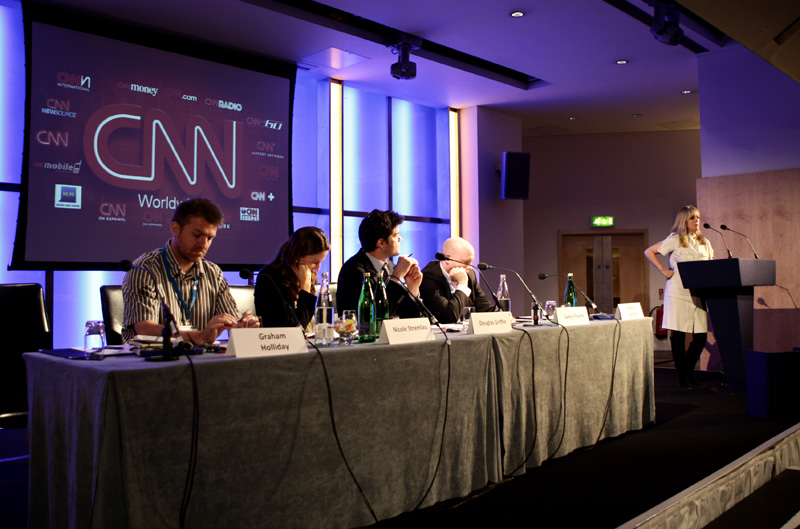
Here in the bunker – it is a rather swish conference room but there’s a serious shortage of natural light – we’ve been looking at new media and strategic communications. In a moment, three themes from the session and the morning’s discussion. 
But if you want a frankly more interesting general overview of what the conference is all about, you’d be well advised to click here and take a look at this post by Rohan Jayasekera, Associate Editor of the Index on Censorship.
 
Newsgathering from Iran
 
Mainstream media news teams have been “utterly overwhelmed” by the volume of information that has been coming in from the streets of Tehran. Twitter and Facebook have been used as a tip-off service and Youtube has provided a lot of video content.
 
Processing material is proving to be a mammoth task but news organisations cannot afford to ignore social media and are developing procedures to sift and verify. Experts and contacts on the ground are brought in to help verify material and translators can help identify different dialects.
 
In short, the experience of covering Iran was described as nothing less than a revolution. (As a history student, who was always warned against the frivolous use of the term ‘revolution’, I’d be cautious. But you know that already.)
 
Communicating Afghanistan
 
The problem is not that governments are not using digital tools, but their use of them exacerbates the fact that they don’t have a clear narrative about what they are trying to achieve in Afghanistan. One speaker was particularly critical of the approach taken in Afghanistan whereby international forces entered the country and then tried to work out what they were supposed to be doing there.
 
On the other hand, it was claimed that the Taliban have a simple message that is easily understood by the local population. Concern was expressed that NATO is losing the information battle – something we’ve heard on numerous occasions before.
 
Echoing thoughts that were touched on yesterday, one speaker said NATO should have begun to produce their own media content a long time ago and that ventures like NATO TV and a recent foray into the Twittersphere were steps in the right direction.
 
But it seems that NATO still has plenty of work to do in developing an effective social media strategy. (I do miss things but the fact that I’d never heard of NATO TV for example suggests something’s not quite right.)     
 
Learning from history in Africa
 
An interesting view was expressed that it was important to get away from the ‘Them and Us’ frame often used by speakers at the conference, whereby ‘the West’ goes into places and churns out messages to ‘them’.
 
It was pointed out that in African nations governments have long thought about how to use communication tools with varying degrees of success. Indeed, concern was expressed that the Somali government has focused attention on the international media rather than providing local journalism for Somalis.
 
Photo: Albany Associates All Rights Reserved
]]>
http://www.beta.frontlineclub.com/strategic_communications_new_media/feed/ 0
Strategic Communications: Day 2 http://www.beta.frontlineclub.com/strategic_communications_afternoon_session_summary/ http://www.beta.frontlineclub.com/strategic_communications_afternoon_session_summary/#respond Thu, 25 Jun 2009 09:10:54 +0000 http://www.beta.frontlineclub.com/dev/?p=3063 Albany Conf 56.JPG

If you were following the blog yesterday I decided to enjoy the sunshine…

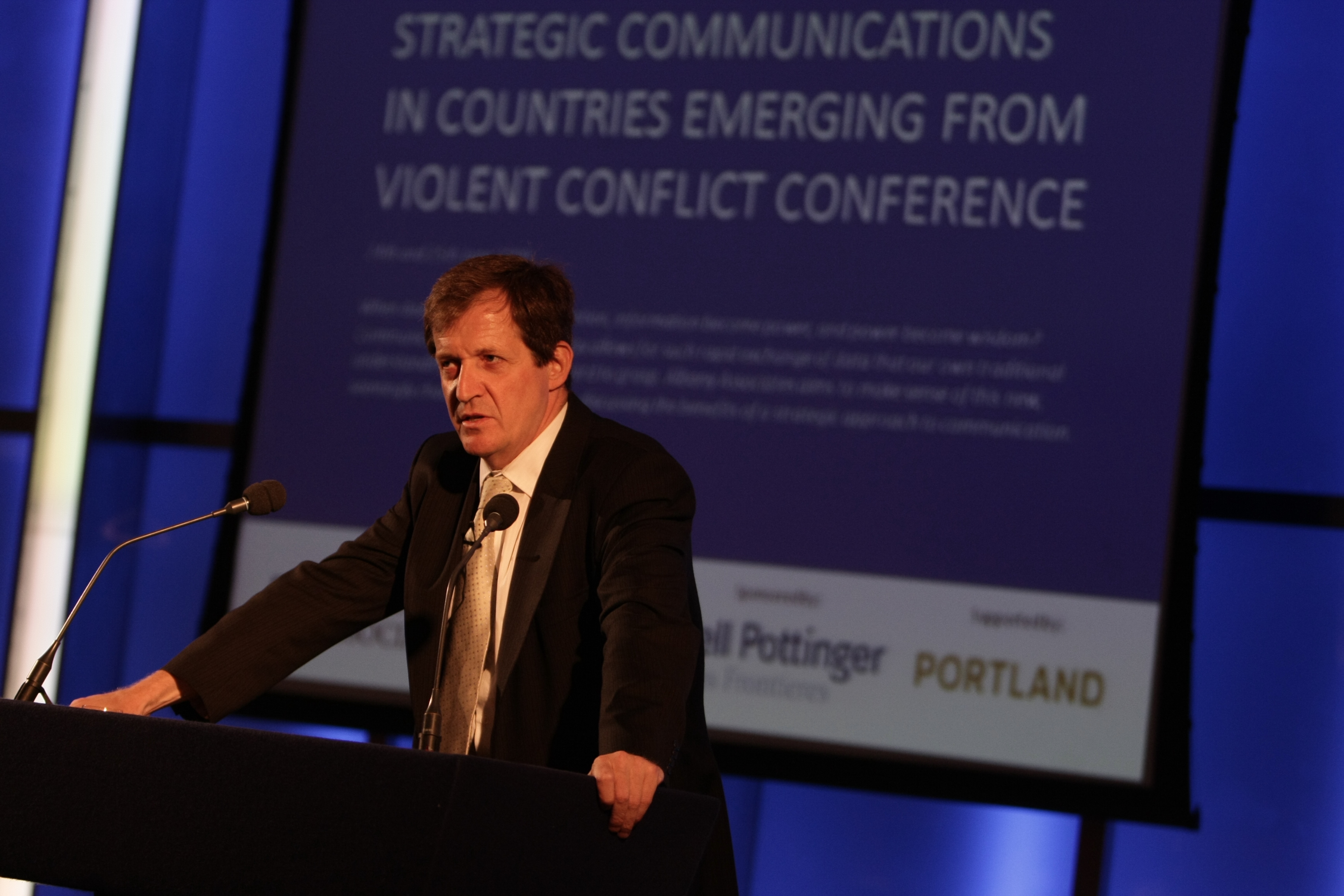
Here’s a photo of Alastair Campbell addressing the conference yesterday. After a question and answer session with Campbell on various topics including Iraq, Kosovo and Afghanistan, we moved onto a panel discussion on how to make a communications strategy work in places like Northern Ireland, Uganda and Darfur.

On the menu today we have:

– Jamie Shea, the current Special Advisor to the NATO Secretary General.

– A panel on strategic communications and new media including an appearance from Frontline Blogger, Graham Holliday.

– A consideration of the place for media development and regulation.

– "A view from the field" – practitioners examine how organisations like the UN, NATO, the AU and NGOs have approached communications.

– A conference plenary drawing some conclusions.

Photo: Albany Associates, All Rights Reserved.

]]>
http://www.beta.frontlineclub.com/strategic_communications_afternoon_session_summary/feed/ 0
Strategic Communications: Morning session summary http://www.beta.frontlineclub.com/strategic_communications_morning_session_summary/ http://www.beta.frontlineclub.com/strategic_communications_morning_session_summary/#respond Wed, 24 Jun 2009 16:21:48 +0000 http://www.beta.frontlineclub.com/dev/?p=3062 …so there’s been a bit of a delay getting the necessary wireless access, but we’re good to go now.
 
We’re also under the Chatham House Rule so observations will be general rather than specific.
 

This morning we’ve been hearing about how the new media landscape has profound implications for the area of strategic communications. ‘Citizen journalists’ can produce and distribute information with a speed that cannot be matched by the lumbering bureaucracies of complex organisations.

 
Most recently, graphic images of the crisis in Iran have found their way to millions of viewers across the world despite the best efforts of the Iranian regime to control information.


The new speed and flexibility of communication networks also have implications for Western democratic governments and institutions. Organisations are struggling to find the right balance between the time pressures of filling the information space and the (sometimes painstakingly) slow task of verifying the facts on the ground.  
 
Difficulties are compounded in situations where public policy is being carried out by a variety of departments, countries or international organisations. ‘Turf wars’, egos, and departmental independence hinder effective communication.
 
It was noted that in the UK there is no coherent national communications strategy, while in Afghanistan countless parties are responsible for distributing messages about the conflict and reconstruction efforts. 
 
Military, international and non-governmental organisations acknowledged that they have plenty to learn from communication failures in the past and as participants in a media arena that is undergoing profound change.
 
But it’s perhaps straightforward to identify the problems in theory, far more difficult to implement solutions in practice. Especially when it seems that what is required is a wholesale change in the communications culture within, and across, sprawling bureaucratic organisations.
 
That’s where we got to this morning, but better refocus on the afternoon session. I’ll try and get another summary up later…(or I might throw it all in and enjoy the sunshine). 


]]>
http://www.beta.frontlineclub.com/strategic_communications_morning_session_summary/feed/ 0
Strategic communications in post-conflict countries http://www.beta.frontlineclub.com/strategic_communications_in_post-conflict_countries/ http://www.beta.frontlineclub.com/strategic_communications_in_post-conflict_countries/#respond Wed, 24 Jun 2009 08:45:43 +0000 http://www.beta.frontlineclub.com/dev/?p=3061 I’ll soon be heading into London for a two-day conference where participants will be discussing strategic communications from various organisational perspectives – military, international, humanitarian, and media. 

On today’s agenda we have:

– A key note from Nik Gowing on the ‘new tyranny of shifting information power in crises‘.

– A discussion between General Sir Mike Jackson, Ed Mortimer and Alastair Campbell setting the military and political background. 

– A panel on the current problems and opportunities in the field of strategic communications.

– An address and Q&A with Alastair Campbell.

– A panel on information ecologies and grass roots campaigns.

Hopefully, I’ll be able to put up another blog post (or two) later in the day. But I’ll have to see what the wireless/power situation is like at the event before I make any rash promises…  

]]>
http://www.beta.frontlineclub.com/strategic_communications_in_post-conflict_countries/feed/ 0