Is this a trend that is repeating itself across the world? Or is Al Jazeera in a unique position?
We will be streaming this event live on our Facebook page at 7pm.
Chair
Safa Al Ahmad – Safa al-Ahmad is an award-winning Saudi Arabian journalist and filmmaker. She has directed documentaries for PBS and the BBC focusing on uprisings in the Middle East. She is the joint winner of the 2015 Index on Censorship Freedom of Expression Award for Journalism and was a finalist for the 2014 Sony Impact Award.
Speakers
Wadah Khanfar – Ex-Director General Al Jazeera Media Network. Wadah Khanfar, President of the Al Sharq Forum and the former Director General of the Al Jazeera Network. He is widely regarded as one of the most influential intellectual in the Arab world. He now devotes much of his time to Al-Sharq Forum, an independent international Network with a mission to develop long-term strategies to ensure the political stability and economic prosperity of the Arab world and the region. His journalistic journey began with Al Jazeera Arabic channel while he was a research fellow in Johannesburg in 1997, subsequently covering some of the world’s key political zones, including US-led wars on Afghanistan and Iraq. During his 8-year tenure at the helm, Al Jazeera transformed from a single channel into a global media network. This period witnessed historic transformation in the Arab World including Arab Awakening. He was ranked first in Foreign Policy magazine’s top 100 global thinkers, and was one of Fast Company’s most creative people in business in 2011
Giles Trendle – Managing Director Al Jazeera English. Tendle is the acting Managing Director of Al Jazeera English where he oversees an editorial staff of over 400 people based in its centres of Doha, London, Washington DC and Kuala Lumpur, as well as in over 70 bureaus around the world. Giles first joined Al Jazeera in 2004 to work on the Arabic channel’s flagship investigative documentary show before moving to Al Jazeera English ahead of its launch in 2006. He began his career in the mid 1980’s as a freelance print journalist based in Lebanon covering that country’s civil war. Giles resides in Qatar where the Al Jazeera Media Network is headquartered. Al Jazeera English produces 24/7 news and current affairs programming for a worldwide TV audience of over 280 million households and mobile content for global digital consumers.
David Hearst – Editor in Chief Middle East Eye. Before this, Hearst was worked at The Guardian as its chief foreign leader writer. In his time, Hearst has covered stories ranging from the miner’s strike, the breakup of former Yugoslavia, the end of the Soviet Union, Chechnya and the backlash from loyalists of the Anglo-Irish agreement.
Dr Marc Jones – Institute of Arab and Islamic Studies Exeter University. His work focuses on political repression in Bahrain, and he is currently working to identify Twitter bots in the Gulf region. He has previously taught Middle East Politics at Tuebingen University, Newcastle and Durham University, and has published widely on new media in the Gulf.
]]>
On Wednesday 7 October, former Al Jazeera English bureau chief Mohamed Fahmy joined a packed audience at the Frontline Club in his first public appearance since his release from a Cairo prison on 23 September. Fahmy was joined in conversation by his lawyer Amal Clooney and BBC chief international correspondent Lyse Doucet.
.@MarwaFahmy11 @Mffahmy11 & Amal Clooney at @frontlineclub pic.twitter.com/wz7jF3C87D
— lyse doucet (@bbclysedoucet) October 7, 2015
Fahmy, an Egyptian-Canadian dual citizen, was arrested in December 2013 along with colleagues Peter Greste and Baher Mohamed, and sentenced to seven years in a maximum security prison on terrorism-related charges. He was finally pardoned by Egyptian President Abdel Fattah al-Sisi on 23 September.
“I am a changed man and I am inspired by what’s happened to me – that’s why I’m fighting for other journalists,” Fahmy said of his newly-established Fahmy Foundation, which will support journalists across the world who have been unjustly imprisoned.
Critical in the past of the Canadian government’s failure to intervene strongly enough on his behalf, Fahmy repeated: “I do believe the Canadian government could have done more.”
He went on to emphasise that “governments should be much faster in intervening” when their citizens are held abroad. “Intervention needs to come immediately, from the highest levels of government.” Fahmy expressed his concern that this had not yet happened in the case of Iraqi VICE News journalist Mohamed Rasool, currently detained in Turkey on charges related to terrorism.
Denouncing Canada’s new Bill C-24, which allows the government to revoke a dual national’s Canadian citizenship if the citizen is convicted of terrorism, Fahmy said, “it’s a very dangerous law. It overrides the judiciary… it should be revisited.”
The discussion then moved onto the role of Al Jazeera, with reports of Fahmy suing his former employer for $100m on the basis of negligence in May 2015. “Al-Jazeera’s shortcomings and mistakes contributed to our situation,” he said. “I had specifically asked many times, are we legal in the Marriott [the Cairo hotel where Fahmy’s broadcast team was based]? They said, ‘Yes, stick to the editorial side, don’t worry about it’… but the answer – I found out in court.”
Fahmy continued, “I asked Al-Jazeera to take responsibility, to present a letter to the judge saying ‘[Greste, Fahmy and Mohamed] have nothing to do with this, this is our fault’, but they did not… it really angered me.”
“It was important to make it clear that there is a distinction between the network and the journalists who work in the network,” said Fahmy, describing the re-trial defence strategy.
Clooney took on Fahmy’s case, she said, when she “realised what was at stake, because Egypt is a leader in the region… It sets a precedent.”
Doucet praised her dedication to the cause: “We want to recognise all lawyers who fight for journalists, and we need more.”
Clooney continued: “Elements of the [Egyptian] government… sought to bring about justice. Belatedly, but they finally did do. The work that lawyers and journalists and human rights activists have to do is to make sure they’re pushing those elements of the government that are a force for good.”
Support @MFFahmy11's NGO @FahmyFoundation fighting 4 imprisoned journalists worldwide @bbclysedoucet @frontlineclub pic.twitter.com/eWMeA7D0NA
— Stefan Simanowitz (@StefSimanowitz) October 7, 2015
Both Fahmy and Clooney praised the media’s essential role in the campaign for his freedom. “Social media was so important in this case,” Fahmy said, mentioning the #FreeAJStaff Twitter hashtag. “It does make a huge difference… This collective effort is why I’m here today.”
Optimism remains key to both Fahmy and his lawyer’s ongoing fight for press freedom. “There are signs of positive development in Egypt… but there’s a long way to go,” Fahmy said.
A new press charter to which he contributed will shortly be presented to President Abdel Fattah al-Sisi, in the hope that journalists will consequently be able to work more freely in Egypt.
Clooney echoed this positive sentiment: “Hopefully this pardon means at the highest level there may be some change in approach.”
Clooney concluded the discussion with a few words on Fahmy‘s long-awaited freedom: “Today, we can take a moment to celebrate what’s happened to this journalist.”
“I’m here,” Fahmy replied, “because I have two very powerful women who are behind me,” thanking Clooney and his wife Marwa Omara.
Fahmy and his wife will shortly return to Canada, where he will take up a visiting post at the University of British Columbia and “continue to fight and use the spotlight” on behalf of the “many more behind bars” across the globe.
More information on the Fahmy Foundation – and their work in campaigning for the release of unlawfully imprisoned journalists, including Egyptian photojournalist Shawkan and Saudi blogger Raif Badawi – can be found here.
]]>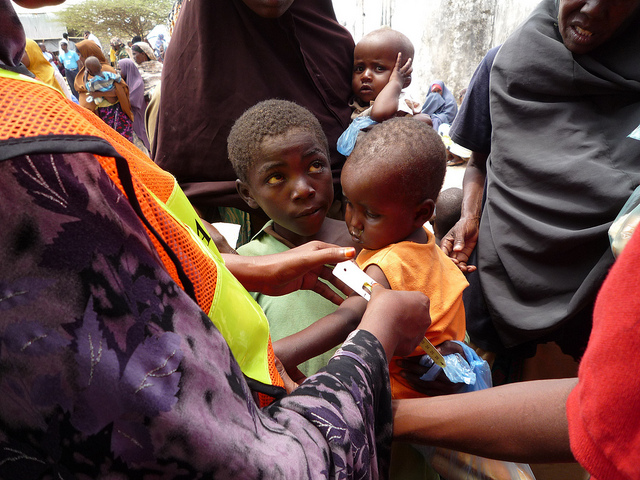
When you think of Somalia, what comes to mind?
Conflict? Pirates? Refugees? Poverty?
Somalia is still a dangerous place for journalists to operate: according to the Committee to Protect Journalists five journalists have been killed there this year.
But improvements in the security situation are offering new opportunities to access stories that may have been too risky to cover in recent years.
Yesterday, I headed along to a seminar at the Dart Center to discuss how Somalia is represented in the media. The informal meeting allowed journalists and other interested observers to share their experiences and grapple with the challenges and opportunities of reporting from the East African country.
The award winning Somali reporter Jamal Osman helped kickstart debate by highlighting a number of weaknesses with journalism from Somalia.
He suggested that a lot of local Somali journalists are young and have not always had access to education as many grew up during Somalia’s civil war after 1991.
He said they do not always "think responsibly" and are under both conscious and unconscious pressure to report stories in the interests of their clan. He believed reporters would benefit from more education in the ethics and principles of journalism.
He also noted that because "money is tight" journalists are understandably likely to value stories for their economic worth rather than their public value – a problem that is far from unique to Somalia.
Turning his attention to international media coverage, Osman argued that journalists often misunderstand the intricacies of clan loyalties, inaccurately portraying conflict in Somalia within the framework of "good vs evil".
As an example, he cited the fact that Somali officials speak to members of the insurgent Al Shabaab group because of shared family and clan ties.
Osman made a strong appeal for independent journalism and was concerned about embedding with other organisations including African Union troops as part of the mission in Somalia (AMISOM) and aid agencies.
Al Jazeera English’s Juliana Ruhfus pointed out that obtaining secure access to Somalia remains a problem for international media organisations. She argued, however, that the cultivation of good local contacts was a starting point for more "human stories", "analysis", "investigative pieces" and "meaningful long form coverage that goes beyond news".
Participants emphasised that there were plenty of fascinating stories waiting to be told outside a media narrative which emphasises poverty, conflict and piracy.
Mary Harper, BBC World Service Africa Editor and author of Getting Somalia Wrong offered some examples including the export trade in livestock and the discovery of oil reserves.
One useful suggestion which came up at the seminar was the possibility of creating some form of media monitoring of output related to Somalia after a number of journalists present had expressed their concern at coverage of the country in recent TV documentaries.
Photo: UNICEF/Iman Morooka
By: Will Turvill
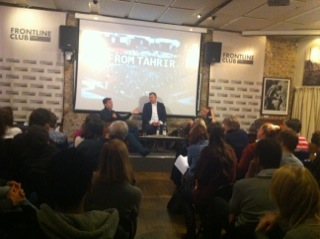
The Frontline Club last night hosted an exclusive screening of an Al Jazeera documentary Tweets from Tahrir.
The film, set to be broadcast on the network for the first time on Thursday, portrays the uprising in Egypt from the perspective of five Twitter users active in the Tahrir Square protests.
After the screening, three men heavily involved in the creation of the film took part in a question and answer session with the audience.
For this, cameraman David Niblock, who had introduced the film, was joined on stage by director Damian Clarke and Adib Nessim, the producer and editor.
One of the more pressing questions on the lips of audience members was how and why, out of all the people involved in the Egyptian uprising, were these five individuals chosen for the documentary.
Clarke admitted there was some bias involved. He said: “This all started from reading Nadia [Idle] and Alex [Nunns’] book Tweets from Tahrir. There were quite a few – about 20 I think – tweeters in there and so we picked from them.
“Obviously these people tweeted in English, owned smart phones and so were quite middle class, but we tried to get a variety. In the five we’ve got one blogger and political activist, two revolutionary socialists, a micro-blogger and an internet specialist.”
Nessim added: “And actually, we chose the specific people because of the interesting personal stories they had as well.”
Niblock, though, pointed out that this should not take anything away from the film, and that it was not designed to be portray an entirely objective view of the events of Tahrir Square.
He said: “When you set out to make films like this you have to concentrate, to put it very simply, on one slice of a cake. We know this one slice isn’t representative but try to tell the truth of this one particular viewpoint on the uprising.”
Asked if any progress has been made in Egypt since the film was made, the trio were keen to impress that the country’s revolutionary fight was far from over.
Nessim said: “We stopped filming a matter of weeks ago so this really is as up-to-date as it can be.
“This is a long term project, and the tweeters are aware of that. A revolution won’t happen overnight.”
From the future of newspapers like the New York Times and whether they can adapt quickly enough to survive to the emergence of new business models offering alternative sources of funding. They will be addressing some of the big questions that are exercising many minds within the media.
A remarkable opportunity to debate the future of the news industry with two of its key players.
]]>https://soundcloud.com/frontlineclub/david-carr-in-conversation-1
David Carr has been writing about the media and its relationship with business, culture and governments for 25 years and has watched the print landscape change dramatically. Now a media and cultural columnist at the New York Times he writes the Media Equation column for the Monday Business section.
He will be joining us in conversation with Richard Gizbert, presenter of Al Jazeera English’s The Listening Post, a weekly show that looks at news coverage by the world’s media. Gizbert has also spent 25 years working in the media world as a foreign correspondent, covering stories around the world.
Drawing on their experiences working with two very different global media players, Carr and Gizbert will be discussing the future of the news industry.
From the future of newspapers like the New York Times and whether they can adapt quickly enough to survive to the emergence of new business models offering alternative sources of funding. They will be addressing some of the big questions that are exercising many minds within the media.
A remarkable opportunity to debate the future of the news industry with two of its key players.
]]>