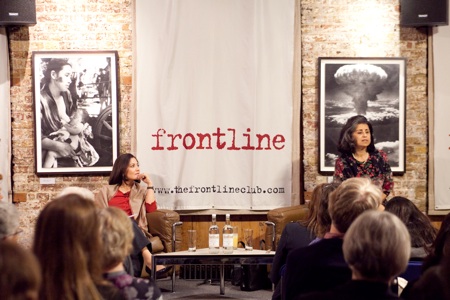
There was an overall feeling of positivity in the Frontline Club last night as the panel, chaired by the Observer‘s foreign affairs editor Peter Beaumont, discussed what the future might hold for the Egyptian people after a year of military rule.
Indeed, despite recognising the number of challenges facing the revolutionary movement, each of the speakers expressed optimism for the future.
One of Egypt’s main problems, it was pointed out by a member of the audience, is its State-run media, controlled by the military, which has maintained strong support for the army, and contempt for the revolutionists.
“State media is run as a State of misinformation consistently,” answered Hossam Abdalla, a political activist involved in Egypt’s student movement during the 1970’s. “It is not surprising [that] the army still hold more than 50 per cent of the country’s support, because of continued misinformation.”
He pointed out, though, that not long ago this figure stood at 70 per cent, and that support for the revolution is increasing. “Before 25 January, the revolutionary movement would have got 2-3 per cent approval, but now it is more like 20 per cent, and that will continue to rise.”
Abdel Latif El Menawy who, as the former head of the Egyptian State media, including for a period whilst it was under the control of the military, was in a perfect position to judge whether reform is needed, and whether it is likely to occur.
“It is required. But is it possible or not – that is the real question.” His “dream”, he explained, was for a media station designed for the public, but admitted the government did not have the power to do this. He said: “The challenge for the future is to create a public media, a tax payer public media.”
In spite of wide-spread military control of the State, Egyptian writer Tarek Osman, author of Egypt on the Brink: From Nasser to Mubarak, said that the revolutionary movement will succeed because of the number of young people in the country.
“If you look at Egypt in 1980, we were roughly 45 million people; today we are 80-85 million people,” he said. “So you have roughly 35-40 million people born in this time, two-thirds of them under 20 years old. [Their] grand objective, is trying to reject a generation of failure, to create a whole new State.”
Whether they are equipped to succeed, with a strong military power in place, is debatable but each member of the panel was confident of eventual success.
Ahdaf Soueif, author of Cairo: My City, Our Revolution, said: “I’m totally optimistic. Every time we talk about the revolution we carry thoughts of people who have been killed or injured, but they are actually a reason to be optimistic.
“They are a very powerful reason why nobody is going to back down, why the revolution will continue, and why it will actually achieve the goals which these people made their sacrifices for.”
Watch the event here:
]]>
Egypt’s ‘day of rage’ on Tuesday 25 January 2011 has been enshrined in Egypt’s history after millions of people took to the streets to oppose the tyranny and oppression of President Hosni Mubarak’s regime.
As we approach the one-year anniversary of that day we will be joined by a panel of Egyptians to discuss their hopes for revolution in Egypt a year later.
Since 11 February, when Hosni Mubarak finally stepped down, Egypt has been governed by the Supreme Council of the Armed Forces. In this time there have been a growing number of military trials, new anti-protest laws and protesters have been detained. In response, protests have continued in Tahrir Square.
With elections underway, we will be discussing how the future looks for the Egyptian people and the challenges that lie ahead.
Chaired by Marwan Bishara, senior political analyst at Al Jazeera.
With:
Hossam Abdalla, a leading Fertility Consultant and a political activist, he was one of the leaders of the student movement in the 70’s in Egypt. He is also father of actor, producer and activist Khalid Abdalla.
Ahdaf Soueif, Egyptian author, political and cultural commentator. Her most recent book is entitled Cairo: My City, Our Revolution;
Tarek Osman, Egyptian writer and author of Egypt on the Brink: From Nasser to Mubarak.
Abdel Latif El Menawy, author and journalist. As head of the news at the Egyptian Radio and Television Union he oversaw all news content, founded Radio Misr, and pioneered documentary broadcasts.
]]>Egypt’s ‘day of rage’ on Tuesday 25 January 2011 has been enshrined in Egypt’s history after millions of people took to the streets to oppose the tyranny and oppression of President Hosni Mubarak’s regime.
As we approach the one-year anniversary of that day we will be joined by a panel of Egyptians to discuss their hopes for revolution in Egypt a year later.
Since 11 February, when Hosni Mubarak finally stepped down, Egypt has been governed by the Supreme Council of the Armed Forces. In this time there have been a growing number of military trials, new anti-protest laws and protesters have been detained. In response, protests have continued in Tahrir Square.
With elections underway, we will be discussing how the future looks for the Egyptian people and the challenges that lie ahead.
Chaired by Peter Beaumont, foreign affairs editor at the Observer. He has reported extensively from conflict zones including Africa, the Balkans and the Middle East, and has written widely on human rights issues and the impact of conflict on civilians. The winner of the George Orwell Prize for his reports from Iraq he is the author of The Secret Life of War: Journeys Through Modern Conflict.
With:
Hossam Abdalla, a leading Fertility Consultant and a political activist, he was one of the leaders of the student movement in the 70’s in Egypt. He is also father of actor, producer and activist Khalid Abdalla.
Ahdaf Soueif, Egyptian author, political and cultural commentator. Her most recent book is entitled Cairo: My City, Our Revolution;
Tarek Osman, Egyptian writer and author of Egypt on the Brink: From Nasser to Mubarak.
Abdel Latif El Menawy, author and journalist. As head of the news at the Egyptian Radio and Television Union he oversaw all news content, founded Radio Misr, and pioneered documentary broadcasts. Author of Tahrir: The Last 18 Days of Mubarak.
]]>Download this episode
View in iTunes
Watch the event here.
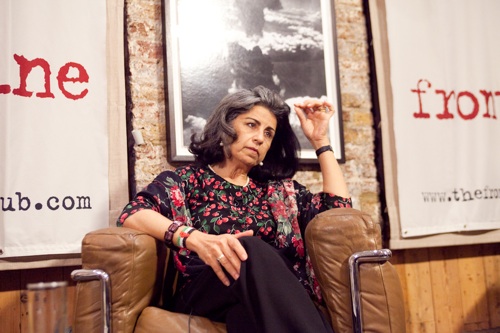
The revolution in Egypt was “a moment whose time had come” said author and commentator Ahdaf Soueif at the Frontline Club on Wednesday.
The author of the bestselling Map of Love told BBC News presenter Mishal Hussein how she had been in Jaipur in India at a literary festival on 25 January when the first protests took place but returned in time for the Friday “day of anger” on 28 January.
We were waiting, [in Embeba] basically loitering near the small mosque there and the preacher went on forever at the end. Before he finished a shout went up, it was one of the young men on the shoulders of another one or two and all in all it was about 15 people.
The sound was that mix between a shout or a chant or cheer that you must have heard if you were following the Egyptian revolution. It’s very rousing and makes your heart go with it. We started moving through the streets and the idea was that this core group goes through the neighbourhood and the particular chant that was used was one that was designed to attract people and make them come down from their homes and join the protest.
-thumb-350x233-2615.jpg)
Soueif described how groups had been “hanging about” in several locations in Cairo and elsewhere in the country, waiting for the right moment at the end of Friday prayers. The scale of the protests had surprised everyone, she said.
What had begun as a young people’s movement was joined by “everybody” said Soueif who added that “four generations” and all sectors of society took part, from those who worked for daily wages to those “who parked their Mercedes by the opera” to join protests. Rural and urban people were also represented by delegations sent by other cities and towns.
It was accepted that decisions would come out of Tahrir and so they were there to give it legitimacy and be part of the process of decision making.
In those 18 days in Tahrir square people formed circles on the ground and by evening time you would see 150 people sitting talking about politics and ideas and when a group agreed on something it would pass over to other groups and eventually there was a central point, what they called ‘Broadcasting House’ where there was a microphone with people in charge of it.
An idea, if it was good enough, would reach the microphone and would be broadcast and it would be either booed or cheered and hence rejected or adopted.
The decision to send in “the cavalry and the one camel that was supposed to defeat the revolution” was “completely strange” and made the people in the Square even more determined, said Soueif.
They resented how the regime claimed that they were not ready for democracy and that without the regime to “sit on our necks permanently, then you’re going to get a society so fanatic, so extreme, so violent, there will be rivers of blood that will wash across Europe”
The Egyptian people had been pleased to “find themselves” and “re-find their image and redefine it and declare it, said Soueif:
Suddenly we go from a progressive people who know what they want and are demanding dignity and freedom to being attacked with camels in best Orientalist Daniel Pipes fashion.
Fiction and film had allowed people to “exercise their muscles of empathy” towards the Egyptian people and that partly explained why there was so much support for them and their protest.
Another thing is that the spectacle of the revolution was done with such grace, it was so relaxed and it was so nice to look at and if you understood the jokes it was funny, yet it could raise its game and defend itself when they came at it with bullets or with stones.
On the night they attacked, the peripheries of the Square were fighting a battle, a very efficient and ferocious battle against the paramilitaries and in the heart of the Square there were stand up comics.
What you saw in Egypt was humanity in diverse forms at its best and that was very attractive, and not because it’s Egyptian, but because it’s a human spectacle. It’s humanity at its best in diverse forms.
Picture credit: Sophia Spring
If you want to hear more about the revolution in Egypt there is a fantastic opportunity to hear some of the key players at tonight’s event at the British Institution Protest, technology and the end of fear.
]]>From 25 January the world watched as protesters took to the streets across Egypt and gathered in Cairo’s Tahrir Square day after day before their demands were finally met on 11 February and President Hosni Mubarak resigned.
Egyptian author, political and cultural commentator Ahdaf Soueif will be joining us in conversation with BBC presenter Mishal Husain, to discuss her experiences at the heart of the protest in Tahrir Square during those momentous 18 days, looking at the roots of the pro-democracy movement and addressing the question of where her country goes from here.
Born in Cairo and educated in Egypt and England, Ahdaf Soueif is the author of two collections of short stories; Aisha (1983) and Sandpiper (1996), two novels; In the Eye of the Sun (1992) and the bestselling The Map of Love which was shortlisted for the Booker Prize for Fiction in 1999. And a collection of essays, Mezzaterra: Fragments from the Common Ground (2004).
]]>
Egyptian/British film-maker Omar Robert Hamilton, who can be seen in the above video speaking at a Democracy Now! event with his mother Ahdaf Soueif was in Washington DC on 25 January when Egyptians took to the streets but after four days he flew to Cairo to take part in, and document, the Revolution.
For four days I sat, paralysed, in Washington DC. From 25 January, the day the Egyptian revolution began, my life was no longer my own. For four days I watched Al-Jazeera, feeling incredibly proud and wretchedly guilty. While my mother was tear-gassed and my cousins raced medical supplies to field hospitals and my friends were arrested and dumped in the desert, I was sat watching television.
I try to be useful, but standing outside the White House and pressing re-tweet every other breath just doesn’t do it. On Saturday 29 January – the day after the people beat the police and central security forces in street battles across three cities – I get on a plane.
Earlier that month Hamilton had been in Sudan, filming a documentary in the northern Sahara and emerged from days in the desert to the news that Tunisia’s Ben Ali had stepped down.
Two days later I was driving through downtown Cairo, looking anxiously for signs of a domino effect. There were none. In the evening I was sat in the same faux Parisian bar I always sit in, with the same friends, everyone jokingly asking if a revolution had been sighted.
I left for America, to a job in DC. Two days later Tahrir Square was flooded with people, and my paralysis set in.
Hamilton, the producer of the Palestine Festival of Literature, who is currently in pre-production on his third short, Though I Know the River is Dry, says by the time he got to Egypt the internet had been shut down and new media "felt important in getting messages out to the world" rather than for internal organisation:
Twitter felt useful to try and counter the panic that was being spread abroad. Though, at the same time, one of the most gratifying things about the Egyptian revolution was that it was irrelevant what Western leaders did or said. In the middle of Tahrir square, Cameron and Obama’s words felt more out of touch than ever. So we weren’t appealing to Western public opinion, just keeping people informed.
An account by Waleed Al Musharaf of the 2 February attack on protesters by pro-Mubarak supporters Justice makes for a clear blue sky was one of the most significant articles he read during that time and "alone makes him one of the most significant literary voices to emerge from the revolution" says Hamilton.
Inspired by the "collective, organic, open-source, inclusive, revolutionary body politic that was lying dormant in the Egyptian people" Hamilton believes the biggest challenge ahead will be "keeping the momentum up" and wants to return to Egypt to live:
]]>When I first got to Tahrir from America, Egypt’s transformation was revealed in an instant, as an old man arched down, one hand holding his weight on his knee, the other sweeping up a small pile of trash. Without fuss, without ego, he was just doing his bit. And so was everyone else.