
A round up of world news in the week ahead from journalist resource ForesightNews.
Monday 28 January

The case against former Italian Prime Minister Silvio Berlusconi, who stands accused of paying for sex with the then 17-year-old call girl Karima el Mahroug (aka Ruby) continues Monday with a hearing in Milan at which Mahroug’s mother is expected to testify. Last week, further hearings were scheduled for March, meaning the case will now not conclude before general elections scheduled for 24-25 February.
In Moscow, meanwhile, a hearing is due to take place in the case against whistleblowing lawyer Sergey Magnitsky for tax evasion. This despite the fact that Magnitsky died whilst incarcerated in November 2009. He had previously testified against a Russian Interior Ministry official while exposing an alleged $230m fraud. His name was subsequently attached to a bill in the US limiting the activities of those thought to be linked to his plight, which in turn led to Russian President Vladimir Putin signing a bill restricting US adoptions of Russian children.
French Foreign Minister Laurent Fabius, with plenty on his plate given the French intervention in Mali, will host a conference on Syria in Paris on Monday. Representatives from the Syrian National Council will be in attendance.
Finally, in neighbouring Spain, an IMF team is due to arrive for a week-long visit in advance of a second monitoring report of reforms to the country’s banking sector.
Tuesday 29 January
On Tuesday, Joint United Nations-Arab League Special Representative Lakhdar Brahimi is due to brief the UN Security Council in New York on his efforts to bring the conflict in Syria to an end. It follows a January 11 Triple B meeting (with US Deputy Secretary of State Bill Burns and Russian Deputy Foreign Minister Mikhail Bogdanov) in Geneva that failed to make any substantive breakthrough.
Despite large protests in Paris against a proposed same-sex marriage bill on 13 January, the country’s National Assembly on Tuesday will take up the controversial bill. Discussions on the bill are scheduled to last until at least 10 February.

In Geneva, Israel’s human rights record is due to be scrutinised by the UN Human Rights Council. Israel has repeatedly accused the body of bias and is likely to boycott the process. The report – known as the Universal Periodic Review, is scheduled to be adopted on Thursday.
Finally on Tuesday, a donors’ conference for Mali will take place at the African Union headquarters in Addis Ababa, Ethiopia.
Wednesday 30 January
A further donors’ conference, this time for victims of the Syrian conflict, will take place on Wednesday in Kuwait. UN Secretary General Ban Ki-moon, who will attend the conference, has said he hopes to raise $1.5bn.
Spain, meanwhile, will release its GDP data for the fourth quarter of 2012. It follows unemployment data released last week that showed the overall rate of unemployment has risen to 26%. Youth unemployment, staggeringly, rose to just a shade under 60%.

Finally, in the United States, the Senate Judiciary Committee is due to hold the first of a series of hearings on gun violence in America following the Newtown massacre. This follows yet another combative diatribe from the NRA’s Wayne LaPierre last week, in which he described proposed curbs on automatic rifles and high capacity magazines as an assault on ‘God-given freedoms’, adding, ‘They belong to us as our birthright. No government ever gave them to us and no government can ever take them away.’
Thursday 31 January
On Thursday, Human Rights Watch is scheduled to release its annual World Report – this, as noted, on the same day the UN Human Rights Council report on Israel is due to be adopted.
Meanwhile, EU foreign ministers are scheduled to meet in Brussels for their first meeting since British Prime Minister David Cameron promised to hold an in-out referendum on Britain’s membership.
In the US, former Nebraska Republican Senator Chuck Hagel is scheduled to appear before the Senate Armed Services Committee in what is expected to be a tense hearing to consider his nomination to replace Leon Panetta as US Secretary of Defense. Hagel’s previous comments on Israel and Iran in particular are likely to be questioned. He will also be asked about operations in Africa, particularly the campaign in Mali. Depending on whether North Korea follows through with its threat to test another nuclear device, this may also feature heavily.

Finally, outgoing US Secretary of State Hillary Clinton is scheduled to deliver what may be her final big speech before stepping down from the post at the Council on Foreign Relations in DC. As with the Hagel nomination, Syria, Mali, Algeria, and North Korea will all likely feature.
Friday 1 February
On Friday, the IMF will at last take up the issue of the serious concerns raised over Argentina’s official inflation and growth data. Specifically, the Fund’s Executive Board is scheduled to consider a report submitted on 17 December by Managing Director Christine Lagarde on the progress made by Argentina in addressing these concerns. Lagarde has warned of ‘additional measures’ from the Fund should Argentina fail the test.
Key figures from the world of international security and diplomacy will convene for the prestigious Munich Security Conference from Friday. As usual, exactly who will be in attendance remains under wraps but if previous years are anything to go by, expect some seriously big-hitters to turn up.
Finally, highly-anticipated monthly unemployment data in the US will be released Friday.
]]>
A round up of world news in the week ahead from journalist resource ForesightNews.
Monday 21 January

Barack Obama delivers his second inaugural address on Monday, the climax of a day of festivities in the US capital following his re-election in November. The need for further action to stem gun violence is all but certain to feature, as well as the ongoing economic challenges facing the United States.
In Brussels, meanwhile, eurozone finance ministers are scheduled to meet, with current president of the grouping Jean Claude-Juncker expected to pass leadership to the Dutch Finance Minister, Jeroen Dijsselbloem.
Finally, India’s Supreme Court is expected to issue its ruling in the controversial Niyamgiri bauxite mine case. The bauxite extracted would be used in an aluminium refinery run by mining conglomerate Vedanta Resources but critics say it will cause untold damage to the Niyamgiri Hills, which are in Orissa state.
Tuesday 22 January

Israeli’s go to the polls in parliamentary elections in which Prime Minister Binyamin ‘Bibi’ Netanyahu and his Likud party is all but certain to secure enough seats in the Knesset to retain power. The campaign has been notable for the rise of Naftali Bennett and his hard-right Jewish Home party.
Meanwhile, Germany’s Angela Merkel and France’s François Hollande will lead celebrations of the 50th Anniversary of the Elysée Treaty. A joint cabinet meeting of the two countries will be held, as well as a joint session of France’s National Assembly and the Bundestag. Expect much focus on the future of the European project.
Japan’s Central Bank, which is under pressure from Shinzo Abe’s government, concludes a two-day monetary policy meeting on Tuesday. Observers anticipate an easing of policy and possibly a doubling of the inflation target to 2%.
Finally, Tuesday marks the 40th anniversary of one of the US Supreme Court’s most well-known, and controversial, decisions: Roe v Wade.
Wednesday 23 January
Some of the world’s most influential business figures will gather in Davos from Wednesday at the World Economic Forum. While health is formally the major theme of this year’s gathering, the US economic outlook and the future of the euro will no doubt be major topics of conversation among the attendees.
In Moscow, Russian Foreign Minister Sergey Lavrov is due to address domestic and foreign journalists. Again, although ostensibly a reflection on Russian diplomacy in 2012, questions are more likely to focus on future affairs, especially in as regards the Syria conflict.
In the United States, outgoing Secretary of State Hillary Clinton is scheduled to address the House Foreign Affairs and Senate Foreign Relations Committees on the September attack on the US consulate in Benghazi in Libya, delayed from December. This will almost certainly be her final testimony before she leaves the post (her nominated successor, Senator John Kerry, is due to have his confirmation hearing on Thursday).

Lastly, Jordan holds elections which the country’s Muslim Brotherhood has vowed to boycott.
Thursday 24 January

As mentioned above, Senator John Kerry will appear before the Senate Foreign Relations Committee on his nomination to be US Secretary of State. He will be questioned on the full gambit of US foreign policy priorities, particularly Israel, Iran and Syria. North Africa also expected to be a significant area of questioning.
Also in US affairs, Senator Dianne Feinstein, author of a ban on assault weapons that expired in 2004, will introduce legislation to once more ban the sale of assault weapons and high-capacity magazines.
In Addis Ababa, African Union Foreign Ministers are due to begin a two-day meeting, with the current conflict in Mali likely to be a key point of discussion, in addition to events in the DR Congo, relations between Sudan and South Sudan (a special meeting on this is scheduled for Friday), as well as unrest in the Central African Republic.
Finally, in Strasbourg, the European Court of Human Rights holds its annual briefing for the media.
Friday 25 January
The Czech Republic holds a run-off in its presidential election, with Foreign Minister Karel Schwarzenberg squaring up against former Prime Minister Milos Zeman.

Egypt, meanwhile, marks two years since the protests began that ultimately led to the downfall of Hosni Mubarak.
Also, US Treasury Secretary Tim Geithner is scheduled to step down. His designated successor, Jacob Lew, has yet to be confirmed. Lew’s unusual signature has attracted much attention.
Saturday 26 January
The top US diplomat on North Korea, Glyn Davies, arrives in Tokyo for talks with counterparts. This is the final destination on a trip that also sees him travel to Seoul and Beijing to discuss the secretive communist state. His visit comes amid reports the DPRK is planning to test another nuclear device.

Saturday is also Australia Day and Republic Day in India.
Sunday 27 January
Leaders from the African Union begin their two-day summit. Again, Mali, the Sudans, DR Congo, Somalia and Algeria all likely to be discussed.
Finally, Bulgarians are due to take part in the country’s first referendum since 1989. The issue at stake: whether to approve the construction of a new nuclear power plant.
Images courtesy of
]]> A special round up of world events from January – June 2013, from journalist resource ForesightNews.
January
Beyond the ‘fiscal cliff’ in the United States, there is plenty of international news taking place in January.
On 10 January, Venezuelan President Hugo Chavez is due to commence his third term in office amid increased concerns about his health. Concerns are exacerbated by his decision to nominate his Vice President and Foreign Minister Nicolás Maduro to succeed him should anything happen to the firebrand former army colonel.

Barack Obama, meanwhile, is due to commence his second and final term as US President on 21 January when he delivers his inaugural address. Although there is a ceremonial swearing-in on the big day, he will actually take the office a day earlier in a private ceremony.
In Israel, Prime Minister Binyamin Netanyahu will be hoping to emerge victorious from parliamentary elections, due 22 January. Former Foreign Minister Tzipi Livni has returned to politics ahead of the poll, abandoning Kadima and founding a new party Hatnua.
Finally, in Addis Ababa, African leaders convene for the African Union’s leaders’ summit. They will have plenty to talk about, from Islamist militants in northern Mali, foreign backed militants in eastern DR Congo and ongoing tensions between Sudan and South Sudan, to name but a few.
February
Viewers worldwide will struggle to understand once again the rules of American Football when the Super Bowl takes place on 3 February. Expect much chat too about the adverts between the match’s interminable breaks.
On 10 February, it is the Chinese New Year, this year being the Year of Snake.

Ecuadorians will cast their votes in presidential and parliamentary elections on 17 February, with incumbent Rafael Correa seeking re-election.
Finally, the first part of the long-awaited civil trial over the Deepwater Horizon oil spill in the Gulf of Mexico back in 2010 is scheduled to begin 25 February.
March
Assuming he is re-elected, March will see Israeli Prime Minister travel to the United States to address the American Israeli Political Action Committee (AIPAC) Policy Conference, the highlight of the influential lobby group’s calendar. Addresses by President Obama and his new Secretary of State are all but inevitable. The conference runs 3-5 March.
In the UK, the long-awaited Al-Sweady Inquiry is scheduled to open on 04 March. The inquiry relates to the detention of Iraqis on 14 May 2002 following a firefight at a vehicle checkpoint known as Danny Boy. Some 20 bodies were returned the following day but it is unclear how many were killed in the firefight.
Kenyans go to the polls to elect a new president on 04 March. Last time around, the election resulted in widespread violence as the then-incumbent Mwai Kibaki refused to concede to challenger Raila Odinga. The region will be hoping for a more peaceful process this time around.
Finally, back in the United States, Private First Class Bradley Manning’s court martial is scheduled to get underway over allegations that he was responsible for divulging vast swathes of confidential information to the whistleblowing website WikiLeaks.

April
British Foreign Secretary William Hague will host his counterparts from the G8 on 10 April, with a summit following later in the year.
With global economic woes set to continue in 2013, the World Bank and IMF Spring Meetings will see the world’s top financial experts convene in Washington DC from 19-21 April to discuss possible remedies. A slew of economic forecasts will come out in the days leading up to the formal meetings.
On 21 April, Paraguay holds presidential and legislative elections that follow the ousting of then-President Fernando Lugo in June 2012 over a botched operation to evict landless farmers from land they were occupying. The so-called ‘mini-coup’ was widely condemned by Paraguay’s regional neighbours.
May
An inquest opens 1 May into the death of Russian spy Alexander Litvinenko, who died on 23 November 2006 in London after being poisoned with the now-infamous Polonium-210. Many suspect Russian governmental involvement.

On 8 May, Madagascans will elect a new President in delayed elections. Newsreaders will once again have to get their heads around such names as Marc Ravalomanana – the former President – and Antonanarivo – the island’s capital.
The Cannes Film Festival begins on 15 May, where Hollywood A-listers mix with unknown actors to compete for the prestigious Palm D’Or, which will be awarded on 26 May.
Finally, politics and entertainment collide on 18 May when the grand final of the Eurovision song contest takes place. The Swiss entry this year features a 94-year-old, yes, 94.
June
With Iran’s nuclear programme likely to feature prominently in 2013, amid talk of an impending Israeli attack, there will be intense interest in who will be elected to replace Mahmoud Ahmadinejad as president when vote opens on 14 June. In reality, the outcome is unlikely to make much difference since the country’s nuclear policy is widely thought to be controlled by Supreme Leader Ayatollah Khamenei.
Three days later, on 17 June, the G8 summit takes place in Northern Ireland, hosted by British Prime Minister David Cameron. It represents a historic moment for the once-troubled province.
Finally, Prince William, the Duke of Cambridge, turns 31 on 21 June. Of course, this will be dwarfed by interest in the Duchess of Cambridge’s pregnancy, which will have reached hysterical levels by this point. Expect wall-to-wall coverage.

Images courtesy of Mark III Photonics / Shutterstock.com
]]>There has been a considerable amount of discussion about the implications of events in Ivory Coast for the rest of Africa – we will be addressing this issue at our event The Ivory Coast: What now for Africa and its strongmen?
Analyst Knox Chitiyo argues that with no higher authority available to decide and implement the decision the stage was set for ‘a violent showdown’ after the stakeholders boxed themselves into a corner:
The lesson? Ivory Coast needs a higher, independent judicial body which has the mandate to resolve post- electoral disputes; and which has the tools to implement decisions.
And such a body must exist in other countries, too.
The arrest of Laurent Gbagbo sent a message to dictators that they cannot disregard the verdict of free elections, US Secretary of State Hillary Clinton said.
There was a great deal at stake in the Ivory Coast, not least because the African Union and the Economic Community Of West African States (Ecowas), have taken an increasingly hard line against illegal takeovers and recalcitrant incumbents in recent years. The continent had to be seen to back its pledge to support democratic transitions of power, Knox Chitiyo argues:
Ivory Coast is a step change in Africa’s support for electoral democracy and democratic transitions.
Over the past decade the tradition has been for power-sharing governments to resolve post-electoral disputes – as seen in Sudan, Zimbabwe and Kenya.
Power-sharing is an important way of resolving military conflict, but it does not always resolve political conflict.
Ivory Coast may mark a shift away from the power-sharing default setting, and back to the tradition of the electoral winner becoming the national leader and forming a government of their choice – either inclusive or single party government.
Ideally, elections are held to choose leaders, but in many cases in Africa, elections are either intended to launder regimes that fought their way to power, or otherwise dress up despots in democratic garb – so the idea of losing is academic. In these neopatrimonial states, the big man, like Mugabe or Museveni, believes only he has the capacity and the right to rule. Hence, Museveni sees "no one else with the vision" to lead Uganda, and Mugabe believes Tsvangirai cannot lead Zimbawe because he did not fight for independence.
With such logic, elections are routinely rigged – the Ugandan courts have found the previous two presidential polls were. And if the rigging falls short, there must be a mechanism in place to announce the big man as the winner.
In Kenya, Zimbabwe and Ivory Coast, the pressure to end the chaos has come from abroad. Whether such pressure can be sustainable is questionable, but perhaps Ivory Coast represents a watershed for African democracy – the optimistic exceptions of countries such as Ghana and Botswana notwithstanding.
Less than a week after Laurent Gbagbo was captured, it was the turn of Nigerians went to go to the polls on Saturday.
Already described as free and fair, it was clear that the elections were judged important by ECOWAS and the EU, which said it was looking to the country to model democracy.
Nigerian-born novelist and journalist Kingsley Kobo – who has spent the past 16 years in Ivory Coast reflects on lessons that could be learnt from events in Ivory Coast and urged the people of Nigeria to play their part in ensuring the same didn’t happen there:
Elections are meant to create a peaceful atmosphere for progress and development, in the way we imagined the Ivorian presidential election would. Sadly, artilleries and mortars, pillaging and looting are speaking.
I urge you never to let this happen in our great country, Nigeria.
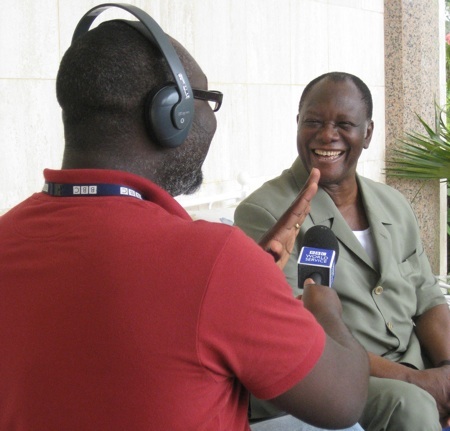
Events are moving fast in Ivory Coast, with a ceasefire reportedly being negotiated and suggestions that the besieged incumbent Laurent Gbagbo who has stubbornly refused to cede the presidency to Alassane Ouattara may now be considering surrender.
At our event on 20 April we will be discussing what message the events in Ivory Coast will send to Africa’s strongmen. With a number of elections due in in Africa in the coming year, the dispute in Ivory Coast took on added significance.
But news of a possible ceasefire comes as the UN announced the discovery of a mass grave with nearly 200 bodies. Sky News’ Emma Hurd puts the number of bodies at more than 300 and writes that the massacre in the western town of Duekoue last week shows that there are "no good guys in this conflict".
At least 800 people were killed in intercommunal violence in Duekoue last week and UN investigators believe president elect Alassane Ouattara‘s fighters were responsible for at least 220 of the deaths.
The warnings had been there for months – a disputed election, an illegitimate president clinging to power through force, and the rightful claimant arming his supporters for a battle.
But the world was focusing on Libya and Colonel Gaddafi as the simmering violence erupted into a full-scale war.
There seems no doubt now, Hurd concludes that Alassane Ouattara will win this battle.
But the atrocities committed by his fighters will taint his presidency and leave the country deeply divided.
The "robust" position taken by UN peacekeeping force which, supported by the French military, targeted forces loyal to Laurent Gbagbo after itself coming under attack, appears to have broken the impasse, writes the Guardian’s Africa correspondent David Smith.
He also highlights concerns about the role of the UN "if they are seen to be co-ordinating with the rebels to topple Gbagbo". And what if Gbagbo has stepped down?
Human Rights Watch worker Corinne Dufka, on Channel 4 News warned that even if if Abidjan and Laurent Gbagbo fall quickly, violence may continue:
A few things raise alarm bells: Ouattara’s forces the RFCI are a loose coalition from different rebel forces, Gbagbo defectors, and decommissioned soldiers, so there is a high potential for undisciplined members to commit abuses" she said
Many of them have committed war crimes in the past, which they have not been prosecuted for. And given the level of brutality of Gbagbo’s side in Abidjan, there is a very high possibility of reprisal killings by Ouattara’s forces were they to take the city.
What role should UN play in disputed elections? What role has the Economic Community of West African States (ECOWAS) and the African Union played and how effective has it been in its handling of the conflict? Join us at the Frontline Club on 20 April to discuss events in Ivory Coast and the implications for future elections in Africa. You can book tickets here.
Picture credit: bbcworldservice via a creative commons licence.
]]>