This event is in partnership with BBC Service for Afghanistan. It will be held at the Shaw Theatre, 100-110 Euston Rd, London, NW1 2AJ.
As the final stage of the withdrawal of foreign troops from Afghanistan begins, we will be bringing together leading experts to look at the country’s roadmap and the legacy of the past 12 years.
How is the transition progressing and who are the main actors? We will be examining that process and the role of parties such as the Taliban. With continuing transition of security from NATO to Afghan leadership, we ask if the Afghans are ready and able to manage their country’s security.
Finally with an election approaching in early 2014 we will be looking ahead at the political process and which figures will play leading roles in Afghanistan’s future.
Chaired by Owen Bennett-Jones, freelance journalist and a host of Newshour on the BBC World Service. As a correspondent with the BBC he has reported from over 60 countries, he is author of Pakistan: Eye of the Storm and his first novel Target Britain. He has also written for the Financial Times, The Guardian, The New Republic and the London Review of Books.
The panel:
Dominic Medley was the Spokesman/Media Advisor to the NATO Senior Civilian Representative in Afghanistan from June 2010 to June 2013. He has worked in Kabul since February 2002 including two years with the UN Mission. He has been a leading figure in the development of journalism in Afghanistan and he is the author of the Kabul Guide.
Emal Pasarly is the multimedia editor for the BBC Pashto-Persian service. He was born in Northern Province of Kunduz, Afghanistan and as a result of the Russian invasion, his family migrated to neighbouring Pakistan. He moved to London in 1993 and began working with the BBC World Service in 1996. He also writes fiction in Pashto and has published two novels and four collections of short stories.
Michael Semple is a Visiting Professor at the Centre for Conflict Transformation, Queen’s University, Belfast and affiliated to the Carr Center for Human Rights Policy, Harvard Kennedy School. He conducts research on the Afghan Taliban Movement, conflict in Afghanistan and Pakistan and approaches to reconciliation. He has specialised on Afghanistan and Pakistan since 1985 and speaks Urdu, Dari and Pashto. During this period he has worked with international NGOs, the United Nations and European Union, including serving as Deputy to the European Union Special Representative for Afghanistan 2004-08. Since 2008 he has worked as a scholar and adviser, focusing on opportunities to end the conflict in Afghanistan and the region.
Martine van Bijlert is co-director and co-founder of the Afghanistan Analysts Network (AAN). She grew up in pre-revolutionary Iran and has spent large parts of her adult life working and living in Afghanistan, Iran and Pakistan. She was a student researcher in Pakistan in the early 90s, a diplomat in Tehran from 2001-2004, and an aid worker from 1997-98. She served as EU political adviser from 2004-08 and has been an independent researcher in Afghanistan since 2007.
Quhramaana Kakar is a leading figure in Afghanistan working for women’s empowerment. She has served as gender advisor for the Afghanistan Peace and Reconciliation Program (High Peace Council). She has worked for women’s social and political empowerment, and leadership development at advisory senior level positions with USAID, UNIOM and other International organisations. Kakar is the founder of the organisation Women for Peace and Participation, which works for social inclusion of Afghans, inside and outside Afghanistan. She was the young ambassador of the US main aid organisation representing refugee women and is the winner of the United Nations 2012 Role Model for Peace award.
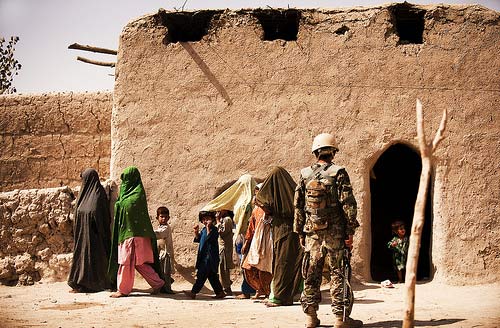
Picture courtesy of multimedia photojournalist John D McHugh
.
]]>
Conversation among decision makers who gather in London’s private dining rooms has turned from Afghanistan to Libya. Over rare beef and fine wine, they voice concern that Western governments have again embarked on a rushed military adventure, in a far away place, on a vague premise, with no clearly defined goal, and no apparent exit point. What is the end game, ask some of the most influential men and women in the country. Do our leaders know what they are getting us in to? Have they learned nothing?
Afghanistan, it seems, has become the object lesson.
David Miliband, Britain’s former foreign secretary, has joined the chorus singing from the hymn sheet of a political solution to the Afghanistan conflict, a new recruit to the latter-day wise who claim, after ten years and two-and-a-half thousand body bags, to recognise a military quagmire when they see one.
Afghanistan is set to become the ‘forgotten war’, overshadowed in the public and political consciousness by events in the Middle East. Nothing could be worse for the Afghan people, exhausted as they are by war, poverty, corruption, and decades of being fought over by the well-meaning and the venal, each equally difficult to determine from the other.
The road to hell is paved with Afghans’ patience, endurance and hopes for peace, and recent shocking events in Mazar-i-Sharif – where United Nations employees were set upon and murdered by a mob – should be seen as a warning that progress in the margins of a bureaucrat’s ledger is meaningless to a man who cannot go to bed at night secure in the knowledge that his door will not be kicked down, by either side of those fighting for his heart and mind.
US Army Lt General William Caldwell, arguably the most important man in Afghanistan today, recently breezed through London to tell anyone who would listen about his efforts to build Afghanistan’s security forces. Withdrawal of Western troops from Afghanistan depends on the success of General Caldwell’s mission to build an army that can keep insurgents at bay, and a police force that can fairly enforce laws backed by a credible judicial system.
The mob attack in Mazar, where the police seemed incapable of controlling the situation, showed there is still a long way to go. But General Caldwell does not have the luxury of failure as an option. And London’s chattering classes, who accept the commitment to Afghanistan is a fait accompli, want him to succeed. They just don’t have the stomach for another war with no end.
Picture credit: United States Marine Corps Official Page via a creative commons licence.
]]>