In spite of the fact I was concentrating hard to try and copy the radio communications word for word, I wasn’t catching a lot except for the repetition of “Demon 26 this is Monkey Six” which didn’t seem like it was getting a lot attention. The first thing I clearly made out was “we’re still taking indirect three o’clock at three hundred metres” and then from one of the guys in my vehicle on the internal only channel “well if you know where they are then fucking shoot them” and before I know it we’re all genuienly laughing out loud albeit with brovado.
To begin with I was struggling to understand where exactly the action was taking place and then as the voices became clearer I recognised that it was the Commanding Officer who was calling-in the incoming and that he was some way down the valley ahead of us and moving at speed as we in turn were trying to catch up on him to provide assistance. We began to settle into what seemed like a rhythm or perhaps I just regained my calm or there was a moment or two’s radio silence which allowed me to break from my note pad. At any rate, I asked the crew whether we were still heading towards the contact, doing my best to use the right military language and being conscious of considering whether it should instead have been “towards the indirect”! The reply was a resounding “hell yes”.
We were moving at such a fast speed for the terrain, with such poor visibility that I wasn’t sure how we would know when we got there and without realising how silly it must have sounded to the guys hauled up with me in our bouncing bullet proof cubicle I blurted my question out loud and received the bloody obvious answer “don’t worry you’ll hear it”, accompanied by more laughter but this time with a hint of the cynical.
“Their indirect is effective, get some rounds up there” came over the radio in a no-bull-shit-tone and it occurred to me that I wasn’t sure what was being fired at us, in fact I wasn’t sure anybody was sure. After the first explosions I’d heard “IED” somewhere in the communications but as the explosions continued there seemed to be confirmation that they were mortars. Up until this point I’d been so carried away by the sudden shift in tempo that those first words had prompted, as if setting of a chain reaction or a natural sequence of cause and effect, that I really hadn’t taken in the fact that we might be in any danger. It was as if the vehicle had an environment of its own, like a war room, isolated from any bombardment behind the safety of its armour. But I knew fine well that a direct hit from a mortar round would most likely be end game and for the first time I had to tell myself to concentrate on what was going on around me.
Outside the terrain continued to look as if it was trying to dizzy me and my enthusiasm to catch up to the fight was not what it had been, instead the possibility of the fight catching up to us without us even trying to reach it cropped into my thoughts. What was to stop them lobbing the damn things in our direction? I think I can thank the call signs Demon and Monkey for stopping me trying to answer that rather pointless question. They were again demanding attention on the radio and somehow surreal enough to be sufficient distraction.
As if I wasn’t already entertained enough by the radio, the next snippet left me wondering exactly how much effort the military puts into sounding cool under any circumstances: “I need you off the net for a second . . . we’re calling in the dude”. For the last portion of our journey towards the attack’s epi-centre I mostly noticed updates on the dude’s progress, is the dude here, isn’t it, where is the dude, what is the dude?
At last we came to a stop towards the rear end of the column of vehicles and took our place facing into the hills as our gunner joined in the hunt for the insurgents on the mountain side, vigilantly scanning his screen, which showed the view from a camera mounted alongside the gun above us. The ANA claimed they had spotted bodies scrambling up the mountain but since they were looking at a point 960 metres away in the fading light of dusk and nobody else could confirm the sighting, they weren’t taken very seriously and I heard someone chirp “I think they just want to fire the RPG for the thrill”. By now the Dude was in place (I’ve yet to figure out what kind of plane this is) and whoever was up on the mountain had pulled of an effective disappearing act.
The last communiqué that could really be directly linked to the attack was “anybody who’s got their lights on, turn them the fuck off, cos you’re about to get shot up like that”. Everyone sat in calm for a good five minutes or so while the dude made its last passes and the gunners searched the rocky slopes of the west facing mountains for any movement. There was no more incoming.

Photograph: Adam Pletts
In the still after the attack I turned my attention back to the tiny window at my side and noticed several camels calmly chewing on what little foliage the valley offered. They didn’t look the slightest bit distressed by anything that had taken place. The mountains were now silhouetted in varies shades of pastel pinks and orange and as I went to take a picture through the window, I noticed the RPG netting blurred in the foreground very much like a cage around us and was reminded of the lyrics of a Pink Floyd tune: “And did you exchange a walk on part in the war for a lead role in a cage?”
I later learnt in conversation with the CO and the Lieutenant that some 25 mortars – which strikes me as a lot – were fired on the CO’s QRF together with machine gun fire, probably from a PKM. The mortar team apparently knew what they were doing and were bracketing the CO’s vehicles, firing first ahead of them and then behind to try and calculate a bearing in the middle along which to fire. To this extent the QRF was lucky to be moving across the mortars’ range rather than towards or away from them, as lateral bracketing is far harder and based more on judgement, especially with a moving target. Had they been moving away from the mortar along a confined path, such as a valley flaw, then the bracketing comes down to trajectory alone which is simple maths.
If I was being cynical I’d say 100 personnel, 27 vehicles, a specially requested RCP, many hours waiting in the valley and taking the risks of an attack was a high price to pay for a ten minute conversation with three old men in a small village down an obscure valley used by the Taliban to smuggle weapons. But then from the other angle, how else can it be done? The other objective though was simply to let the Taliban know that they can’t move with impunity in the area. The CO told me there were at least two confirmed hits on the Taliban positions and he believed at least two KIA and probably many more wounded among the Taliban’s number.
]]>The mountains north of the village are a known transit route for insurgents crossing in from Pakistan who then head north to resupply the insurgency in Kunar. They use the villages of Reneh and Parchaw located in an inaccessible valley that runs along the Afghanistan-Pakistan border as a staging post. Technically the villages sit on the Afghan side of the border but they might as well be in no-man’s land. Part of the company’s mission is to extend the coalition/government influence into these areas and stomp out these supply routes by strengthening the Afghan Border Police who are currently in no real position to stand up to the insurgents.
Lal Por was the destination of my second excursion out of COP Garcia. The mission included the usual meetings with local leaders and the police (KLEs). I found it amusing that the school principle asked for barbed wire, not to keep “bad guys” out but to keep the school kids in, a request that was prioritised.
The second part of the day’s activities was a patrol down a valley towards the insurgent’s known staging posts. There was authorisation to proceed east to a certain grid line along the sides of the mountain so as to get a view down on the routes that the insurgents must be using in and out of the valley. The grid line coincided with a steep bend in the valley’s path so that we wouldn’t actually be within sight of the villages. We dismounted from the armoured vehicles some two or three kilometres from the villages and regrouped with the ANA, bring our total to some 20 hats, roughly split equally between the US and Afghans. There was a certain tension in the air and when I asked if we were being watched the reply came “they’re always watching us – they count the vehicles out of the COP, they count the dismounts out of the vehicles, they know our fire capability, they know the works” after which a young soldier called over to me “I sure as hell wouldn’t be going up that valley without a gun”. My first thought was that I must have heard this in a movie and wondered who was imitating whom.
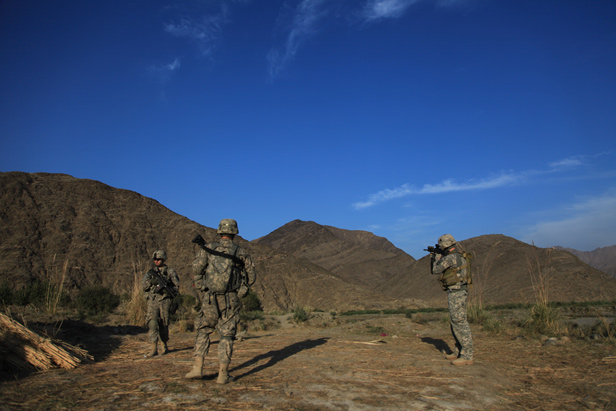 I would say I was too busy contemplating how beautiful the pictures across the valley to Pakistan could turn out but I was also a little rattled, or perhaps I was just excited. I’m sure that if I continue embedding “contact” is a strong possibility at some point but I wasn’t entirely sure that this was when I wanted it, not this soon and not on such a beautiful day with the sun throwing golden light across the valley. I thought about it a little harder and began to speculate “What if I’m about to be immersed into the deafening confusion of RPG explosions and bullets tinging past my ears?” Would my veins even be able to cope with the pressure that I anticipated on them as my heart would probably leap into the high 180s in a fraction of a second? I felt a rush rise up through my stomach, but no different to the one that you’ve felt before a track race, the start of an exam or interview or phoning a girl up for a date for the first time. I dealt with it by lighting up a cigarette and was annoyed to notice that that left me only one and decided to save it for the peak of wherever it was that we were heading to.
Climbing up the hills the valley floor began to reveal itself as a series of interlinked channels glistening in the evening sun, separated by islets, some of which supported thick vegetation. On the opposite side of the valley, the Pakistani sky line was already sinking into a darker blue and the Afghan’s pointed out the Pakistani observation posts perched on the crests of the highest mountains. It was the first time I’d been out in the open like this for a while and it was such a contrast to Beirut’s clogged arteries that nature’s tranquillity overwhelmed any thought of eyes that might have been prying down sights on the mountain slopes.
Looking down on the valley, you could clearly make out where vehicles had been coming and going to the village – although nothing said that they were anything other than innocent grocery runs.
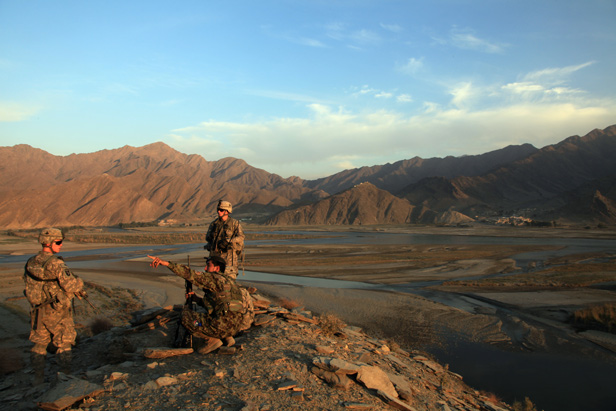 The aim of the short patrol was to get a better idea whether the unit would be able to approach the villages through the valley. Having reached the specified grid line and satisfied that they had pictures of the valley and a better idea of whether they could make it in, the Lieutenant turned to me and said “OK, business over, now it’s facebook time”. We climbed inwards taking the high road on the way back over a hill top where the American’s stopped to take pictures that would later be “tagged” and the Afghan’s phoned friends and family to tell them where they were. The hilltop was the natural place from which to defend the valley and was fortified with dry stone walls in trench-like dugouts rising up a whole side of the hill. Some of the Afghan’s set about kicking them down with surprising venom. As we paused briefly the lieutenant realised that the hill rising behind us was hill-top 911 and the irony was lost on nobody. Looking out over the valley towards Pakistan I enjoyed one of those rare little moments of pleasure built on nothing much more than coincidence but which seem so much more significant.
Even as we descended the hill somebody commented to me “if they’re gonna attack it would be as we’re going downhill” but the brief sensation of fear that I had felt as we grouped before departing now seemed distant and unnecessary; I even questioned whether they hadn’t been pulling my leg.
Dinner that evening was a Meal Ready to Eat (MRE) which is still enough of a novelty to me so as to be looked forward to. I slept on the ground in the cold open air in what turns out to be a very bad sleeping bag. Surrounded by hescos and armoured vehicles I had the sense of being in a bubble, disconnected even from Kabul, let alone further afield, and unsure what was going on anywhere beyond the hescos.
]]>