The price of a barrel of oil has fallen more than 70% since June 2014 and reverberations are being felt across the globe. Less than a year after the excitement surrounding the historic 2015 election which peacefully transferred power from the People’s Democratic Party (PDP) to the All Progressives Congress (APC), Africa’s largest economy and the continent’s biggest oil producer is on the brink of an economic crisis. Oil prices have fallen to roughly $33 a barrel – the lowest value since the 1990s – and in a context where oil accounts for 35% of GDP and 75% of the government’s revenue, this has had serious consequences.
President Muhammadu Buhari and his administration are grappling with a widening deficit which is expected to reach $15 billion in 2016, a plunging growth rate of 3% at the end of last year, and dwindling foreign currency reserves. The government is looking to borrow $9 billion from financial institutions, and is trying to keep the value of the naira from depreciating by banning the import of several goods and restricting the supply of foreign currency.
But what deeper structural problems does the currency crisis reveal? Can the clock be turned back on Nigeria’s deindustrialisation and over-dependence on oil? And how do social media campaigns such as #BuyNaijaToGrowTheNaira contribute to economic transformation and sustainable growth? Join award-winning broadcaster Funmi Iyanda and a panel of experts as they explore these questions.
‘How to Fix Nigeria’ is an event series conceived by Funmi Iyanda, award-winning producer and broadcaster at Creation TV and Oya Media, and organised in collaboration with the Royal African Society and the Frontline Club. The series brings together a broad range of speakers to discuss practical solutions to Nigeria’s contemporary challenges – and to definitively explore ‘How to Fix Nigeria’.
The panel:
Professor Charles Soludo is an economist and former Governor of the Central Bank of Nigeria (2004 – 2008). He has served in more than 25 standing or ad-hoc technical and policy committees of the Nigerian government, and has acted as a consultant to 18 international organizations including: World Bank; IMF; OECD; EU; various UN-agencies; UK-DFID; USAID, AU, ECOWAS, IBM consulting, USA, IDRC Canada. Soludo has been a visiting scholar at Oxford, Cambridge, and Warwick (UK) and a visiting professor at Swarthmore College (US). He currently serves as chair or member of boards of several think-tanks; and as a strategic advisor to institutional investors.
Feyi Fawehinmi is a senior investment accountant at Friends Life UK. He qualified as an accountant a decade ago and has since worked in banking, private equity and insurance in the UK’s financial services industry. He has been blogging on politics and economics in Nigeria for the last 8 years and has been featured on Quartz, CNN and Buzzfeed.
Natznet Tesfay is director of Africa analysis, economics and country risk at IHS. She is responsible for data, analysis and forecasts on political violence and the political economy in Sub-Saharan Africa. Her areas of specialisation include analysis of political developments affecting the offshore energy sector in West Africa, particularly Nigeria; commercial developments, especially in mining, energy, and infrastructure in East Africa; and piracy risks in the Gulf of Aden and Gulf of Guinea.
Additional speakers to be announced.
]]>
Last month, when the world’s attention was focused on the attacks in France, reports emerged that as many as 2,000 people had been killed in the northeast Nigerian town of Baga. This attack comes as part of an increased surge in violence linked to Boko Haram.
As Nigeria gears up for a presidential election on 14 February, we will be exploring what is being done to combat Boko Haram and why these efforts seem to be failing.
With attacks in neighbouring countries on the increase, as the group continues to expand its operations, we will be examining the regional impact and asking what needs to be done to confront this growing threat.
Chaired by BBC journalist Peter Okwoche.
The panel:
Alex Perry is an author, correspondent and a contributing editor at Newsweek’s international edition. His books include Falling Off The Edge, Lifeblood and The Rift, and The Hunt for Boko Haram. Prior to joining Newsweek, he was a correspondent for TIME.
Mike Smith is a foreign correspondent for AFP news agency and was bureau chief in Western Africa from 2010 to 2013, based in Nigeria. He has extensively covered the Boko Haram insurgency and is author of Boko Haram: Inside Nigeria’s Unholy War.
Funmi Iyanda is a Nigerian producer, talk show host and journalist. She is the co-founder and director of Creation UK. She independently produced and hosted Nigeria’s most popular talk show, New Dawn with Funmi Iyanda, which ran on the national network for eight years.
Bala Mohammed Liman is a doctoral candidate at the School of Oriental and African Studies (SOAS), where his research is examining the nexus between conflict and identity in Nigeria, with particular emphasis on the emerging culture of conflict in Northern Nigeria. His research also focuses on understanding the Boko Haram insurgency and its effect on the region.
]]>On 6 April 1994, a plane carrying Rwandan President Juvenal Habyarimana was shot down over Kigali airport. The events that followed saw bitter ethnic divisions engulf the country: neighbour turned on neighbour and in the space of 100 days an estimated 800,000 Rwandans, mostly Tutsis, were killed.
At the time the international community was heavily criticised for its slow response and now declassified diplomatic cables have revealed that the US, Britain and the United Nations were explicitly warned that a “new bloodbath” was imminent in Rwanda.
Twenty years on we will look at how communities in Rwanda have been reconciled, the political, social and economic strides the country has taken and what more still needs to be done. We will also ask if the international community has learnt its lessons and if it can ensure that such a failure to react will never occur again.
Chaired by foreign affairs editor of Sky News, Sam Kiley. Through the 90’s he served as Africa bureau chief for The Times, covering the genocide in Rwanda and its aftermath in the Democratic Republic of Congo (formerly Zaire).
The panel:
David Belton worked as a producer at BBC Newsnight in the 1990s where, amongst many foreign assignments, he covered the civil war in Bosnia and the genocide in Rwanda. In 2002, he co-wrote the story and produced the award-winning feature film Shooting Dogs based on real events that had taken place during the Rwandan genocide. He has since produced and directed many critically acclaimed and award-winning documentaries for British and American television. When The Hills Ask For Your Blood: A Personal Story of Genocide and Rwanda is his first book.
Eric Murangwa Eugene is a Rwandan survivor of the 1994 genocide and former Rwandan international football player who founded Football for Hope, Peace and Unity (FHPU Enterprise) an initiative which uses sport and football in particular to assist the transformation of Rwandan community for social change and reconciliation here in the UK and in Rwanda itself.
Mukesh Kapila, CBE is professor of Global Health and Humanitarian Affairs at the University of Manchester. Previously he was Under Secretary General at the International Federation of Red Cross and Red Crescent Societies and the UN Resident and Humanitarian Coordinator for Sudan. He was the first UK government official to enter Kigali in 1994 after the genocide. He is author of Against a Tide of Evil.
His Excellency Williams Nkurunziza is the high commissioner of the Republic of Rwanda to the United Kingdom and non-resident ambassador to Ireland. His previous posting was as high commissioner to India. Prior to his diplomatic career, he served as director general of the Rwanda Investment and Export Promotional Agency (RIEPA), during which time he worked to reposition post-genocide Rwanda in the international marketplace as an ideal investment destination and a reliable trading partner. During this time, he also served on President Paul Kagame’s Presidential Economic Advisory Council.
]]>As the ceremonies to mark the passing of Nelson Mandela come to a close and South Africa prepares for a national election, we will be bringing together a panel to look at the political future of the country.
This year’s election will be the fifth free election since the end of apartheid in 1994. As South Africa enters its 20th year of democracy we will be examining today’s political landscape. What does the future hold for the ANC and its current leader Jacob Zuma?
With wide-spread corruption, unemployment rising and slow economic growth under the ANC, who will the people of South Africa turn to in 2014? The ANC is still the dominant political force but without change will this still be the case following another term? We will be looking at the political make-up of the country, where the divisions lie and how these might develop.
Chaired by Patrick Smith, the editor-in-chief of Africa Confidential and Africa-Asia Confidential.
The panel:
John Battersby is the country manager of Brand South Africa in the UK. Previously he was editor-in-chief of the Sunday Independent in Johannesburg, and served as The New York Times and the Christian Science Monitor’s southern Africa correspondent.
Sophie Masipa is the director of communications at the Mo Ibrahim Foundation, established in 2006 with a focus on the critical importance of leadership and governance in Africa.
Martin Plaut is senior research fellow at the Institute of Commonwealth Studies, former BBC Africa editor and author of a number of books including Who Rules South Africa?
Jonny Steinberg is a South African writer and lecturer in African Studies at Oxford University. His work explores South African people and institutions in the wake of the transition to democracy.
]]>https://soundcloud.com/frontlineclub/first-wednesday-south-sudan
Fighting continues as delegations from South Sudan’s warring factions meet for talks in Addis Ababa, Ethiopia. The country, which gained its independence in July 2011, has seen at least 1,000 killed and 180,000 displaced since mid-December.
We will be joined by a panel of experts, journalists and aid workers to give you an up-to-date picture of what is happening on the ground and an insight into the divisions and tensions that have caused the conflict.
As fighting between supporters of President Salva Kiir and sacked deputy Riek Machar continue, we ask what the future holds for the world’s youngest country.
Chaired by Lindsey Hilsum, international editor at Channel 4 News and author of Sandstorm; Libya in the Time of Revolution.
The panel:
Heather Pagano joined Medecins Sans Frontieres/Doctors Without Borders (MSF) in 2008 and is currently the Regional Information Officer for East and Central Africa, based in Nairobi, Kenya. She has a special interest in South Sudan and recently returned from Juba.
James Copnall was the BBC correspondent for Sudan and South Sudan from 2009-12.. He is author of A Poisonous Thorn in Our Hearts: Sudan and South Sudan’s Bitter and Incomplete Divorce which will be published in March 2014. He has just returned from Juba.
Mukesh Kapila, CBE is professor of Global Health and Humanitarian Affairs at the University of Manchester. Previously he was Under Secretary General at the International Federation of Red Cross and Red Crescent Societies and the UN Resident and Humanitarian Coordinator for Sudan.
Thomas Mawan Muortat, is a South Sudan political analyst, with an interest in development, democracy and peace issues. He has lived in the UK since 1984, and has travelled back and forth to South Sudan since 2008.
]]>https://soundcloud.com/frontlineclub/will-2013-see-the-end-of
On 31 May Zimbabwe’s Constitutional Court, the nation’s highest court, ordered that elections should take place by the end of July. The elections will end an uneasy power-sharing government between President Robert Mugabe and Prime Minister Morgan Tsvangirai, which was formed following tense negotiations in September 2008.
As the country goes to the polls we will be joined by a panel of experts to discuss what this election will mean for the future of Zimbabwe. Will 2013 see the end of Mugabe’s 33-year rule and who will replace him?
Chaired by Dr Sue Onslow, a leading oral history practitioner who has published extensively on Rhodesia/Zimbabwe, South Africa and Southern Africa in the Cold War era. Between 1994 – 2010 she lectured and taught at the London School of Economics, and also at King’s College, London. She is currently Senior Research Fellow at the Institute of Commonwealth Studies, London, working on the major AHRC oral history project on the History of the Commonwealth since 1965.
The panel:
Wilf Mbanga is the founder, publisher and editor of The Zimbabwean newspaper. He is also the founder and first Chief Executive of Associated Newspapers of Zimbabwe, the publishers of The Daily News which closed down in 2003.
Chofamba Innocent Sithole is a Zimbabwean journalist and currently works as assistant editor of London-based NewsAfrica magazine. He is also a regular commentator on African affairs and has appeared on BBC’s Focus on Africa and Al Jazeera’s The Listening Post, among others.
Simukai Tinhu is an African Affairs Analyst based in London. His work has been published in The Financial Times, the Guardian, Sky News Website, The Christian Science Monitor and Think Africa Press amongst others.
]]>Despite being wanted by the International Criminal Court (ICC) for crimes against humanity, on Saturday Uhuru Kenyatta won election as Kenya’s new President. Join us as we discuss what Uhuru Kenyatta’s victory means for Kenya?
Kenyatta’s running mate William Ruto, also indicted by the ICC, is likely to become Deputy President. The turnout was high, a reported 86%, but with a marginal victory and the count plagued by delay and hundreds of thousands of spoiled ballots Kenyatta’s main rival, Prime Minister Raila Odinga, has already said he will fight the outcome. We will be examining the choices made in this crucial election and what they mean for the future of Kenya.
Since the last election, a new constitution has come into force which has divided Kenya into 47 new counties, each with its own governor and parliament. The overarching idea of the new constitution is that the people will decide. We ask if this has been effective or has resulted in further division.
Chaired by Audrey Brown, a producer and presenter on BBC Focus on Africa and Network Africa.
The panel:
Daniel Branch is an associate professor of African history at the University of Warwick. He is the author of Kenya: Between Hope and Despair and Defeating Mau Mau, Creating Kenya: Counterinsurgency, Civil War and Decolonization.
Natznet Tesfay is head of Africa Forecasting at Exclusive Analysis Ltd. Prior to joining Exclusive Analysis she worked in the field of urban development, consulting for municipal governments in the Middle East, Asia and Latin America.
Mathias Muindi is currently an editor with the BBC Monitoring office in Nairobi, which covers the entire Sub-Saharan Africa. He joined Monitoring in July 2002 after working with Kenyan media since graduating from Nairobi’s Daystar University in 1998.
]]>https://soundcloud.com/frontlineclub/congo-dreams-hopes-and
This event is in association with the Royal African Society and will be held at Conway Hall.
The recent fighting involving the M23 rebel group that has put eastern DR Congo back on the front pages has reached a fragile ceasefire. Despite this being the focus of international attention, a recent Oxfam report highlights that the M23 are just one amongst many groups of rebels that regularly attack civilians, forcing hundreds of thousands to flee.
In this special event in association with the Royal African Society, we will be looking at the implications of recent developments and the prospects for the current peace process. In a region so fractured and difficult to stabilise, we examine the structural problems and ask what could break the cycle of violence. Is it is time for a coordinated international approach to DR Congo?
This event is part of I Dream of Congo: Narratives from The Great Lakes, an exhibition which celebrates “the hope and optimism that pervades in the region despite years of war”.
Chaired by Patrick Smith, editor of Africa Confidential.
The panel:
Noëlla Coursaris Musunka is an internationally renowned model, humanitarian activist and founder of the Georges Malaika Foundation, she was born in Lubumbashi, DR Congo.
Jean-Roger Kaseki, a human rights campaigner in the UK and DR Congo. He is a Labour councillor for Tollington Ward, Islington and a human rights and social justice research institute associate, at London Metropolitan University.
Kassim Kayira, journalist and commentator at BBC Africa.
Ben Shepherd, associate fellow of the Africa programme at Chatham House and former Great Lakes specialist at the Foreign and Commonwealth Office.
17% of ticket sales will go to Congo Connect which will distribute all proceeds raised during the exhibition to on-the-ground projects in eastern DRC, including Panzi Hospital, City of Joy and Women for Women International’s Bukavu programme.
Picture Credit: Marcus Bleasdale/VII

The Marikana miners’ strike in South Africa which resulted in the shooting dead of 34 workers by police is becoming a pivotal moment in South Africa’s post-apartheid history. We will be joined by a panel of experts to discuss the root causes in society and politics in South Africa that lead to the Marikana massacre.
As doubt is cast over governing authorities in the country, ANC leadership elections will take place in December which Jacob Zuma must win to guarantee a second term at presidential elections to be held in 2014. We will be examining how the Marikana massacre reflects on politics in the country and how it may effect Jacob Zuma’s chances of re – election.
Eighteen years after attaining democracy, South Africa is rife with corruption and unemployment is at crippling levels. With more and more miners joining the strike action we will be looking at the root causes of these social problems.
Chaired by Richard Dowden, director of the Royal African Society. He was Africa editor of The Independent from 1986 to 1994 before being appointed Diplomatic Editor, and then joining The Economist as their Africa Editor. He is author of Africa: Altered States, Ordinary Miracles.
With:
Terry Bell, a journalist, commentator and author based in Cape Town, South Africa, he specialises in political and economic analysis and labour matters.
Audrey Brown, a producer and presenter on BBC Focus on Africa and Network Africa.
Andrew Feinstein a former ANC Member of Parliament in South Africa, a
writer, campaigner and broadcaster. He is the author of The Shadow World: Inside the Global Arms Trade and the political memoir After the Party: A
Personal and Political Journey Inside the ANC.
Jonny Steinberg, a South African writer and scholar. He is the author of several books including Midlands and The Number, which won South Africa’s premier nonfiction award, the Sunday Times Alan Paton Prize. He is currently a lecturer in African Studies at Oxford.
Natznet Tesfay, head of Africa Forecasting at Exclusive Analysis Ltd. Prior to joining Exclusive Analysis she worked in the field of urban development, consulting for municipal governments in the Middle East, Asia and Latin America.
]]>
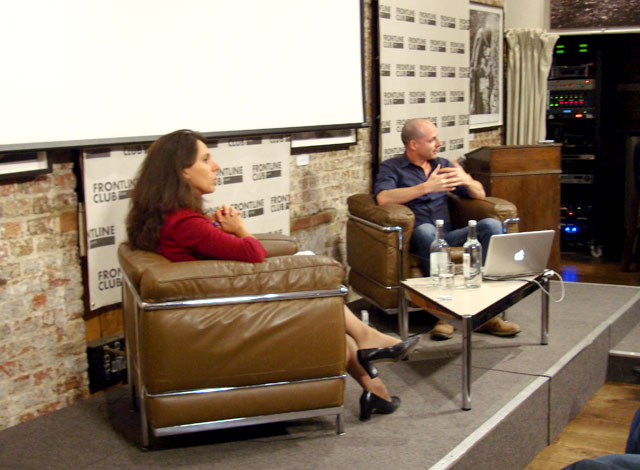
Aiming to dispel the familiar and stereotypical image of refugees living in camps World Press Photo Award winning photographer Andrew McConnell previewed a new body of work about the 50% of refugees now living in cities at the Frontline Club’s, In the Picture: Urban refugees with Andrew McConnell, on September 24.
Taken over the last four months, in seven cities and four continents, with the help of the International Rescue Committee (IRC), McConnell photographed and produced short films about individual refugees in cities such as Nairobi, Bangkok, Kuala Lumpur, Jordan, Port-au-Prince and New York.
Dr Sara Pantuliano, a political scientist and Head of the Humanitarian Policy Group at the Overseas Development Institute (ODI) introduced McConnell and he wasted no time in getting to his motivations behind the project:
"The whole reason for this project is this new phenomenon, that refugees no longer flee to camps, that the old stereotypes don’t really fit anymore. Over half the world’s refugees live in cities. And so what I hope to achieve with the work is to challenge those stereotypes and hopefully present a new way of viewing refugees in the modern world."
Pantuliano asked whether McConnell had any expectations about what he would find when starting the project:
"There were no huge surprises, I found what I suspected I would find. People living in terrible conditions, in very small cramped places, one family in one room … the same things repeated themselves; the same fears, fear of detention, the authorities, afraid to go outside."
The element of fear was not the only similarity that McConnell found between the people he met:
"They had an incredible resilience, they’ve suffered things that you and I can only imagine. That will to survive was there in each and every one of them – they weren’t giving up."
McConnell relayed the stories of the people in his photographs from a lady who had escaped with her family to Burundi from Congo where she had been kidnapped and raped by FDLR or Mai-Mai forces; to Syrians who had fled over the southern border into Jordan after conditions in Homs became unbearable.
He then took the audience through how he tried to convey these people’s stories through his images:
"The whole series was photographed at night time and what I’m really trying to do is give a sense really, how forgotten these people in cities are … They don’t understand what rights they have and so they’re afraid to go outside, they suffer discrimination, it’s hard to find employment and so they often find themselves hidden away."
"We were really here trying to give a sense of the isolation these people feel, coming to a foreign city like this and trying to some how survive."
McConnell has big plans for the project – there will be an exhibition in St Pancras Station in January and after that he hopes to take it to Brussels and New York.
Listen to Andrew McConnell on his photographs:
Listen to Andrew McConnell on why refugees choose cities instead of camps:
]]>