https://soundcloud.com/frontlineclub/in-the-picture-journey-to-the
In late winter 2012, following in the footsteps of Eric Newby, French photographer Frédéric Lagrange journeyed to the foothills of the Hindu Kush, on assignment for Port Magazine. With minimal camera equipment, he made his way to the Wakhan Corridor – in the north-eastern Badakhshan Province of Afghanistan – a thin finger of land reaching eastwards to China, and dividing Tajikistan to the north and Pakistan to the south.
In this isolated and somewhat independent region – known by those who live there as the roof of the world – Lagrange spent a month living with and photographing the Wakhi people, whose lifestyle has changed little in hundreds of years.
Due to their remoteness they avoided much of the terror exercised upon the people of Afghanistan by the Taliban, but now there is a growing anxiety as to what the coming years may hold. With the Nato withdrawal fast approaching, they are recalling the violence that took sway 25 years ago during the two-year Mujahideen presence following the Soviet retreat.
Lagrange will be joining us in a discussion chaired by the The Independent’s defence correspondent, Kim Sengupta and featuring Rory Stewart MP, whose 32-day solo walk across Afghanistan in early 2002 was the basis for his first book, The Places in Between. Lagrange will present his work and they will discuss the fears and concerns he heard from the Wakhi people about the upcoming Nato withdrawal and an uncertain future.

Rob Hornstra and Arnold van Bruggen will also be leading a day-long workshop on independent documentary journalism and self publishing at the Frontline Club on Saturday 2 November. For more information click here.
Photographer Rob Hornstra and writer/filmmaker Arnold van Bruggen have been working together since 2009 to tell the story of Sochi, Russia, the site of the 2014 Winter Olympic Games. Together their images and text reveals a telling portrait of this complex region.
In a talk chaired by BBC Radio Current Affairs presenter Lucy Ash, Rob Hornstra and Arnold van Bruggen will present images from The Sochi Project and speak about the wider Caucasus region and its contrast with the glamour of the Olympic Games. They will also be discussing their approach to self-publishing.
Both based in the Netherlands, they have returned repeatedly to this region as committed practitioners of “slow journalism”. Over four years, they have established a solid foundation of research on, and engagement with, this small yet incredibly complicated corner of the world, documenting changes as it finds itself in the glare of international media.
The Sochi Project is a dynamic mix of documentary photography, film and reportage about a world in flux; a world full of different realities within a small but extraordinary geographic area.

All images © Rob Hornstra, courtesy Flatland Gallery NL|Paris.
]]>https://soundcloud.com/frontlineclub/in-the-picture-brave-new-burma
This event is organised in partnership with the Asia House Festival of Asian Literature.
Twenty years in the making, Nic Dunlop‘s new book Brave New Burma is an intimate portrait of Burma through pictures and words. It takes the reader from the front lines of the ongoing civil war to its deceptively tranquil cities; from the home of Aung San Suu Kyi to the lives of ordinary people and their struggle to survive.
In a talk chaired by BBC foreign correspondent and writer Fergal Keane, Dunlop will present images from Brave New Burma and speak about the changes he has witnessed in the two decades he has covered Myanmar as it opens up to the outside world.
Nic Dunlop is a Bangkok-based photographer and writer represented by Panos Pictures in London. In 1999, he received an award for his discovery and exposure of Pol Pot’s chief executioner Comrade Duch, a story told in his book, The Lost Executioner. Dunlop also co-directed Burma Soldier, an HBO film which was awarded the Grand Jury Prize at the United Nations Association Film Festival and nominated for an Emmy for Outstanding Individual Achievement in Writing.
Picture credit: Burma’s Army © Nic Dunlop/Panos Pictures

 By Sally Ashley-Cound
Wednesday 21st November saw the World Photography Organisation hold the first PhotoTALK event at the Frontline Club; a new series of talks which will take place around the world.
Chaired by Stuart Smith of SMITH design, the panel for PhotoTALK with WPO: The Funding Game consisted of Canadian photographer Donald Weber who recently won first prize in Current Affairs for the 2012 Sony World Photography Awards; World Photography Organisation Academy member photojournalist Carol Allen Storey and World Press Photo winning photojournalist Laura Pannack.
Weber started things off by talking about how applying for grants has changed the way he works:
“It’s turned me into a writer, I certainly wouldn’t call myself a writer but writing about my work has forced me to articulate my ideas in a stronger way… If I’m able to say exactly what I’m doing not only does it allow me to get a grant or apply for a fund but it also allows me to contact a magazine, or a gallery and say this is what I’m doing, this is why I’m doing it and this is why frankly you should be giving me money to go and do it.”
Pannack who has worked with charities such as Save the Children then spoke about making the most of the time that she was given access to people on a trip to South Sudan with Oxfam International
“I knew they were funding my trip so I really wanted to take advantage of it and I really wanted to work with them and just go out there and find more stories. When you’re given that access and given that funding you just have to run with it and be like ‘wow, I’m out here I just have to find everything.’”
Allen Storey, who left her job as Creative Vice-President of Worldwide Marketing for Chanel six years ago to take up a career in photography and now works with NGOs, spoke about how access was the most important thing for her when she was starting out:
“I knew I was going to fund it myself and the most important thing was access so that’s how I got started… I would not have been able to get commissions [with Save the Children and UNICEF] which allows me further access to the kind of work which I want to make without having a portfolio of work showing and illustrating that I’m prepared to bust my ass to go out there and work hard.”
A discussion then stemmed from questions put forward to the panel from the room and on Facebook.
Allen Storey answered the question ‘How do you know who to approach for funding if you’re a fine art photographer?’
“You have to also ask yourself ‘Who else would be interested that I could share this with?’… And that’s really important because at the end of the day publishers will say to you…’Who is going to buy this book?’…How you approach that, how you put your body of work together, how you organise it and the story behind it is all part of how you’re going to position it and get it out there. The most important thing to have in your own mind when you’re talking to people… is that they’re going to ask you ‘Why should I support this project?’ And you should be able to respond to that in a very sincere and convincing way.”
But there are less structured routes to funding, as Weber found whilst on an expenses only trip to Kosovo in 2009 with the Organisation for Co-oporation and Security in Europe:
“It was a six week assignment to go and photograph the first independent elections of Kosovo…’We’ll pay for your flight, you’re food’ that’s essentially all it was. I still wanted to do it because I wanted to go to Kosovo…but I needed to find a way to make a little bit of money. I was driving by [the National Library of Pristina] and thought that’s an archive, this is a brand new country, what’s the point of an archive, it’s about history… So I went in there, I said this is who I am, this is what I’m doing, this is what the project’s about. I’d made some cheap prints at the local print shop and gave it to them and said you guys should really own this because this is a part of Kosovar history… I ended up selling 12 pictures.”
Pannack:
]]>“I think that for me defines funding…I don’t think there’s an answer to funding. As photographers, if we want to shoot something we’re going to go and shoot it and we’ll find the money, we’ll work in a bar or do what ever we want to do. I think what Donald is saying is that he used his initiative. He looked at the main question: who does this interest? Who is this going to benefit? Is it going to benefit a museum, is it going to benefit a world organization, is it going to benefit a major brand and then approaching those people and saying ‘look, I have something that you might want and I need some dollar to pay my rent right now so lets do an exchange.”
Encompassing powerful images from the 1956 Hungarian Uprising to the recent Arab Spring, Magnum Revolution: 65 Years of Fighting for Freedom brings together hundreds of photographs from Magnum members depicting historic events. To mark the recent release, Magnum photographers Ian Berry and Peter Marlow will speak about their careers and experiences photographing war and peace with the book’s co-author, Jon Lee Anderson.
Chaired by Monica Allende, picture editor of the Sunday Times Magazine.
Ian Berry cut his teeth photographing South Africa during apartheid and in 1964 moved to London to become the first contract photographer for the Observer Magazine. He joined Magnum in 1962 and documented Russia’s invasion of Czechoslovakia; conflicts in Israel, Ireland, Vietnam and Congo and famine in Ethiopia for a wide range of publications.
Peter Marlow covered Lebanon and Northern Ireland as a news photographer in the late 1970s for the Paris-based Sygma agency. After joining Magnum in 1980, Marlow developed his photography away from war zones, by focusing first on Liverpool and later on Amiens.
Jon Lee Anderson is foreign correspondent for The New Yorker, and is the author of many books including The Fall of Baghdad.
Copies of Magnum Revolution: 65 Years of Fighting for Freedom will be on sale at a special discounted price of £30 on the night and the speakers will be available for a signing after the talk, with complimentary drinks made available courtesy of Prestel.
]]>After three years focusing on the drug related violence destabilising Mexico, photographer and anthropologist Teun Voeten has just released his latest photobook Narco Estado. Voeten photographed the drug violence capital, Ciudad Juarez, as well as other hot spots such as Culiacan and Michoacan.
Voeten will present his images and speak about the collaborative and anthropological approach he adopted for the book, using introductory essays by El Paso based anthropologist Howard Campbell as well as Culiacan based writer Javier Valdez Cardenas. Voeten‘s images and the text combine to achieve a punchy work which tries to explain why the drug violence in Mexico can no longer be ignored as a fringe criminal problem.
This event will be moderated by Peter Watt, Lecturer in Hispanic Studies at the University of Sheffield. He is co-author of Drug War Mexico: Politics, Violence and Neoliberalism in the New Narcoeconomy, published earlier this year by Zed Books.
Teun Voeten has covered the conflicts in the Former Yugoslavia, Colombia, Rwanda, Sudan, Sierra Leone, Liberia, Afghanistan, Iraq, Lebanon, Gaza, Honduras, DR Congo and Libya for magazines such as Vanity Fair, Newsweek, The New Yorker and National Geographic. He has also worked for the International Red Cross, Human Rights Watch and the UNHCR. He gave a talk at the Frontline Club in 2010 about his book Tunnel People, a journalistic and anthropological account of five months living with an underground homeless community in New York.
Narco Estado is available to purchase online via Teun Voeten’s website.
]]>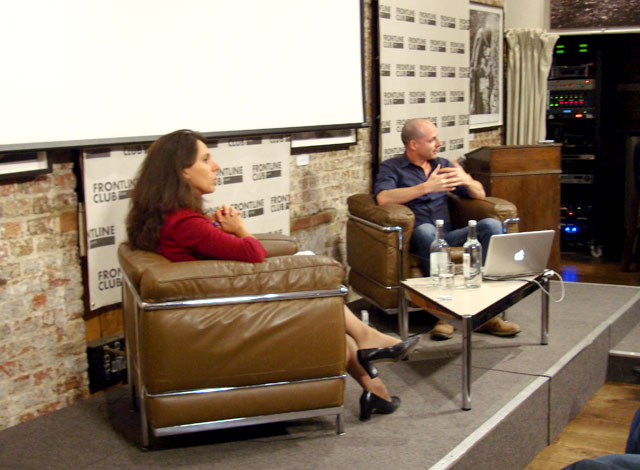
Aiming to dispel the familiar and stereotypical image of refugees living in camps World Press Photo Award winning photographer Andrew McConnell previewed a new body of work about the 50% of refugees now living in cities at the Frontline Club’s, In the Picture: Urban refugees with Andrew McConnell, on September 24.
Taken over the last four months, in seven cities and four continents, with the help of the International Rescue Committee (IRC), McConnell photographed and produced short films about individual refugees in cities such as Nairobi, Bangkok, Kuala Lumpur, Jordan, Port-au-Prince and New York.
Dr Sara Pantuliano, a political scientist and Head of the Humanitarian Policy Group at the Overseas Development Institute (ODI) introduced McConnell and he wasted no time in getting to his motivations behind the project:
"The whole reason for this project is this new phenomenon, that refugees no longer flee to camps, that the old stereotypes don’t really fit anymore. Over half the world’s refugees live in cities. And so what I hope to achieve with the work is to challenge those stereotypes and hopefully present a new way of viewing refugees in the modern world."
Pantuliano asked whether McConnell had any expectations about what he would find when starting the project:
"There were no huge surprises, I found what I suspected I would find. People living in terrible conditions, in very small cramped places, one family in one room … the same things repeated themselves; the same fears, fear of detention, the authorities, afraid to go outside."
The element of fear was not the only similarity that McConnell found between the people he met:
"They had an incredible resilience, they’ve suffered things that you and I can only imagine. That will to survive was there in each and every one of them – they weren’t giving up."
McConnell relayed the stories of the people in his photographs from a lady who had escaped with her family to Burundi from Congo where she had been kidnapped and raped by FDLR or Mai-Mai forces; to Syrians who had fled over the southern border into Jordan after conditions in Homs became unbearable.
He then took the audience through how he tried to convey these people’s stories through his images:
"The whole series was photographed at night time and what I’m really trying to do is give a sense really, how forgotten these people in cities are … They don’t understand what rights they have and so they’re afraid to go outside, they suffer discrimination, it’s hard to find employment and so they often find themselves hidden away."
"We were really here trying to give a sense of the isolation these people feel, coming to a foreign city like this and trying to some how survive."
McConnell has big plans for the project – there will be an exhibition in St Pancras Station in January and after that he hopes to take it to Brussels and New York.
Listen to Andrew McConnell on his photographs:
Listen to Andrew McConnell on why refugees choose cities instead of camps:
]]>
As urbanisation reshapes much of the world, refugees are increasingly moving to built up areas, including large towns and cities. Working with the International Rescue Committee and the European Commission’s humanitarian aid and civil protection department ECHO in eight cities across four continents, Panos Pictures photographer Andrew McConnell has spent many months documenting the new reality for refugees. Through images, refugee testimonies and video, the resulting body of work presents a unique insight into the lives of urban refugees today and challenges commonly held stereotypes. From Somali refugees in Nairobi to Syrian refugees in north Jordan, and from Burmese refugees in Kuala Lumpur to Afghani refugees in New York, the story of where people flee when all is lost is changing.
McConnell will present his work at the Frontline Club in an event moderated by Dr Sara Pantuliano, Head of the Humanitarian Policy Group at the Overseas Development Institute (ODI).
Andrew McConnell began his career covering the end of the conflict in his home country Ireland, before venturing overseas to document social issues around the world. McConnell‘s work has been published and exhibited internationally, appearing in National Geographic Magazine, Time Magazine, The New York Times, The Guardian, FT Magazine, Vanity Fair, the Sunday Times Magazine and Der Spiegel among other publications. In 2011, he won two 1st prizes at World Press Photo Awards and two National Press Photographers Awards, including the prestigious Best of Show.
Dr Sara Pantuliano is a political scientist with more than 20 years’ experience in conflict and post-conflict contexts. Prior to joining ODI, Pantuliano led UNDP Sudan’s Peace Building Unit. She has written extensively on Sudan and is a regular media commentator on Sudan and humanitarian issues. Pantuliano is the Managing Editor of Disasters, the leading peer-reviewed journal in the field of natural catastrophes and man-made disasters, anda member of the World Economic Forum’s Global Agenda Council on Catastrophic Risk.
]]>“I wanted to show the range that photojournalists do, and I wanted to somehow grasp the idea that they could be doing a basketball game in the afternoon and going to Haiti that night. I think it’s one of the most remarkable things that these people are able to do so many things and do them so well.”
In Deadline Every Second, director Kenneth Kobre did exactly that. Following 12 photographers from the Associated Press, Kobre captures the working lives of those journalists on assignment in locations across the world, from Downing Street to Gaza. Lefteris Pitarakis, one of those featured in the documentary, joined Kenneth at the Frontline Club for a screening of the film and a Q&A session on 21 September.
The wide ranging discussion with the audience opened with AP photographer Pitarakis defending the emergence of citizen journalism:
“It’s great if everyone’s able to take pictures on the spot and report what he or she sees especially local people in areas where I can’t go, then it’s great for all of us. The mainstream media has very strict ethical rules about how we validate the work and make sure the truth is there so there are some issues that have to be addressed every time.”
Kobre added that professionals always bring a different perspective to a story and produce quality work:
“During the Arab Spring, the first pictures out were those citizen journalist pictures but very soon afterwards you saw the professionals start to arrive and the quality of the photos improved immensely. Photojournalists see the world in a very different way than an amateur sees the world and even if the equipment is the same, the pictures are rarely the same.”
The discussion then touched on technological developments and their impact on the profession. Pitarakis acknowledged the benefits and the downsides of digital technology and rolling news coverage:
“For me the most important thing is that I’m able to stay in a place for longer … because I have a satellite modem and I can send my pictures right there. Sometimes it causes trouble because of the volume of pictures. Personally it causes me overload and I over work. I’m lucky if I sleep three hours.”
Turning to a question on the power of photography, Kobre stressed the cumulative impact of a series of photographs.
]]>“No single picture changes history. A picture doesn’t end a war, but they start to add together. They are used over and over again and become burned in to our minds. I can’t point to any picture that’s changed history recently except for one and that’s the one in Somalia, with the dead soldier being dragged, Black Hawk Down. That caused Clinton to have a fear of that ever happening again and when Rwanda occurred he didn’t send in American troops in part, they say, because he feared that kind of publicity. But short of that I don’t think individual pictures do, it’s like drops of water that add up.”
Picture credit: Andrew McConnell / Panos Pictures / IRC UK
As urbanisation reshapes much of the world, refugees are increasingly moving to built up areas, including large towns and cities. Working with the International Rescue Committee and the European Commission’s humanitarian aid and civil protection department ECHO in eight cities across four continents, Panos Pictures photographer Andrew McConnell has spent many months documenting the new reality for refugees. Through images, refugee testimonies and video, the resulting body of work presents a unique insight into the lives of urban refugees today and challenges commonly held stereotypes. From Somali refugees in Nairobi to Syrian refugees in north Jordan, and from Burmese refugees in Kuala Lumpur to Afghani refugees in New York, the story of where people flee when all is lost is changing.
McConnell will present his work at the Frontline Club in an event moderated by Dr Sara Pantuliano, Head of the Humanitarian Policy Group at the Overseas Development Institute (ODI).
Andrew McConnell began his career covering the end of the conflict in his home country Ireland, before venturing overseas to document social issues around the world. McConnell‘s work has been published and exhibited internationally, appearing in National Geographic Magazine, Time Magazine, The New York Times, The Guardian, FT Magazine, Vanity Fair, the Sunday Times Magazine and Der Spiegel among other publications. In 2011, he won two 1st prizes at World Press Photo Awards and two National Press Photographers Awards, including the prestigious Best of Show.
Dr Sara Pantuliano is a political scientist with more than 20 years’ experience in conflict and post-conflict contexts. Prior to joining ODI, Pantuliano led UNDP Sudan’s Peace Building Unit. She has written extensively on Sudan and is a regular media commentator on Sudan and humanitarian issues. Pantuliano is the Managing Editor of Disasters, the leading peer-reviewed journal in the field of natural catastrophes and man-made disasters, anda member of the World Economic Forum’s Global Agenda Council on Catastrophic Risk.
]]>