A packed audience filled the Frontline Club forum on 23rd October to hear a panel tackle the question: In whose hands should internet governance be entrusted? Chaired by the Chief Executive of Index on Censorship Kirsty Hughes the event, in association with BBC Arabic, featured: Icelandic MP Birgitta Jónsdóttir; developer for The Tor Project, Jacob Appelbaum; independent media technology consultant, Karl Kathuria and director at the Cyber Security Centre Dr Ian Brown.
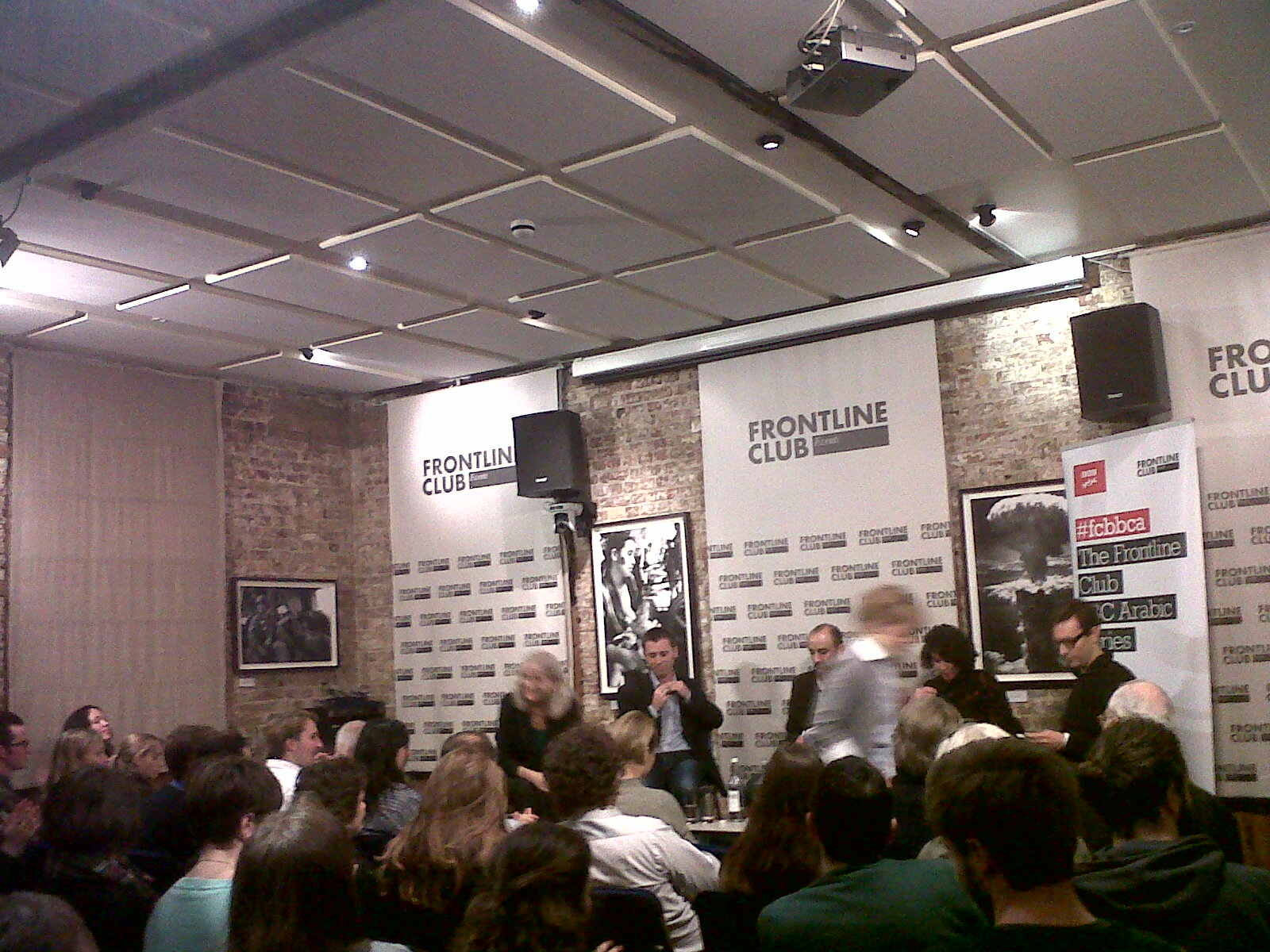
Dr Ian Brown kicked off proceedings by describing the distribution of power over cyberspace. Referring particularly to ICANN (Internet Corporation for Assigned Names and Numbers) which runs the international domain name system and although it is a “international facing” it is governed by US laws.
“Is it fair that this one powerful country the US should have such say over something that is a global resource?… Since so many large internet companies; the Googles, the Facebooks, the Twitters and so on, that are becoming increasingly important in internet governance debates, are headquartered in the US or at the very least have significant exposure to the US, and US law and case law has very firmly said that the behaviour of companies… with any assets exposed to the US had better watch out when it comes to their behaviour elsewhere in the world because there have been a number of US laws applied to the behaviour of these companies elsewhere in the world”
Karl Kathuria then moved on to discuss the censorship of information by governments from a more optimistic viewpoint, describing his time at the BBC on access to users in Iran and China:
“People were still able to get access to that content anyway, people are always looking for the content… its average everyday people who are reaching out.”
Birgitta Jónsdóttir has misgivings on calls for further global internet governance:
“Shouldn’t we have a global freedom of information act?… it is impossible… it would destroy the internet as it is today… maybe we need to start to look at this differently.”
Jacob Appelbaum, a core member of the anti snooping software Tor described the rise of cyber snooping and the oppression it can bring:
“Surveillance is a support system for violence.”
“What we see is a massive expansion of authoritarianism across the globe, even in so called free countries… the mere fact that it has gone so far and the American government has become so brazen.. is an incredibly bad sign, because in a lot of ways the US has led the world in these matters.”
“Freedom from suspicion is part of the necessity for feeling free… we should look at Facebook as stasi-book, and we should look at human data as human data-traffic. It is not a problem of over there-istan, it is a problem over here.”
Birgitta Jónsdóttir discussed the Iceland Modern Media Initiative as a solution to internet governance and excessive cyber snooping, and its uptake by the Icelandic Government to turn Iceland into a “safe haven” for freedom of information.
“Take the same concept as if you were to create a tax haven, so why not create the same for a freedom of expression and speech haven… if you have one country that sets the standard [other countries will rise to it]. I have a dream for a ‘Scandinavian Shield’… as the Scandinavian countries now have a good idea of the importance of these rights to bring the laws into the 21st century.”
Dr Ian Brown finished on a note about public uptake of new technology that can divert around any governmental snooping, “encouraging people to use the tools that already exist is the first step”.
View reaction to the debate on Twitter: #fcbbca, or watch the debate as it happened below.
]]>How to send stories by carrier pigeon, when to run when you are under fire and the best way to brush off tweets were amongst titbits of information from Alan Cowell’s discussion of his new book ‘The Paris Correspondent.’
Cowell has long been a correspondent with the New York Times, and before that worked for Reuters. This is his third book.
In discussion with Charles Glass, freelance writer and former chief Middle East correspondent with ABC News in Beirut, Cowell says that reporting and producing news has changed for good. The book’s two male protagonists grapple with the fast pace of this change in the news industry. Cowell reads an excerpt:
“News men and newswomen were going down with the ships on which they had once sailed the kindly oceans of expense account lunches, five-star hotels and mortal peril. Print, that great, gorgeous messy alchemy of ink and hot type and whirring reals of paper and working stiffs in stained overalls was expiring, but not quite finished.”
And as Cowell suggests, there is no reason not to reminisce a little about how things used to be:
“I remember in N’Djamena I was doing an interview with [President] Goukouni Oueddei… you had to go across the river to Cameroon to be able to find a phone… and on the bar there, there was a direct dial telephone… located next to an ice bucket where there was always a fresh bottle of champagne…”
“And there was also a curfew… and you had to be poled across the Chari River in a dugout canoe. And I remember saying to President Oueddei, “I’m sorry I’m going to have to cut this short because I have to catch the last pirogue before curfew.”
Those times have gone, says Cowell:
“If you say ‘Is that a more pleasant way of earning a living than slaving over a computer screen all day trying to bat off tweets like mosquitoes?’ Then yes, sure. But we can’t turn the clock back and what we have to do now is… bringing the standards and the values that have always made newspapers sell, into this new era.”
It was in Zimbabwe reporting shortly before independence, that Cowel was able to hone his carrier pigeon sending techniques. With no way to send his stories back he was given a huddle of “cooing carrier pigeons” by the last white mayor of Bulawayo and the last editor of the Bulawayo chronicle.
“…we didn’t know exactly how we were supposed to cope with them and he said look, Sid said “you hold the birds legs between those fingers, you put your thumb over the neck, you give it a little kiss and whisper something nice to it, then you loft it up to the air… And you write the story on a 30 packet of Madison cigarettes – there was a small bit of tissue paper inside and you could write 400 words of spidery script on it.
It is hard to avoid the feeling that news has definitely changed.
]]>The screening of Afghan Army girls ended with a roaring sound of applause at the Frontline Club yesterday evening. Lalage Snow, also a photojournalist, made her directing debut with a film beautifully weaved in stills and moving images to showcase the lives of women preparing for a life in the Afghan national army.
Focussing on the lives of three girls training in the army, Samiya, Homa and Zeinab, the film captured their individual personalities, following them on a ten week training course to an isolated military base in Kabul and into some of their homes.
Anyone who is remotely familiar with Afghan news and culture would know that staying away from home is taboo for women, and that this is a big step forward.
One member of the audience questioned if and whether this has had any impact.
Snow said,
“Lets not forget before the occupation of the Taliban, the Afghans used to employ at least 4,000 women in the army. Of course all this has been superimposed by ISAF and NATO lately in an effort to empower the women and the country.
All the training and classes take place in a compound. About the impact – I really don’t have much of an idea now. Of course there are higher generals who are women but they still need to develop a better sense of authority without being trampled over by their male peers.”
Many were curious to know about the reactions from fellow Afghan countrymen and women. Snow said:
“In Afghanistan, not many women are aware that women are being recruited for the armed forces. There is not much publicity about it. Not sure if this is a move by ISAF and NATO to superimpose women’s rights on top of the agenda. Female soldiers are being recruited for the army and the police force to conduct searches.”
She added
“Can’t speak for all but many of the men-folk are progressive and want a future that is sustainable. They want peace and stability.”
While the film tackled many aspects of being a woman in the armed forces, many were still looking for answers as to what would happen when the international troops pull out.
Snow said:
“Well it is a mixed response; I have argued this over and over with my friends. Many think they would like the foreign forces to leave. Others think there is just going to be a civil war if that happens.”
One audience member had the room in hysterics asking, “So can the women shoot?” To which Snow replied, jokingly “No.”
As seen in the film, after graduation, no-one made it to the Afghan Air Force. “All of them were extremely proud and happy to have undergone this training except for one, Samiya,” said Snow.
]]>With over one hundred million ‘views’ the Kony 2012 video has started a far-reaching debate on the aims and value of a production seen by many as an over-simplification of complex situation.
Produced by the NGO ‘Invisible children’, the video calls for military intervention to “stop Kony and disarm the LRA”.
Host Paddy O’Connell of BBC Radio 4’s Broadcasting House was on the hunt for controversy – which is exactly what he found.
Perhaps the most scathing comments on the video came from film-maker and journalist Callum Macrae.
“Low and behold the world has paid attention and I’m hating every minute of it… This is a dreadful, I’m afraid, campaign. But nonetheless very important and we need to discuss it.”
Macrae says the unwavering focus on Joseph Kony puts him ill at ease.
“We shouldn’t be lowering ourselves to the level of Kony or the people who see him as an African bogeyman, we should be looking at the issues that are raised by it.”
Mareike Schomerus, of LSE’s Justice and Security Research Programme agreed that focusing entirely on Kony is a dangerous simplification.
“If you go into LRA controlled areas and actually stay there it becomes clear that the situation is actually much more complex than elevating just one man to the position of superpower…
When I talk, especially to military men,… and I say to them ‘do you honestly really believe that that one man can be responsible for messing about… 5 national armies and 3 UN missions and the US army, and the French army and sometimes the Israeli army.”
Programmes Director for the charity War Child, Amanda Weisbaum also casts a critical eye on the content of the video.
“They did 30 minutes of filming and they didn’t really do any history surrounding it or any complexities surrounding it… but yes I would have loved the 100 million hits”
But how then do people kindle an interest for African issues? Asks Benjamin Chesterton of production company DuckRabbit.
“Do you think we all start with PHDs?… we have to start somewhere… a percentage of [these people that watched the video] will go away and find out more… and maybe do something more than sitting around debating it.”
Poet and musician of Ugandan descent, Musa Okwonga rejects this out of hand.
“It’s utterly patronising to say that children can’t handle complexity… people followed complex narratives involving multiple characters over seven books with Harry Potter”
The idea put forward by the video that military intervention is the only solution held no water for the panel.
“The lessons of history” says Macrae, “are that it’s always gone wrong; it’s always scatter gun and it’s always brought more havoc”
Watch the full event here:
]]>The post-screening Question and Answer session with Al-Jazeera Executive producer Jon Blair was covered live by Thomas Lowe.
You can read through by clicking below.
]]>By Thomas Lowe
It could have made no sense.
But with a gently-gently approach to explaining new apps and why they exist, the gap between the journo geeks and the journo technophobes was momentarily bridged – with a little help from the BBC’s technology correspondent Rory Cellan-Jones.
Empowerment:
Former photographer for the dailies, Christian Payne, went on vacation in 2005 to spend time with the Kurdish Peshmerga. Here he says how new technology at the time allowed him to “bypass the mainstream media.”
“I was a photographer for the dailies and I got frustrated with the amount of editors between my images and the final piece of work. So I decided to go to Iraq for a holiday.
“Every time I was blindfolded and taken to a new place I would look down and write secret base 1… I had a dumb phone, but by texting my coordinates home I knew that my last position would always be noted.”
So, technology can empower journalists in far off places where it can provide some form of security. But what about when it comes to daily, non-stop use of social media? Tom Barfield, site editor and community manager at Demotix, a citizen journalism new wire, says new technology is a journalist’s bread and butter:
“I think this is absolutely what [they] should be doing and what [they] have always done is develop contacts and developed relationships and trusted sources of information.”
Yet apps, and the technology that goes with them, are not just the preserve of journalists. Ryan Schlief, program manager for Witness says the important issue is practical application:
“it’s not about hi-fi or low-fi, it’s about ‘wow’ this is a really great tool that’s going to help someone out with the specific purpose they have in mind.”
He nodded to an example in Cairo where Witness trained some members of a community living in a slum there how to use cameras. This, he says, allowed them to take their message “into their own hands.”
Privacy:
The panel agreed on the need to protect sensitive or personal information. Payne says risks come with the benefits of using new methods of communication:
“I think technology’s moving faster than peoples’ awareness of how valuable and dangerous it can be… It only took the regime in Syria to upload pictures of protestors on Facebook for people to start tagging their friends.”
Sam Carlisle, developer of the Sukey app, a tool for protestors following demonstrations in real time, says the basic fault lies with the phone manufacturers:
“The makers of these [phone] devices haven’t necessarily considered your privacy or empowerment through setting up their devices – it’s not a concern for them.”
“They want to create profit… It’s really people jail-breaking and working to create after-market community tools that are allowing you to do something different with the platform other than what it was originally created for.”
Luddites:
To the question you can always rely on: whereto for professional journalists in these hyper-connected times? Payne again:
“…If they can’t get their stories out there quicker than the man on the street… with their phone in their pocket, they should be sitting to receive it going “ok, let’s do something long form around it and let’s add some credibility to [it].”
A positive note to end on with no mention of the moderator’s famous pink socks.
]]>In association with BBC College of Journalism
Governments and security forces are becoming increasingly wise to the role of social media in organising and enhancing protest movements. As a result they are developing new ways to block, hack and track citizens tweets, Facebook and other social media tools in order to prevent unrest.
Protesters and citizen journalists the world over are able to stay one step ahead, however with the help of Open Source developed phone apps that allow them to communicate effectively without being tracked as easily. From letting friends know if you’ve been arrested to getting your story public, there is an app for all possible situations.
ObscuraCam, a collaborative project between Witness and technology-focused activists, has developed a camera app for Android phones. It allows the user to share video and images without it being tracked back to them through data embedded into the file, whilst detecting and obscuring faces. Protestors can now safely share information without fear of identification.
But will apps really protect protesters, and are they any safer than traditional social media? What do mobile apps mean for citizen journalism? Join us at the Frontline Club for a lively debate about the latest technology for protesters and citizen journalists and how far technology could go in making protest safer and smarter.
Chaired by Rory Cellan-Jones, BBC’s technology correspondent and author of the blog, dot.rory. (@BBCRoryCJ)
With:
Christian Payne, mobile media maker and professional blogger. He champions story making with mobile devices and explores new social media and its applications. He can also be found speaking internationally on technology and lecturing MA journalism students at Goldsmiths. (@documentally)
Sam Carlisle, entrepreneur, hacker and developer of the Sukey mobile app that crowdsources information during demonstrations onto a map, allowing protestors to stay safe and one step ahead.(@samthetechie)
Tom Barfield, site editor and community manager at Demotix, the crowdsourced photojournalism wire. He’s a linguist, sci-fi and technology lover and something of a news junkie. (@tombarfield)
Ryan Schlief, programe manager at Witness. An international nonprofit organisation that uses video and storytelling to inform the world of human rights abuses. They are also one half of the Obscuracam collaboration. (@witnessryan)
Image Credit: The Guardian Project
]]>“’It came out of nowhere because of Facebook and Google’ is not true. It was a long time coming.”
So said Marwan Bishara, Al Jazeera English’s senior political analyst and author of ‘The Invisible Arab: The promise and peril of the Arab revolution.’
In conversation with the BBC presenter and special correspondent Lyse Doucet, Bishara discussed his new book which challenges the mainstream media’s portrayal of the 2011 uprisings in the Arab world as a series of spontaneous acts sparked by the self-immolation of a Tunisian fruit vendor.
“Social media was very important, but not the reason for the revolution. [The reason] is the young people with a history of struggle.”
“These regions were open to democracy – they were only stopped because of politics and dictators,”
Bishara’s view is that the West has, until recently, perceived Arab nations as ‘invisible’ and so been unaware of the struggle that has been building up for a number of years.
“First, the inside struggle was made invisible from the rest of society by dictators who made sure those who wanted to say something could not say it. People were imprisoned, tortured, censored, kept away from the media – even sent into exile or to their death.
“Outside, they were made invisible by a media paradigm – [they were seen as] a threat to energy security, a threat to Israeli security, and a threat to national security.”
These feelings are historical, deep-rooted and inevitable, he said.
“There was a massive demand for radical change, and a break from the past was indispensable. It was a collective break that is psychological, political and mental.”
But he warned that the struggle has a long way to go yet, despite much of the western media drawing its attention away from the events which continue to unfold in the ‘Arab Spring’ countries. Predicting more violence to come, he emphasised that these revolutions do not have a specific timeline and it was impossible to tell when they would be over. But he said that he is optimistic, as this young generation has embraced pluralism.
“Arabs know their future is going to look nothing like the past. They have one foot in the past and one foot in the future.
“I see a lot of violence coming our way. But Yemenis, Egyptians, Tunisians… they want to be funny, they want to be creative, they want to be non-violent, they want to be girls and boys together in a revolution. It’s miraculous. They are the miracle generation.”
“A lot of us project the view on these revolutions, asking ‘where is the democracy?’” he added.
“It will come as it comes. We have to take them as they are. I am at least optimistic that we are breaking from the past. There are perils and pitfalls – it’s up to this new generation to move their society on the right track.”
Watch the whole event here:
]]>By Alan Selby
The advent of new media has seen an increasing pressure placed upon journalists to become multidisciplinary, but often to the detriment of each medium. During an evening moderated by David Campany, reader in photography at Westminster University, writer A. A. Gill and photographer Tom Craig mounted an impassioned defence of collaborations between photographers and writers. The duo were speaking in the lead up to a new exhibition of their work, a collection of 20 of Craig’s unseen photographs accompanied by text from Gill, which is opening at the Flaere Gallery in March.
The audience were guided through an eclectic series of images from Gill and Craig’s travels, which have taken them from the blistering heat of Chad to the freezing depths of the Arctic. As their presentation began, Craig explained that his dissatisfaction with the news media was a driving force behind their collaboration:
“I was becoming disillusioned with the imagery that I was seeing appearing in the news and feature print media. The reason for that was I felt increasingly individual photographers were going to places with very specific agendas. They had a photograph in mind before they even got there… I think it’s a dangerous place to be in, because it represents a place where it’s very difficult to be impartial.”
Discussing the unique marriage of text and imagery that the pair have produced, Craig added:
“I believe that the power of the image and the written word are great on their own, but they’re a lot greater when they’re combined… I’m at an advantage, I can tell the quieter story because I know there are other things that will be said about it.”
Craig provided the foil to Gill’s inimitable sense of humour throughout the evening and, despite claiming that Craig’s interests amounted to taking photographs of people taking photographs, and of the backs of people’s heads, Gill praised his approach:
“What you want is a photographer who’s aware of himself, and aware of changing the dynamic he is in. Tom does that, he’s very sensitive.”
In response to questions from the floor, the pair discussed how they first met on assignment in Chad, and how they approach the assignments that they undertake. As the proceedings reached their conclusion, Gill offered up his own evaluation of their work together:
“What we do gets rarer and rarer, because a lot of journalists now are expected to take their own pictures. A lot of us are expected to have phones that can take print ready pictures. Then there’s everything that’s happening on the internet: everybody is a photographer, and everybody is a journalist. What you have is this babel of karaoke news. I feel like we’re a Farrier and a Thatcher, we’re doing two jobs that are from the last century, but that’s what we do, and we do it well. When we do it well I don’t think there’s anything else that can touch it.”
Watch the event here:
]]>In conversation with Vin Ray, Matt Frei let us into the deepest, darkest and funniest recesses of his journalistic mind. Here is his advice for putting together a good story for television.
1. Pictures
Writing well for TV is quite simple, Frei says. The lesson is just to “get out of the way” of the images or the sound:
“It’s kind of a nerdy thing to say but if you’re doing television writing you’ve got to look at the pictures – they won’t tell you what points to make but they’ll confine what you can say.”
Frei says that former BBC correspondent Martin Bell is the ‘go to’ man on writing:
“Martin would look at [the shots] and pace up and down… then out would come twelve seconds of words followed by the sound of a dog barking or a shell going off.”
2. Immediacy
For Frei, the carefully managed journalism event comes as a distant second to the immediate.
A piece to camera by ITVs John Irvine standing on a road in Baghdad as US army trucks scrape by him at high speed is a good example.
“It’s not a kind of standard piece to camera where I’m standing here for thirty seconds telling you what I think this is all about… [John Irvine] writes simply – it’s the light touch.”
And in carefully orchestrated Washington, where Frei works at the moment as correspondent with Channel 4 News:
“These unscripted moments, they’re gold dust.”
3. Humour
In the same way that Frei’s chuckling asides gave this discussion momentum, he says that laughter can be great for telling stories:
“There’s a lot of funny stuff out there and if you don’t use it you’re missing a trick.”
4. Detail
Noticing small, hidden things can bring a difficult story to life.
In South Korea, where the economic crisis had a huge impact on the personal lives of people made redundant, was a bridge that people jumped off to commit suicide. But how do you tell the story with no obvious pictures?
The authorities had put grease up the bridge to stop people climbing up, but slip marks showed that not everyone had been put off trying to reach the top:
“You’re not going to get someone jumping off a bridge and going to funerals isn’t going to do it either, so you have to find something that works… in that little scratch signature in the grease you can see the agony, you can imagine what was going through his mind… it’s a little glimpse in that detail into the desperation that makes people do something like this.”
5. Interviews
In America, Frei says that getting people to talk isn’t hard, but he concedes that interviewing well is a tricky business, albeit one with a simple solution:
“My policy is to start off with a big fat smile and just try and disarm the situation by being unthreatening – then go for it afterwards”
Watch the full event here:
]]>