]]>“Nur Muse Hussein paid greatly for his dedication to journalistic profession. Today is another unforgettable and sad day for Somali journalists community,” Omar Faruk Osman, NUSOJ Secretary General.
“Nur is the fourth journalist that became victim in this year for the crimes committed by the gun carrying men in Somalia. The death of Nur Muse Hussein highlights the unacceptable, continuing and deliberate violence against journalists in Somalia”.
Nur Muse Hussein left 5 children and a widow. link
He was killed as he was crossing the road at Wardhigley police station, according to Director of Radio Shabelle Mukhtar Mohamed Hirabe. Abdirisak was on his way to Radio Shabelle when bullets hit him at the chest. His body was laying on the road for about 45 minutes as the militias was shooting every one that wanted to take his body. In June 2008, Abdirisak Warsameh Mohamed was one of 48 Somali journalists that received safety training in Djibouti from NUSOJ and the International News Safety Institute (INSI). link
The editor at Radio Shabelle confirmed the death of Abdirisak to the AFP,
]]>The editor of Radio Shabelle said one of its journalists was killed as he tried to flee the fighting.
“His relatives have confirmed to us that he was crossing a road to escape the fighting when he was caught in the crossfire. He died instantly,” said Abdirahman Yusuf. link
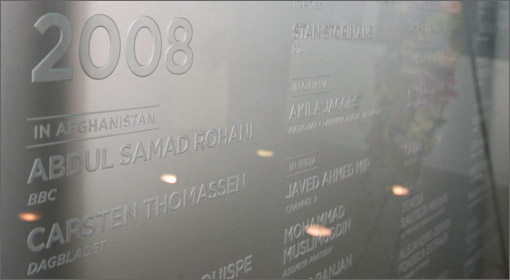
The names of 62 journalists killed in 2008 and 15 killed in previous years have been added to a memorial wall at the Newseum in Washington D.C. that honours journalists killed doing the job of journalism. Iraq and Mexico were the deadliest places for journalists last year. 13 names from Iraq were added to the wall and 5 from Mexico, including El Diario newspaper reporter Armando Rodriguez who was gunned down as he took is daughter to school,
"These are not long ago and far away events," [said Alberto Ibarguen, the Newseum’s chairman, and president and CEO of the John S. and James L. Knight Foundation and a former publisher of The Miami Herald.] "The story they’re covering in Mexico is a story of drugs and corruption and guns… These murders strike at the heart of democracy by silencing speech and by depriving a community of the information it needs to conduct its affairs." link
Photo by AP Photo/J. Scott Applewhite
]]>Unidentified armed men on Thursday night killed Raja Asad Hameed, senior reporter of a local English daily. The incident took place at 10pm, when the armed men came to Hameed’s house and rang the doorbell. When he opened the door, the men shot and killed him. A large number of journalists from Islamabad and Rawalpindi rushed to the Central Hospital and took Hameed’s body to his residence. link
UPDATE: The Crime Investigation Agency (CIA) and Sadiqabad Police have launched an investigation into the murder.
“The crime scene has been properly preserved with footage and drafting and police have also recorded statements of some eye-witnesses,” they said.
“Hameed’s mobile phone data of two hours before his killing has been also collected through mobile detection system and if investigators failed to establish any link with the culprits with the help of this data they would compile a comprehensive investigation record of last 48 days including mobile phone calls and his routine life to trace the culprits,” said the sources. link
Journalist murder cases are rarely solved in Pakistan and concerns were recently raised as to the worsening situation for journalists in the country. Meanwhile Prime Minister Yousuf Raza Gilani announced a donation of 0.5 million rupees to the family of Hameed.
]]>]]>The BBC failed my sister, then subjected us to years of anguish in an effort to hide the facts – and now they are escaping press scrutiny.
Since the murder of my sister, BBC senior producer Kate Peyton, in Mogadishu in February 2005, the behaviour of her employer towards her family has been increasingly evasive and vindictive. The Corporation struggled to eliminate consideration of its own actions from the coroner’s inquest two weeks ago, withheld crucial evidence until the very last minute, and even now is busy misrepresenting the coroner’s findings. And so far they seem to be getting away with it.


Kate was shot in the back by a passing gunman on the day of her arrival in Mogadishu. She was supposed to be producing some stories with a colleague, Peter Greste. It was the first time they had worked together, and neither had ever worked in Somalia. Despite initial reports that her injury wasn’t life-threatening, Kate died from internal bleeding hours after reaching hospital. She was 39.


Sadly, the coroner was not able to hear the testimony of journalists with specialist knowledge of Somalia, like Aidan Hartley, who has filmed in Mogadishu for Channel 4’s Unreported World strand. Kate had four days to decide to accept the trip and complete the risk assessment process and logistical arrangements. Hartley says that he spends ‘literally months’ planning a trip to Mogadishu: ‘You can’t just go charging in there’. We spoke to several journalists with similar expertise who said the same thing; unfortunately none were willing to go public, for fear of upsetting their paymasters. It seems Hartley might have been willing to risk ruffling the feathers of his bosses – unfortunately we were unable to make contact with him in time for the hearing. In the event the coroner, Dr Peter Dean, found that the risk assessment had been ‘thorough’ – a reasonable conclusion based on the evidence he was able to hear.


More troublingly for the BBC, the coroner also found that it was ‘abundantly clear’ that Kate had not wanted to go on the trip, and had felt unable to refuse only because she feared it might affect the renewal of her contract. In the months preceding her death, Kate’s relationship with her immediate boss had all but broken down. She had approached colleagues in London about problems with the management of the Johannesburg bureau that were already known to others in the BBC hierarchy (as was stressed to me at her funeral by a senior correspondent). But nothing was done about her concerns. By the time she died, Kate had become deeply disillusioned about her ability to improve the circumstances of her work.


Her boss suggested the Somalia trip to her only a few hours after he had questioned her commitment to the job. The BBC has repeatedly stressed the sanctity of any employee’s right to refuse a dangerous assignment. But Kate felt that her freedom to exercise this right was severely compromised. As the coroner found, Kate took on the trip because of the extreme pressure she was under.


In the months following Kate’s death, we asked that a statement be obtained from her boss giving a full account of the deployment. After some initial prevarication, I received an email from Fran Unsworth, head of Newsgathering, making the extraordinary assertion that any investigation of the role of Kate’s boss in the deployment was ‘neither necessary nor appropriate’.


Fortunately, in June 2006, the coroner made it clear that, on the contrary, statements from her boss and others would be of central relevance to the inquest. And, sure enough, the BBC furnished the necessary statements – two years later. In fact, the statement from Kate’s boss wasn’t even taken until January of this year: almost three years after the events recalled.


That was only the beginning of our struggle to get the BBC to take issues around Kate’s deployment seriously. After a series of delays, the inquest was due to be heard at the end of July this year. It had been agreed by all parties that it should explore two areas: the quality of the risk assessment, and the question of whether Kate was pressured to take the assignment. Before the planned July inquest, we submitted a number of statements. These included expert testimony from Aidan White, secretary-general of the International Federation of Journalists, which supported the claim that Kate had been under undue pressure.


At this point the Corporation suddenly changed its mind about what had been agreed, insisting that only the ‘last link in the chain of causation’ should be considered by the coroner – in other words, that he should only look at events that took place after Kate landed in Mogadishu. The BBC hired ‘Leading Counsel’ to produce lengthy arguments that the coroner was exceeding his authority, and mention was made of Judicial Review. Happily, though granting an adjournment until November, the coroner was unmoved by any of this, and the scope of the inquest remained unchanged despite the strenuous efforts of BBC lawyers, right up to the beginning of the hearing last month, to prevent the coroner from examining any aspect of the Corporation’s role in the deployment.


On the first day of the hearing the BBC produced another surprise. As far back as 2005 I was assured that we had been provided with all of Kate’s emails that might have any bearing on the deployment. But on that Monday they produced a new email, written by Kate to her fiancé, and stating very clearly that she had serious concerns about the safety of the trip. It included the words: ‘I AM DROWNING’, and was very distressing for us all to read. Why had this important document been withheld by the BBC? There was no conceivable reason for disclosing it only at that point other than to make the family’s testimony more traumatic – which it achieved. And what other evidence did they keep to themselves?


In the meantime, the BBC was busy threatening the Press Association with legal action because of an interview we had given to them, released on the first morning of the hearing. My sister Rebecca was seen talking to a journalist for our local weekly newspaper, whose editor then received a bullying call from the Corporation, likewise threatening legal action if it printed anything ‘defamatory’.


At the end of the inquest, the BBC journalists who had attended throughout recorded our official statement – but failed to broadcast it or make it available on their website. If you read it, you might understand their reasoning.


But the most breathtakingly disingenuous moment in this whole drama was still to come. After the inquest the BBC posted an interview on its website with Helen Boaden, the director of BBC News. Boaden made the false claim that the coroner had made it clear that ‘the BBC did not put Kate under any pressure’. He did no such thing. While he was very clear that Kate had felt pressured into going, and outlined the very strong reasons she had for feeling that way, he left open the question of whether the BBC had placed any ‘overt or covert’ pressure on her. As the BBC knows very well, the Coroner’s Rules meant that he was unable to frame his findings in a way that would appear to apportion blame. That he did not do so is no indication that mistakes were not made. It is difficult to understand this piece of ‘misspeaking’ on Boaden’s part as an innocent error.


Boaden went on to promise, unblushingly, that the BBC would of course take onboard the coroner’s advice that it should in future ‘be very, very sensitive’ in situations where deployments to danger zones coincide with discussions about contracts. But a question the interviewer failed to put to her was this: If you had succeeded in your vigorous efforts to muzzle the coroner on the subject of the BBC’s role, how would you have learned the lessons you now claim are so important? Unfortunately, no journalist – from the BBC or anywhere else – has so far seen fit to pose this rather straightforward question.


Last week my living room filled up with a Dutch TV crew, filming for a primetime discussion of ethical issues raised by Kate’s inquest. They were particularly shocked by the persistent stonewalling of the BBC in response to our questions over the last three-and-a-half years. In the immediate aftermath of Kate’s murder the Corporation was very supportive. But since we started to ask awkward questions, we have endured an exhausting odyssey of obstruction and dismissiveness. The BBC’s withholding of crucial evidence and flat-out misrepresentation of the coroner’s findings are glaringly at odds with the inclusive image it must maintain in order to justify its receipt of large sums of public money.


It was reassuring that a Dutch TV show focusing on media ethics took an interest in our story. But it did prompt the question: Must we really leave the posing of tough questions about this episode to the Dutch? Whereas a great deal of ink has been squandered over a misjudged prank call on a late-night radio show, there is apparently a general indifference in newsrooms around the country to the bullying and obstruction meted out by Auntie to the family of one of her murdered employees.


My family are all industrial-level consumers of the BBC’s product, and staunch supporters of the licence fee. But prolonged contact with the creepy, reptilian underside of the Corporation has left us feeling exhausted and depressed in ways we could never have imagined even in the immediate aftermath of Kate’s murder.


We would like to echo NUJ secretary-general Jeremy Dear’s call to end the culture of short-term contracts in the more dangerous parts of the media industry. When travelling – and sending other people – to extremely dangerous places is part of somebody’s job, making use of the transience of their employment status as a ‘motivational tool’ is cynical and inherently dangerous.
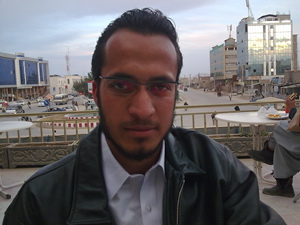
Javed Yazamy, a freelance camerman and fixer working in Kandahar in southern Afghanistan, was killed yesterday in a drive by shooting. He worked for Canadian news outlets mainly CTV News and went also went by the name of Javed Ahmed and the nickname of JoJo. The Committe to Protect Journalists sent out this statement,
]]>"We send our condolences to Jawed Ahmad’s family and friends at this time of deep loss," said Bob Dietz, CPJ’s Asia program coordinator. "CPJ had come to know Jawed and his family well over the 11 months he was held in U.S. detention at Bagram Air Base without being charged by U.S. forces. We hope that his killing will not follow the pattern of other journalists’ deaths in Afghanistan in recent years and go unsolved." link
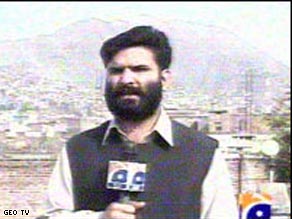
Mosa Khankhel, a journalist with GEO TV in Pakistan, was shot and killed by attackers in the Taliban controlled area of Swat valley, 100 miles northwest of Islamabad today. The attackers subsequently tried to behead him. Reporters without borders express outrage at the killing,
“We want to express our full solidarity with journalists in the tribal areas, who are once again the target of attacks and threats from extremely violent and determined groups”, the worldwide press freedom organisation said.
“Journalists in these regions who are victims of this war should also get the support of the authorities and the international community. Without that, these regions bordering Afghanistan are at risk of becoming news ‘black holes’”, it added. link
UPDATE: Feb 19 – The News in Pakistan carries an obituary today,
]]>Musa Khankhel used to tell his colleagues at The News International that he will be killed for his work as a journalist in Swat. He was right…
…Just when everyone thought peace was finally returning to Swat, the first murder after the enforcement of the ceasefire was that of a journalist. And it happened to be Musa Khankhel, who undoubtedly was one of the most courageous reporters in Swat. link
A total of 130 journalists were killed in Colombia in the past 30 years. The organisation notes that Colombian journalists are still regularly threatened by terrorist organisations. FLIP reports that death threats are still a highly effective way of preventing independent reporting. link
However, 2009 has already got off to a bad start for Colombian journalists. According to the Latin American Herald Tribune, Maria Eugenia Guerrero, a Colombian journalist was found dead on the outskirts of the Ecuadorian city of Tulcannear earlier this month,
]]>[Guerrero] who was working for the Integracion Estereo station in the southern Colombian city of Ipiales, was brutally assaulted and killed and her body was left in a remote area outside Tulcan… The body, according to the forensics report, showed signs of sexual assault and it is presumed the journalist was killed in a violent manner because a portion of her skull was not found and had presumably been detached as a result of a severe blow. link
"We are shocked by the killing of Ando Ratovonirina and extend our condolences to his family and colleagues," said CPJ’s Africa program coordinator, Tom Rhodes. "President Marc Ravalomanana’s government must immediately investigate the shooting by members of the presidential guard and hold those responsible to account." link
Ratovonirina is the first journalist to have been killed since the CPJ started keeping death records in 1992.
]]>]]>Mohammed Yunis Mohammed, a Mosul policeman, had been drinking when he approached the home of neighbour Salam al-Dosaki, a journalist with the local al-Hadba newspaper, police said. An argument ensued between the two men and Mohammed, an Arab, shot and killed Dosaki, a Kurd, on his doorstep. Mohammed was in police custody on Thursday evening, police said. Police said it was a personal dispute. link