Throughout the Leveson Inquiry, news executives have consistently vilified freelance journalists, who provide a means to assign blame for a paper’s illegal activities without indicting any of its full-time staff. If newspaper owners are to be believed, any unlawful means to procure information for a story are used by "people outside the company", with no collusion with any staff journalists at all. Even when a senior reporter was actually found guilty and incarcerated – Clive Goodman, the former News of the World (NOTW) royal editor and reporter who was jailed in 2007 – it was his co-conspirator, private investigator Glenn Mulcaire, who was made to take the brunt of the punishment for hacking into voice messages relating to the three Princes. Mulcaire – a non-permanent member of NOTW staff – received a six month sentence compared to Goodman’s four. This was despite the fact that out of the 609 calls made to access the voice messages, 478 were made by Goodman and 122 by Mulcaire, according to Prosecutor David Perry QC*.
The disclosure that Goodman conducted almost four times as many hackings as Mulcaire insinuates the use of illegal tactics was much more internalised than NI previously led the public to believe; it was the permanent employees, not the outside investigators, who were doing the majority of the dirty work. Conveniently however, the two men pled guilty, and so were unable to be called to give evidence at Leveson. The way in which both Goodman and Mulcaire were disowned from the newspaper was the beginning of a sustained agenda of using freelancers as scapegoats in the British news industry.
It is absurd to have to associate Mulcaire with the larger family of freelance journalists. Granted, it is difficult to define what makes one a journalist; a university degree is not necessarily required to become one, and today anyone with a computer and an opinion could contribute to journalism in some way. However, to link private investigators and paparazzi (the two most frequent offenders in the Leveson evidence) with published purveyors of news who just so happen to not be in the full time employ of a newspaper is highly fallacious.
Yet it is precisely this group that will be subject to censure (possibly total censure) if plans to license journalists, such as those proposed by Paul Dacre, editor of the Daily Mail, come to fruition. The proposal would limit access to press briefings solely to those journalists whose employers have signed up to a code of practice of a revamped Press Complaints Commission (PCC). These journalists would be provided with press cards, which would be the only manner in which to access official press briefings. Freelancers’ lack of a permanent employer would mean that they would be largely ineligible, while the cost of licensing would alienate smaller papers and blogs as well. The idea has been given credence by figures as senior as the Prime Minister, who said, "we have to see is there a way of saying ‘If you’re not part of [the new PCC], you’re not in the lobby, you don’t get any information from government, you don’t get this or that.**’" Cameron’s comments make clear that in this new landscape, participating in independent journalism is effectively treated as a breach of the rules, deserving of sanction. Unlike newspaper owners such as Richard Desmond, who have financial motivations behind not being part of the PCC (avoiding the possibility of fines, for example), freelancers do not have the ability to opt in at all. Their exclusion from such a plan would be by default.
The threat that this card could be revoked if a journalist was caught behaving illegally is meant to eliminate the danger posed by unregulated members of the press, but will accomplish just the opposite. The aforementioned private investigators and paparazzi would be wholly unaffected by such a change, as they do not rely on press briefings for their journalistic output. Similarly, the countless undiscovered rogue reporters still in the full-time employ of news organisations would not be disturbed by the plans, but rather licensed and legitimized further.
The only possible entry point for freelancers to become licensed would be through a "gatekeeper", such as the NUJ (National Union for Journalists). The proposal is flawed for a variety of reasons. Firstly, it requires the NUJ to implement "an appropriate ethical code and the processes to handle complaints", effectively treating the union as a giant newsroom employing 38,000 journalists, which misrepresents its function. As the NUJ does not publish or have any input into their members’ articles, it is not their job to police their members’ ethical practices either.
More critically, it is unjust to make a code of ethics and internal complaints systems a precursor to the NUJ being able to license journalists, when the major news organisations would be able to license their employees by default. Based on the fact that it was the news organisations that were under investigation during the Leveson Inquiry, it is unclear why they are "innocent until proven guilty," and their judgement when distributing press cards is unquestioned. For the NUJ to get licensing powers, it would have to prove that it possessed the aforementioned ethical code and complaint handling mechanisms, a contradiction not lost on the NUJ’s General Secretary Michelle Stanistreet. "Why would the industry, why would the newspaper owners, be in a position to somehow guarantee things don’t happen as a result of the press card gatekeepers?" she asked. "I think this is yet another example of how as an editor – a very high-profile influential member of the industry – is trying to pin the blame on … individual journalists***".
Furthermore, the licensing proposal is made weaker by the sheer unlikelihood that a journalist would actually have his or her card revoked. If the news organisations are the ones who self-regulate their employees, issuing and revoking press cards as they see fit, punishing one of their employees could very well lead to him or her revealing that their orders came from a senior member of permanent staff. According to Stanistreet, the plan "doesn’t account for the fact that journalists operate in a culture that is imposed upon them from above, from the likes of Mr Dacre and others within the industry, and yet under his model he would have all the power and none of the responsibility for that." Even the Leveson inquiry, which has heard evidence from 470 witnesses and cost over £5.5 million, has so far led to only eight people being criminally charged, all of whom were "big fish" in the news industry. There seems to be no interest in prosecuting the regular full-time journalists who were likely complicit in some capacity with the illegal actions of their superiors.
The fact that the vast majority of freelance journalists are not hired to hack into phones and wiretap should not come as a surprise to anyone. To punish them as a group, especially in the name of a better and more accurate press, is highly contradictory. Putting aside the obvious losers in the licensing plan – freelance journalists working in print media – the plans could have the added effect of curtailing Internet political bloggers. The advent of the Internet has allowed freelance journalists to establish followings without being in the full-time employ of a newspaper. Currently, they can attend press conferences, and through their online presence, still express their opinion on issues despite not being published. This freedom of expression is vital in cultivating a vibrant press, where not having a contract with a newspaper does not preclude a journalist from contributing to the public discourse.
In a larger sense, the Internet is increasingly becoming a vital player in the news industry. This is not because of its purported audience; the average newspaper reader spends 40 minutes with a print newspaper per day, in contrast to 15 minutes per month spent with its online version. Rather, the Internet acts as a check and balance to the traditional print media; granted, not effective enough to the point that it replaces the need for PCC reform, but it provides a venue where the traditional news media can be challenged on crucial facts in their stories.
For example, the New Statesman’s blog – comprising largely of freelance bloggers – recently highlighted how the BBC was effectively acting as a "stenographer" for the police. Despite having contradictory evidence at hand, the BBC blindly repeated the police’s (fraudulent) statement of events verbatim. After the NS blog’s article****, the police statement (as well as the BBC’s reporting of it) changed to reflect the true version of affairs. Thus, while one of the largest news organisations in the world was reduced to practicing the most minimal form of journalism possible – just sharing an official statement – some relatively easy investigative journalism by a online blog led to both the BBC and the police admitting the truth, underscoring the real world importance of political blogging. Under the Dacre plan, content aggregation and the "passing-on" of other people’s information would be the maximum extent of bloggers’ influence, extinguishing a vital voice in the journalistic discussion.
The scope of the problem becomes apparent when one realizes that even full-time reporters have no other option when told to employ morally dubious tactics in chasing a scoop. In her evidence to Leveson, NUJ’s Michelle Stanistreet cited journalists complaining about "endemic bullying, huge pressure to deliver stories, overwhelming commercial pressures." Similarly, former NOTW editor Ian Edmondson said the culture was "a case of you will do as you are told and you live in that environment." When these complaints were put to Rupert Murdoch in the inquiry, attributed to an anonymous employee, he asked, "Why didn’t she resign?" Leveson replied that the journalist probably needed a job. It was an accurate summation of the major obstacle to eliminating illegal journalistic techniques; if one reporter is not willing to do something, there are many more that are, making the reporter a hindrance who will likely be let go.
The degree to which bullied journalists are largely left on their own can be seen most clearly in cases involving the so-called "NISA clause". This clause derives its name from the News International Staff Association (NISA), a trade union that was set up by Rupert Murdoch’s titular company, and makes a mockery of independent unions and the aid they could give to journalists. Under current law, there is a loophole that prevents a trade union from representing a worker if said worker is already represented by another, employer-recognised union. The recognised union does not even have to be independent (NISA was refused a certificate of independence, as its funding comes wholly from the employer). Thus, when asked to do something immoral, a journalist’s only recourse is to ask for help from the very company that they are complaining against.
It has been suggested by figures such as the Chair of the Institute of Employment Rights (IER), John Hendy QC, that Murdoch himself exerted pressure onto Tony Blair’s Labour government to ensure that such a loophole was allowed to remain as law. The charge is denied, but the fact remains that the NISA clause is a state-sanctioned obstacle for any journalist wishing to expose wrongdoing, demonstrating how deep the problem runs. In a climate where the UK narrowly avoided having the lion’s share of its media owned by one company after News International’s failed BskyB bid, disobeying a superior’s orders could having huge ramifications on finding a job elsewhere. If anything, this should be seen as evidence that there is less incentive for freelancers to resort to illegal tactics when writing their stories; they are detached from the bullying culture, and do not have in-house politicking with superiors to wade through.
At the current time, Dacre’s proposal remains just that: a proposal. Although highly worrying, it is an unlikely that Leveson will recommend such action, especially considering his recent comments distancing himself from any radical "Ofcom-style" regulation through a PCC-like body. The more pressing issue is what is becoming an increasingly broad and simplistic definition of what it is to be a freelance journalist in the UK today. In the simplest terms, people who write for a living are being artificially compounded with people who take candid pictures of celebrities and conduct covert investigations into their private lives. There must be greater efforts to avoid letting "freelancers" become a homogeneous scapegoat for all the illegalities in the newspaper industry. Statutory underpinning of press regulation is necessary to ensure an excessive invasion of privacy by the press, but a crude curtailing of independent journalism will only accomplish the opposite.
References:
*http://news.bbc.co.uk/2/hi/uk_news/6301243.stm
**http://www.guardian.co.uk/media/2012/jun/18/journalists-pcc-press-cards
***http://www.guardian.co.uk/media/2012/feb/09/paul-dacre-press-card-nuj-boss
****http://www.newstatesman.com/blogs/broadcast/2012/07/met-police-statement-contradicted-video
]]>
RISC trains freelance journalists in battlefield medicine and in April they completed their first training session. Their near-term goal is to train 125 freelance combat journalists by the end of next year, and hope to eventually provide medical training to the entire freelance community.
We hope to soon welcome them to London, but RISC is a non-profit that does not charge for training so in order for this to happen they need donations. The money you donate will help pay for medical kits, lodging and a three day intensive course for our students.
DONATE HERE
]]>We have now opened the survey up to the public and we would very much like to encourage you to participate by clicking here. We intend to publish more results later in the month, and will be using the contributions as part of a report that we will be submitting to the government select committee that has been assembled to gather evidence on the future of investigative journalism.
Of those who have so far responded to the survey, a majority believe:
* The phone hacking scandal will not fundamentally change the relationship between politics and journalism (Yes 18%; No 45%; Too early to tell 36%)
* Phone hacking was a widespread practice used by more media groups than just News International (Yes 82%; No 0%; Don’t know 18%)
* Illegal practices such as blagging, bribery etc. were accepted as common practice in journalism (Yes 91%; No 9%; Don’t know 0%)
*That the Press Complaints Commission should not be scrapped, but instead restructured (Yes 9%; No 9%; It shouldn’t be scrapped, but it should be restructured 73%; Don’t know 9%)
A majority of members also said they:
* Had confidence in the Media Ethics inquiry committee not to harm press freedoms (Yes 64%; No 18%; Don’t know 18%)
* Did not believe the introduction of new statutory powers over the press was the best solution (Yes 0%; No 82%; 18%)
* Felt David Cameron’s reputation and leadership has been harmed by the scandal (Yes 73%; No 18%; Don’t know 9%)
* Unanimously agreed that the industry of journalism should implement a new code of ethics, similar to a Hippocratic oath (Yes 100%; No 0%; Don’t know 0%)
Asked to propose a change to media regulation in the UK, contributions included:
* I would change the libel laws, which currently prevent journalists from reporting important issues which are in the public interest (eg: Trafigura case). There needs to be a way of separating out the exposure of corruption/wrong-doing by a company such as Trafigura and the exposure of some footballer’s sexual habits. The latter is not necessarily in the public interest, unless he has a campaign to tell young people to be faithful to their spouses or somesuch. The former is.
* The fit and proper test applied to owners, editors and board members.
* Improve the right to privacy. France’s privacy laws are tougher than those in the UK but France remains a thriving democracy, even if we Brits don’t like to admit it.
* Hold the press accountable for incorrect or malicious reporting.
* Create an independent regulator that is neither for or against the press, but is genuinely independent.
* To have a [regulatory] body with more ability to act – more teeth.
Asked what function investigative journalism serves for society, respondents wrote:
* To watch the watchers and expose wrongdoing and hypocrisy.
* Its function is to reveal the truth, to root out facts many people often want to keep hidden, to re-establish fairness, to shine light in dark places. Good investigative journalism is journalism’s strongest suit.
* Investigative journalism should call the powerful to account, and expose corruption. It is important in any democracy. It has nothing to do with prying into the private lives of celebrities – that’s a separate matter. Journalists may need some subterfuge to carry it out, but this is not the same as hacking into the telephones of celebrities to get gossip.
* Journalism can hold individuals and institutions accountable in the way that elections every five years or AGMs do not. Its purpose should be to uncover that which others might wish to remain hidden. Preferably issues that affect society, not the issue of which slapper Giggsy is shagging.
Asked how the phone hacking scandal would end, answers included:
* With the weakening of News International, and diminution of Rupert Murdoch’s power in British politics. I also think the tabloids may be ‘tamed’ to some extent but the danger is that important investigative reporting in the public interest will be caught in the same net.
* There will be a lot of early retirement (on full pensions of course) of many older hacks, of many more papers than have been implicated right now. There will be some calls for an independent press. Give it two months and it will all be forgotten.
* News Corp ousting the Murdochs, a few policeman and Coulson in jail.
* It will be old news at some point. Old scores will have been settled and new ones started. It will be referred by the sanctimonious to grab moral high ground when it is useful. Although it is extremely serious, it is being treated as a drama which devalues the important ethical implications.
* Cameron is brilliant; he can charm his way out of a crisis and turn on the head of a pin, so I don’t think it will bring him down – though it could. I think it will inevitably lead to greater press regulation which is why we need to ensure our voice is heard soon and with strength and conviction.
* In 24 months we will have forgotten all about it.
If you would like to participate in the survey, you can do so here. It will be open until 12pm on 10 August, after which time the final results will be published alongside full statistics.
]]>
A write up of a Q&A section with Assange, which followed the speeches, can be found here (part I) and here (part II).
]]>Illustration by Chris Riddell
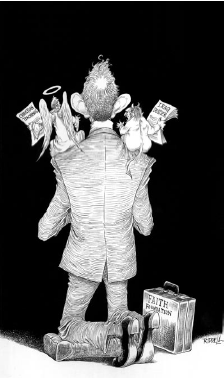
Tony Blair is busy outing himself as a man of God. Which is immediately ironic after all that time during which Blair refused to “do God” – as his media manager Alastair Campbell informed us. Since leaving Downing Street, Blair has used the G-word with a mixture of the fervour and regularity of a Jehovah’s Witness knocking on your front door, and the calculated spin of a Labour campaign. And this is not the result of a road-to-Damascus conversion since leaving office in June 2007, or a public-relations campaign to promote his retirement toy, the Tony Blair Faith Foundation. While the Foundation plans to use religion to solve the problems of the world, Blair lectures at the Yale Divinity School, preaches from pulpits including that of Westminster Cathedral, and gives a drip-drip-drip of interviews during which he acts coy before divulging more details about how Jesus was his guiding light when he was Prime Minister. His Christian faith had been “hugely important” to him while in office, he told the BBC in 2007. And more recently – ironically in an edition of New Statesman guest-edited by Campbell – Blair intoned: “My faith has always been an important part of my politics.”
All of which offers an invitation to take him at his word, rather than simply allowing the former British Prime Minister, now banker and aspirant global statesman, to wrap himself and his record in a comfort blanket of moral oneupmanship. How does the Blair legacy compare with the New Testament that the one-time leader was always apparently dipping into? And was the architect of New Labour inspired by Jesus, or did he come to imagine that he understood the mind of God rather better than his saviour?
Hiding the light of his faith under a bushel while Prime Minister does, of course, offend against the basic rule of Christianity, which was born as a missionary faith and still encourages believers to evangelise. “Go,” Jesus tells his apostles, “and make disciples of all nations; baptise them in the name of the Father and of the Son and of the Holy Spirit, and teach them to observe all the commands I gave you…” Contemporary Christianity concedes that there are different ways of doing this. You can set an example by your words or your deeds. So if, post-resignation, Blair is majoring on words, while in office he seems to be saying that God was in the detail. Moreover, he would surely contend that in the particular circumstances of late-20th-century Britain – officially Protestant but with strong leanings towards secularism and scepticism – to start waving his crucifix around, would not have been appropriate. He would, as he put it in a BBC interview, have been taken for a “nutter”.
Fair enough, up to a point, though Blair’s desire to be all things to all men was always both his greatest strength and his greatest weakness. But as the Anglican Bishop of Rochester, Michael Nazir-Ali, pointed out at the time of Blair’s ‘nutter’ remark, if the New Labour Prime Minister was genuinely following the dictates of a highly developed religious conscience when in 10 Downing Street, it might have led to a more constructive social policy at home and principled policies abroad.
Christianity, of course, comes in 57-plus varieties, so the first thing to establish is quite what sort of Christian was Prime Minister Tony Blair. Nazir-Ali is a bishop of the Anglican Church of England, the denomination he officially espoused during his premiership. However, a key part of Blair’s running confession since resigning has been to suggest that his reception into the Catholic Church in 2007 was a formality, a public acknowledgment of something he had been living out in Downing Street. This impression is reinforced by third-party revelations. In December 2008, his former spokesman Lance Price told Radio 4 that as early as 1998, his boss had asked him to “squash” a report that he had told the Catholic Archbishop of Siena that “in my heart I feel more of a Catholic”. Blair explained it to Price by saying: “I don’t discuss my Catholicism with anybody.” So it is reasonable to deduce that the correct yardstick for measuring Blair’s God-inspired deeds as Prime Minister is Catholicism.
Long before he became premier, Blair had been attending Catholic services and receiving communion with the blessing of his local priest, but without ever joining the Church of Rome. The impression given subsequently was that he was doing so to please his cradle-Catholic wife, Cherie, and to maintain a united front once they had decided to raise their children as Catholics. But this now looks like a smokescreen in the light of Blair’s post-resignation remarks on faith. If going to mass and communion was only a question of pleasing Cherie, why were the couple married in an Anglican church? And, as she has hinted, he was more devoutly Christian than she was when they met, and it was he who encouraged her, rather than the other way round, to build on the cultural Catholicism that came with her childhood and upbringing in Liverpool, at the same time he was constructing his own hybrid of politics and religion.
Once Blair was Leader of the Opposition, his hitherto-unnoticed practice of taking communion started making headlines. In 1996, shortly before his first landslide election victory, he received a letter from Cardinal Basil Hume, reminding him that as an Anglican he could not join the rest of his family at the altar rails to receive the bread and wine, since the Catholic understanding of Eucharist is different from that of other Christian faiths. For his first years in office, Blair appeared to take this on the chin and was to be seen going to mass in the Cardinal’s Westminster Cathedral, but not taking communion. After 9/11, security concerns ruled out such trips, and a Catholic priest would come on a Sunday to Chequers or No 10 to say a private mass for the Blair family. The clerics concerned have always refused to comment on suggestions that, behind closed doors, the Prime Minister once again started living the sacramental life of a Catholic in pectore – “in the heart or chest”, a phrase usually used by the Roman church for bishops secretly appointed in communist lands whose status had to remain a mystery for reasons hardly applicable to Blair.
If he was unofficially our first Catholic Prime Minister since the Reformation, Blair’s reception into the Church by Cardinal Cormac Murphy O’Connor was a question of tying up the loose ends from a decision made long ago. In such a scenario, Blair’s delaying formal conversion until after he had left office was a typical bit of realpolitik, sacrificing his own religious sentiments on the altar of public prejudices. It is intriguing, though, to ask if Blair’s delay in coming out as a Catholic was because he didn’t want the teachings of the Catholic Church to be used against him as Prime Minister.
In 2003, Blair made the defining decision of his premiership, joining his fellow, more overt, Christian George W. Bush in taking Britain to war in Iraq. In a rare name check for the Almighty, he told television interviewer Michael Parkinson in March 2006 that God would be the judge of the invasion as a moral decision. Parkinson asked if Blair had prayed before committing British troops to Iraq. “Well, I don’t want to get into something like that,” Blair replied, as if suddenly remembering what Campbell had told him. The implication, though, was that h
e had indeed been on his knees seeking divine guidance (or blessing), and this has only been borne out by everything that has been said since.
Jesus is equivocal on war. “Put your sword back,” he tells one of his followers when he is arrested, “for all who draw the sword will die by the sword.” But earlier he tells a crowd: “do not suppose that I have come to bring peace to the earth: it is not peace I have come to bring but a sword”. Blair has enjoyed a close friendship with Cardinal Murphy O’Connor. But the Archbishop spoke on behalf of his fellow bishops in 2002 when he said that governments had a “moral responsibility” to avoid war with Iraq, and “the need to avoid war is a cornerstone of Christian teaching”. O’Connor was not alone. Every church and denomination in Britain and the USA, apart from the extreme rightwing Southern Baptist Church in America, vociferously opposed the war. The leadership and congregation of President Bush’s United Methodists pleaded with and petioned its member in the White House not to go to war. More of the putting away the sword, then, than drawing it.
If Christ’s statement did still leave Blair with wriggle-room to reconcile the war with Catholic morality, Pope John Paul II left no leeway at all. The ageing Polish pontiff warned repeatedly and passionately in the run-up to the US-UK invasion of Iraq that a pre-emptive strike would be wrong and a “defeat for humanity” that couldn’t be morally or legally justified. “Violence and arms can never resolve the problems of man,” he said. The conventional Catholic “just war” theory – rooted in the New Testament’s ambiguity and teaching that war, in some circumstances, could have a positive moral purpose – didn’t apply to Iraq, he added. Indeed, throughout his long pontificate, this Pope showed a marked disinclination to “just-war” criteria in any conflict. He was, for instance, a lonely voice on the global stage in 1991 in damning the first Gulf war. The “just war” theory was first set out by St Augustine in the 5th century, in the light of the invasion of Rome by the Barbarians.
There are four criteria: the damage inflicted by the aggressor on the nation or community of nations must be lasting, grave and certain; all other means of putting an end to it must have been shown to be impractical or ineffective; there must be serious prospects of success; and the use of arms must not produce evil and disorders graver than the evil to be eliminated. The current catechism of the Catholic Church, the 800-page rulebook approved by John Paul II in 1992 as a guide to good Catholic living in the modern world, adds a note to this final point: “The power of modern means of destruction weighs very heavily in evaluating this condition”.
This anti-war stance is therefore the mainstream of Christian theology and of current interpretations of Jesus’s teaching. Blair is utterly out of step. So, does this give the lie to all his high-and-mighty talk about faith influencing his decisions? Here is probably the most important judgment he made in office – and the most calamitous for his political and moral standing – and he is lining up against the Pope. Well, not quite. There is a group of American “theocons”, admired by the Methodist George W Bush, though they are largely Catholic.
They are led by George Weigel of the Ethics and Public Policy Center in Washington, and since the mid 1990s had been arguing that a “preventive war”, as they termed it, could be justified by Catholic just-war conditions. In Iraq they saw a perfect case for the application of their own take on the “just war”. Weigel is an influential fi gure in world Catholicism and wrote a bestselling biography of John Paul II. But on Weigel’s efforts to label the invasion of Iraq a just war, the two parted company. Weigel attacked the church’s “presumption against war”, which, he claimed, had infected Catholicism since the second world war.
In a 2002 lecture on Moral Clarity in a Time of War, given to the Catholic University of America Law School, he argued that true just- war theorists “did not stigmatise first resort to force because their concern was with responding to injustice… and [thus] did not define just cause in terms of self-defence”. In the influential Catholic journal America, Weigel wrote in 2003 that “classic just war thinking begins with moral obligations… the obligation to defend the peace of order in world affairs”.
The words carry a familiar echo. Once Blair had stopped talking about nonexistent weapons of mass destruction, his only justification for the invasion was the moral one: defending peace and order by pre-emptive regime change. This defence rested heavily on the Weigelian argument: the world and Iraqi people would be better off without Saddam Hussein. Though subsequent events have shown the invasion violating not one but all four just-war criteria – as John Paul II predicted in rebutting Weigel and the theocons – Blair might just argue that he was not entirely out on his own in Catholic terms in choosing to commit British forces to this unpopular conflict. But he was out on a limb – as John Paul II himself would have made clear to him when Blair visited the Vatican in February 2003 and lobbied on behalf of the planned invasion. The Pope refused to budge an inch in his opposition to Blair’s war. Catholic social teaching is sometimes called its “best-kept secret”. Yet it is the very core of Jesus’s teaching in the gospels. “I tell you solemnly, in so far as you did this to one of the least of these brothers of mine,” he predicts his father will say on the Day of Judgment, “you did it to me.” The Catholic Code of Canon Law, its rulebook, makes plain that this must shape how each of us interacts with our neighbour.
Good Catholics, it says, “are also obliged to promote social justice and, mindful of the precept of the Lord, to assist the poor from their own resources”. Throughout the cold war, Catholicism tended to try to position itself as a “third way” between capitalism and communism. When Pope John Paul II visited the United States in 1995, he confounded and irked his hosts by suggesting that neither capitalism nor the ideology he had devoted his life to overthrowing in Poland was compatible with Christianity.
Four years earlier, after the collapse of the Soviet Union, John Paul II had produced one of the keynote encyclicals of his papacy, Centesimus Annus. It contained some of the warmest words a Catholic leader had ever uttered in modern times about wealth creation, though it balanced them with warnings about respecting workers’ rights. At first glance, it might be taken for a blueprint for Blair’s economics: the light hand of regulation and cosying up to business. On his approach to the banking and business sectors, however, Blair was out of step with both the political left and the Polish pope.
“The church acknowledges the legitimate role of profit as an indication that a business is functioning well,” John Paul wrote in Centesimus Annus. “When a firm makes a profit, this means that productivity factors have been properly employed and corresponding human needs have been duly satisfied. But profitability is not the only indicator of a firm’s condition. It is possible for the financial accounts to be in order and yet for the people, who make up the firm’s most valuable asset, to be humiliated and their dignity offended… In fact, the purpose of a business firm is not simply to make a profit, but is to be found in its very existence as a community of persons who i
n various ways are endeavouring to satisfy their basic needs and who form a particular group at the service of the whole society.”
The Pontiff had tough words about politicians’ role as regulators of a market economy: “Economic activity, especially the activity of a market economy, cannot be conducted in an institutional, juridical or political vacuum. On the contrary, it presupposes sure guarantees of individual freedom and private property as well as a stable currency and efficient public services. Hence the principal task of the State is to guarantee this security, so that those who work and produce can enjoy the fruits of their labours and thus feel encouraged to work efficiently and honestly. The absence of stability, together with the corruption of public officials and the spread of improper sources of growing rich and of easy profits deriving from illegal or purely speculative activities, constitutes one of the chief obstacles to development and to economic order.” “Easy profits deriving from… purely speculative activities”.
These words in some ways sum up Blair’s economic legacy, now shown to have created a gap between the richest and poorest greater than at any time in Britain since before the boom of the 1960s. For the duration of his time at No 10, there is no evidence that he made any attempt to warn or even gently remind those who were making easy profits from purely speculative activities that they were walking a tough moral line. Instead he invited them to dinners and awarded them honours, the bankers and financiers who we now know to have been breaking the backs of the poor, and whose ranks Blair has now himself joined. “My faith has always been an important part of my politics” begins to ring a little hollow. Jesus may have been equivocal about war, but he was very clear when he said (Matthew 19:24) that “it is easier for a camel to pass through the eye of a needle than for a rich man to enter their Kingdom of God”.
The party line now is that the cause of the present distress is a global problem, and that Blair, Brown et al cannot shoulder the blame. But distinguished Catholic theologians locate responsibility closer to home. “While there are many proximate causes of the current financial crisis,” says Dom Christopher Jamison, Benedictine Abbot of Worth, “the ultimate cause is ethical. We can now see that the financial services industry was both over-regulated and unethical, a lethal combination.” Far from Blair’s view of his premiership at a time when there was a strong moral and religious undertow to public policy, Jamison sees a climate where “public morality has become rule and law compliance [with] the term ‘moral’ so debased that it is usually connected to ‘moralizing’, a pejorative term to describe people sticking their noses into other people’s business”. While it would be naive to expect Prime Minister Blair to act in imitation of Christ and drive the usurers out of the modern-day temple, it is not unreasonable to wonder that he might have exercised more caution in personal dealings with the money-lenders while in office. For Catholicism has long abhorred usury. In the 13th century, one of its greatest thinkers, Thomas Aquinas, wrote: “Now money… was invented chiefly for the purpose of exchange: and consequently the proper and principal use of money is its consumption or alienation whereby it is sunk in exchange. Hence it is by its very nature unlawful to take payment for the use of money lent, which payment is known as usury…”
Medieval principles that have no place in the current world? Well, not according to the current Catholic catechism: “Those whose usurious and avaricious dealings lead to the hunger and death of their brethren in the human family indirectly commit homicide, which is imputable to them.” In his ‘Concordance’ to the Bible of 1737, the Anglican Alexander Cruden spoke with uncanny clarity to the present when he wrote: “The law of God prohibits rigorous imposing of interest or exacting it, of a return of a loan without regard to the condition of the borrower, whether poverty occasioned his borrowing, or a visible prospect of gain by employing the borrowed goods” – in other words, it is sinful to get rich on interest on loans to people who are skint – the premise of the system, underwritten by Blair, which brought about global financial disaster.
His resignation as Prime Minister has allowed Blair, he has himself claimed, finally to be his own man in terms of a public reconciliation of his work and his religious beliefs. “Religious faith,” he writes in The New Statesman, “could help guide and sustain the era of globalisation, lending it values, and, in bringing faiths and cultures to a great understanding of each other, could foster peaceful coexistence”. Sounds good.
“All leaders, whether of religious faith themselves or not, have to ‘do God’.” So, do as I say, not as I did. To his warning on usury, Aquinas attaches guidance on how to repent: “just as man is bound to restore ill-gotten goods, so is he bound to restore the money which he has taken in usury”. Not much sign of that.
But there is a temptation to see Blair’s post resignation activities as attempting to make good his legacy and use his new-found freedom to live out more clearly the religion he now publicly professes. His Faith Foundation wants to harness the power of the world’s religions to end rather than start conflicts. And his work in the Middle East as a peace envoy arguably shows him, in a religious sense, as seeking some sort of redemption for the damage he caused to the region. In Catholic terms, this retirement activity – especially since it is patently so pointless, as he has no credibility left with Arab leaders – might be counted as him doing his penance.
But the peace-envoy role comes with a salary as well as a hairshirt, and an award in May 2009 of $1m by the Israeli Dan David Foundation for “his exceptional leadership and steadfast determination in helping to engineer agreements and forge lasting solutions to areas of conflict”. Few are sure what Blair’s contribution to peace in the region amounts to, despite rental of an entire storey of a beautiful hotel in East Jerusalem, apart from a proposal to build a special road for tourists to Bethlehem – the last thing needed in the West Bank, already a maze of special roads. Blair’s laureate preceded the carnage in Gaza by a matter of months.
Peacemaking, however, is not Blair’s main source of income, to which should be added a reported £2.5m from American investment bank JP Morgan (Blair’s conversion having done little to quench his appetite for easy profits from usury and speculation), £2m as an adviser to the Swiss insurer Zurich, £4.5m for writing his Downing Street memoirs, and an income of an estimated £200,000 per speech on the international lecture circuit (though some of his talks are unpaid). And in February he announced his latest venture, Tony Blair Associates, a “commercial partnership” that will advise paying and non-paying clients on matters of economics and politics. It promises to be a nice little earner. All of which brings us to the final intuitive problem with Blair’s attempts to cloak himself and his legacy in a religious imperative. He just doesn’t quite look like, sound like or act like a man of God. He simply doesn’t fit any of the stereotypes of Godliness. There is the whiff of money that hangs over him: the houses with million-pound-plus price tags, the lavish holidays in villas with Silvio Berlusconi and the Bee Gees, and accumulation of advisory roles.
My Christian Br
other teachers would have condemned it as vainglory. Moreover, there is Blair’s failure, in all his endless talk about God, to accept that he may have got anything wrong in the past. It is all very well trying to indulge in a little self mortification by being a peace envoy destined to fail in the Middle East; but in Catholic theology, you have to confess the sin first and then do the penance.
Please subscribe to the Frontline broadsheet. It is only £15 a year including postage for four issues.
]]>Harold Macmillan called it “the family silver”; the post-war Labour leader Ernest Bevin called it something different, but in the same spirit, the welfare state; and for centuries it had been known as the common wealth – some sense of national asset, belonging to the country and the people. Until three decades ago, the notion of family silver and common wealth informed the social fabric, so that certain industries and services were regarded as integral to the responsibilities of state: the essential infrastructure, railways and public transport, water, gas, electricity, health, security and the resources that produced energy, some keystone industries such as coal and steel.
They were seen as something for which those elected by the people were responsible for providing and managing for the people, not as means of fabulous wealth for the few which the people were meant to underwrite. Until, that is, the looting of Britain. “First, all the Georgian silver goes,” Macmillan told the Tory Reform Group in November 1985, “and then all that nice furniture that used to be in the saloon. Then the Canalettos go.” How bitterly quaint but irrevocably lost they sound now: the National Coal Board, British Steel, British Rail, the Gas Board, the Water Board.
And this is not nostalgia: this is to lament the loss of something precious to this country, to a smash-and-grab. The looting began with Margaret Thatcher. It continued with John Major, was enthusiastically embraced by Tony Blair, is keenly inherited by Gordon Brown and will be carried on by David Cameron. It has been seamless, with no party-political colour, for all the ersatz and meaningless distinctions the media, think-tanks and what Ivan Illich called “the knowledge stock” seek to establish between politicians and parties. Looting is the product of national hubris as well as seamless ideological zeal between 1979 and the present, for it has no parallel on the continent of Europe from which Britain is arrogantly detached, and its legacy is plain to see: the IMF and OECD put Britain clear bottom of the league of world recession- proofing, more vulnerable than any other nation to the ravages of unemployment, and economic decline. The philanthropist billionaire George Soros adds that Britain itself, never mind the banks, will need a bail-out – Soros, the man who made a billion dollars by speculating against sterling in 2000, just as Blair and Chancellor Gordon “Safe Pair of Hands” Brown were boasting of the currency’s impregnability, against the perils of conjoining the whimsical fortunes of the euro, then worth 60p.
In the present round of bank bail-outs, Britain’s will have cost the taxpayer the equivalent of 19% of the total turnover of gross domestic product, by far the highest in the G20. The US taxpayer has been sent a bill of 6.3% of GDP; the French, 1.5%. Meanwhile, the super-rich whom Labour rewarded – created, even – with its version of the looting of Britain count their blessings, bonuses and benefits, including Blair, Brown and their cronies, while the cosmetic “re-regulation” comes way too late.
At the G20 in London, President Obama could say that “the United States certainly has some accounting to do with respect to a regulatory system that was inadequate” and helped cause the crisis, because he is talking about the Bush administration. Brown could not, because he would be talking about himself and his predecessor. Margaret Thatcher was of course the foremost ideologue of looting with regard to manufacturing industry and the family silver and common wealth. The first looting, from 1981, was of British Aerospace, National Freight, Sealink, the airports and Jaguar cars. But the big adventure was the flotation of British Telecom from 1984, at almost £4 billion the biggest privatisation in British history and intended to epitomise the forging of a nation of mini-capitalists, just as Alistair Darling wants now to create “a nation of bankers” – with about as much effect.
The result is an arrogantly overpriced telephone service that operates as close to a monopoly as is legal, keeping its wretched customers listening for hours to the following payment options before being transferred to Mumbai or Hyderabad. Thatcher famously proceeded to the pitheads of the coal industry, for which she hired Ian Kinloch MacGregor from the Amax corporation of America, who had successfully broken the back of the US coal miners’ union (though unlike Britain, the US kept a coal industry), and British Steel.
The shipyards, markedly Cammell Laird and Vickers, and car factories – Rover, Rolls-Royce – followed. So Birkenhead, Belfast and Tyneside are graveyards while Vigo thrives; Renault and Citroën are troubled but remain French; Saab, Scandia and Volvo, Swedish; BMW, Audi and Mercedes, German – while not a single car of the few still made in Britain is British. Lancia-Alfa- Romeo-Fiat emerges as another matter altogether – a powerhouse which will not only remain Italian, based in the quintessential European manufacturing city of Turin, but also deal with overcapacity by engulfing Opel, GM Europe and Vauxhall, to the cost of British jobs.
In his famous speech, Macmillan called the sale of British Telecom and British Gas that of “the two Rembrandts still left”. The privatisation between 1986 and 1990 of public utilities – gas, water and electricity – which were split into regional companies before full-blown “competition”, has a special irony. Not only did it lead, logically, to the highest domestic utility bills in Europe by far, but it also led to money flowing from British households to state-run French and German companies, which had quickly and sensibly spotted an easy and lucrative way to buy up British utility-providers such as Thames Water and London Electricity in order to subsidise their rates at home.
EDF (Eléctricité de France) even needs to use a cosmetic British name, whether supplying homes or buying up the nuclear power industry. The fault is not French or German but British, with the almost comic twist that those who most fervently advocated selling off utilities were equally fanatical in their Euroscepticism and insistence on what they called “independence” from Europe – as they still are, as the still ‘little England’ Conservatives prepare for power. Tell Sid, indeed. Thatcher had the sense to see that even by her standards, some things were wisely left in the state sector – such as railways, a natural infrastructural monopoly, and British Energy, whose long-term liabilities involved the running and decommissioning of nuclear power stations. But with the decadent corporate boardroom government of John Major came the wholesale and thoroughly fl awed privatisation – at a bargain price – of a railway network that had been the pride of Europe, for immediate and corrupt gain of individuals close to the cabinet: a brazen lunacy unthinkable on the continent. British Rail valued the track and stations floated on the stock exchange in 1996 at £6.4 billion – and they were sold for £1.8 billion.
The result, utterly predictable, is manifest: a once magnificent railway system has become a national disgrace, of enor
mous financial benefit to those who bought it and claim to run it with silly slogans such as Love Every Minute (Virgin) and Transforming Travel (First). Transformed it they have, with every hateful minute costing the taxpayer more than British Rail did. Britain now suffers the shocking embarrassment of having by far the worst, and by even further the most expensive, railway service in Europe – the trains inefficient, sporadic, lurching, filthy, cramped and crowded, and in some cases taking longer to reach a destination, if at all, than they did during World War One. While in Europe, superfast TGV trains and sturdy iron horses, operated by dedicated expert railway managers paid by the state, carry the people reliably, speedily and at fractions of the British fares.
By way of a postscript in the present, when railway companies complained about the rigour of law insisting that to have 10 out of 100 passengers standing constituted overcrowding, Labour, instead of telling them to shut up and put on more trains, simply changed the law so that 30 passengers – or “customers”, as they now are – per 100 standing is acceptable on a British train. Yes, Transforming Travel. This is but metaphor, because after victory in the 1997 election, Tony Blair’s Labour accepted the orthodoxy of looting – even with a majority of 179 – and continued the sacking of national assets, so that the transition from a Conservative to a Labour epoch was without interruption or even interregnum.
One of the flagship projects of the new Chancellor, Gordon Brown, was unthinkable anywhere else in Europe or even the US: privatisation of the capital city’s metropolitan subway system Not to a single company, but to three giant consortia who would be assured the windfall of a 30-year guaranteed contract. The so-called PPP that followed was so complicated that it cost the taxpayer £500m in lawyers’ and accountants’ fees alone. The very personal politicisation of the process by Brown scuppered any hope there might have been of any tangible improvement to the Tube: current upgrades to the system merely paper over cracks at vast cost.
The result is plain to see: while civic owned, subsidised European metro systems whiz about in relative silence for an average fl at fare of a euro (half that on Madrid’s wonderful system), London suffers Europe’s worst, lurching subway service to the sound of cacophonic announcements about never finished “planned engineering works”, while the profits, lavish bonuses and pensions pile up for Brown’s friends at Tube Lines and Metronet. The Blair-Brown doctrine continued Thatcher’s belief that manufacturing was nothing to do with Britain, worshipping instead at the temple of quick money. “Service industries” and, above all, financial services were to be the bedrock of the economy, the bankers unleashed to make as much money as they could thanks to Brown’s fanatic belief in deregulation.
He constantly lambasted European countries for not following his lead and that of the USA, but they stuck with what Labour saw as their archaic regulation. European governments were chastised by British and American politicians and self assured newspaper columnists and told to “liberalise” (as the jargon put it, offensively to liberalism) their economies and state assets – ergo, to loot them too, for quick money.
Europeans of all political colours were sceptical about extreme deregulation of financial markets and total de-industrialisation, prudently seeking to hold onto what was possible in a global economy. The results, again, are now plainer than ever: Europeans are better weatherproofed against recession than basket-case Britain. The pound, so jealously guarded from the euro by Blair’s false promises and Brown’s Europhobia, stumbles around at levels not witnessed for decades.
Britain’s zealous belief in unleashing banks and bankers puts the UK bottom of the IMF’s league table for recession proofing – with all the social cost that comes with that in an already belligerent, fragmented, depressed and unpleasantly boorish society – while politicians of astounding mediocrity and inexpertise blather on about how all this is global, affecting everyone equally, which it is not. At least, not until countries with more mature policies pay the price for American and British greed. The European soccer championships in Austria and Switzerland last year were a metaphor: a gathering of 16 teams and two million fans for a feast and festival of football. But Britain was not there. Any more than it is among the nations of the Schengen treaty, whereby 400m Europeans travel across 25 countries without a passport – from Lisbon to Ukraine, from Palermo to Helsinki.
Why, even the big football teams have been sold off: Manchester United, Aston Villa and Liverpool to Americans, Chelsea to Russians, Manchester City to Arabs, and Arsenal about to go, while Fiat owns Juventus, Berlusconi owns Milan (for better or worse, but at least he is Italian), European Champions Barcelona owns itself and the fans own Real Madrid – the metaphor intact.
Both the looting itself and the style, culture and lexicon of management in the looted industries and services offends those who work for and still care about them. Relegated to mere cash cows, they are seen by government and managerial bosses as no different from a processed-food business, so that anyone devoted to railways or health finds it hard if passengers and patients become “customers”; and librarians do not like having their job description changed to “managers of Info Centres”.
No lesson learnt, Labour last year co-opted none other than Gerry Grimstone to its Treasury team. This assistant secretary under Margaret Thatcher from 1982 to 1986 is back, two decades and 20 privatisations later. Next, after the Royal Mail (which even Thatcher shrank from looting, after a call from Her Majesty), come the Ordnance Survey and Royal Mint, so that even the pound can be Made in China.
Britain has since 1981 been the laboratory for a free-market experiment that not even the USA would undertake (Reagan was determined to retain American industries such as automobile manufacturing as far as he could, as Obama is now). A British experiment in which deregulation, privatisation, “downsizing”, “outsourcing”, and cutting red tape were supposed to set the country on the road to growth and prosperity. But it has instead taken the country to ruin.
Even in the good days, growth was no faster than in the ’50s, ’60s and ’70s, and it has been slower. Living standards have risen more slowly, and the fruits of growth have been spread more unevenly. The argument that nationalised industries and services would be made more efficient and cheaper by being sold off is a hollow, sick joke. If the idea was that privatisation would stop a drain on the public purse, that of the railways merely increased the subsidy from £900m, in the year before Major sold them, to £2 billion two years later. Hardest of all to swallow is that Britain’s standing at rock bottom in the IMF table was utterly predictable on grounds of the most basic general knowledge.
But with their arrogance and doctrinal fanaticism, Labour’s market dogmatists – with their own personal financial interests in mind – ignored the obvious, and ploughed on towards the public abyss. On regulation and greed – the cult of which Gordon Brown now laughably claims to combat with the man who personifies greed and spin, Lord Mandelson – Brown has now to bleat the exact opposite of everything he has been preaching for years as a friend of the City, while pretending not to. The safe pair of hands was a foo
l all the while that his vast apparatus of quangos, civil servants and economic advisers conjoined and justified the smash-and-grab, squeezing every last penny they could get from the taxpayer to fund their folly, with no end in sight.
And here comes the twist. For while all the things that should remain among the responsibilities of state, and still do in most of Europe – infrastructure, transport, fairly priced utilities, post and pensions – are looted, a massive and costly renationalisation is under way of exactly what society does not need in the public sector, in addition to the billions spent on the banks and bankers. RBS, Lloyds Banking Group, Northern Rock and Bradford & Bingley are now firmly under government control, while the taxpayer is expected to underwrite toxic loans to the tune of hundreds of billions of pounds.
Cabinet members and Downing Street spin doctors point the finger at their erstwhile friends the bankers, even as the Labour government increases the tax burden on the average citizen. And an unapologetic Brown, steward of the economy for the past 12 years, maintains his position as Britain’s unelected Prime Minister – because in Looted Britain, the buck is passed on like a baton but never stops at the top.
]]>Illustration by Clara Vulliamy
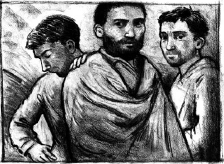
While Pakistan has helped the war on terror, it has been reluctant to crack down on militants from the Lashkar-E-Taiba group. Now it is under pressure to do just that – with explosive results.
The guard stands lazily at the entrance of a crammed brick bunker. Without saying a word, he checks my haversack and frisks me thoroughly. With an inquisitive look on his face, he gazes at the tiny picture on my identity card and whispers my name as if reassuring himself. Finally he moves to let me in. I enter the bunker, where his gun-wielding colleague has to squeeze his body to let me through another hole, covered by a raggedy blanket, to enter the compound. The main entrance of this police camp, a large and heavy metallic gate, remains locked. Spools of razor-sharp barbed wire, a large iron sheet covering the stretch of road with thick nails protruding from its surface, and a huge iron pipe form several layers of the security barricade. Half a dozen armed men, their fingers ready to pull the trigger, stand around the gate, while others watch from the pigeonholes of the bunkers erected above the compound wall.
The headquarters of the Special Operations Group, the counterinsurgency police, has always been a scary compound, and people even avoid the lanes around it. The screams from its dark and dingy torture cells, where captured militants were once interrogated, have become legendary in strife-torn Kashmir. Dozens of men have perished in this two-storey building.
On the few times I have entered the compound over the years, a strange tension was always evident. One particular room, hidden from the public, contained a selection of torture instruments: a hook in the roof with a nylon rope hanging from it, a metal bed with its legs fixed into the floor, whips and a thick wooden rod that would be used to roll over suspects’ bodies during “question-and-answer sessions”. The SOG operations were simple: extract information from the captured men and look for their associates. The militants countered, and 10 years ago sent fidayeens in police uniform into the camp to kill dozens.
This cycle continued for years, until a new officer arrived in the camp. Mohammad Irshad, the current Superintendent of Police, has changed the rules of the game. Like members of the militant group Lashkar-e-Taiba, he is a Salafi, and the only difference between them is in their understanding of jihad. While Lashkar men sneak in from Pakistan with a belief that they are fighting a holy war in Kashmir, Irshad contests it and has no doubt that his war against the Lashkar is well within the ambit of Islamic scripture. Thus, for several years, the camp’s interrogation room has been a site for regular theological debate, and Irshad puts each captured militant’s understanding of jihad to a rigorous test. Unlike Deobandis – the parent religious organisation of the Taliban, who belong to the Hanafi school of Islamic jurisprudence and follow Imam Abu Hanifa – the Salafis do not follow any particular imam and consider the Koran and Hadith as their only guides. The Salafis are a dominant school of thought in Saudi Arabia, and their world view is shaped by the teachings of Ibn Taymiyyah. Al-Qaeda’s leaders also follow this puritanical form of Islam.
This is an unusual counterinsurgency strategy even for Kashmir, where the militant movement against Indian rule is now dominated by the Lashkar – a group that believes its struggle here is part of a pan-Islamic movement, a compulsory religious duty and not merely a fight for people’s rights. Irshad and his team have managed silently to convince and co-opt several of the captured militants, and generated a vibrant debate within the Salafis. This has not become a big success only because a majority of Lashkar men prefer death over arrest. The Lashkar has been responsible for over 200 suicide attacks in Kashmir in the past decade. Within hours of the 9/11 attack, Pakistan took a U-turn on its Afghan policy, allied with the United States and became a frontline state in the ‘war on terror’. The sudden policy shift was major: from being a close friend and ally, the Taliban was now the enemy.
Since 2002, the Pakistani government has fought the Taliban and Al-Qaeda even at the cost of serious setbacks to its internal security, especially along its western border. But Pakistan’s efforts at tightening the noose around groups waging war against India have been extremely difficult. It has been impossible for Pakistan’s government to hand over the Lashkar ideologue Hafiz Mohammad Sayeed to New Delhi, though it did not hesitate to arrest Khalid Sheikh Mohammad and other Al-Qaeda followers on behalf of the US. This shows a dichotomy in Pakistan’s policy, and the reason is Kashmir and its history. Since Pakistan’s creation, the Kashmir dispute has been at the core of its existence.
Unlike Afghanistan, Kashmir has traditionally been a major influence on Pakistan’s domestic as well as foreign policy. Though the Pakistani government did launch a crackdown after the 2001 parliament attack, it insisted that this shift did not mean it was abandoning its support for separatists in Kashmir. The other aspect influencing Pakistan’s policy is to do with ideological and demographic differences between the Taliban and the Lashkar. The Taliban movement in Afghanistan and Pakistan is primarily modelled on the Deobandi school of thought, while the Lashkar is Salafi-based. Apart from differences in the practice of religion, Deobandis in Pakistan seek the establishment of an Islamic state in letter and spirit, and even favour a jihad against the establishment, while the Salafis do not support rebellion against the government in a Muslim country, but advocate reform to turn the ruling elite into “Muslims at heart”. This means that the Lashkar and its parent organisation, the Markaz-e-Dawa-wal-Irshad, were never a security risk for the Pakistani state.
In 1986, Hafiz Mohammad Sayeed and two other Pakistani professors – Dr Zafar Iqbal and Hafiz Abdur Rehman Makki, a close relative of Sayeed – set up the Markaz-e-Dawa-wal-Irshad (Centre for Preaching and Guidance). Sayeed, a professor in the Islamic Studies Department of the Lahore University of Engineering & Technology, had been to Saudi Arabia for higher education in Islamic studies, where he and the others associated with Saudi ulema at Madinah University. The connection was Sheikh Abdullah Azzam, a Palestinian from Jenin refugee camp, who had links with the Muslim Brotherhood of Egypt and a well-known ideologue of Afghan jihad. Soon after his return from Saudi Arabia, he and two other professors set up the Markaz in Muridke, near Lahore.
A year later the Lashkar-e-Taiba was launched, with the aim of participating in the Afghan war. Its militants fought the Russians inthe Jaji area of Paknea province together with the Afghan mujaheddin outfit Itihad-e-Islami. But as the war reached its end, the group shifted its attention to Kashmir. According to security agencies, its Valley operations began in 1993. For years, the group kept a low profile, so much so that government agencies had little clue about its ideology and cadre. The first sensational act by the outfit was in July 1999, soon after the Kargil war, when it launched a fidayeen attack on a paramilitary camp.
This brought the group and its top ideologue Hafiz Mohammad Sayeed to the public’s attention and ever since that July attack, the Lashkar and Sayeed have remained in the headlines. This Salafi group was in absolute conformity with Pak
istan’s policy until 9/11 that blurred the line dividing armed movements and terrorism internationally. And this is why President Pervez Musharraf’s decision to ban the Lashkar was seen as a major step, even though it did not match New Delhi’s demands. On December 24, 2001, almost a month ahead of Pakistan’s ban on the Lashkar, Sayeed called a press conference and officially distanced himself from the Lashkar, closed down the Markaz-e-Dawa-wal-Irshad, and set up Jamaat-ud-Dawa, with an exclusive aim of dawa (preaching) and charity. The Dawa describes itself as “a multi-purpose movement that aims to spread the true teachings of Islam” that “works peacefully, regardless of the circumstances in the country [Pakistan]”. Before Pakistan’s ban on the Lashkar, Jamaat-ud-Dawa had 1,150 organisational offices in Pakistan, of which 74 were at the district level.
The Lashkar was officially confined to Pakistan-administered Kashmir. These measures, announced publicly by Sayeed, worked, and in time the organisation managed to evade a total ban by the Pakistani government. By contrast, Islamabad responded with an iron fist to Deobandi groups. While the Pakistani army has waged a war against Tehreek-e-Taliban in Fata, the military action on the Lal Masjid mosque in Islamabad in 2007 showed the Pakistani establishment’s intolerance to any threat to its authority. The mosque and its two affiliate Deobandi schools were run by two brothers, Abdul Rashid Ghazi and Maulvi Abdul Aziz, who vehemently supported “jihad against America” and condemned Musharraf for joining the war on terror. Lal Masjid was involved in challenging the writ of the government by setting up a parallel judiciary inspired by Sharia law. The Pakistani army’s Operation Silence ended in a bloodbath at Lal Masjid, with Ghazi and hundreds of students dead.
Pakistan had another practical difficulty in cracking down on the Lashkar. While the Taliban draws most of its cadre from the Frontier province, the Lashkar’s men are predominantly from rural Punjab. And thus any action against the Lashkar perceived to be taken as a result of pressure from New Delhi will have consequences in Pakistan’s biggest province and the hub of its political elite – and thus is a big risk.
But the attacks in Mumbai last year brought Pakistan under international pressure to act against the Lashkar and its parent group, Jamaat-ud-Dawa. Both the Lashkar and Dawa denied their role in Mumbai. The Pakistani government took over Dawa’s headquarters at Muridke, closed down the schools and arrested its founder, Hafiz Mohammad Sayeed. The government also launched a crackdown against the Lashkar, arresting several of its top leaders for their suspected role in the bombings. But the attacks in Mumbai were followed by two similar strikes in Lahore which helped Islamabad to mollify international pressure to act against Lashkar. It is too early to tell if Pakistan will confront the Lashkar inside its own territory, but if Islamabad decides to adopt a uniform policy towards all Islamic militant groups in the country, it will open a dangerous new frontier for Pakistan, with military and political consequences. Unlike the Taliban, the Lashkar’s jihad nurseries function deep inside Pakistani society, and Kashmir is its main recruiting sergeant.
If recent incidents along the Line of Control are an indicator, the flow of Lashkar men into Kashmir resumed unhindered as soon as the snow started to melt over the mountainous passes. The Indian army intercepted two major groups of Lashkar militants when they sneaked in through the heavily guarded Line of Control in March 2009. Around 25 Lashkar men were killed. Irshad believes that the war is not enough to confront the Lashkar: “We certainly need to understand them. Death is not a deterrent for them, it is a reward. There is no way we can win this war by guns alone.”
Please subscribe to the Frontline Broadsheet. It is only £15/year for four issues.
]]>
The case against those accused of killing Russian journalist Anna Politkovskaya outside her Moscow apartment in October 2006 collapsed this Thursday as the jury aquitted all three suspects. One day later the presiding judge, Yevgeni Zubo, ordered the Russian Investigative Committee reopen the case,
“The fact that no one at all has been held accountable for this murder sends a very clear message to potential perpetrators: You can do it, and you can get away with it,” said Tatyana Lokshina, deputy director of the Human Rights Watch Moscow bureau. “Brazen killings have become almost routine in the Russian Federation.” link
Rustam Makhmudov, the man suspected of pulling the trigger, reportedly offered to turn himself in during the summer of 2008. However, he remains at large. The Guardian newspaper published a timeline of the Anna Politkovskaya murder case beginning from the day before the former Novaya Gazeta investigative journalist was killed,
5 October 2006
Anna Politkovskaya, Russia’s most famous opposition journalist, gives an interview to Radio Liberty. In it, she talks about her ongoing investigation into the Chechen president, Ramzan Kadyrov, expressing the hope that he is tried for numerous human rights abuses.7 October 2006
Politkovskaya is shot dead in the lift of her block of flats in Moscow after returning from a shopping trip. Her killer shoots her in the chest and head, then flees, leaving behind an Izh pistol equipped with a silencer. It is President Vladimir Putin’s birthday.10 October 2006
After three days of silence, Putin dismisses Politkovskaya as "insignificant". He tells the German paper Süddeutsche Zeitung that the journalist and Kremlin critic was "well-known only in the west".Late August 2007
Russia’s prosecutor general, Yury Chaika, announces that 10 people have been arrested in relation to the murder investigation. He blames the killing on a Moscow criminal gang, adding that "unfortunately" officers from the FSB – Russia’s spy agency – and police provided operational support.September 2007
The chief investigator in the case is demoted and several new officers are brought in. The investigation is handed over to a new committee headed by a rival prosecutor, Alexander Bastrykin.June 2008
Prosecutors announce that the case is ready to go to court. Six out of the 10 original suspects are quietly released.July 2008
Bastrykin says Politkovskaya’s alleged killer, Rustam Makhmudov, has escaped from Russia and is now hiding somewhere in western Europe. He fails to explain how he slipped out of the country.19 November 2008
The trial of four men accused of involvement in Politkovskaya’s assassination begins at Moscow’s military district court. The judge announces that the trial will be held in closed session in accordance with the jury’s wishes. He is forced to overturn his decision after a juror reveals that this was not true.19 February 2009
The jury is sent out to consider its verdict after closing speeches by prosecution and defence lawyers. Karina Moskalenko, a lawyer for the Politkovskaya family, suggests the defendants may have been the victims of an elaborate set-up. link
We’ll update this post and the timeline as the investigation continues. For now, I’ll leave the last word to Miklos Haraszti, the Organization for Security and Cooperation in Europe’s representative for media freedom,
]]>“Russia is a country where for years and years now, journalists who cover human rights issues and corruption are being murdered and assaulted… It has to be admitted, at the highest level of the country, that there can be no free speech in a country where the best journalists are afraid for their lives for doing their jobs.” link
No other profession calls on its practitioners to lay down their lives for their art save the armed forces and, in Sri Lanka, journalism. In the course of the past few years, the independent media have increasingly come under attack. Electronic and print-media institutions have been burnt, bombed, sealed and coerced. Countless journalists have been harassed, threatened and killed. It has been my honour to belong to all those categories and now especially the last.
I have been in the business of journalism a good long time. Indeed, 2009 will be The Sunday Leader’s 15th year. Many things have changed in Sri Lanka during that time, and it does not need me to tell you that the greater part of that change has been for the worse. We find ourselves in the midst of a civil war ruthlessly prosecuted by protagonists whose bloodlust knows no bounds. Terror, whether perpetrated by terrorists or the state, has become the order of the day. Indeed, murder has become the primary tool whereby the state seeks to control the organs of liberty. Today it is the journalists, tomorrow it will be the judges. For neither group have the risks ever been higher or the stakes lower.
Why then do we do it? I often wonder that. After all, I too am a husband, and the father of three wonderful children. I too have responsibilities and obligations that transcend my profession, be it the law or journalism. Is it worth the risk? Many people tell me it is not. Friends tell me to revert to the bar, and goodness knows it offers a better and safer livelihood. Others, including political leaders on both sides, have at various times sought to induce me to take to politics, going so far as to offer me ministries of my choice. Diplomats, recognising the risk journalists face in Sri Lanka, have offered me safe passage and the right of residence in their countries. Whatever else I may have been stuck for, I have not been stuck for choice.
But there is a calling that is yet above high office, fame, lucre and security. It is the call of conscience.
The Sunday Leader has been a controversial newspaper because we say it like we see it: whether it be a spade, a thief or a murderer, we call it by that name. We do not hide behind euphemism. The investigative articles we print are supported by documentary evidence thanks to the public-spiritedness of citizens who at great risk to themselves pass on this material to us. We have exposed scandal after scandal, and never once in these 15 years has anyone proved us wrong or successfully prosecuted us.
The free media serve as a mirror in which the public can see itself sans mascara and styling gel. From us you learn the state of your nation, and especially its management by the people you elected to give your children a better future. Sometimes the image you see in that mirror is not a pleasant one. But while you may grumble in the privacy of your armchair, the journalists who hold the mirror up to you do so publicly and at great risk to themselves. That is our calling, and we do not shirk it.
Every newspaper has its angle, and we do not hide the fact that we have ours. Our commitment is to see Sri Lanka as a transparent, secular, liberal democracy. Think about those words, for they each has profound meaning. Transparent because government must be openly accountable to the people and never abuse their trust. Secular because in a multi-ethnic and multi-cultural society such as ours, secularism offers the only common ground by which we might all be united. Liberal because we recognise that all human beings are created different, and we need to accept others for what they are and not what we would like them to be. And democratic… well, if you need me to explain why that is important, you’d best stop buying this paper.
The Sunday Leader has never sought safety by unquestioningly articulating the majority view. Let’s face it, that is the way to sell newspapers. On the contrary, as our opinion pieces over the years amply demonstrate, we often voice ideas that many people find distasteful. For example, we have consistently espoused the view that while separatist terrorism must be eradicated, it is more important to address the root causes of terrorism, and urged government to view Sri Lanka’s ethnic strife in the context of history and not through the telescope of terrorism. We have also agitated against state terrorism in the so-called war against terror, and made no secret of our horror that Sri Lanka is the only country in the world routinely to bomb its own citizens. For these views we have been labelled traitors, and if this be treachery, we wear that label proudly.
Many people suspect that The Sunday Leader has a political agenda: it does not. If we appear more critical of the government than of the opposition it is only because we believe that – pray excuse cricketing argot – there is no point in bowling to the fielding side. Remember that for the few years of our existence in which the UNP was in office, we proved to be the biggest thorn in its flesh, exposing excess and corruption wherever it occurred. Indeed, the steady stream of embarrassing expos‚s we published may well have served to precipitate the downfall of that government.
Neither should our distaste for the war be interpreted to mean that we support the Tigers. The LTTE are among the most ruthless and bloodthirsty organisations ever to have infested the planet. There is no gainsaying that it must be eradicated. But to do so by violating the rights of Tamil citizens, bombing and shooting them mercilessly, is not only wrong but shames the Sinhalese, whose claim to be custodians of the dhamma is forever called into question by this savagery, much of which is unknown to the public because of censorship.
What is more, a military occupation of the country’s north and east will require the Tamil people of those regions to live eternally as second-class citizens, deprived of all self respect. Do not imagine that you can placate them by showering “development” and “reconstruction” on them in the post-war era. The wounds of war will scar them forever, and you will also have an even more bitter and hateful Diaspora to contend with. A problem amenable to a political solution will thus become a festering wound that will yield strife for all eternity. If I seem angry and frustrated, it is only because most of my countrymen – and all of the government – cannot see this writing so plainly on the wall.
It is well known that I was on two occasions brutally assaulted, while on another my house was sprayed with machine-gun fire. Despite the government’s sanctimonious assurances, there was never a serious police inquiry into the perpetrators of these attacks, and the attackers were never apprehended. In all these cases, I have reason to believe the attacks were inspired by the government. When finally I am killed, it will be the government that kills me.
The irony in this is that, unknown to most of the public, Mahinda and I have been friends for more than a quarter century. Indeed, I suspect that I am one of the few people remaining who routinely addresses him by his first name and uses the familiar Sinhala address oya when talking to him. Although I do not attend the meetings he periodically holds for newspaper editors, hardly a month passes when we do not meet, privately or with a few close friends present, late at night at President’s House. There we swap yarns, discuss politics and joke about the good old days. A few remarks to him would therefore be in order here.
Mahinda, when you finally fought your way to the SLFP presidential nomination in 2005, nowhere were you welcomed more warmly than in this column. Indeed, we broke with a decade of tradition by referring to you throughout by your first name. So well known were your commitments to human rights and liberal values that we ushered you in like a breath of fresh air. Then, through an act of folly, you got yourself involved in the Helping Hambantota scandal. It was after a lot of soul-
searching that we broke the story, at the same time urging you to return the money. By the time you did so several weeks later, a great blow had been struck to your reputation. It is one you are still trying to live down.You have told me yourself that you were not greedy for the presidency. You did not have to hanker after it: it fell into your lap. You have told me that your sons are your greatest joy, and that you love spending time with them, leaving your brothers to operate the machinery of state. Now, it is clear to all who will see that that machinery has operated so well that my sons and daughter do not themselves have a father.
In the wake of my death I know you will make all the usual sanctimonious noises and call upon the police to hold a swift and thorough inquiry. But like all the inquiries you have ordered in the past, nothing will come of this one, too. For truth be told, we both know who will be behind my death, but dare not call his name. Not just my life, but yours too, depends on it.
Sadly, for all the dreams you had for our country in your younger days, in just three years you have reduced it to rubble. In the name of patriotism you have trampled on human rights, nurtured unbridled corruption and squandered public money like no other President before you. Indeed, your conduct has been like a small child suddenly let loose in a toyshop. That analogy is perhaps inapt because no child could have caused so much blood to be spilled on this land as you have, or trampled on the rights of its citizens as you do. Although you are now so drunk with power that you cannot see it, you will come to regret your sons having so rich an inheritance of blood. It can only bring tragedy. As for me, it is with a clear conscience that I go to meet my Maker. I wish, when your time finally comes, you could do the same. I wish.
As for me, I have the satisfaction of knowing that I walked tall and bowed to no man. And I have not travelled this journey alone. Fellow journalists in other branches of the media walked with me: most of them are now dead, imprisoned without trial or exiled in far-off lands. Others walk in the shadow of death that your Presidency has cast on the freedoms for which you once fought so hard. You will never be allowed to forget that my death took place under your watch. As anguished as I know you will be, I also know that you will have no choice but to protect my killers: you will see to it that the guilty one is never convicted. You have no choice. I feel sorry for you, and Shiranthi will have a long time to spend on her knees when next she goes for Confession for it is not just her owns sins which she must confess, but those of her extended family that keeps you in office.
As for the readers of The Sunday Leader, what can I say but Thank You for supporting our mission. We have espoused unpopular causes, stood up for those too feeble to stand up for themselves, locked horns with the high and mighty so swollen with power that they have forgotten their roots, exposed corruption and the waste of your hard-earned tax rupees, and made sure that whatever the propaganda of the day, you were allowed to hear a contrary view. For this I – and my family – have now paid the price that I have long known I will one day have to pay. I am – and have always been – ready for that. I have done nothing to prevent this outcome: no security, no precautions. I want my murderer to know that I am not a coward like he is, hiding behind human shields while condemning thousands of innocents to death. What am I among so many? It has long been written that my life would be taken, and by whom. All that remains to be written is when.
That The Sunday Leader will continue fighting the good fight, too, is written. For I did not fight this fight alone. Many more of us have to be – and will be – killed before The Leader is laid to rest. I hope my assassination will be seen not as a defeat of freedom but an inspiration for those who survive to step up their efforts. Indeed, I hope that it will help galvanise forces that will usher in a new era of human liberty in our beloved motherland. I also hope it will open the eyes of your President to the fact that however many are slaughtered in the name of patriotism, the human spirit will endure and flourish. Not all the Rajapakses combined can kill that.
People often ask me why I take such risks and tell me it is a matter of time before I am bumped off. Of course I know that: it is inevitable. But if we do not speak out now, there will be no one left to speak for those who cannot, whether they be ethnic minorities, the disadvantaged or the persecuted. An example that has inspired me throughout my career in journalism has been that of the German theologian, Martin Niem”ller. In his youth he was an anti-Semite and an admirer of Hitler. As Nazism took hold in Germany, however, he saw Nazism for what it was: it was not just the Jews Hitler sought to extirpate, it was just about anyone with an alternate point of view. Niem”ller spoke out, and for his trouble was incarcerated in the Sachsenhausen and Dachau concentration camps from 1937 to 1945, and very nearly executed. While incarcerated, Niem”ller wrote a poem that, from the first time I read it in my teenage years, stuck hauntingly in my mind:
First they came for the Jews
and I did not speak out because I was not a Jew.
Then they came for the Communists
and I did not speak out because I was not a Communist.
Then they came for the trade unionists
and I did not speak out because I was not a trade unionist.
Then they came for me
and there was no one left to speak out for me.
If you remember nothing else, remember this: The Leader is there for you, be you Sinhalese, Tamil, Muslim, low-caste, homosexual, dissident or disabled. Its staff will fight on, unbowed and unafraid, with the courage to which you have become accustomed. Do not take that commitment for granted. Let there be no doubt that whatever sacrifices we journalists make, they are not made for our own glory or enrichment: they are made for you. Whether you deserve their sacrifice is another matter. As for me, God knows I tried.
The Sunday Leader has a farewell page with words from a great many friends, relatives and colleagues. This entry is cross posted on the From the Frontline blog.
]]>Read more http://tinyurl.com/6xpee3.
]]>