A packed audience filled the Frontline Club forum on 23rd October to hear a panel tackle the question: In whose hands should internet governance be entrusted? Chaired by the Chief Executive of Index on Censorship Kirsty Hughes the event, in association with BBC Arabic, featured: Icelandic MP Birgitta Jónsdóttir; developer for The Tor Project, Jacob Appelbaum; independent media technology consultant, Karl Kathuria and director at the Cyber Security Centre Dr Ian Brown.
Dr Ian Brown kicked off proceedings by describing the distribution of power over cyberspace. Referring particularly to ICANN (Internet Corporation for Assigned Names and Numbers) which runs the international domain name system and although it is a “international facing” it is governed by US laws.
“Is it fair that this one powerful country the US should have such say over something that is a global resource?… Since so many large internet companies; the Googles, the Facebooks, the Twitters and so on, that are becoming increasingly important in internet governance debates, are headquartered in the US or at the very least have significant exposure to the US, and US law and case law has very firmly said that the behaviour of companies… with any assets exposed to the US had better watch out when it comes to their behaviour elsewhere in the world because there have been a number of US laws applied to the behaviour of these companies elsewhere in the world”
Karl Kathuria then moved on to discuss the censorship of information by governments from a more optimistic viewpoint, describing his time at the BBC on access to users in Iran and China:
“People were still able to get access to that content anyway, people are always looking for the content… its average everyday people who are reaching out.”
Birgitta Jónsdóttir has misgivings on calls for further global internet governance:
“Shouldn’t we have a global freedom of information act?… it is impossible… it would destroy the internet as it is today… maybe we need to start to look at this differently.”
Jacob Appelbaum, a core member of the anti snooping software Tor described the rise of cyber snooping and the oppression it can bring:
“Surveillance is a support system for violence.”
“What we see is a massive expansion of authoritarianism across the globe, even in so called free countries… the mere fact that it has gone so far and the American government has become so brazen.. is an incredibly bad sign, because in a lot of ways the US has led the world in these matters.”
“Freedom from suspicion is part of the necessity for feeling free… we should look at Facebook as stasi-book, and we should look at human data as human data-traffic. It is not a problem of over there-istan, it is a problem over here.”
Birgitta Jónsdóttir discussed the Iceland Modern Media Initiative as a solution to internet governance and excessive cyber snooping, and its uptake by the Icelandic Government to turn Iceland into a “safe haven” for freedom of information.
“Take the same concept as if you were to create a tax haven, so why not create the same for a freedom of expression and speech haven… if you have one country that sets the standard [other countries will rise to it]. I have a dream for a ‘Scandinavian Shield’… as the Scandinavian countries now have a good idea of the importance of these rights to bring the laws into the 21st century.”
Dr Ian Brown finished on a note about public uptake of new technology that can divert around any governmental snooping, “encouraging people to use the tools that already exist is the first step”.
View reaction to the debate on Twitter: #fcbbca, or watch the debate as it happened below.
]]>
The conflict and humanitarian issues Syria faces is at the forefront of many peoples minds at the moment, this was reflected by the full house that gathered at the Frontline Club’s panel discussion, Communicating about Syria – A humanitarian perspective on 10th October.
Lindsey Hilsum, Channel 4 News’ International Editor chaired a panel which included Hicham Hassan from the International Commitee of the Red Cross (ICRC); Lyse Doucet, BBC Chief International Correspondent; Ben Parker, head of the UN Office for the Coordination of Humanitarian affairs (OCHA); and Fadi Haddad from the Mosaic Initiative for Syria.
Hilsum started things off by asking Doucet to set out the current situation in Syria, where over a million people are now displaced within the country, 50% of which are children.
There can be no doubt that when it comes especially to war we [journalists] take the side of the people. And sadly it’s ugly terrible bloody wars that drag on there’s a lot of people that are affected and Syria is no different…And of all those people that are stuck in the middle one of the other sad realities of the Syrian conflict is that most of them are children.
Parker, who was only in London by coincidence on a break from his post in Syria as head of OCHA then spoke about how the problems in Syria are unlike any he has faced before.
I’ve never in my career spoken less to journalists. It’s a very unusual situation; aid agencies want to talk to the media for three things: 1. Cash. 2. To make sure that the attention doesn’t go away, and 3. We also have advocacy, in the sense that we want the people with power to take a certain course of action. In Syria, none of these three really work. In terms of the course of action, nobody has the answer. And what is the course of action? Stop the violence? ok…We’re heading into unknown territory.
There’s normally criticisms that we’re too tight with journalists… but here I can’t help you [journalists] at all, I can say maybe you should check out that school, but you being associated with me makes your job even harder. The state of Syria feels that the humanitarian people need to be watched just as much as the journalists because they have the potential to delegitimise and confuse and be instrumentalised by hostile forces.
Hassan who is the Middle East spokesperson for the International Commitee of the Red Cross (ICRC) said that the humanitarian aid is not there to solve the problems in Syria:
A very good friend of mine said: “The solution in Syria is not humanitarian because the problem in the first place is not humanitarian; it is political so don’t you think you guys are there to solve the problems.” It is true, we are not there to solve the problem, humanitarian aid is just there to push the limit a bit more and a bit more and a bit more.
Haddad from the Mosaic Initiative for Syria who works directly with human rights defenders and NGOs inside Syria and neighboring countries, gave some insight into how he gets supplies to people in Syria by foot through Turkey, but how even that is getting more difficult.
I’ve been targeted now more than the Free Syrian Army, if they know that there’s a field hospital in a place, they will try to shut it straight away. It’s getting more stressful.
When you’re dealing with these groups you need a good relationship with the local community and this is where journalists have to help us, as they go inside they know these communities so our mission is to work in partnership with them and to work like a middle agent between the international NGOs and the people on the ground.
Melissa Flemming, chief spokesperson for the UN High Commission of Refugees (UNHCR) was in the audience and Hilsum asked her to give her take on the situation. She finished with a final thought about the displaced people of Syria, before the discussion was opened to questions from the audience.
They’ve all lost family and they’ve all got horrendous stories to tell and they’re living in places like Lazatri camp which is inhospitable because of the landscape…It would be like any one of you who is used to living in an apartment having a high standard of living, and from one day to the next having to pick up everything probably having lost a lot and run for your lives across the border and try to make a life for yourself in a tent.
Listen to Lyse Doucet talk about the current state of affairs in Syria:
Listen to Lindsey Hilsum talk about the different kinds of people who have been caught up in the Syrian conflict:
Listen to Fadi Haddad talk about the problems he faces when getting aid to the people who most need it in Syria, he also tells the story of one man he couldn’t get aid to quick enough:
Watch the full event here:
]]>
 "He was there!" Director Thomas O’Connor said of English author and journalist Graham Greene (1904-1991), the subject of his documentary Dangerous Edge: A Life of Graham Greene, which was viewed by a full house at the Frontline Club on 1 October.
"There, you know, for 70 years, from one place to another, in these hot spots."
Greene – whether meeting with the Pope, giving a speech to Gorbachev’s Kremlin, conversing with Latin American rulers, or journeying in the 1930s through the hinterlands of Mexico or Liberia – had his finger on the very pulse of the 20th century: its crimes of foreign policy, the inner angst of its inhabitants.
In his own life, Greene left his wife and two daughters early on, indulged in drugs, prostitutes and affairs, suffered from bipolar disorder, and fought powerful suicidal urges, often admitting to his own yearning to die.
"Dear Vivien," he wrote to his wife, "the fact that must be faced, dear, is I have been a bad husband. You see, my restlessness, moods, melancholia, even my outside relationships, are symptoms of a disease, not the disease itself. Unfortunately, the disease is also one’s material. Cure the disease and I doubt whether a writer would remain."
"He was a tremendously courageous writer and journalist," O’Connor reflected, sharing that a driving motivation to make the film was that he "worried about journalism [today]," that future generations would lack voices as brave and voluminous as Greene’s.
"Some writers write their novels," O’Connor said, "and then every once in a while a letter to the Editor. Greene had a whole book of letters to the Editor!"
His eyes searing with intelligence and sensitivity, Greene asked readers to see more deeply into the world around them. He challenged the injustices of big business, globalization, Soviet totalitarianism, and British and American interventionism.
"I would go to any lengths to put my feeble twigs into the spokes of American foreign policy," Greene wrote.
His 1955 novel The Quiet American paired the damage done by a naive American idealist with that by a cynical English journalist like himself, both living in Saigon and desiring the same Vietnamese woman. The work so touched a nerve that, as O’Connor highlighted, even George W. Bush could not help mentioning it in a 2007 speech to American war veterans.
O’Connor wished Greene had been alive to challenge the narrative that led to the latest invasion of Iraq.
]]>"We still need writers," he argued, "as [Greene] famously said, ‘with a sliver of ice in their heart,’ and willing ‘to be a piece of grit in the state machinery.’"
“I wanted to show the range that photojournalists do, and I wanted to somehow grasp the idea that they could be doing a basketball game in the afternoon and going to Haiti that night. I think it’s one of the most remarkable things that these people are able to do so many things and do them so well.”
In Deadline Every Second, director Kenneth Kobre did exactly that. Following 12 photographers from the Associated Press, Kobre captures the working lives of those journalists on assignment in locations across the world, from Downing Street to Gaza. Lefteris Pitarakis, one of those featured in the documentary, joined Kenneth at the Frontline Club for a screening of the film and a Q&A session on 21 September.
The wide ranging discussion with the audience opened with AP photographer Pitarakis defending the emergence of citizen journalism:
“It’s great if everyone’s able to take pictures on the spot and report what he or she sees especially local people in areas where I can’t go, then it’s great for all of us. The mainstream media has very strict ethical rules about how we validate the work and make sure the truth is there so there are some issues that have to be addressed every time.”
Kobre added that professionals always bring a different perspective to a story and produce quality work:
“During the Arab Spring, the first pictures out were those citizen journalist pictures but very soon afterwards you saw the professionals start to arrive and the quality of the photos improved immensely. Photojournalists see the world in a very different way than an amateur sees the world and even if the equipment is the same, the pictures are rarely the same.”
The discussion then touched on technological developments and their impact on the profession. Pitarakis acknowledged the benefits and the downsides of digital technology and rolling news coverage:
“For me the most important thing is that I’m able to stay in a place for longer … because I have a satellite modem and I can send my pictures right there. Sometimes it causes trouble because of the volume of pictures. Personally it causes me overload and I over work. I’m lucky if I sleep three hours.”
Turning to a question on the power of photography, Kobre stressed the cumulative impact of a series of photographs.
]]>“No single picture changes history. A picture doesn’t end a war, but they start to add together. They are used over and over again and become burned in to our minds. I can’t point to any picture that’s changed history recently except for one and that’s the one in Somalia, with the dead soldier being dragged, Black Hawk Down. That caused Clinton to have a fear of that ever happening again and when Rwanda occurred he didn’t send in American troops in part, they say, because he feared that kind of publicity. But short of that I don’t think individual pictures do, it’s like drops of water that add up.”
The significance of Polish journalist Ryszard Kapuściński was the topic of a heated debate at the Frontline Club on 19 September.
Fans and a few critics flocked to the Frontline Club to discuss the writers’ life with: renowned Polish journalist and recent Kapuściński biographer, Artur Domoslawski; Victoria Brittain, former associate foreign editor at the Guardian; John Ryle, a British writer and specialist in Eastern Africa; and Antonia Lloyd-Jones, an award winning translator of Polish literature.
Revelations about Kapuściński’s possible involvement with the Communist Polish secret service, after his death in 2007, polarised opinion about the veracity of his writing and legitimacy of his position as one of the great journalists of the twentieth century.
Antonia Lloyd-Jones, who translated Artur Domoslawski’s book to English, said:
The facts of Kapuściński’s biography don’t detract from Kapuściński as a writer. It made me want to read his books again.”
Lloyd-Jones’ thoughts reflect the tone of the debate; most wanted to focus on the singular brilliance and political significance of Kapuściński’s reportage, rather than possible inaccuracies. Victoria Brittain, an “unabashed Kapuściński fan”, referred to the event’s title Where does journalism end and literature begin? as “quite unhelpful”. “I think more interesting is Kapuściński,” she said.
Aside from the literary quality of his writing, Brittain said Kapuściński’s work was relevant and important. She recalled meeting people living in Angola during her time reporting there who read his book Another Day of Life about the Angolan civil war.
“…people in Angola lived with him, really enjoyed him and found the book told the story they wanted told”.
John Ryle, a lone detractor during the debate, said adulation of Kapuściński should not distract from questions over the truthfulness of the writer’s accounts.
“He was a great stylist, but if you are interested in the history of Ethiopia it is problematic,” he said.
Ryle was concerned that though readers in the west and Poland voice opinions on the significance of Kapuściński’s work, little attention is given to his subjects, particularly those in Africa.
“It is important not to allow our admiration for his style, I don’t think we should take that as an authority about the things he writes about,” he said. It is not just the “elasticity of the facts”, he added, “but the whole representation of Africa.”
To support his argument Ryle referred to the Granta article by Kenyan writer Binyavanga Wainaina, How to Write About Africa. “The main inspiration for the essay was Kapuściński,” said Ryle.
But Domoslawski staunchly defended Kapuściński, his work and his legacy. Kapuściński’s style derived from a school of reportage particular to communist Poland, he said, which was heavily censored at the time.
“Reportage became a description of the darker side of reality of life in Poland under Communism. The reporters changed the names of the people in order to [protect] them, they created fictional characters,” he said. “From the perspective of the free world you can say that is absolutely unacceptable in journalism.”
However, at the time it was necessary to convey a certain message. In reference to criticism of Kapuściński’s book The Emperor, about the last days of Haile Selassie in Ethiopia, Domoslawski said people reading it in Poland at the time saw it as an allegory of their own society. One of the sources for his book told him that, “The Emperor was the best Polish novel of the 20th century”. Domoslawski added: “I think Kapuściński wouldn’t mind [this accolade].”
Where does journalism end and literature begin? The question remained unanswered as both the audience and panel succumbed to the “great seducer” Kapuściński. However, insight into the creation of lyrical, yet accurate, reporting came from Domoslawski:
“Instinctively, you can write things that capture the spirit of the moment. You have to use real ingredients, you can’t make things up. There are some descriptions in Kapuściński’s books which are very poetic, they are literature but they are journalism.”
Watch the full discussion here:
]]>
A gathering at the Frontline Club was held in remembrance for Anthony Shadid, two-time Pulitzer Prize-winner, who died in February this year while crossing the border out of Syria.
The room was filled with family, friends and colleagues, including his wife, Nada Bakri; Jonathan Rugman, foreign affairs correspondent at Channel 4 News who was with Anthony in Syria; Kareem Fahim from The New York Times; and Katia Jarjoura, friend and filmmaker who documented the rebuilding of his family’s house in southern Lebanon. The evening was chaired by Granta editor, John Freeman.
The trials and tribulations of Anthony’s project to rebuild his family home are captured in Jarjoura‘s filming and in his posthumously published book, House of Stone, a book that moves beyond the story of a house, encompassing family, history and the hopes for a Middle East about which he was passionate.
“I was fascinated to see a war reporter – even though Anthony never wanted to be called a ‘war reporter’ – who could spend hours watching the colours of the stone change through the light, or the wind through the trees, or picking up olives, or just listening to the people around him – I never thought that such a person could exist.” — Katia Jarjoura
Such patience, warmth and listening was evident in his reporting, and Kareem Fahim expanded on Anthonys role in developing a new language in journalism – or ‘poetry on a deadline’, as John Freeman called it – and in redefining the relationship between the US and the Middle East.
“He was an incredible mentor, incredibly gracious, and he had a reputation as one of the good guys. I wasn’t prepared for how generous he was, how passionate he was about what he did or how disciplined he was as a journalist – he had an incredible number of gifts and he wore them all very lightly.” — Kareem Fahim
Fahim also spoke about how special the “Arab Spring” was to Anthony, how for him it was vindicating because he had so much love for the region and higher hopes for the people he was reporting on. And such was his insight and grasp, that what strikes him most now, is how much people miss his voice. He wasn’t an analyst but he illuminated things that others missed.
“One evening I walked into a room in northern Syria and there, sitting like a pasha on the floor wreathed in cigarette smoke, and engaged in conversation was Anthony Shadid. He had a pile of notebooks in front of him, which were bulging with his handwriting. And those were the stories he was going to write for The New York Times, which he never got to write.” — Jonathan Rugman
Yet, said Rugman, “he looked like a man in his element, because he’d got the story he wanted to tell, the story of remarkably ordinary people doing the most extraordinary things”. To him is left the memory of a Levantine dreamer, a man who believed in a better Middle East and was looking for it. Anthony’s approach to journalism and the stories he tried to tell is expanded in this conversation with Jillian Schwedler, Professor of Political Science at University of Massachusetts.
Rugman summed up Anthony with an extract from House of Stone about Dr Kkairalla, in whom he saw his reflection:
Simply put, he was the kind of man I wanted to be, but worried I would never become – gentle and kind, principled, ever curious. Choices didn’t seem to disturb him; in the fullest of lives, the way forward was easier to discern. I felt shy around him. I was too eager to impress, too reluctant to offend. I suppose I admired him too much.
His wife and fellow reporter, Nada Bakri, said: “To me, this is Anthony. He was really fascinated by Dr Kkairalla because he saw in him all the things he wanted to be.”
The evening paid tribute to a man who loved to listen and to tell stories, no matter who was telling them. Oliver August from The Economist, who reported from Iraq alongside Anthony, remembered his inability to dislike anyone, even Ahmad Chalabi.
“Anthony liked people: to sit with them and talk with them. It was his thing. He really liked people and their stories.” — Nada Bakri
Watch the event here:
]]>
In Mexico over the past decade, several dozen journalists have been killed, abducted, and tortured. Crime flourishes, and ties between cartels and politicians are deeply intertwined.
Yet journalist Lydia Cacho has persisted in uncovering these networks, risking her life to tell the stories of their victims and reveal the businessmen and politicians involved.
She was raped and beaten in 1999, an act alleged by some to be retaliation for her reporting; she was abducted and tortured by police for 20 hours in 2005; her car wheels were tampered with in 2007, nearly leading to a fatal crash; and she has received numerous death threats, the most recent of which appeared to come from a very high-level military or cartel source.
On Friday evening, she came to the Frontline Club to discuss her latest book: Slavery Inc.: The Untold Story of International Sex Trafficking.
Cacho spent five years documenting the global sex trade, at times playing roles such as a nun, prostitute, pole dancer and client.
“I found it incredible how similar the culture in Vietnam is to the culture of Mexico,” she reflected. “Families that are living in extreme poverty … [coming] from generations of people that have never had a real chance, they never had a break.”
The story seemed universal: sex traffickers promising poor families to employ their children as maids in a big city, giving them an education, income, and chance at a better life.
“Which parent wouldn’t want that to happen?” Cacho asked.
But the price that sex workers pay – giving up their sexual subjectivity, and with it their integrity, to a clientele of mostly older and more powerful men – Silvio Berlusconi famously among them – is nearly always demanded when they are too young, and too deprived, to recognize the transaction taking place.
Throughout the world, Cacho lamented:
“People are becoming commodities … trained that it’s alright to become an object, [because] you know, this is just a business.”
On 30 April of this year, Cacho’s friend and fellow journalist Regina Martinez was found beaten to death in her home in Xalapa. Martinez, too, had made a career of exposing crime and corruption in Mexico. Still, Cacho continues.
“I know my job is useful,” she explained. “Sometimes it’s hard. And sometimes it’s really good, when you get a [criminal] sentence, or when you get the time to go salsa dancing, and have some tequillas, and just laugh about everything, including the death threats, and just remember that there are a lot of good things in life: love, and good sex, and all that. Then you just combine the whole thing.”
“One thing I learned after I survived jail and torture was … I would never give these Mafias my happiness.”
As the event concluded, Cacho was met with a standing ovation.
Watch the event here:
]]> The ‘post-Leveson’ question becomes ever more pressing, as identified at yesterday’s University of Westminster conference, attended by a range of international media researchers, as well as regulation and legal specialists.
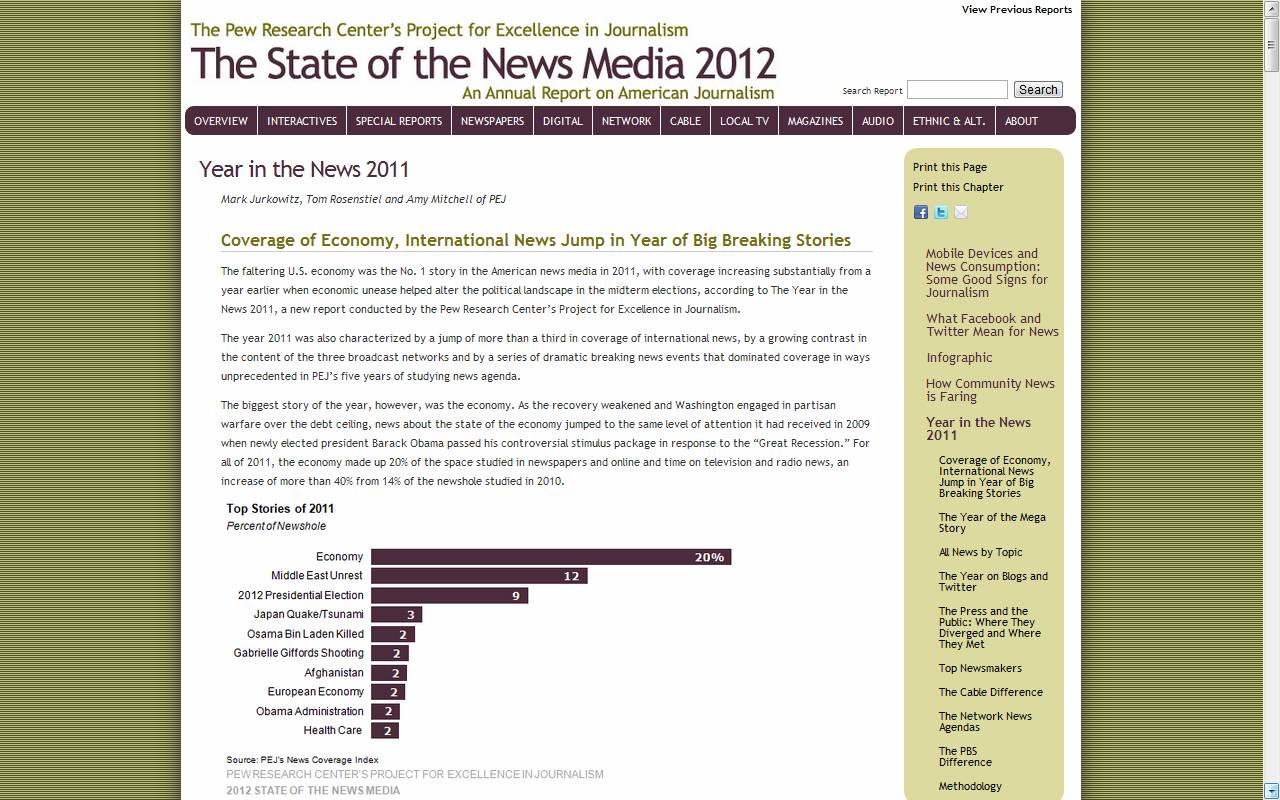 One section of the report offered a comprehensive understanding of which stories and topics were regarded as newsworthy by American journalists and included data for news being shared by bloggers and Twitter users.
So, chaired by Richard Sambrook, we are pulling in many of the events attendees and other parties to properly think through the ideas that came up before re-presenting them. We will look for workable refinements on duty of care issues, consider how safety training might cover new threats, study how freelance insurance could deliver and think how best to launch a safety ‘Kitemark’ for freelances. We aim to report at the end of September.
It is clear that the Frontline Club can play a collaborative role in promoting workable ideas on news safety. Our relationship with practitioners, the club’s members, and our history in freelance journalism places us in a unique and complimentary position to other bodies that promote news safety, like INSI or the CPJ.
To inform the 8th May meeting I sent out survey to freelance photojournalists, video journalists and newspaper stringers. Below are links publishing the results.
The Frontline Club Freelance Safety Survey is the first survey of its kind. Freelances play an ever-increasing role in gathering the news, their importance to journalism is unlikely to diminish but their voices are rarely heard on issues like news safety. It is clear that they need to be.
In 1989, when Peter Jouvenal, Rory Peck and Nick della Casa and I launched the Frontline News Television agency, we were completely dependent on the established news industry to purchase and publish our work. This is changing, particularly for photojournalists who increasingly fund their work elsewhere, viewing the established industry as a partner or outlet rather than an employer.
Personally, I believe that freelances have become journalism’s great hope. For as long as I have been in news they have complimented the mainstream output and with most overseas bureaux a thing of the past they help fill widening gaps.
At Frontline News Television we learned from the news industry. We weren’t welcomed by it, but we soon realised that to be accepted we had to subscribe to journalism’s ethics and did so fully. The survey tells us that today’s freelances will do the same thing now on safety and since freelances mentor each other good practice can be spread.
In the survey I ask freelances the question, “If the Frontline Club launched a representative body for independent journalists, cameramen and photographers would you support this and continue to contribute your opinions?”, 90.7% of respondents indicated “Yes, wholeheartedly”, 8.8% said that ‘It was a good thing but they wouldn’t participate” and only 0.5% that this “Was not interesting”.
While we consider it how to best deliver on this mandate, the Frontline Club will continue to gather freelance views and present them as helpfully as possible. I am personally convinced that an industry recognised ‘Kitemark’, won through demonstrating a professional approach to news safety and the promotion of the highest freelance reporting ethics will serve freelances and journalism well.
This link publishes Frontline Club Freelance Safety Survey 1, showing the comments by those who left them.
Freelance Safety Survey 1 – Full
The following three links illustrates where answers between photojournalists, video journalists and newspaper stringers are significantly different.
Freelance Safety Survey 1 – Photojournalists
Freelance Safety Survey 1 – Video Journalists
Freelance Safety Survey 1 – Newspaper Stringers
N.B. In the interests of openness I am happy to receive requests to audit this survey. Note that I have removed respondents where I was satisfied that they had no actual experience working in conflicts.
]]>
Speaking to a packed Frontline Club on 26th April, Channel 4 News’ International Editor Lindsey Hilsum shared a fascinating personal insight into the revolution in Libya last year that overthrew the regime of Colonel Muammar Gaddafi after 42 years in power.
In Hilsum’s words, Libya was the "only true revolution of last year – where the whole apparatus of state was overturned."
The challenge now faced by Libya is that of building a new state in the wake of a leader who deliberately undermined the country’s institutional development:
"The problem with Libya is that power is everywhere and nowhere," said Hilsum. "There are no strong institutions and no strong figures – and Libyans are allergic to strong political figures after Gaddafi."
Elections are scheduled to take place in June for a 200-member assembly that will form a new government and write a new constitution. But the creation of a new political reality in Libya will take years rather than months.
"Anyone who thinks you can go from 42 years of dictatorship to democracy overnight is dreaming," said Hilsum. "It’s an extremely rocky path ahead."
As if to prove the point, within hours of Hilsum’s talk, news emerged that the country’s interim ruling council had fired the cabinet – just five months after it took office.
But despite the immense challenges that Libya now faces, Hilsum firmly believes that whatever the motivation for NATO’s much-criticised intervention in Libya in March 2011, there is no doubt that it saved lives:
"I defy anyone who was in Benghazi that week to think that Gaddafi would not have come in and killed tens of thousands of people," she said.
Reading excerpts from her recently-published book, Sandstorm: Libya in the Time of Revolution, Hilsum spoke passionately about a Gaddafi regime, the brutality of which had been obscured by a decade of engagement with the West:
"We turned Gaddafi into a buffoon, and he was a buffoon, but we failed to acknowledge how terrible his regime was," she said.
Sandstorm was inspired by Tarek Ben Halim, a Libyan philanthropist and champion of democracy, who sadly died before he could witness the revolution.
It tells the story of many others like Tarek who in 2011 found the courage to challenge a regime that for 42 years had brutally crushed any opposition.
As well as shedding light on the 2011 revolution, Sandstorm also provides what Hilsum says is the first full account of the Abu Salim massacre in 1996, in which 1,270 people are believed to have been killed.
In one meeting recounted by Hilsum, a stooped, elderly man in a fez told her of the regular 600-mile journeys he made to the prison to deliver care packages to his brother-in-law. It was only after 14 years of such visits that the regime saw fit to tell him that his brother-in-law had long been dead.
It was these personal stories, told with humour and humility, that stood out from Hilsum’s talk.
There is much "weeping and quarrelling" to come in Libya, said Hilsum. But after four decades of oppression, there is also great hope.